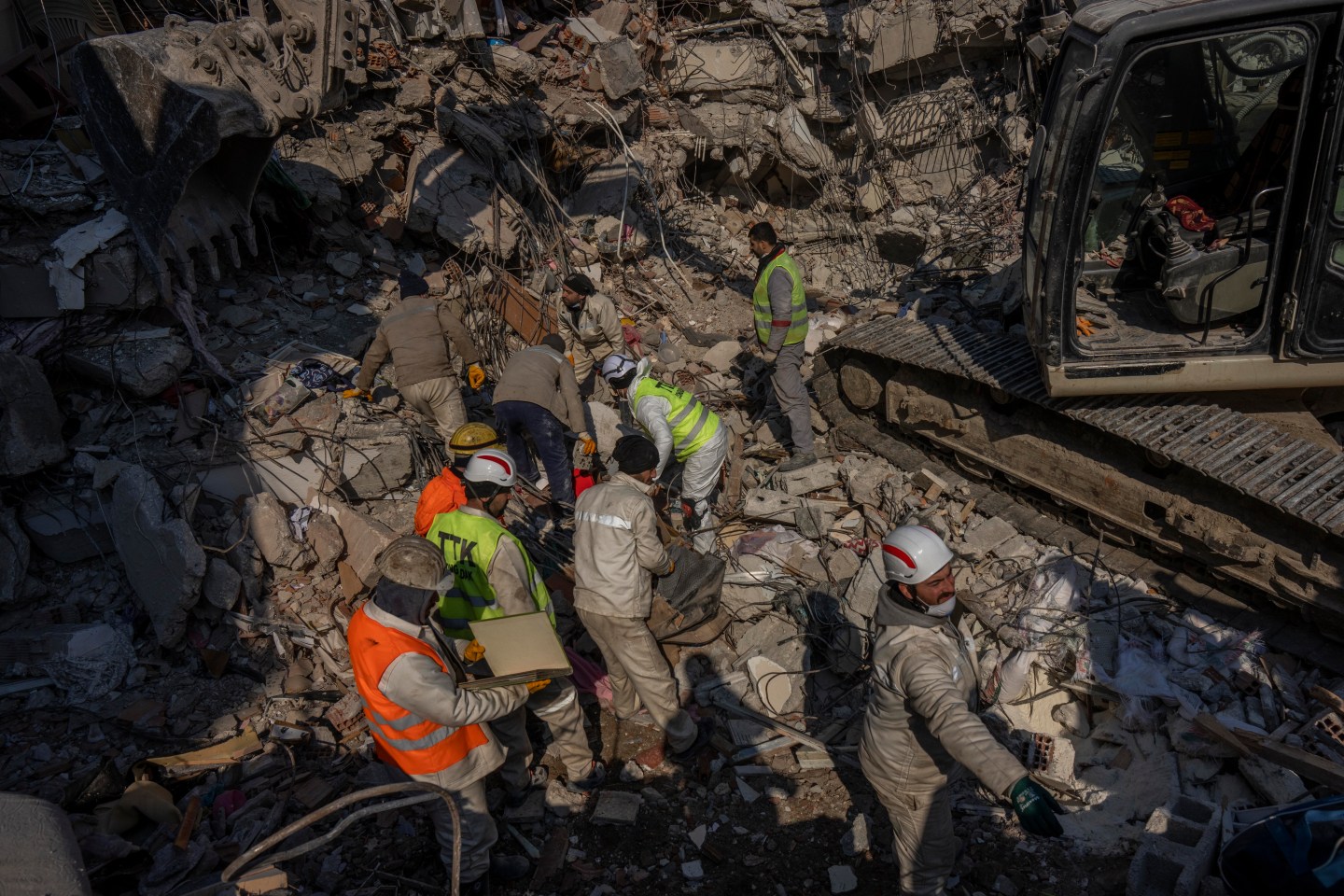
In the aftermath of the devastating earthquake in Turkey and Syria, thousands of volunteer software developers have been using a crucial Twitter tool to comb the platform for calls for help — including from people trapped in collapsed buildings — and connect people with rescue organizations.
They could lose access as soon as Monday unless they pay Twitter a monthly fee of at least $100 — prohibitive for many volunteers and nonprofits on shoestring budgets.
“That’s not just for rescue efforts which unfortunately we’re coming to the end of, but for logistics planning too as people go to Twitter to broadcast their needs,” said Sedat Kapanoglu, the founder of Eksi Sozluk, Turkey’s most popular social platform, who has been advising some of the volunteers in their efforts.
Nonprofits, researchers and others need the tool, known as the API, or Application Developer Interface, to analyze Twitter data because the sheer amount of information makes it impossible for a human to go through by hand.
Kapanoglu says hundreds of “good Samaritans” have been giving out their own, premium paid API access keys (Twitter already offered a paid version with more features) for use in the rescue efforts. But he says this isn’t “sustainable or the right way” to do this. It might even be against Twitter’s rules.
Monday is the deadline Twitter set for shutting off free access to its API, an added challenge for the thousands of developers in Turkey and beyond who are working around the clock to harness Twitter’s unique, open ecosystem for disaster relief.
“For Turkish coders working with Twitter API for disaster monitoring purposes, this is particularly worrying — and I’d imagine it is similarly worrying for others around the world that are using Twitter data to monitor emergencies and politically contested events,” said Akin Unver, a professor of international relations at Ozyegin University in Istanbul.
The new fees are just the latest complication for programmers, academics and others trying to use the AP — and they say communicating with anyone at the company has become essentially impossible since Elon Musk took over.
The API paywall is Musk’s latest attempt to squeeze revenue out of Twitter, which is on the hook for about $1 billion in yearly interest payments from the billionaire’s acquisition, completed in October.
It’s not just disaster relief groups that are concerned. Academic and non-governmental researchers for years have used Twitter to study the spread of misinformation and hate speech or research public health or how people behave online.
Rebekah Tromble, director of the Institute for Data, Democracy, and Politics at George Washington University, used the Twitter API to track conversations on Twitter to see what kinds of tweets elicited attacks from trolls — and what got them to go away — in one study.
“With so little information from Twitter about the practicalities of this new policy, the specifics of it, we just don’t know where to go. We have no way to do the planning. And for many of us who are in the field, running programs, running projects that have real world consequences, that’s pretty scary,” she said.
Twitter wasn’t alone but was unique among social media companies in making its API open and free. TikTok, for instance, is working on it now but so far has not released its API. Facebook’s is more limited because it is very protective of the data it collects.
Tromble said social platforms like YouTube, Facebook, Instagram and others are taking steps to increase researcher access and transparency — largely due to new European regulations. Twitter, on the other hand, is moving in the opposite direction.
“They’ve gone from in a first in class to absolute dead last,” she said.
It costs money to maintain an API. As a private company, Twitter is free to charge for its tools. But researchers and developers say it wouldn’t take much for Musk to carve out exceptions for academic research and nonprofits.
“No other technology has changed society as quickly and as profoundly as social media. Having access to the thoughts and emotions of other people worldwide, that’s a fundamental change to society,” said Kristina Lerman, a computer science professor at the University of Southern California who studies misinformation. “And you can’t understand it without access to data, access to observe.”
Takeshi Kawamoto, a Japanese software developer who runs a popular earthquake alert bot with more than 3 million followers, created the account back in 2007 as a hobby.
There are an incredible number of such bots on Twitter — useful, friendly or quirky accounts set up by people or group with a specific interest. There are weather bots, tools that combine long Twitter threads into one easy-to-read file, bots that send quotes from famous books or people, bots that remind you to stand up and stretch at random intervals during the day, bots that insert a little bit of nonsense and weirdness into your Twitter scrolling.
The earthquake bot Kawamoto created didn’t take off until the devastating 2011 earthquake, tsunami and nuclear disaster that hit Japan, when people turned to it for information about quakes and aftershocks.
Kawamoto was ready to shut down the bot when Twitter first announced it was going to charge for API access. Paying $1,200 a year for an account that is decidedly not making a profit was not going to be possible. Last week, Twitter announced that it would make a small exception to offer “write-only” API access for free to accounts that send less than 1,500 tweets a month.
This might help, but Kawamoto says the 1,500 limit will present a problem after a big earthquake with a lot of aftershocks. He would like to ask Musk to allow accounts to post more than 1,500 tweets on a pay-as-you-go basis.
So far, Twitter has offered no other exceptions, although it’s possible that Musk will see one of the many tweets from developers working on earthquake relief who have been pleading for a solution.
For Mark Sample and his small army of Twitter bots, such as one that would send carefully curated quotes from Herman Melville’s “Moby Dick” at random intervals, it’s too late. The Moby Dick bot, as well as one that sent out computer clip art from 1994 and one called “weird satellite” have all left Twitter. Some have moved to Mastodon, the social platform that some discouraged Twitter users have been migrating to.
Sample’s bots were part of “weird Twitter,” a quirky subculture of Twitter that peaked in the mid-2010s and included strange, fun, nonsensical bots sending bursts of randomness into people’s feeds.
“I’m kind of going through a mourning process, kind of grieving. The API…Twitter was doing something that none of the other social media platforms did, which is kind of like having this open playground,” said Sample, a professor of digital studies at Davidson College in North Carolina. “I mean, there were ways that people could take advantage of it and and distort things and and use it and malevolent ways. But it was also this terrific playground for hobbyists and creative people. None of the other social media platforms had that. In some way in the API when the only thing Twitter had going for it, the only thing that really set it apart.”
For Sample, the breaking point was not the API announcement. It came last fall when Musk began mass firing Twitter workers and going after journalists who questioned or criticized him, he said. Building apps for a platform when someone just shut it all down on a whim, he said, is “not a good use of our time and creative energy.”
“I mean, it had a good run. It’s like 15 years or whatever. So it’s a pretty good run. And maybe it’s time for something else.”