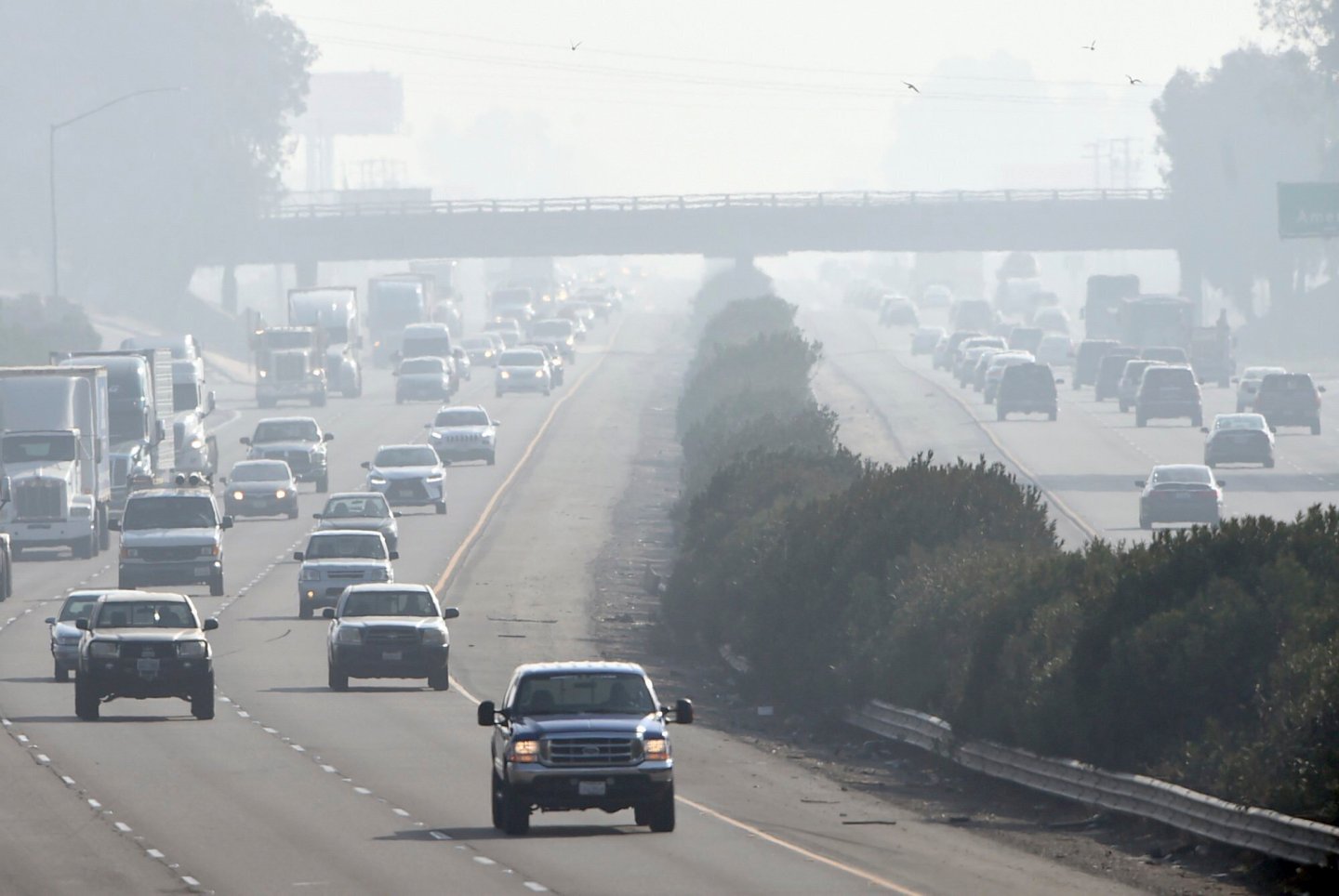
The Biden administration is proposing tougher standards for a deadly air pollutant, saying that reducing soot from tailpipes, smokestacks and wildfires could prevent thousands of premature deaths a year.
A proposal released Friday by the Environmental Protection Agency would set maximum levels of 9 to 10 micrograms of fine particle pollution per cubic meter of air, down from 12 micrograms set a decade ago under the Obama administration. The standard for particle pollution, more commonly known as soot, was left unchanged by then-President Donald Trump, who overrode a scientific recommendation for a lower standard in his final days in office.
Environmental and public health groups that have been pushing for a stronger standard were disappointed, saying the EPA proposal does not go far enough to limit emissions of what is broadly called “fine particulate matter,” the tiny bits of soot we breathe in unseen from tailpipes, wildfires, factory and power plant smokestacks and other sources.
In a development that could lead to an even lower standard, the EPA said Friday it also would take comments on a range of ideas submitted by a scientific advisory committee, including a proposal that would lower the maximum standard for soot to 8 micrograms. A microgram is one-millionth of a gram.
EPA Administrator Michael Regan said the proposal to strengthen the national ambient air quality standards for fine particle pollution would help prevent serious health problems, including asthma attacks, heart attacks and premature death that disproportionately affect vulnerable populations. Those populations include children, older adults and those with heart and lung conditions as well as low-income and minority communities throughout the United States.
“This administration is committed to working to ensure that all people, regardless of the color of their skin, the community they live in or the money in their pocket, have clean air to breathe, clean water to drink and the opportunity to lead a healthy life,” Regan said at a news conference. “At EPA, we are working every single day to create cleaner and healthier communities for all and have been doing so for over 50 years.”
Harold Wimmer, the president of the American Lung Association, called the EPA’s proposal disappointing, saying it is “inadequate to protect public health from this deadly pollutant.”
“Current science shows that stronger limits are urgently needed … to protect vulnerable populations,” Wimmer said, calling for the EPA to lower the standard to 8 micrograms or lower.
Seth Johnson, an attorney for the environmental group Earthjustice, called the EPA plan “a disappointment and missed opportunity overall.” While it would strengthen some public health protections, “EPA is not living up to the ambitions of this administration to follow the science, protect public health and advance environmental justice,” Johnson said. He urged the EPA “to hear communities, not industrial polluters, and strengthen this rule. Overburdened communities have the right to breathe clean air.”
The U.S. Chamber of Commerce and other business groups called for the current standards to be maintained.
“The United States has some of the best air quality in the world, thanks to steady reductions in contributors to particulate matter emissions over the last decade,” said Chad Whiteman, vice president of environment and regulatory affairs at the chamber’s Global Energy Institute.
The proposed rule could “stifle manufacturing and industrial investment and exacerbate permitting challenges that continue to hamper the economy,” Whiteman said.
Mike Ireland, president of the Portland Cement Association, which represents U.S. cement manufacturers, added that the EPA’s proposed action “is yet another regulatory burden that will hamper the cement industry’s ability to manufacture sustainable construction materials to meet the nation’s infrastructure needs.”
EPA scientists have estimated exposure at current limits causes the early deaths of thousands of Americans annually from heart disease and lung cancer as well as causing other health problems.
Dr. Doris Browne, president of the National Medical Association, the oldest and largest national organization representing African American physicians, hailed the plan as “the bold action needed to protect public health across the country.”
Appearing with Regan at a news conference, Browne said the proposal is likely to have lasting benefits across the country “but especially for those communities of color and low-income communities that experience the increase in particulate matter pollution.” Smog, soot and other pollution near factories, power plants and other hazards has a “devastating impact on public health,” she said.
The EPA proposal would require states, counties and tribal governments to meet a stricter air quality standard for fine particulate matter up to 2.5 microns in diameter — far smaller than the diameter of a human hair. A micron, also called a micrometer, is equal to one-millionth of a meter.
The standard would not force polluters to shut down, but the EPA and state regulators could use it as the basis for other rules that target pollution from specific sources such as diesel-fueled trucks, refineries and power plants.
A 2022 report by the American Lung Association found that 63 million Americans live in counties that experience unhealthy daily spikes in soot pollution and 21 million live in counties that exceed annual limits for soot pollution. Most of those counties were in 11 Western states, the report said. People of color were 61% more likely than white people to live in a county with unhealthy air quality, the report said.
Fresno, California, displaced Fairbanks, Alaska as the metropolitan area with the worst short-term particle pollution, the report found, while Bakersfield, California, continued in the most-polluted slot for year-round particle pollution for the third year in a row.
As of Dec. 31, five metropolitan areas were not in compliance with current standards, the EPA said. Four of those areas are in California, including the San Joaquin Valley and Los Angeles. Allegheny County, Pennsylvania, which includes Pittsburgh, also is out of compliance.
The EPA will accept comments on the proposed rule through mid-March and will hold a virtual public hearing over several days. A final rule is expected this summer.
Our new weekly Impact Report newsletter examines how ESG news and trends are shaping the roles and responsibilities of today's executives. Subscribe here.