In the packed field of prospective net-zero solutions, nuclear fusion stands out in its scope and ambition. By successfully replicating the reaction that powers the sun, humanity could—in the words of Stephen Hawking—unlock an “inexhaustible supply of energy, without pollution or global warming.” Fusion development has progressed at a glacial pace for decades, however, and breakthroughs have been intermittent at best.
That could be about to change. With sweeping international collaboration and billions of dollars of public and private investment, scientists have recently made a series of meaningful advances in both the duration and power output possible from fusion reactions.
Whereas nuclear fission—the process that drives conventional nuclear power plants—involves the splitting of atoms, fusion takes place when a pair of light atomic nuclei combine to form a single heavier one. When this happens, an immense amount of energy is released: four times as much as fission, and nearly 4 million times greater than the burning of fossil fuels. From a safety standpoint, nuclear meltdown is practically impossible, and only a small volume of relatively short-lived radioactive waste is produced.
Fusion’s incredible promise is being pursued by a consortium of global physicists supported by China, Russia, the United States, and several European governments. With the funding taps open, significant progress has recently been made to overcome a litany of scientific challenges—not least the enormous temperatures required to trigger a fusion reaction. In the core of the sun, atoms combine at approximately 10 million degrees Celsius; on Earth, where gravitational forces are far, far smaller, at least 10 times as much heat is required.
As no known material can withstand contact with such scorching temperatures, scientists have devised different methods of confining super-hot plasma—a cloud of charged particles in which fusion occurs—to allow for continuous energy output. In California, the National Ignition Facility (NIF) is developing the use of high-powered lasers to compress fusion fuel into a tiny space, while researchers in other parts of the world favor confinement via strong magnetic fields.
Promising progress
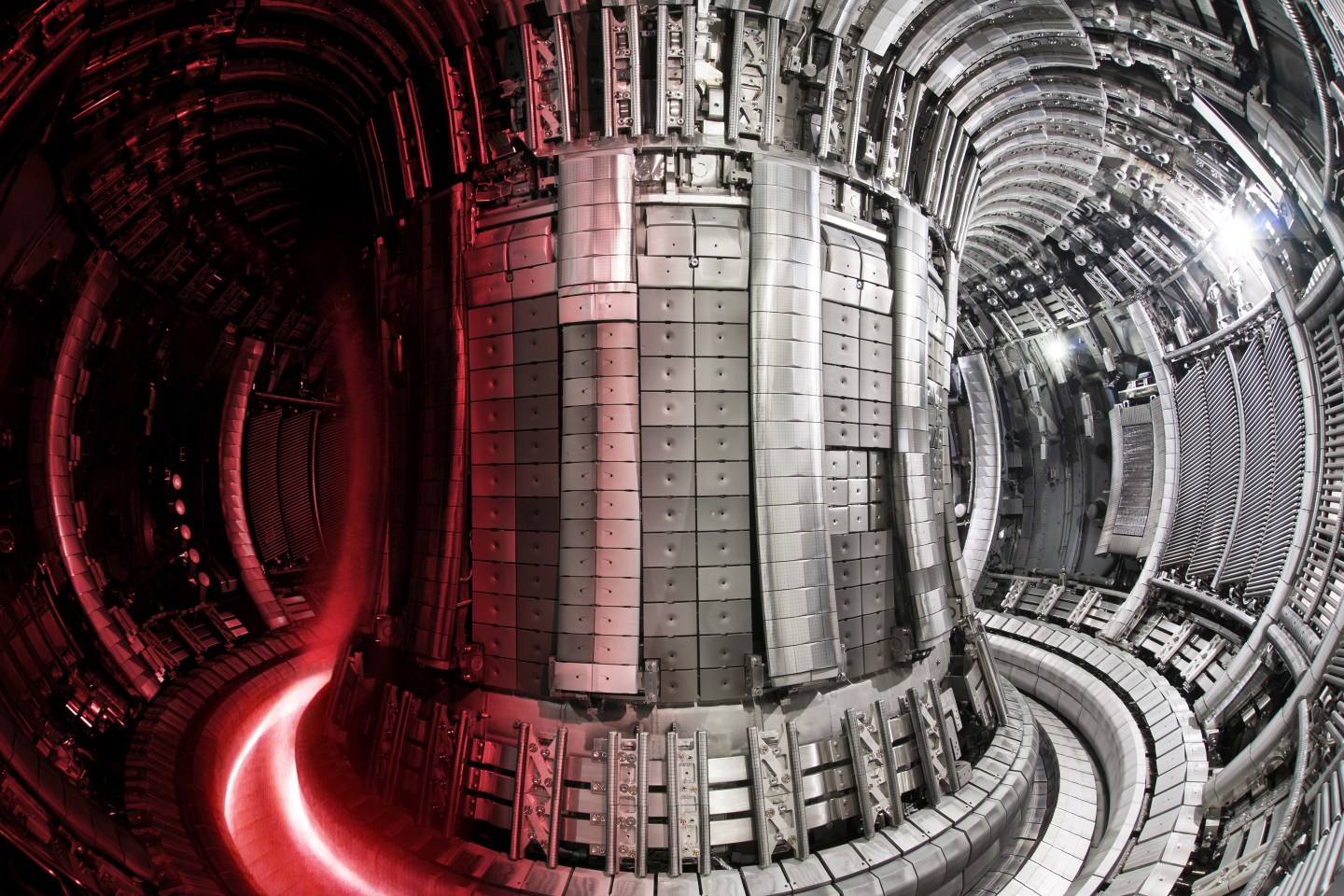
The Joint European Torus (JET) is a pioneer of the latter. Defeating its own world record for fusion power, the U.K.-based JET laboratory recently managed to produce and maintain a comparatively high level of thermal energy over a five second period. A little less than 60 megajoules (MJ) of energy was generated—just enough to boil a few dozen kettles—but it marked a significant step forward in the quest for sustained fusion energy.
“A five-second pulse and 59 MJ of energy production might not sound like a lot, but it shows that we’re capable of achieving a sustained discharge that produces a high fusion yield,” says Joelle Mailloux, a nuclear physicist co-leading the JET research team. “We now have a blueprint for scaling up operations in the future, with the goal of maintaining output for much longer than a few seconds.”
Huge hurdles remain for global fusion research, however. JET’s record-breaking experiment used significantly more power than it produced—net energy gain from fusion is yet to be demonstrated anywhere—while the magnets used to contain the plasma warmed too quickly for extended operation.
Nonetheless, progress is being made. Earlier this year, Chinese scientists managed to sustain a 17-minute fusion reaction—albeit with a fuel source which isn’t viable for large-scale power production. Then there is the International Thermonuclear Experimental Reactor (ITER)—the world’s most ambitious fusion project which, all going well, will be operational by mid-decade.
Drawing on data from the soon-to-be decommissioned JET program, the far larger ITER facility in southern France is being constructed from materials that can withstand much higher temperatures, allowing, in theory, for fusion experiments to run long enough to produce more power than they consume. But that’s unlikely to happen before the late 2040s, experts say, and when it does, there’s no telling how quickly fusion energy will become cost-effective.
‘A flurry of startups’
Another serious issue revolves around the two forms of hydrogen, deuterium and tritium, used to fuel ITER’s fusion reaction. Deuterium can be derived in abundance from seawater, but tritium is exceptionally rare (only 20 kilograms are thought to exist worldwide). To overcome this deficit, techniques for “breeding” tritium during fusion are being explored, Mailloux says, but again, that technology is likely decades from realization.
Enter private enterprise. A flurry of startups seeking alternate fusion solutions have emerged in recent years, propelled by billions of dollars of venture capital investment. Among those is Google- and Chevron-backed TAE Technologies, a California-based firm developing tritium-free fusion reactors.
By replacing the scarce tritium hydrogen isotope with nonradioactive hydrogen-boron, TAE chief executive Michl Binderbauer believes his team can sidestep problems around fuel availability and achieve commercial energy production as soon as the early 2030s.
“Our machines are far more compact than other fusion reactors; a small city can be powered by one roughly the size of a couple double-decker buses,” Binderbauer says. “This means they’ll be easier to centrally manufacture, unlocking economies of scale.”
When it comes to pricing, TAE is bullish—cost per kWh will start out mid-field, Binderbauer claims, somewhere between nuclear fission at the high end, and natural gas at the bottom. And as the cost of fabricating complex components comes down, so too will the price of energy.
Not all in the global science community are so confident, however. As a physics undergraduate in the 1960s, Emeritus Professor Ian Lowe—a green energy expert at Griffith University in Australia—first heard that commercial fusion power was at least 50 years away. More than a half century later, he’s worried that it still is.
“Yes, there have been exciting developments, but ultimately all would-be fusion reactors are still in the research stage, and we need clean energy solutions now,” Lowe says. “We already have renewables that can generate cost-efficient zero-carbon power; scaling those up needs to be our focus.”
This story is part of The Path to Zero, a special series exploring how business can lead the fight against climate change.