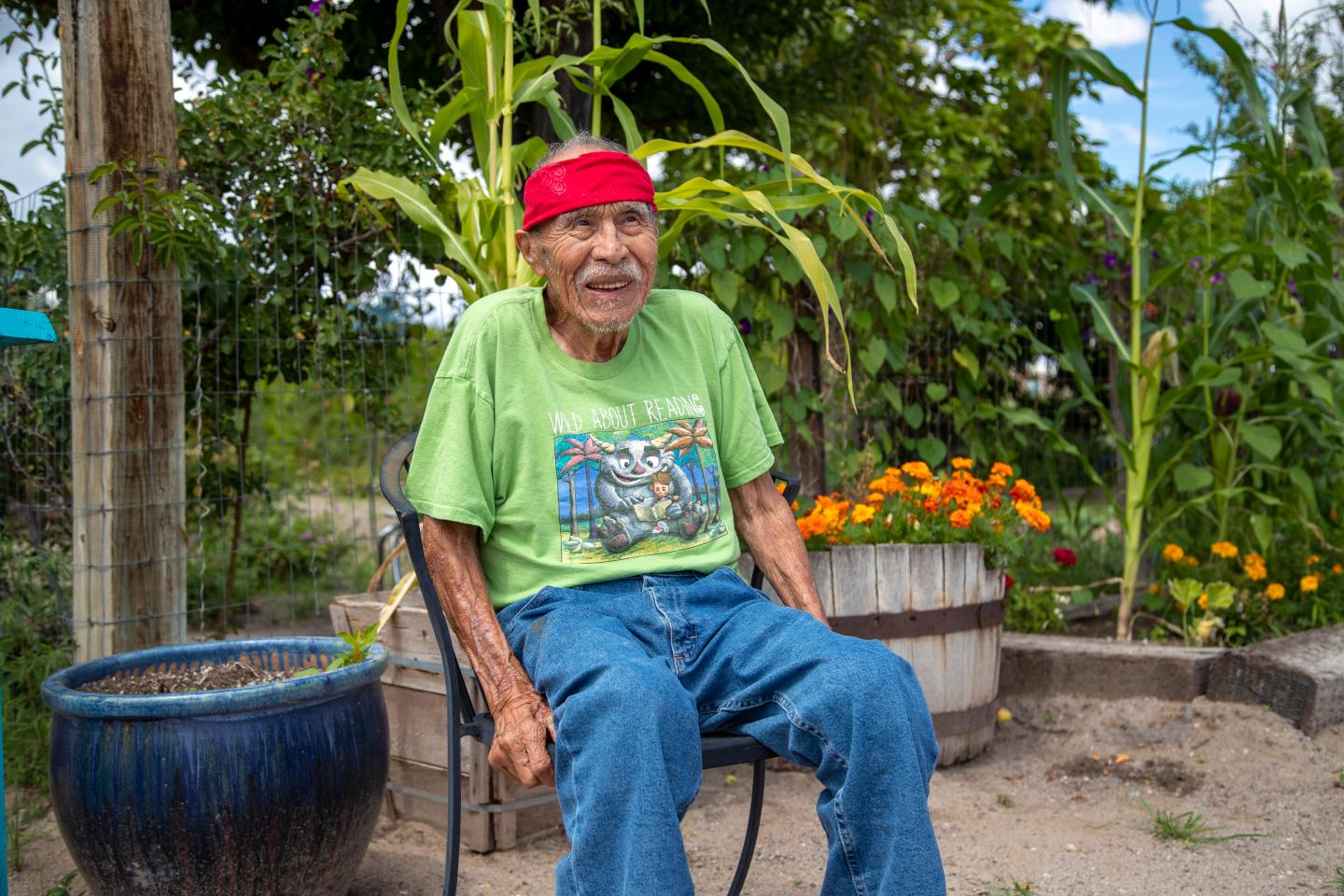
Raymond Naranjo sings for rain, his voice rising and falling as he softly strikes his rawhide-covered drum.
The 99-year-old invites the cloud spirits, rain children, mist, thunder and lightning to join him at Santa Clara Pueblo, where Tewa people have lived for thousands of years on land they call Kha’p’o Owingeh, the Valley of the Wild Roses.
“Without water, you don’t live,” says Naranjo’s son Gilbert, explaining the rain dance song his father, a World War II veteran, has sung for decades — and with increasing urgency as the tribe fights for the survival of its ancestral home.
With unsettling speed, climate change has taken a toll on the the pueblo’s 89 square miles (230 square kilometers) that climb from the gently rolling Rio Grande Valley to Santa Clara Canyon in the rugged Jemez Mountains of northern New Mexico.
Hotter temperatures and drier conditions, exacerbated by global warming, have made their forests a tinderbox, shrunk waterways and parched pastures and gardens, threatening a way of life tied to land, water and animals they pray for daily and celebrate through stories, songs and dances passed down through the ages.
Elders in the tribe of about 1,350 remember dense forests of fir, pine, spruce and aspen. A creek cascading through a series of ponds in the canyon. A valley of sage and juniper with shady cottonwood galleries and gardens along a creek and river.
They hunted deer and elk, gathered firewood and medicinal and ceremonial plants and dug clay to make the shiny black and redware pottery pueblo artisans are renowned for. Fields irrigated by the creek and the Rio Grande bore a bounty of corn, beans, squash and chiles.
But three large wildfires in 13 years burned more than 80% of the tribe’s forested land. The last one, the 2011 Las Conchas fire — then the largest in New Mexico history — burned so hot it hardened the ground like concrete.
And in a cruel twist two months later, it took just a quarter-inch of rain to unleash the first of several devastating flash floods, scouring charred slopes and sending tree trunks, boulders and vast quantities of sediment surging through the pueblo. It buried sections of a Santa Clara Canyon road 50 feet (15 meters) deep, blew out earthen dams and drained ponds where the tribe planned to reintroduce native trout. It decimated habitat for beavers, bears, elk, mule deer and eagles.
In the valley, flash floods still fill irrigation ditches with sediment and ruin crops planted near the creek. And now tribal farmers who for centuries freely diverted water from the Rio Grande can only do so on designated days because the river has been critically low. Hotter temperatures and stronger winds dry the soil quickly, rain is unpredictable, snowfall is scarce.
People here in the high desert are familiar with drought. About 500 years ago, the tribe moved from the pueblo’s cliff dwellings — called Puye, or “where the rabbits gather” — to the Rio Grande Valley after drought dried up a stream and made dryland farming difficult.
But the megadrought now gripping the West and Southwest, the worst in 1,200 years, makes the future less certain.
“How do you prepare … with so many unknowns?” says Santa Clara Pueblo Gov. J. Michael Chavarria. “Where do we go? We have nowhere else to go.”
So the people are trying to adapt by returning to their roots: embracing natural methods to restore their watershed and make the forests more resilient, growing trees and crops from native seeds that evolved to withstand drought. But they’re also willing to embrace new ways if that helps them stay.
Their connection to this place and the future of their people is too important to do otherwise, Chavarria says. “We can’t just pack up our bags and leave.”
Road to restoration
Garrett Altmann peers into the woody debris, looking for conifer seedlings planted last fall along Santa Clara Creek. Only a third have survived.
But as he keeps walking, Altmann is surprised to find fir and spruce seedlings sprouting naturally in a previously burned area. Though just an inch high, they represent an ecological victory, says Altmann, a geographic information systems coordinator and project manager with the tribe’s forestry department.
About 60% of the more than 2 million trees planted in the past 20 years, from seeds collected on the pueblo, have died. And some areas, especially unshaded south-facing slopes, may never again support trees in a hotter, drier world.
So to see some sprouting on their own is “like the apex of restoration,” says Altmann, who has crews place logs and scatter tree branches to stop erosion and build up soil. “Knowing that you’re doing something that nature will be able to propagate from, it just makes me happy.”
The tribe hopes to restore and even reengineer the canyon by combining scientific and native knowledge and using natural materials: rocks to slow water, bend waterways and create ponds and floodwater diversions; tree roots and debris to create habitats, enrich the soil and shade seedlings and Santa Clara Creek.
“My goal for this watershed is to build it back better than it was before,” says Altmann, who is not a tribal member.
That’s a difficult but important target, tribal officials say — not just to protect the canyon and prevent runoff that could threaten the village, but also to ease the tribe’s collective grief and restore some of what’s been lost: family hunting and camping trips, pilgrimages to ancient sites so sacred they’re kept secret from outsiders.
Some elders weep when they see treeless slopes, deeply eroded stream banks and burned out cabins, says Daniel Denipah, the tribe’s forestry director.
“They say, ‘This just doesn’t look like the same place,’” he says. “It breaks your heart.”
They also worry a generation of children — many who’ve never seen the canyon — will lose an important connection to their culture, including songs that identify special places and give thanks to the animals, plants and life itself.
So the forestry department enlists schoolkids to help plant trees and grass plugs and build rock dams to forge a bond with the land. That’s what motivates Denipah, who says it could take more than 100 years for the tribe’s beloved forests to regrow.
“I’m going to … try my hardest to put things back the way they were and to keep this culture alive,” says Denipah. “That’s what’s important to me – trying to give that back to the people.”
Hope and fear
Signs of renewal are everywhere.
A carpet of green, including wild onions and currants, spreads beneath blackened trees. Bulrushes hug the streambanks. Young aspens are coloring an area where conifers burned. Bluebirds flit about a meadow of mullein and wild roses.
A bear and two cubs wade in Santa Clara Creek, disappearing into a thicket when Altmann stops his truck. A pair of eagles soars overhead as squirrels dart between logs. Deer, turkey and bobcats also are returning.
But there still is much to do — and much uncertainty — even after about $100 million in federal disaster aid and other funding was spent for emergency response and to rebuild a temporary canyon road, widen bridges, erect steel mesh barriers to catch debris sliding from ravines, and to dig ash and sediment from ponds and the creek.
It could cost almost $200 million more to rebuild a permanent road in the canyon and build dams to restore the ponds, where the tribe wants to reintroduce a pure strain of native cuthroat trout, pueblo officials say.
But they believe they can spend less and accomplish more with their nature-based approach to restoration, while recognizing limitations in a warmer climate.
For example, the tribe will be strategic about where it replants trees, choosing the most promising sites and leaving space between future forest stands. They’ll revive prescribed burns — an ancient practice long discouraged by state and federal agencies — to keep forests from again becoming overgrown, which made them susceptible to drought, insects and disease.
Still, people here fear climate change could outpace recovery, that another large wildfire could undo years of progress.
“I want to be hopeful. But the way things are going now, I don’t know,” says Eugene “Hutch” Naranjo, 63, who had hoped to share his childhood experiences — hunting, fishing, camping — with his grandchildren.
He recalls his grandfather’s advice from more than a half century ago: Remember how the canyon looks so you can tell your kids and grandkids, “because things are changing and I don’t know if (they) will ever see things the way you see them now.”
Feast or famine
Hutch and Norma Naranjo bend over rows of chiles tucked among drying corn stalks, filling baskets to roast and preserve or mill into powder.
Normally they’d be harvesting the corn, but it ripened a month earlier, in August, after a long dry spell was quenched by unexpectedly heavy and prolonged rains. They scrambled to get the crop in before it rotted or became too hard, then roasted and dried the kernels, a staple of the Tewa diet.
Farming is now “a guessing game,” says Hutch, lifting a load of chiles into his pickup truck. He and Norma also grow alfalfa, beans, squash, sweet peas and watermelon, raise cattle and pasture horses on Santa Clara land inherited from Hutch’s grandfather.
Dozens of families once farmed on ancestral plots, enabling the pueblo to be so self-sufficient, they say, that they barely noticed the Great Depression, didn’t worry about grocery shopping.
But sustaining that life is increasingly difficult.
“Fields just aren’t producing like they used to,” says Gilbert Naranjo — no relation to Hutch — who’s in charge of plowing farmers’ fields. He says some people now buy starter plants because it can be difficult to get seeds to germinate.
This year, many farmers — including him — didn’t bother planting after losing much of last year’s crop to winds and a late-summer frost. Of the 15 or so who did, some lost crops again when it didn’t rain for more than 2 1/2 months, after unusually heavy monsoon rains in July and August, or when elk that used to stay in the canyon raided their fields.
“Man, this weather is strange,” says Naranjo, who had someone else grow chiles for him this summer. “It has really changed.”
Farmers say there are more days when the temperature surpasses 90 and 100 degrees (32 and 38 Celsius), including in typically mild autumn. The wind blows harder, drying soil and flattening crops. And mountain snowpack that once melted in spring, filling waterways and recharging aquifers, is increasingly scarce.
Norma Naranjo says their grandfathers used to tell them not to plant until the snow disappeared from the peaks. She tries to recall the last time it stayed all winter.
“Years. It’s been years,” Hutch says.
A recent National Oceanic and Atmospheric Administration assessment for New Mexico projects there will be even less mountain snowpack in the future, along with more intense heat waves and droughts that could lead to more wildfires and dust storms.
The changes over the past 30 years already contribute to both drought and extreme weather events, says hydrologist Andrew Mangham, from the National Weather Service in Albuquerque.
The summer monsoons, for example, are more erratic. “It’s becoming very, very feast or famine,” Mangham says. “We either have no rain or we get 5 inches at once or 8 inches at once.”
Water worries
Tribal members say rainfall can be bittersweet — they need it for their crops but it also can wreak havoc.
Former Santa Clara Gov. Walter Dasheno was hoping for a decent corn harvest after rains started. But in late July, sediment from the canyon destroyed his irrigation system, which connects to Santa Clara Creek, during a flash flood, then weeds grew so high and thick that he couldn’t get to surviving crops.
But that same rain helped boost Hutch and Norma Naranjo’s crops. They irrigate from the Rio Grande and had worried they might lose some crops because the river was low and irrigation sporadic.
Irrigation ditches now are only about a quarter full. The forestry department cuts down elm trees and invasive salt cedar and Russian olive trees because they compete for water. Meanwhile, stands of native cottonwoods that thrived along the Rio Grande are dying because they require periodic floods.
Still, water security feels precarious, and they worry whether groundwater, which supplies pueblo homes, will continue to recharge quickly enough amid drought and lack of snowfall.
Denipah, the forestry director, says the tribe is hoping to lower the banks of the Rio Grande in some places to recreate historical wetlands and help recharge surface and groundwater.
Dasheno, who’s on a pueblo water rights committee, says he wants to make irrigation more reliable to encourage people to resume farming, perhaps by drilling a solar-powered well, rerouting a ditch to improve access to the creek or finding a way to store water from Santa Clara Creek.
All ideas are on the table, Gov. Chavarria says, because water “is going to be more valuable than gold.”
“If you don’t have good water to irrigate your crops … what happens to them? They die off,” he says. “So if we don’t have a good water source, good quality of water, we may die off as well.”
Native ways
Hutch Naranjo believes he has another answer to drought. He pulls back a tarp to show wire racks of drying corn — a native variety passed down to him by his grandfather, who got the seeds from his own father.
This is one key, Naranjo believes, to his successful harvest when so many others failed.
“The seed over the years has learned how to grow even in times when we don’t have any water; it still grows and it still produces,” he says. “I think a lot has to do with the prayers that we have … for our crops.”
But Naranjo worries store-bought hybrid corn planted by others will cross pollinate with his, making it more difficult to pass on the native, hardy strains to his grandchildren.
He shares his seeds and harvest with others from the pueblo because his grandfather instilled in him, “Corn is life.”
The dried kernels — chicos — are used in stews and puddings. It’s ground into meal for bread. It’s used in songs and dances, and is the basis of many Tewa prayers.
“One of the things that he would say (is) ‘Don’t be stingy with what you grow. Give it away so that people will be nourished,’” Naranjo says.
He also credits his success to other native growing traditions: rotating crops, planting sweet peas to restore soil nitrogen and putting cattle into his corn fields after harvest to help with fertilization.
He and Norma also are teaching their grandchildren to farm, and they’re involved from sowing to roasting.
Pueblo elders say ancestral knowledge is key for future generations to develop a strong cultural and spiritual sense of self, a connection to this ancient place so they have a fighting chance to preserve their way of life.
“As caretakers of this world, of … Mother Earth, we need to learn how to preserve, how to cherish, how to respect the mother, the water, the land, the mountains, the trees, the animals, everything in it,” says Gilbert Naranjo, who calls his jar of native seeds “my wealth,” and is teaching his 5-year-old grandson traditional Tewa customs and songs centered on nature.
“That’s our mission. To take care of it, not to destroy it.”