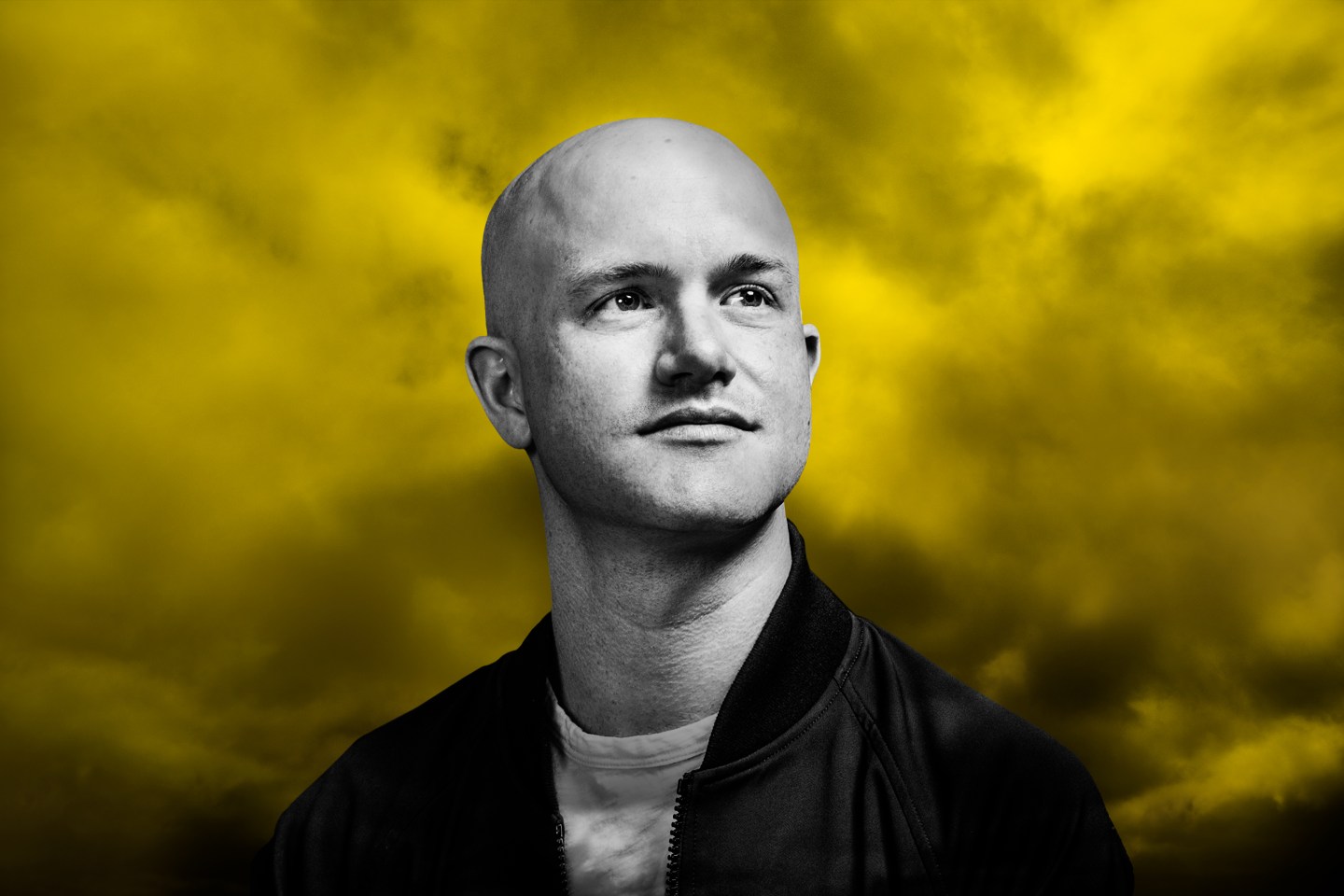
Brian Armstrong is being patted down with a makeup sponge as a big green screen looms behind him.
“Coinbase is a company with an ambitious vision: to create more economic freedom,” he reads off a teleprompter, but flubs the final part of the line. “We’ll try that one again.”
The stoic, bald Armstrong, clad in a favorite black jacket, is standing on an empty stage, reciting lines about Coinbase, the company he founded, for a promotional video for investors. A self-described introvert, Armstrong is notoriously averse to media appearances, except in the right context—including taping the 88-minute-long documentary COIN, which the company commissioned.
The film, released in early October, documents Coinbase’s scrappy beginnings as a Bitcoin exchange in 2012 all the way through its public direct listing in 2021. But it wraps up before the turmoil of the current year, which has seen Coinbase wrestle with lackluster product rollouts, bungled launches in new countries, and grim earnings.
These recent events have prompted withering media accounts about the company as a whole and, by implication, Armstrong’s leadership. This crested in June when Coinbase slashed headcount by 18%—a move that came just days after Armstrong published an inflammatory Twitter thread in which he chastised dissatisfied employees for criticizing executives and suggested they “quit.”
The question today for Coinbase employees and investors alike is whether Armstrong, who founded the company a decade ago, is still the best fit to be CEO.
“There’s always going to be a question when you have the founder of a company, the one who establishes the vision, about whether that individual is the best person to actually execute toward that vision. And I think that that’s what we’re facing right now,” says BTIG managing director and analyst Mark Palmer, who covers Coinbase.
Fortune spoke with former employees, analysts, early investors, and others, who described a methodical and dedicated CEO generally admired by his employees—but whose decisions have placed Coinbase in a precarious position.
Coinbase’s rocky year
The history of Coinbase and its CEO is well known: Brian Armstrong grew up as a self-described “shy” kid in San Jose. After discovering the Bitcoin white paper in 2010, Armstrong started Coinbase and enrolled it in the famous Silicon Valley Y Combinator program in 2012. He had a simple but compelling vision: make it easy for anyone to buy and sell Bitcoin.
Since those early days, the company has grown dramatically and today offers services like staking (the crypto version of interest-bearing term deposits), a platform for non-fungible tokens, or NFTs, and a prime brokerage business. It became the first well-known crypto company to go public and now has nearly 5,000 global employees.
But as Armstrong’s company ballooned in size and popularity, some insiders suggest it lost focus. According to a former senior-level employee, Coinbase “overgrew, overhired, tried to do too much in the last year. And I think they’re paying the price for that a little bit right now,” the person tells Fortune.
Coinbase’s recent misfires include teasing an NFT marketplace to compete with industry leader OpenSea for months only to roll out a lackluster launch in May. A much-hyped entry to India likewise fizzled as the company pulled back in response to pressure from local regulators. Meanwhile critics have questioned Coinbase’s decision to spend time and money on ventures beyond the scope of its core business, including various film projects. When the company released a short-film series about NFTs in July, dubbed The Degen Trilogy, a Twitter user described the endeavor as “Cringebase.”
“It’s been a big problem. And realistically, none of that was free,” Morningstar analyst Michael Miller, who covers Coinbase, told Fortune of the India launch in particular.
Meanwhile, the return this May of Crypto Winter—the industry term for the prolonged and painful downturns that recur in crypto—has hurt Coinbase’s earnings and led its stock to crater over 70% so far in 2022.
Nonetheless, some analysts note that Coinbase wisely did not get involved in some of the riskier parts of the industry, like high-yield lending, which triggered much of the pain in the crypto market earlier this year. And a good chunk of Coinbase’s $1.1 billion loss in the second quarter was actually the result of quirky accounting rules that require firms to book a loss when the price of crypto falls but not when it rises. (Coinbase’s actual Q2 operating loss was closer to $640 million.)
Armstrong has said Coinbase’s path forward will include achieving its long-stated goal of diversifying its revenue beyond retail trading fees. “We’re realizing that trading fees…[are] still gonna be a major part of our business 10 years from now, even 20 years from now, but I’d like to get to a place where more than 50% of our revenue is subscription and services,” he said during a rare public interview in August. Armstrong declined to be interviewed for this story.
For analysts like Palmer, such changes can’t come soon enough. “It is imperative that Coinbase management pushes forward with some of these initiatives, makes some necessary changes in the coming months, to better position the company and the stock for the current market,” he says.
That current market has also seen fast-growing competitors nipping at Coinbase’s heels. These include crypto exchange FTX, headed by eccentric billionaire Sam Bankman-Fried, which has taken advantage of Crypto Winter by snapping up weakened firms—an M&A strategy Coinbase hasn’t replicated. Meanwhile, mainstream firms like PayPal and Robinhood have also joined the growing list of companies offering crypto services.
Compared with some competitors, Armstrong’s Coinbase has been more conservative and U.S.-centric in its strategy, making the company “kind of like the Chevy of the crypto industry,” according to early Coinbase investor Greg Kidd (Kidd has also invested in its rivals).
But when it comes to fending off its biggest competitors, Binance and FTX, Coinbase may have a reputational edge: Trust and security are even more crucial in the current environment, Bank of America payments and crypto analyst Jason Kupferberg says.
Other analysts like BTIG’s Palmer argue it’s crucial for Coinbase to bolster its institutional platform to better balance its business, but note the company’s progress has been slower than he would have expected, especially in areas like derivatives, where FTX and Binance dominate.
“To his credit, [Armstrong] takes a long-term view of the business,” Palmer notes. But “as a publicly traded company, you know, the investment horizon of many of the hedge funds and others that are trading stocks like Coinbase is not as long-term in many cases.”
Meanwhile, Morningstar’s Miller offers measured support for Armstrong: “I think, broadly speaking, there’s been missteps. But I think he could have done a significantly worse job.”
While most market watchers appear willing to give Armstrong some breathing room when it comes to business strategy, the CEO also faces a more subtle challenge: showing he can continue to inspire the rank-and-file of a company that is much larger and very different from the one he founded in 2012.
‘Juicy feedback’
“It’s a different company, like, 10 times over,” the former senior-level employee says of changes that have taken place at Coinbase in recent years.
In Fortune’s conversations with current and former Coinbase employees about Armstrong and his leadership, some words came up again and again: “introvert,” “methodical,” “rigorous,” “calm,” “stoic,” and “thoughtful.” But some of his behaviors have raised eyebrows.
One of Armstrong’s challenges as a leader, according to a former executive who worked closely with him, is his emotional intelligence (EQ), and being able to recognize how other people are feeling, adding that Armstrong has sometimes struggled to empathize with those far from the C-suite. Armstrong himself is aware of how he can come across.
“I do feel emotions; I don’t express them the same way as other people. I probably have Asperger’s, like, somewhere on the spectrum,” he says in the Coinbase documentary.
During his decade-long tenure as CEO, Armstrong has struggled with internal and external communications, and as the former executive puts it, he is not always adept at “reading the room.”
Coinbase’s president and chief operating officer, Emilie Choi, tells Fortune Armstrong may inadvertently cause offense but that she will flag such incidents and encourage him to reach out to people and convey his true intent.
One recent example of this occurred when Armstrong penned a Twitter thread about Coinbase needing a head of communications while discussing the shortcomings of the company’s public relations—which evidently did not go unnoticed by those who worked on the team. Choi says she responded by telling Armstrong the team’s performance had been outstanding and that the shortcomings lay with Coinbase executives for not taking more of an external role earlier in the year.
“And he was like, ‘Oh, yeah, of course—did that not come across in my tweet storm? That, like, I was owning the responsibility for that?’ And I was like, ‘No, I think actually they might have perceived it as, like, some failing or something.’ And he was like, ‘Oh, God, no, that was me,’” she recalls.
The anecdote supports the assessment of some former employees who say Armstrong’s communications blunders are because he is oblivious, not insensitive. Choi argues: “It’s a little bit extreme to say he has bad EQ, because I think he actually works on it actively.”
Meanwhile, reports of Armstrong’s alleged quirks may be overstated, according to former employees who know him. These include his practice of conducting meetings where attendees would type in lieu of talking—at least for a portion of the meeting—a behavior they say isn’t peculiar but rather common in engineering culture and the tech industry. A Coinbase spokesperson denied such meetings take place, although two sources with direct knowledge tell Fortune they have occurred.
All of this portrays an introverted CEO focused on achieving a long-term vision for his company, but who continues to struggle with daily interactions and management skills. Like other big companies, Coinbase imposes legal strictures that forbid current and former staff from disparaging the company, so it can be difficult to obtain a true gauge of employee sentiment. Some disgruntled workers, though, have shared their complaints on anonymous workplace review site Glassdoor.
“You are losing the top talent via attrition. It’s already hurting…Soon the only people left are the most cult-y, whether blindly worshipping crypto or [Coinbase]/Brian Armstrong. And those people are of the mindset if/when you speak up or question anything, ‘then just leave’?” wrote one such employee in September.
A notable leadership blunder, according to some, was the CEO’s response to a petition from anonymous employees at Coinbase calling for the ouster of top executives—though not Armstrong himself. The petition, among other things, criticized the company’s aggressive hiring plan as unsustainable and complained of the “over-prioritization” of certain products.
In response, Armstrong did not circulate an internal reply via Coinbase’s HR department, as many companies would have done, but instead took to Twitter to denounce the petition as “really dumb.” The employees, he scolded, should “quit and find a company to work at that you believe in,” and stated criticism should be directed at him instead.
In response, employees lit up a Slack channel with comments that the tweet was a “bad look for [the] company,” according to David Visini, a former Coinbase customer support analyst who was laid off in June.
When layoffs occurred just four days after Armstrong’s controversial Twitter thread, Coinbase’s chief people officer, L.J. Brock, acknowledged in the layoff email—which was sent to employees’ personal inboxes since their access to the company’s system was cut off—that employees may have been “feeling shocked and unsettled right now,” according to the email, which was viewed by Fortune.
Even Armstrong supporters like SkyBridge Capital founder and former White House communications director Anthony Scaramucci told Fortune back in June: “Should he have grown slower? Should he have made different decisions? Sure. That’s hindsight, though.”
A Coinbase spokesperson says the company takes employee feedback seriously, and has the “utmost confidence in our executive team,” though the company recognizes that there will always be areas for improvement.
According to those who know him, one of Armstrong’s most salient qualities is his commitment to continuous self-improvement and feedback. For instance, he is known for his insistence on putting everything in writing, and keeping ongoing documents to track everyone’s ideas and areas for improvement. COO Choi says the two have a one-on-one meeting every week, where they work through a highly organized document together, at the end of which Armstrong adds a section titled “juicy feedback.”
“That is a device for both of us to be able to give each other very, very juicy feedback. Maybe it’s, ‘I felt like in that meeting, you were kind of undermining what I was saying, and I want to just unpack what was behind that,’” says Choi. She adds that Armstrong views the tactic as a way to promote open and honest conversations, noting it is a “very engineering way of kind of approaching this stuff.”
Those open conversations apparently extend beyond his exec team: One former employee noted that prior to the pandemic Armstrong would frequently eat lunch with Coinbase workers as part of an effort to listen and improve as a CEO.
On a personal level, Armstrong’s quest for improvement includes a daily routine of doing cardio in the morning while listening to a podcast or audiobook, according to the former senior-level employee, who claims the CEO has read “every business book you could imagine.”
According to Choi, most people don’t appreciate that Armstrong is a “very warmhearted, caring person” who checks in on her personal life. Other sources complimented Armstrong’s dedication to working on himself and soliciting feedback, as well as his engineering prowess.
Armstrong, like many CEOs, has had to learn on the job when it comes to leading employees and managing rapid growth. In the past, however, he has been accountable only to workers and venture investors while today he must continue finding a new trajectory for the company while also answering to public shareholders—a formidable task even for an experienced corporate CEO.
The founder CEO
The question facing Armstrong—whether as the founder he is the right person to guide a public company—isn’t a new one. There are certainly high-profile examples of founders who continue to lead the companies they started for years after they go public: Think Block CEO Jack Dorsey or Meta CEO Mark Zuckerberg.
When it comes to learning to lead public companies, founder CEOs all face similar challenges, according to Michael Useem, a professor of management at the Wharton School of the University of Pennsylvania.
“If you’re public, you’ve got all these equity analysts, not to mention the people at BlackRock and Vanguard looking over your shoulder…They carry implicit rules or norms of expected behavior, not to mention expectations of results,” he tells Fortune.
In the case of Armstrong, he’s under even greater scrutiny than his crypto peers given that he is the only CEO of a well-known public crypto company. Indeed, the risk disclosures Coinbase published before going public note, “Our management team has limited experience managing a publicly traded company [and] interacting with public company investors.”
For founder CEOs like Armstrong to persevere, Useem argues, they should seek out advice from others who’ve gone through similar experiences and enlist executive coaches to grow.
Armstrong may be ahead of the curve on that front. Choi says Armstrong consults leaders like Zuckerberg and Tobias Lütke, cofounder and CEO of Shopify (who is also on Coinbase’s board), and has executive coaches.
Indeed, the COIN documentary shows scenes of Armstrong working with a coach prior to the company going public. In one frank exchange, the coach tells him, “The elephant in the room is that you don’t love to manage people, and my prediction therefore is that you’re not good at it.”
Although it’s standard practice for public company CEOs to engage with the press, Armstrong largely eschews traditional media outlets in favor of blogs, podcasts, and Twitter. In a recent podcast discussing the documentary, Armstrong candidly stated: “I was worried that somebody was going to go try to tell the story; I had seen that movie, The Social Network…but it was kind of a negative film on Facebook. At some point in my mind I was thinking, ‘I hope somebody doesn’t go and do a hit piece story on us, so maybe if I go and tell the authentic story first, it will negate some of that.’”
When asked for comment on Armstrong’s reservations about speaking with the press, Coinbase directed Fortune to his rare CNBC interview in August, and a recent podcast appearance.
Regardless of what others, including the media, may think, Armstrong holds majority voting power in the company and can keep the top job at Coinbase if he so chooses. This will be the case even after Armstrong goes forward with a plan to sell around 2% of his shares over the next year to donate to scientific research.
While Armstrong’s voting power means no one can push him out, there appears in any case to be little support for doing so. The majority of those who spoke to Fortune argue that he remains the right person to lead Coinbase.
If Armstrong didn’t have a “sharp focus,” it would be time to replace him, argues early investor Kidd, who added that even if Armstrong is conservative compared with his rivals, bringing in a corporate CEO wouldn’t necessarily increase the company’s risk appetite.
And supporters like Ryan Selkis, founder and CEO of crypto research firm Messari, which has business ties to Coinbase, believe “it is almost always a mistake when tech companies replace visionary founders with non-founders.” He notes there’s a lot of innovation happening in the company outside of just the exchange, and maintains that bringing in a non-founder to the top job means you “lose a lot of that.”
The upshot is that, while Armstrong has shortcomings in his leadership style and eschews some of the behavior expected of public company CEOs, crypto companies may best thrive with a different style of leader—including someone who is comfortable being unconventional.
Armstrong himself appears to be entertaining no thoughts of quitting. He reaffirmed in a June blog post announcing the layoffs that the buck stops with him, and declared in a recent Twitter thread that “I intend to be CEO of Coinbase for a very long time.”
For Armstrong, that means navigating the company out of its precarious situation. To that end, he and his team have been betting more heavily on their institutional business, including announcing liquid staking in August, a tool that will let users transfer tokens while still being able to stake them. They’ve also been focusing more on building out their Web3 ecosystem tools, like Coinbase Cloud and its developer platform, and Coinbase Wallet, the firm’s self-custodial crypto wallet.
“Long term, there is logic there; it’s just not going to really fix their current problems,” Morningstar analyst Miller suggests of the firm’s Web3 investments.
However some analysts point to the more than $6 billion in cash on Coinbase’s balance sheet, and its partnership with BlackRock, the world’s largest asset manager, as positive signs. BTIG analyst Palmer believes the firm’s subscription approach with its Coinbase One business, which offers subscribers various benefits like $0 trading fees and 24/7 customer support, may be its best strategy moving forward.
Though analysts like Palmer are concerned about the timing of the company’s new initiatives, he argues management at least recognizes there are areas for improvement. Other components, like Armstrong’s often brash tweeting style, could benefit from a little “more tact,” Miller argues, especially when it comes to criticizing regulators on Twitter. He adds though that Armstrong’s outbursts are unlikely to have seriously harmed the company, especially given the rough-and-tumble attitude of the crypto industry.
The debate over Armstrong’s leadership may flare up again on Nov. 3, when Coinbase reports its third-quarter earnings. But for now, the Street is waiting to see if Armstrong’s fixations on self-improvement will improve the rest of his company.