
• Home
  • Latest
  • Fortune 500
  • Finance
  • Tech
  • Leadership
  • Lifestyle
  • Rankings
  • Multimedia
CommentarySustainability

How companies can significantly extend the reach of sustainability

By
Kanika Sanghi
Kanika Sanghi
,
Aparna Bharadwaj
Aparna Bharadwaj
, and
Lauren Taylor
Lauren Taylor
Down Arrow Button Icon
By
Kanika Sanghi
Kanika Sanghi
,
Aparna Bharadwaj
Aparna Bharadwaj
, and
Lauren Taylor
Lauren Taylor
Down Arrow Button Icon
October 25, 2022, 4:55 PM ET
It’s time for companies to look beyond the bottom of the funnel. Consumers in each of these groups have the potential to make sustainable choices, but leaders must use specific strategies for reaching them.
It’s time for companies to look beyond the bottom of the funnel. Consumers in each of these groups have the potential to make sustainable choices, but leaders must use specific strategies for reaching them.Getty Images

Companies everywhere are facing a new imperative: Help save the planet.

How can leaders and their teams do that? One important way is to expand the number of consumers who make sustainable choices—and encourage them to make those choices more frequently.

There’s good news on that front. Up to 80% of consumers indicate that they already consider sustainability in their day-to-day choices, according to a 2022 Boston Consulting Group survey. But only 1% to 7% say they are paying a premium for sustainable products and services.

Still, companies often focus on the smaller group; they don’t make actionable plans to reach the much larger proportion of consumers who could be persuaded to more fully embrace sustainability.

As the voice of consumers within an organization, chief marketing officers (CMOs) have a unique ability to change that. But CMOs aren’t in this alone. The entire C-suite must collaborate; pricing, innovation, sales, and more must be involved. How can these teams work together to help the 80% of consumers who are already considering sustainability act on their concerns?

Strategies to expand sustainable choices

To begin with, companies must understand the “funnel” of consumer attitudes toward sustainability, from the largest segment to the smallest:

  • Depending on the category, 49% to 80% of consumers say they are concerned about the climate and sustainability, according to the BCG survey. Among the categories tested, concern is highest among consumers in the car and electricity-provider categories.   
  • Up to 60% of consumers say they are adopting sustainable behaviors, which include day-to-day behaviors such as promptly switching off lights and fans when not in use, washing clothes in cold water, and avoiding food waste. Electricity provision, home care, and dining out are the categories that show the highest adoption of sustainable habits.
  • Up to 18% say they are acting on their sustainability concerns by making sustainable purchases, with the highest percentages seen in the dining out and home care categories.
  • At the bottom of the funnel, 1% to 7% of consumers say they are paying a premium for sustainable goods and services—with leisure travel on the low end and home care on the high end.

It’s time for companies to look beyond the bottom of the funnel. Consumers in each of these groups have the potential to make sustainable choices, but leaders must use specific strategies for reaching them. And that requires a deep understanding of consumers—the core needs that drive their purchasing decisions and the barriers that prevent them from choosing sustainable products and services.

To reach consumers who are “concerned” and “adopting,” companies can:

  • Break the tradeoffs. Why do consumers hesitate to purchase certain sustainable products and services? Sometimes it’s a matter of awareness and access. Sometimes, consumers don’t have positive perceptions of certain sustainable products; they assume that sustainable products have limitations—sustainable skin care products are perceived as not being convenient or “trendy,” to give one example. Sometimes the products or services have real shortcomings—a lack of variety among sustainable snacks, for instance, or paper straws that don’t work well. But sometimes the reason might be a misperception—for example, BCG found that consumers who don’t buy sustainable products and services think they are more expensive than they actually are.

When consumers hesitate for any of these reasons, companies can help them break the tradeoffs—by addressing real shortcomings through innovation and perceived shortcomings through messaging and marketing.

  • Broaden the dialogue. When consumers are choosing which product or service to purchase, “sustainability” is among the top three deciding factors only 7% to 16% of the time, depending on the category. But many more consumers (20% to 43% across the categories tested) might make sustainable choices based on other highly relevant needs that are related to sustainability.

Just 7% of consumers cite sustainability as a top-three consideration in purchasing a beverage, for instance. But many more consumers seek beverages that are healthy, high-quality, guilt-free, and socially responsible. Often, sustainable beverages are seen as having those positive attributes. Companies can, in their outreach, broaden the dialogue to emphasize those related consumer needs—and thereby attract purchases of sustainable products even when sustainability is not a primary driver.  
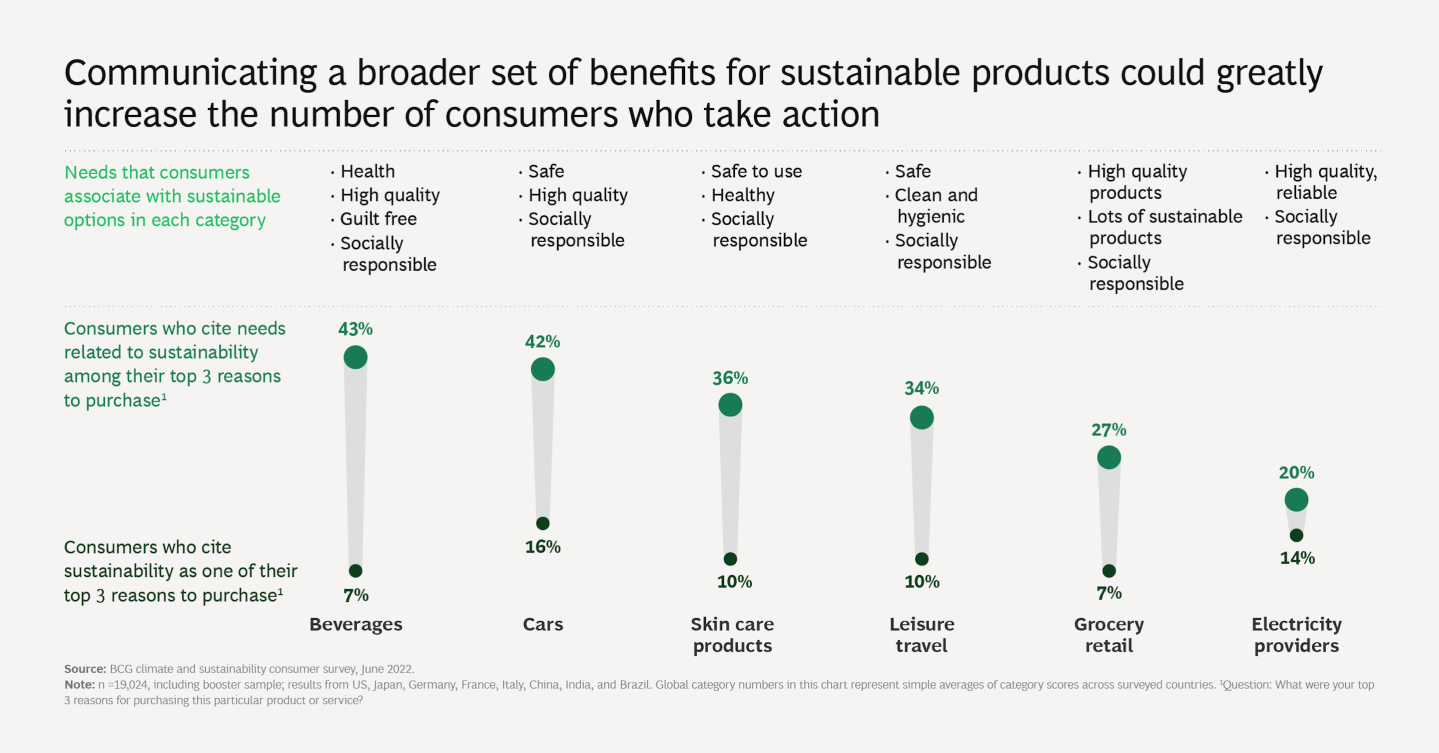
The BCG survey ran from June to July of 2022. It involved some 19,000 participants from the U.S., Japan, Germany, France, Italy, China, India, and Brazil.
Courtesy of BCG

And to reach consumers who are “acting” and “paying,” companies can…

  • Make claims locally relevant. Companies can expand the participation of these consumer segments by using language that will really resonate with them. (Always, though, claims about sustainability must be legitimate and based in fact; consumers are wary of the possibility of “greenwashing.”) The language that works best in skin care, for example, is based on ingredients—both the absence of bad ones and the presence of good ones.
  • Further, product claims resonate best when they are developed with a sense of the language and considerations relevant to particular markets. For instance, Japanese consumers have expressed particular concern about packaging, so emphasizing the use of recyclable, reusable, or compostable packaging is likely to be effective. In Brazil, claims about protecting forests are particularly meaningful to consumers.

The key role of CMOs

Consumer choices are powerful. They can make or break products, services, and companies—and perhaps climate and sustainability efforts, too. Without the participation of mainstream consumers, companies cannot make a significant impact through sustainable strategies. Consumers are therefore the key to taking green mainstream. All of the C-suite can help turn this opportunity into reality, creating wins for both the environment and the company’s bottom line. (It’s worth noting that sustainable products and services have higher net promoter scores relative to non-sustainable alternatives.)

But in the effort to help consumers step up to make more sustainable choices, it’s imperative that CMOs and their teams take advantage of their unique perspective to step up, too. They’ve got the essential view and voice to be the crucial interface with consumers:

  • They see the core market in detail. They are the closest to the consumer, and they have a deep understanding of what consumers want. As such, they can work with other teams within the company to shape sustainable offerings to meet those needs, overcoming real barriers to uptake and addressing misperceptions that also stand as barriers.
  • And they can speak to that core market in direct and personalized ways, giving consumers the information they need to help them see the value of sustainable products and services—and choose them.

Kanika Sanghi is a partner and director in the Mumbai office of Boston Consulting Group. Aparna Bharadwaj is a managing director and partner in the firm’s Singapore office. Lauren Taylor is a managing director and partner in BCG’s Dallas office.

Sign up for the Fortune Features email list so you don’t miss our biggest features, exclusive interviews, and investigations.

About the Authors
By Kanika Sanghi
See full bioRight Arrow Button Icon
By Aparna Bharadwaj
See full bioRight Arrow Button Icon
By Lauren Taylor
See full bioRight Arrow Button Icon

Latest in Commentary

Finance
Lorem ipsum dolor sit amet, consectetur adipiscing elit, sed do eiusmod tempor incididunt ut labore et dolore magna aliqua. Ut enim ad minim veniam
By Fortune Editors
October 20, 2025
Finance
Lorem ipsum dolor sit amet, consectetur adipiscing elit, sed do eiusmod tempor incididunt ut labore et dolore magna aliqua. Ut enim ad minim veniam
By Fortune Editors
October 20, 2025
Finance
Lorem ipsum dolor sit amet, consectetur adipiscing elit, sed do eiusmod tempor incididunt ut labore et dolore magna aliqua. Ut enim ad minim veniam
By Fortune Editors
October 20, 2025
Finance
Lorem ipsum dolor sit amet, consectetur adipiscing elit, sed do eiusmod tempor incididunt ut labore et dolore magna aliqua. Ut enim ad minim veniam
By Fortune Editors
October 20, 2025
Finance
Lorem ipsum dolor sit amet, consectetur adipiscing elit, sed do eiusmod tempor incididunt ut labore et dolore magna aliqua. Ut enim ad minim veniam
By Fortune Editors
October 20, 2025
Finance
Lorem ipsum dolor sit amet, consectetur adipiscing elit, sed do eiusmod tempor incididunt ut labore et dolore magna aliqua. Ut enim ad minim veniam
By Fortune Editors
October 20, 2025

Most Popular

Finance
Lorem ipsum dolor sit amet, consectetur adipiscing elit, sed do eiusmod tempor incididunt ut labore et dolore magna aliqua. Ut enim ad minim veniam
By Fortune Editors
October 20, 2025
Finance
Lorem ipsum dolor sit amet, consectetur adipiscing elit, sed do eiusmod tempor incididunt ut labore et dolore magna aliqua. Ut enim ad minim veniam
By Fortune Editors
October 20, 2025
Finance
Lorem ipsum dolor sit amet, consectetur adipiscing elit, sed do eiusmod tempor incididunt ut labore et dolore magna aliqua. Ut enim ad minim veniam
By Fortune Editors
October 20, 2025
Finance
Lorem ipsum dolor sit amet, consectetur adipiscing elit, sed do eiusmod tempor incididunt ut labore et dolore magna aliqua. Ut enim ad minim veniam
By Fortune Editors
October 20, 2025
Finance
Lorem ipsum dolor sit amet, consectetur adipiscing elit, sed do eiusmod tempor incididunt ut labore et dolore magna aliqua. Ut enim ad minim veniam
By Fortune Editors
October 20, 2025
Finance
Lorem ipsum dolor sit amet, consectetur adipiscing elit, sed do eiusmod tempor incididunt ut labore et dolore magna aliqua. Ut enim ad minim veniam
By Fortune Editors
October 20, 2025
Fortune Secondary Logo
Rankings
  • 100 Best Companies
  • Fortune 500
  • Global 500
  • Fortune 500 Europe
  • Most Powerful Women
  • World's Most Admired Companies
  • See All Rankings
  • Lists Calendar
Sections
  • Finance
  • Fortune Crypto
  • Features
  • Leadership
  • Health
  • Commentary
  • Success
  • Retail
  • Mpw
  • Tech
  • Lifestyle
  • CEO Initiative
  • Asia
  • Politics
  • Conferences
  • Europe
  • Newsletters
  • Personal Finance
  • Environment
  • Magazine
  • Education
Customer Support
  • Frequently Asked Questions
  • Customer Service Portal
  • Privacy Policy
  • Terms Of Use
  • Single Issues For Purchase
  • International Print
Commercial Services
  • Advertising
  • Fortune Brand Studio
  • Fortune Analytics
  • Fortune Conferences
  • Business Development
  • Group Subscriptions
About Us
  • About Us
  • Press Center
  • Work At Fortune
  • Terms And Conditions
  • Site Map
  • About Us
  • Press Center
  • Work At Fortune
  • Terms And Conditions
  • Site Map
  • Facebook icon
  • Twitter icon
  • LinkedIn icon
  • Instagram icon
  • Pinterest icon

Latest in Commentary

agentic
CommentaryAI agents
Why your data infrastructure — not your AI model — will determine whether Agentic AI scales
By Jeffrey Sonnenfeld, Stephen Henriques, Catherine Dai and Zander JeinthanuttkanontApril 30, 2026
51 minutes ago
hoskins
Commentaryoffices
Gensler Co-Chair: Hot-desking was supposed to save money. It may be costing you your culture
By Diane HoskinsApril 30, 2026
2 hours ago
tillis
CommentaryCongress
Thom Tillis: Free markets built American prosperity. Government intervention puts it at risk
By Thom Tillis and John StanfordApril 30, 2026
4 hours ago
iran
CommentaryIran
The Strait of Hormuz is a data problem, not just a military one
By Erik Bethel and Ami DanielApril 30, 2026
4 hours ago
hollywood
CommentaryMarketing
I spent 20 years learning to navigate an industry. Then I built a campaign for the man who’s dismantling it
By Matti YahavApril 29, 2026
23 hours ago
aging
HealthLongevity
We’re the CEOs of Peloton and the Hospital for Special Surgery. Living longer isn’t enough, we need to live better, too
By Bryan T. Kelly and Peter SternApril 29, 2026
1 day ago

Most Popular

Apple cofounder Ronald Wayne—whose stake would be worth up to $400 billion had he not sold it in 1976—says that at 91, he has no regrets
Success
Apple cofounder Ronald Wayne—whose stake would be worth up to $400 billion had he not sold it in 1976—says that at 91, he has no regrets
By Preston ForeApril 27, 2026
3 days ago
‘Take the money and run’: Johns Hopkins economist Steve Hanke on why the UAE quit OPEC
Energy
‘Take the money and run’: Johns Hopkins economist Steve Hanke on why the UAE quit OPEC
By Shawn TullyApril 29, 2026
1 day ago
Jamie Dimon gets candid about national debt: ‘There will be a bond crisis, and then we’ll have to deal with it’
Economy
Jamie Dimon gets candid about national debt: ‘There will be a bond crisis, and then we’ll have to deal with it’
By Eleanor PringleApril 29, 2026
1 day ago
‘The cost of compute is far beyond the costs of the employees’: Nvidia executive says right now AI is more expensive than paying human workers
AI
‘The cost of compute is far beyond the costs of the employees’: Nvidia executive says right now AI is more expensive than paying human workers
By Sasha RogelbergApril 28, 2026
2 days ago
‘They left me no choice’: Powell isn’t going anywhere—blocking Trump from another Fed appointee
Banking
‘They left me no choice’: Powell isn’t going anywhere—blocking Trump from another Fed appointee
By Eva RoytburgApril 29, 2026
18 hours ago
More than two-thirds of U.S. schools say they’re unable to afford the cost of student free lunch—and MAHA’s dietary guidelines may make it worse
Economy
More than two-thirds of U.S. schools say they’re unable to afford the cost of student free lunch—and MAHA’s dietary guidelines may make it worse
By Sasha RogelbergApril 29, 2026
1 day ago

© 2026 Fortune Media IP Limited. All Rights Reserved. Use of this site constitutes acceptance of our Terms of Use and Privacy Policy | CA Notice at Collection and Privacy Notice | Do Not Sell/Share My Personal Information
FORTUNE is a trademark of Fortune Media IP Limited, registered in the U.S. and other countries. FORTUNE may receive compensation for some links to products and services on this website. Offers may be subject to change without notice.