While shopping at the Harbor Lifestyle mall in Mérida, Mexico this year, 24-year-old hospitality student Mascha Rudolph, did a double-take. The store’s big logo, all-white interior, and enormous size all screamed Forever 21, but she could have sworn the fast fashion retailer had shuttered all of its shops years ago.
The student from Germany, who’s completing a year abroad in Latin America, stepped inside and was immediately transported back to her teens, when she shopped at Forever 21, a store known for basics like t-shirts as well as “going out tops,” festival outfits, and clubbing apparel. Nowadays, Rudolph normally eschews fast fashion, but the thrift stores and sustainable brands she prefers are hard to come by in Mexico so she bought a baby-blue romper and imitation gold necklace during her visit. The store “looked the same as 10 years ago,” she says. “It felt very familiar.”
In recent months, scores of Forever 21 stores have started popping up in the U.S. and overseas as the Los Angeles-based apparel chain attempts a comeback from a 2019 bankruptcy that forced it to shutter hundreds of stores worldwide. With its new physical presence, the teen and tween retailer is reigniting millennials’ memories of the brand and introducing itself to Gen Z and Gen Alpha shoppers for what may be the first time, trying to recapture the magic that merited 700 stores and generated $4.4 billion in annual sales at Forever 21’s peak.
But the familiarity that Randolph felt on her visit may complicate any post-bankruptcy, post-pandemic revival. Forever 21 is trying to return from the near-dead using a strategy similar to one that faltered before: a rapid expansion of brick-and-mortar stores across the globe.
Losing the magic touch
In 1984—three years after immigrating to the U.S. from South Korea—husband-and-wife duo Do Won and Jin Sook Chang launched Fashion 21, a single shop for cost- and trend-conscious young shoppers in Los Angeles, Calif.
By the mid-2000s, the brand—by then renamed Forever 21—began offering an expanding inventory of trendy clothes that mimicked runway styles and were restocked every few days at rock-bottom prices. The quick turnover of cheap, fashionable clothes made Forever 21 a fast fashion pioneer and endeared it to a generation of young female shoppers. By 2010, the Changs operated 500 Forever 21 stores in the U.S. By 2015, they had an additional 250 Forever 21 stores overseas, and the couple ranked among the U.S.’s richest 100 people with a combined net worth of nearly $6 billion. The Changs couldn’t be reached for comment.
The Changs’ insular leadership of the company and mismanagement of inventory reportedly contributed to Forever 21’s demise, but the company’s most significant misstep was snapping up so much real estate. In the mid-2000s to mid-2010s, as mall foot traffic trailed off in favor of online shopping, the company bought up the cavernous spaces of failing U.S. department stores like Sears and Mervyn’s—often over 100,000-square feet in size with long-term leases—that it struggled to fill.
The business model simply “wasn’t sustainable the way it was scaled,” says Shelley Kohan, a Syracuse University management professor and associate professor at the Fashion Institute of Technology.
Forever 21 was a “command and control” empire tightly managed by its founders who had a “brilliant run,” says Mark Cohen, a retail professor at Columbia University’s Graduate School of Business. “But they got carried away with their success and became overextended. It’s no surprise they hit the wall,” he says.
As rivals Zara and H&M ramped up their online offerings and sustainability initiatives to meet consumer demand, Forever 21 seemed to fall out of step with the latest trends. In 2019, it launched a Cheetos-inspired clothing line, and kept churning out t-shirts emblazoned with words like “Pizza, Love, Boys, Music, Parties, Dancing, Whatever,” and “Daddy’s Girl” stamped below a sparkling kitten and rainbow.
In 2018, nearly half of 13- to 30-year-olds ranked Forever 21 as “hot” and 45% said they would buy from the retailer. But a little over a year later, those figures had fallen to 31% and 33%, respectively, according to youth-focused research firm YPulse.
In 2019, total sales dropped 30% to $3.1 billion from a 2016 peak, while the retailer’s annual total rent ballooned to $450 million. Its international operations alone lost $100 million from the fall of 2018 to the fall of 2019.
In September 2019, Forever 21 filed for Chapter 11 bankruptcy protection, which lent it additional time to restructure, find financing, and postpone its debt obligations to its creditors.
As Forever 21 was reorganizing—it shuttered 350 of its 800 stores worldwide and halted operations in 40 countries—Authentic Brands Group (ABG), a brand licenser that buys struggling retailers, and two of Forever 21’s biggest landlords, Simon Property Group (SPG) and Brookfield Property Partners, swooped in. In February 2020, the consortium purchased Forever 21 at a bankruptcy auction for $81.1 million.
Strategic nostalgia
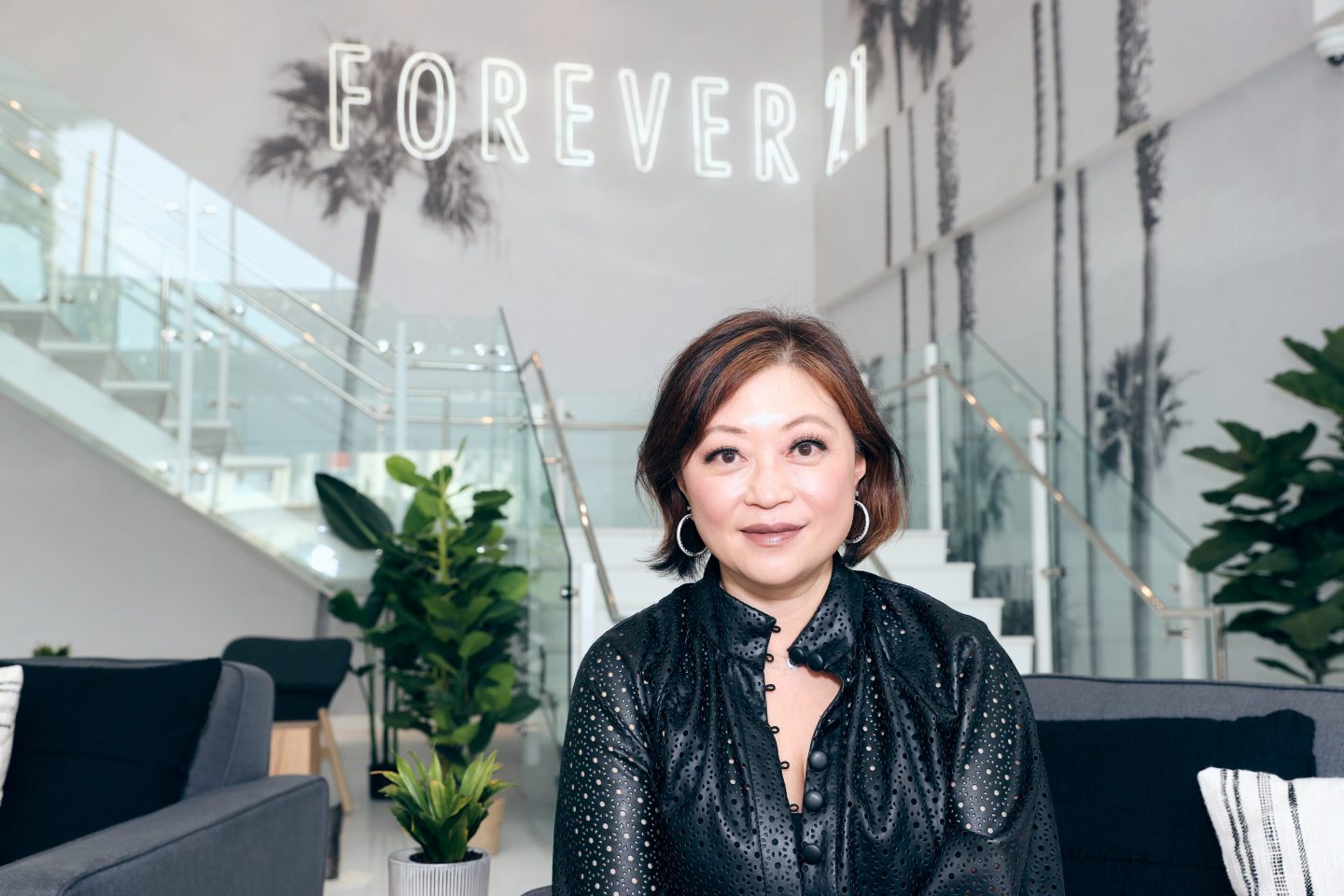
This January, Forever 21’s new owners tapped CEO Winnie Park to lead its attempt at a turnaround. She’s the retailer’s second CEO in as many years. The company hired former H&M executive Daniel Kulle in 2020, but he stepped down last October. Park was CEO of stationary retailer Paper Source for six years and held management roles at luxury travel retailer DFS Group.
Park doesn’t want the new Forever 21 to be defined as a fast fashion brand, but rather as a youth-focused company offering apparel that will span many styles and generations and center on its Los Angeles roots. “Inclusivity is… key. We aspire to be a safe place for self-expression through fashion,” the CEO says. Forever 21’s base of young shoppers, particularly Gen Z, “doesn’t want to… be restricted to one persona. Their fashion sense is a form of self-expression that can change from Barbie… to Goth to Y2K in… a single day,” Park says.
Starting last year, the company renovated select stores with light wood floors and softer lights. Some stores have designated ‘style’ zones with names like Malibu and Venice, with each section offering different looks that reflect the vibe of each city.
The Forever 21 store in Mérida, Mexico, “actually had a lot of cute stuff,” Rudolph says. “They even had a collab with Juicy Couture… and Y2K styles.”
In March, TikTok user @pennyysmom recorded a video, which now has 184,000 views, showing Forever 21’s new Fubu line—a hip hop label popularized by rappers like LL Cool J in the 1990s. Her video showed bucket hats, baseball jerseys, and neon apparel. She wrote: “If you’re a 90s kid… please run to Forever 21.”
Nineties fashions are an example of what Forever 21 hopes will be its multi-generation appeal. Such apparel captures millennials’ sense of nostalgia as well as younger shoppers’ fondness for the decade’s style. “We’re seeing parents and their kids shopping together,” Park says.
More problematic may be the brand’s return to its playbook of expanding its brick-and-mortar footprint. In bankruptcy, Forever 21 cut its store count to 450 but has already opened 100 new stores since then. It plans to add 13 to its current count of 566 this year.
Forever 21’s physical shops remain its “strategic assets” that account for the 87% of sales, Park says. For rivals H&M and Zara, in-store shopping accounts for 68% and 75% of sales, respectively. She sees the new Forever 21 stores, which will be smaller in size than its pre-bankruptcy shops, as akin to mini department stores. The physical stores will target its core demographic of young female shoppers, but also offer menswear, gender-fluid collections, and home decor.
Customers develop a “deep loyalty [to a brand] through emotional engagement,” which can only happen through in-person shopping, Park argues. Consumers do still desire to “try, touch and feel products,” says Martin Roll, an independent retail strategist. But all-in-one department stores are nearing extinction, killed off by dwindling mall traffic, a shrinking middle class, and the online shopping boom.
Forever 21’s continued focus on opening physical stores seems “counterintuitive” to what its core demographic is looking for; they’re increasingly gravitating toward online retailers, particularly those with digital operations that react quickly to trending styles, Kohan says. Around 40% of Gen Z buys more than half of their clothes online, according to research from consultancy Accenture.
Forever 21 is making “hundreds of upgrades” to its online shop and mobile app to improve its digital shopping experience, Park says. Forever 21’s physical stores are integrated with its online shopping to allow customers to “click and collect” or shop online and pick up their purchases in-store, the CEO says. But digitally, Forever 21 is “far behind its counterparts. It has a learning curve in order to play catch-up,” Kohan says. China-based, online-only retailer Shein, for instance, introduces hundreds of new designs every day at “unfathomably lower prices” through its sophisticated and integrated supply chain technology,” says Erin Schmidt, senior analyst at retail technology advisory firm Coresight Research.
Experts suggest that Forever 21’s ongoing store expansion is a product of its new ownership; the retailer’s physical presence benefits its parent companies in more ways than one.
To Simon Property Group, one of the U.S.’s biggest mall operators, Forever 21 represents an important tenant in its sprawling shopping centers. One-quarter of Forever 21 stores are located in a Simon Property Group mall. Shopping mall vacancies are “deadly” so it “makes sense that they would buy [Forever 21] to keep the lights on… [and] rent and revenue streams intact,” Cohen says. The operator owns 199 properties nationally, including 95 malls and 69 outlets.
Lockdown-weary consumers in the U.S. are trickling back to shopping malls, but mall traffic sits 16% below pre-pandemic levels. Still, Simon Property Group signed 4,100 leases for 15 million square feet last year, its highest figures in six years.
Authentic Brands Group, meanwhile, sells products from its other portfolio companies through Forever 21, and vice versa, says Carol Spieckerman, founder of consultancy Spieckerman Retail. Authentic has used Forever 21 to launch partnerships with once-popular labels like Juicy Couture and Hervé Léger that it owns and has placed Forever 21 products in JCPenney department stores—another Authentic Brand asset.
Through the Authentic Brands-Simon Property partnership Forever 21 has scored “variable rent” contracts, which means its rent is dictated by how much it sells. But in today’s fast fashion environment, where Forever 21 has lost market share to its rivals, “store expansion amid declining sales is not a sound strategy, particularly long-term, even with a variable rent contract,” Schmidt says.
Park notes that the brand is “trying to meet Gen Z where they are. For instance, the company is trying new initiatives like teaming up with gaming platform Roblox to launch a metaverse shop.
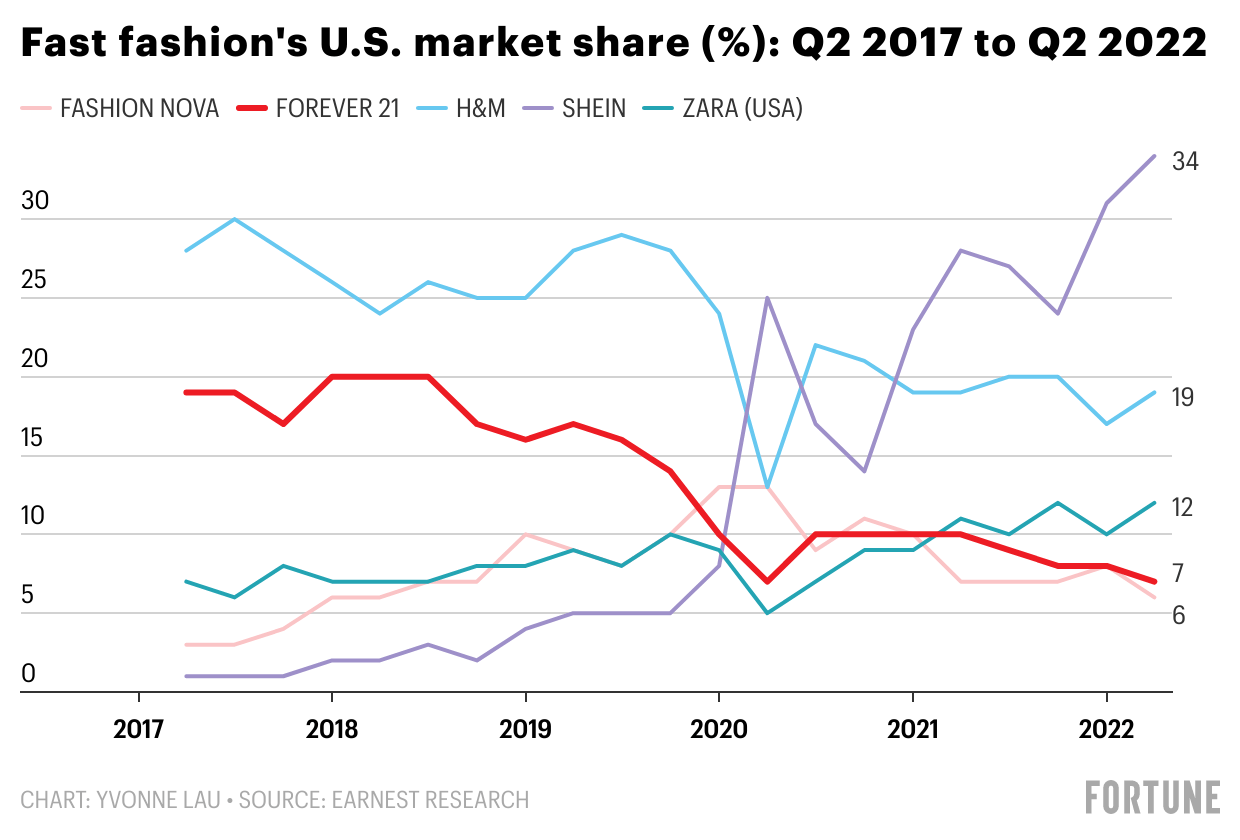
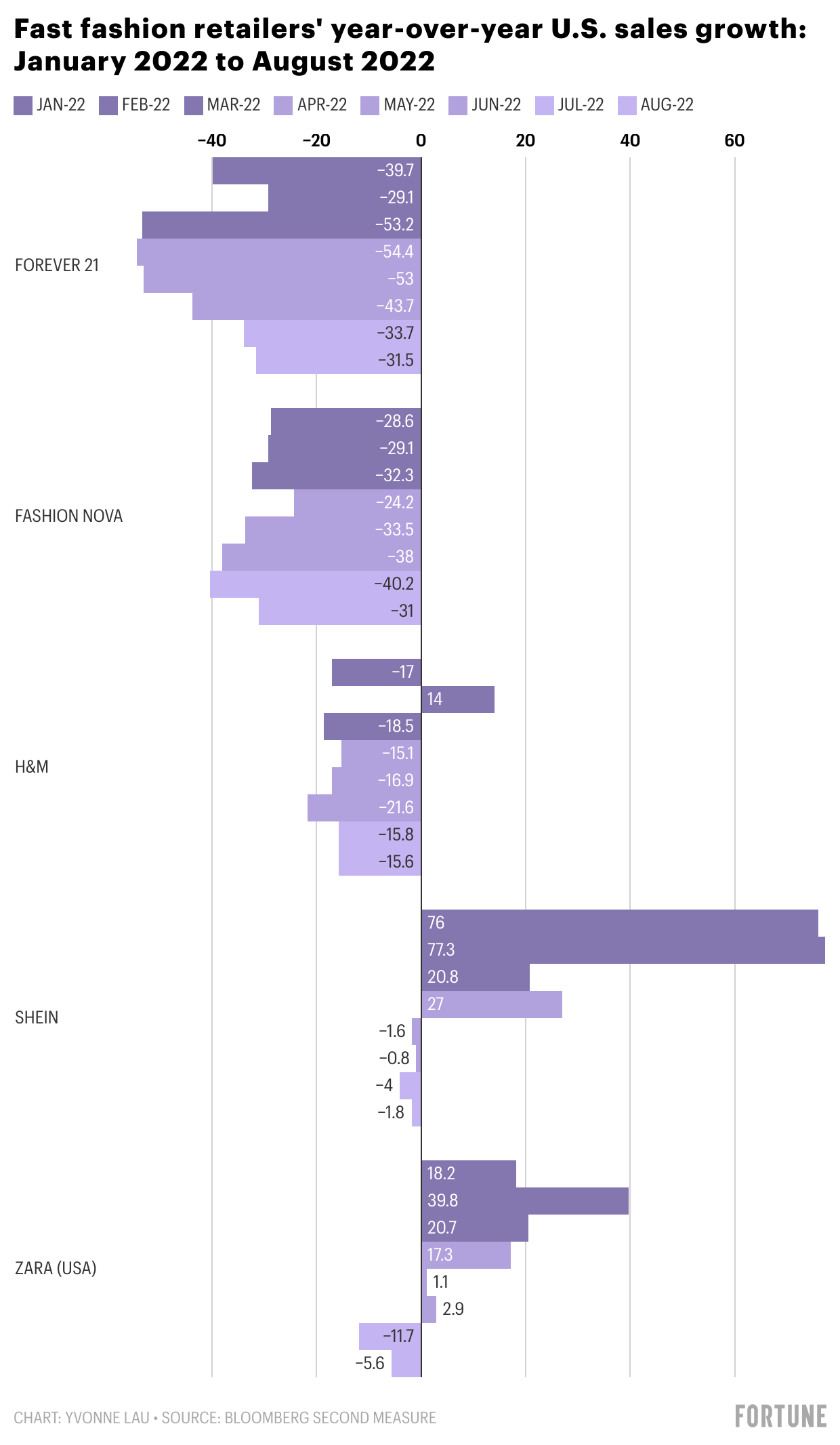
In the second quarter of this year, Forever 21’s U.S. fast fashion market share plunged to 7% from 20% during the same time in 2018. Yet its rivals, like online-only retailer Shein, grew even cheaper, faster and more digitally savvy and big-box retailers like Target and Walmart lured young shoppers looking for inexpensive fashion. In the first eight months of 2022, Forever 21’s year-on-year sales growth sank 42% per month on average.
Forever 21 must rebrand and create a distinct identity that differentiates it from its fast fashion competitors, Schmidt says. “What worked for Forever 21 [before] isn’t necessarily going to work for them today,” she says.
Sign up for the Fortune Features email list so you don’t miss our biggest features, exclusive interviews, and investigations.