• Home
  • News
  • Fortune 500
  • Tech
  • Finance
  • Leadership
  • Lifestyle
  • Rankings
  • Multimedia
Leadership

Workers at Amazon, Chipotle, and Starbucks are winning union elections. But it might take years before they see a contract

Paolo Confino
By
Paolo Confino
Paolo Confino
Reporter
Down Arrow Button Icon
Paolo Confino
By
Paolo Confino
Paolo Confino
Reporter
Down Arrow Button Icon
September 14, 2022, 6:00 AM ET
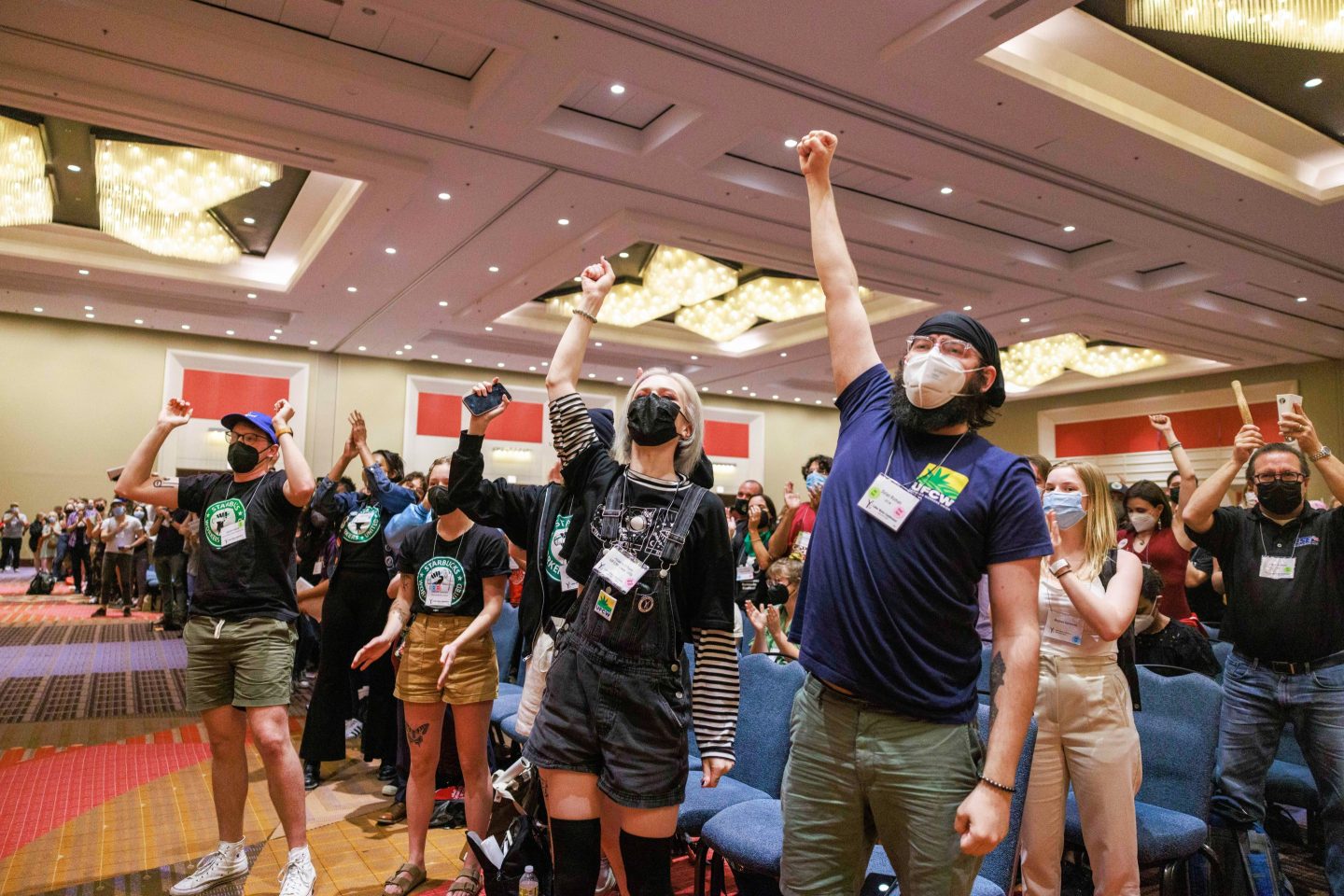
Audience members react as Sean O'Brien, president of the Teamsters labor union, speaks during the Labor Notes conference.
Audience members react as Sean O'Brien, president of the Teamsters labor union, speaks during the Labor Notes conference.Jeremy Hogan—SOPA Images/LightRocket/Getty Images

A Starbucks in Seattle, an Amazon warehouse in Staten Island, and a Chipotle restaurant in Lansing, Mich., each made history by becoming the first locations at their respective companies to unionize. In the process, they’ve rekindled American support for the labor movement. But the real fight begins after voting to unionize, as workers race against the clock to secure their first contract before decertification risks shattering the union before it gains momentum. 

When workers win union elections, little changes in the short term. They aren’t immediately granted the improved working conditions or salary requests they lobbied for during the union campaign—merely the right to begin collectively negotiating for them. Workers rush to negotiate their contract within one year of winning a union vote, when the decertification bar, which prohibits employers from holding a vote to disband the union, lapses. Employers know this and thus often use sophisticated union avoidance efforts to delay signing a contract during the bargaining process, says Joseph Richardson, a lawyer at the labor law firm Willig, Williams & Davidson. “It can take the form of bargaining that walks right up to the line, perhaps a little bit over, in terms of what is allowed,” he says. 

It takes unions an average of 409 days to negotiate a contract, according to a study conducted by Bloomberg Law. And just under half of newly formed unions reach a contract before the one-year decertification deadline, according to a study from the Economic Policy Institute. 

“Not having an agreement means that the parties have to negotiate every individual circumstance affecting terms and conditions of employment: each schedule change, each pay raise, each major discipline, each work rules change,” Richardson explains. “This imposes huge transaction costs on both sides.”

To stall the process, companies may avoid information requests, repeatedly reschedule bargaining sessions, or introduce demands meant to divide union members. Unions can maneuver aroundthis ploy by continuing their organizing efforts and demonstrating their advocacy for employees’ interests. This helps exert pressure on employers and convince skeptical employees not to decertify the union, says Danielle Mahones, a director at the UC Berkeley Labor Center. It’s of particular importance, she adds, because management may attempt to use the stasis induced by its own stalling tactics as evidence that unions don’t benefit employees. 

“To be able to win, it’s really important for workers to have a majority of their coworkers united and participating in the process.” 

Regardless of how adversarial the employer-employee relationship may be, contract negotiations begin after every successful vote. “In collective bargaining, everything can be reduced to two issues: money and power,” says Fred Braid, a management lawyer at the law firm Holland & Knight. 

Management wants to control its ability to respond to market conditions, while workers want to ensure said control doesn’t create an unfavorable working environment. The inherent tension leads some employers to instinctively react negatively to unionization efforts. Braid cautions against that. 

“[An employer] might want to remain non-union because of the freedom it has, but it also doesn’t want to wreck its business and do foolish things just because employees have organized,” Braid says. 

That includes violating labor laws by discriminating against pro-union employees with reduced hours, worse benefits, or even termination. Should an employer do so, employees can file charges with the National Labor Review Board. 

Despite some highly publicized conflicts, collective bargaining typically goes over smoothly, according to Braid. But even in good-faith negotiations for the first contract, he advises clients to prioritize the “preservation of as much managerial freedom as possible.” He cites seniority during layoffs as an example. Often, management prefers to let employees go based on performance, while workers prefer a “last in, first out” method. 

“If management is weak and makes bad deals, which makes the company noncompetitive, shareholders won’t be happy about that,” Braid says. 

Still, shareholders and company leadership will have to evaluate the expenditures incurred by either recognizing the union, such as higher labor costs; or fighting it, such as legal fees and potential losses in productivity should there be a strike. 

Even among the most union-friendly employers, these decisions take time, allowing both sides to hopefully make mutually beneficial work arrangements.

Sign up for the Fortune Features email list so you don’t miss our biggest features, exclusive interviews, and investigations.


About the Author
Paolo Confino
By Paolo ConfinoReporter

Paolo Confino is a former reporter on Fortune’s global news desk where he covers each day’s most important stories.

See full bioRight Arrow Button Icon

Latest in Leadership

C-SuiteFortune 500 CEO Interview
Bristol Myers Squibb CEO Chris Boerner says company culture was the missing piece of his ‘patent cliff’ plan
By Diane BradyDecember 5, 2025
3 hours ago
Shuntaro Furukawa, president of Nintendo Co., speaks during a news conference in Osaka, Japan, on Thursday, April 25, 2019. Nintendo gave a double dose of disappointment by posting earnings below analyst estimates and signaled that it would not introduce a highly anticipated new model of the Switch game console at a June trade show. Photographer: Buddhika Weerasinghe/Bloomberg via Getty Images
NewslettersCEO Daily
Nintendo’s 98% staff retention rate means the average employee has been there 15 years
By Nicholas GordonDecember 5, 2025
3 hours ago
Co-founder and chief executive officer of Nvidia Corp., Jensen Huang attends the 9th edition of the VivaTech trade show at the Parc des Expositions de la Porte de Versailles on June 11, 2025, in Paris.
C-SuiteNvidia
Before running the world’s most valuable company, Jensen Huang was a 9-year-old janitor in Kentucky
By Eva RoytburgDecember 5, 2025
3 hours ago
Future of WorkBrainstorm Design
The workplace needs to be designed like an ‘experience,’ says Gensler’s Ray Yuen, as employees resist the return to office
By Angelica AngDecember 5, 2025
5 hours ago
LawAT&T
AT&T promised the government it won’t pursue DEI. FCC commissioner warns it will be a ‘stain to their reputation long into the future’
By Kristen Parisi and HR BrewDecember 4, 2025
15 hours ago
Zoe Rosenberg
LawCrime
Gen Z activist gets jail time for liberating chickens from Perdue plant in Northern California
By The Associated PressDecember 4, 2025
16 hours ago

Most Popular

placeholder alt text
Economy
Two months into the new fiscal year and the U.S. government is already spending more than $10 billion a week servicing national debt
By Eleanor PringleDecember 4, 2025
1 day ago
placeholder alt text
Success
‘Godfather of AI’ says Bill Gates and Elon Musk are right about the future of work—but he predicts mass unemployment is on its way
By Preston ForeDecember 4, 2025
21 hours ago
placeholder alt text
Success
Nearly 4 million new manufacturing jobs are coming to America as boomers retire—but it's the one trade job Gen Z doesn't want
By Emma BurleighDecember 4, 2025
21 hours ago
placeholder alt text
Success
Nvidia CEO Jensen Huang admits he works 7 days a week, including holidays, in a constant 'state of anxiety' out of fear of going bankrupt
By Jessica CoacciDecember 4, 2025
20 hours ago
placeholder alt text
North America
Jeff Bezos and Lauren Sánchez Bezos commit $102.5 million to organizations combating homelessness across the U.S.: ‘This is just the beginning’
By Sydney LakeDecember 2, 2025
3 days ago
placeholder alt text
Health
Bill Gates decries ‘significant reversal in child deaths’ as nearly 5 million kids will die before they turn 5 this year
By Nick LichtenbergDecember 4, 2025
1 day ago
Rankings
  • 100 Best Companies
  • Fortune 500
  • Global 500
  • Fortune 500 Europe
  • Most Powerful Women
  • Future 50
  • World’s Most Admired Companies
  • See All Rankings
Sections
  • Finance
  • Leadership
  • Success
  • Tech
  • Asia
  • Europe
  • Environment
  • Fortune Crypto
  • Health
  • Retail
  • Lifestyle
  • Politics
  • Newsletters
  • Magazine
  • Features
  • Commentary
  • Mpw
  • CEO Initiative
  • Conferences
  • Personal Finance
  • Education
Customer Support
  • Frequently Asked Questions
  • Customer Service Portal
  • Privacy Policy
  • Terms Of Use
  • Single Issues For Purchase
  • International Print
Commercial Services
  • Advertising
  • Fortune Brand Studio
  • Fortune Analytics
  • Fortune Conferences
  • Business Development
About Us
  • About Us
  • Editorial Calendar
  • Press Center
  • Work At Fortune
  • Diversity And Inclusion
  • Terms And Conditions
  • Site Map

© 2025 Fortune Media IP Limited. All Rights Reserved. Use of this site constitutes acceptance of our Terms of Use and Privacy Policy | CA Notice at Collection and Privacy Notice | Do Not Sell/Share My Personal Information
FORTUNE is a trademark of Fortune Media IP Limited, registered in the U.S. and other countries. FORTUNE may receive compensation for some links to products and services on this website. Offers may be subject to change without notice.