• Home
  • Latest
  • Fortune 500
  • Finance
  • Tech
  • Leadership
  • Lifestyle
  • Rankings
  • Multimedia
FinanceRecession

How a telephone exec and a socialist economist teamed up to form the organization that decides if we’re in a recession

Will Daniel
By
Will Daniel
Will Daniel
Down Arrow Button Icon
Will Daniel
By
Will Daniel
Will Daniel
Down Arrow Button Icon
July 28, 2022, 6:00 AM ET
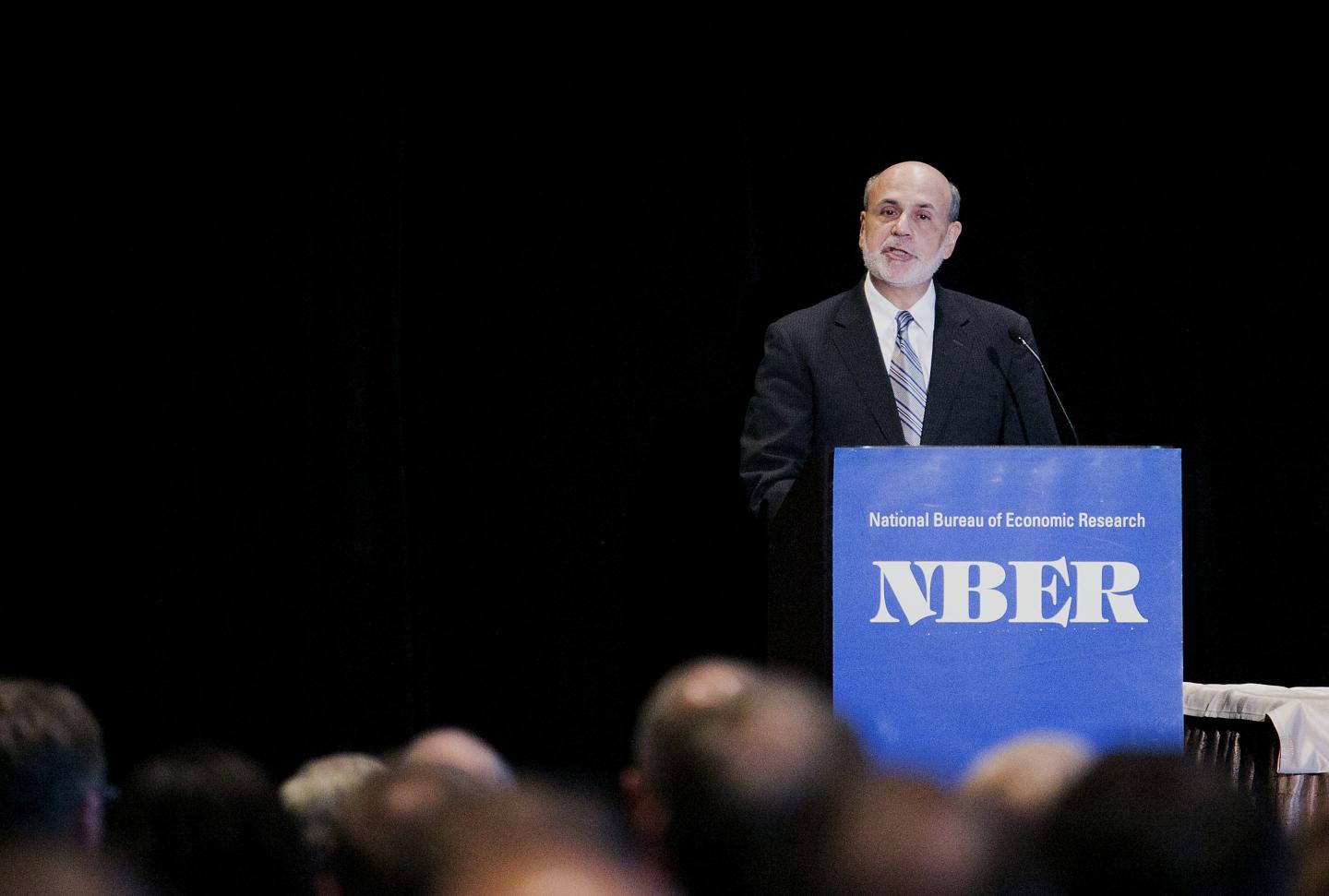
Former Fed Chair Ben Bernanke gives a speech at a 2013 NBER conference.
Ben S. Bernanke, former chairman of the U.S. Federal Reserve, speaks during the National Bureau of Economic Research Conference in Cambridge, Massachusetts on July 10, 2013.Kelvin Ma—Bloomberg/Getty Images

The debate on both Wall Street and Main Street over how to properly define a recession is raging—and both sides are digging in their heels.

Some say that a recession is when U.S. gross domestic product (GDP) contracts for two consecutive quarters, and that the labor market’s strength or what experts say is irrelevant. 

By that definition, the Bureau of Economic Analysis’ Thursday release of second-quarter GDP data could decide whether the U.S. economy is in a recession, after it reported a decline in GDP in the first quarter.

But most economists and investment banks argue that the economy isn’t in a true recession until the non-profit National Bureau of Economic Research (NBER) declares one. Until recently, the century-old organization mostly remained under the radar, but with recession predictions raining down like a hurricane, it’s now in the spotlight. 

The founding of NBER

NBER’s origins trace back to the meeting of two unlikely friends, Malcolm Rorty, the chief statistician at the American Telephone and Telegraph Company (AT&T), and Nachum Stone, a socialist labor organizer with a Ph.D. in economics from Columbia University.

Rorty was famous for his ultra-conservative viewpoints and laissez-faire approach to business during the pre-World War I era. Stone, on the other hand, was known for pushing for the equal distribution of wealth and an economy that was “more in accordance with contemporary social ideals.”

In Wesley C. Mitchell’s 1945 book, The National Bureau’s First Quarter-Century, Stone wrote a chapter detailing the birth of NBER and Rorty’s role in its founding. In the book, Stone recounts how he first met Rorty when the two jousted as opposing advisers at hearings of the New York State Factory Investigating Committee and New York City’s Unemployment Committee in 1915. 

It wasn’t exactly love at first sight.

“In advocating the expediting of as many public works projects as the city could undertake as an alternative or supplement to public soup kitchens, I again clashed with Rorty. He formed a definite impression of me as a dangerous radical,” Stone wrote of their first meeting.

About a year later, however, the relationship would begin to improve after Stone wrote an article in the Intercollegiate Socialist, an economics newspaper meant for college students, in which he questioned an economist’s paper on national income distribution.

Rorty, expecting a “red hot diatribe on the unjust distribution of income under capitalism,” was impressed by Stone’s objective approach in the article. It gave him “a new slant on the dangerous radical” Stone.

“This was followed by several conferences which culminated in a warm friendship, although we continued to differ strongly on many public questions,” Stone wrote.

At a lunch meeting, Stone said that Rorty gave the following profound statement that sits at the core of what NBER does today:

“Here we are considering a most important question which deeply affects the lives of every man, woman, and child in this country, and despite a large fund of statistical data, there is no agreement…Would it not be a great step forward if we had an organization that devoted itself to fact-finding on controversial economic subjects of great public interest?”

Stone agreed, and the two set out to find “well-known economists representing every school of economic thought from extreme conservative to extreme radical” and form NBER. They ended up recruiting Columbia Professor Wesley Clair Mitchell, a leader in the study and measurement of economic fluctuations who became NBER’s inaugural research director, a position he held for 25 years.

Rorty and Stone also received support from the Carnegie Foundation and the Laura Spellman Rockefeller Foundation, which allowed them to meet their $10,000 goal to fund NBER. The organization held its first meeting on May 7, 1920. 

Claudia Goldin, an economic historian and the Henry Lee Professor of Economics at Harvard University, told Fortune that NBER’s creation “set down the statistical foundations” of American economics.

“It played an enormously important role,” she said. “It is pretty amazing that this non-partisan organization is bound and takes it upon itself to lift up the standards by which we measure the economy.”

NBER developed statistical data to measure gross national income, gross national product, the money supply, and other key economic measures. Before then, economists were “flying in the clouds” without enough information to accurately measure the U.S. economy’s health, Goldin said.

As Solomon Fabricant, a former vice president of research at NBER, wrote in a 1984 essay: “Few readers of the daily newspapers know how often the reports they see on the economic situation owe something to the work of a private, non-profit organization established over 60 years ago.” 

Who decides if we’re in a recession?

All of this leads us back to the question: Who decides if we’re in a recession?

There is no official governing body that decides whether the U.S. is in a recession. Instead, most people look to the National Bureau of Economic Research. Specifically, the organization’s bipartisan Business Cycle Dating Committee, which includes eight of the most respected U.S. economists, has declared the beginning and end of business cycles since 1978.

The committee defines a recession, not by any specific contraction in GDP, but as “a significant decline in economic activity that is spread across the economy and that lasts more than a few months.” It looks at indicators like changes in nonfarm payroll employment, personal spending, and industrial production. 

Then it uses three key criteria—depth, diffusion, and duration—to determine if these indicators are illustrative of a true recession. If these aren’t met, then even if GDP is contracting, it doesn’t consider the U.S. to be in a recession. 

Since the Business Cycle Dating Committee was created, it has been chaired by Robert Hall, an applied economist from Stanford University. Current members include the following economists: Robert J. Gordon, from Northwestern University; James Poterba, of MIT; Valerie Ramey, of the University of California, San Diego; Christina Romer, of the University of California, Berkeley; David Romer, also from the University of California, Berkeley; James Stock, from Harvard University; and Mark W. Watson, of Princeton University. 

While the debate over what defines a recession will likely persist as sky-high inflation continues to batter consumers and economic productivity. As far as most experts are concerned, a little-known non-profit will ultimately settle the argument. 

Sign up for the Fortune Features email list so you don’t miss our biggest features, exclusive interviews, and investigations.
About the Author
Will Daniel
By Will Daniel
LinkedIn iconTwitter icon
See full bioRight Arrow Button Icon

Latest in Finance

Finance
Lorem ipsum dolor sit amet, consectetur adipiscing elit, sed do eiusmod tempor incididunt ut labore et dolore magna aliqua. Ut enim ad minim veniam
By Fortune Editors
October 20, 2025
Finance
Lorem ipsum dolor sit amet, consectetur adipiscing elit, sed do eiusmod tempor incididunt ut labore et dolore magna aliqua. Ut enim ad minim veniam
By Fortune Editors
October 20, 2025
Finance
Lorem ipsum dolor sit amet, consectetur adipiscing elit, sed do eiusmod tempor incididunt ut labore et dolore magna aliqua. Ut enim ad minim veniam
By Fortune Editors
October 20, 2025
Finance
Lorem ipsum dolor sit amet, consectetur adipiscing elit, sed do eiusmod tempor incididunt ut labore et dolore magna aliqua. Ut enim ad minim veniam
By Fortune Editors
October 20, 2025
Finance
Lorem ipsum dolor sit amet, consectetur adipiscing elit, sed do eiusmod tempor incididunt ut labore et dolore magna aliqua. Ut enim ad minim veniam
By Fortune Editors
October 20, 2025
Finance
Lorem ipsum dolor sit amet, consectetur adipiscing elit, sed do eiusmod tempor incididunt ut labore et dolore magna aliqua. Ut enim ad minim veniam
By Fortune Editors
October 20, 2025

Most Popular

Finance
Lorem ipsum dolor sit amet, consectetur adipiscing elit, sed do eiusmod tempor incididunt ut labore et dolore magna aliqua. Ut enim ad minim veniam
By Fortune Editors
October 20, 2025
Finance
Lorem ipsum dolor sit amet, consectetur adipiscing elit, sed do eiusmod tempor incididunt ut labore et dolore magna aliqua. Ut enim ad minim veniam
By Fortune Editors
October 20, 2025
Finance
Lorem ipsum dolor sit amet, consectetur adipiscing elit, sed do eiusmod tempor incididunt ut labore et dolore magna aliqua. Ut enim ad minim veniam
By Fortune Editors
October 20, 2025
Finance
Lorem ipsum dolor sit amet, consectetur adipiscing elit, sed do eiusmod tempor incididunt ut labore et dolore magna aliqua. Ut enim ad minim veniam
By Fortune Editors
October 20, 2025
Finance
Lorem ipsum dolor sit amet, consectetur adipiscing elit, sed do eiusmod tempor incididunt ut labore et dolore magna aliqua. Ut enim ad minim veniam
By Fortune Editors
October 20, 2025
Finance
Lorem ipsum dolor sit amet, consectetur adipiscing elit, sed do eiusmod tempor incididunt ut labore et dolore magna aliqua. Ut enim ad minim veniam
By Fortune Editors
October 20, 2025
Fortune Secondary Logo
Rankings
  • 100 Best Companies
  • Fortune 500
  • Global 500
  • Fortune 500 Europe
  • Most Powerful Women
  • World's Most Admired Companies
  • See All Rankings
  • Lists Calendar
Sections
  • Finance
  • Fortune Crypto
  • Features
  • Leadership
  • Health
  • Commentary
  • Success
  • Retail
  • Mpw
  • Tech
  • Lifestyle
  • CEO Initiative
  • Asia
  • Politics
  • Conferences
  • Europe
  • Newsletters
  • Personal Finance
  • Environment
  • Magazine
  • Education
Customer Support
  • Frequently Asked Questions
  • Customer Service Portal
  • Privacy Policy
  • Terms Of Use
  • Single Issues For Purchase
  • International Print
Commercial Services
  • Advertising
  • Fortune Brand Studio
  • Fortune Analytics
  • Fortune Conferences
  • Business Development
  • Group Subscriptions
About Us
  • About Us
  • Lists Calendar
  • Press Center
  • Work At Fortune
  • Terms And Conditions
  • Site Map
  • About Us
  • Lists Calendar
  • Press Center
  • Work At Fortune
  • Terms And Conditions
  • Site Map
  • Facebook icon
  • Twitter icon
  • LinkedIn icon
  • Instagram icon
  • Pinterest icon

Latest in Finance

How does the Fed impact gold prices? What investors should know
InvestingGold
How does the Fed impact gold prices? What investors should know
By Joseph HostetlerApril 22, 2026
5 minutes ago
Vivian Balakrishnan, wearing a suit and in front of a blue backdrop, speaks and gestures with his hand.
AsiaIran
The Strait of Hormuz chaos is just a ‘dry run’ for if war breaks out between the U.S. and China, Singapore foreign minister says
By Sasha RogelbergApril 22, 2026
10 minutes ago
frank
CommentaryVisa
Visa CMO: AI agents are your new customers — here’s how to sell to them
By Frank Cooper IIIApril 22, 2026
1 hour ago
A man helps a woman pick meat in the grocery store
EconomyFood and drink
Beef is becoming a luxury as prices stay at record highs. They likely won’t come down until 2028, says Farm Bureau
By Jacqueline MunisApril 22, 2026
2 hours ago
President Donald Trump
AITariffs
The AI boom is singlehandedly carrying the U.S. import market—and adding $200 billion to the trade deficit, Fed study finds
By Tristan BoveApril 22, 2026
3 hours ago
shlomit
Commentarycyber
The Mythos meeting focused on the wrong AI risk to banks. Here’s the one nobody is talking about
By Shlomit WagmanApril 22, 2026
4 hours ago

Most Popular

The tables have turned: Florida and Texas are the biggest losers in the housing market as Ohio emerges a surprise winner
Real Estate
The tables have turned: Florida and Texas are the biggest losers in the housing market as Ohio emerges a surprise winner
By Sydney LakeApril 21, 2026
1 day ago
'Something sinister could be happening': FBI looks into dead or missing nuclear and space defense scientists tied to NASA, Blue Origin, and SpaceX
Politics
'Something sinister could be happening': FBI looks into dead or missing nuclear and space defense scientists tied to NASA, Blue Origin, and SpaceX
By Catherina GioinoApril 21, 2026
1 day ago
‘Something sinister’: What we know about the FBI probe into dead and missing scientists linked to space and military industries
Economy
‘Something sinister’: What we know about the FBI probe into dead and missing scientists linked to space and military industries
By Jim EdwardsApril 22, 2026
10 hours ago
John Ternus, the man stepping into Tim Cook and Steve Jobs' shoes, is a 25-year Apple veteran with zero LinkedIn posts
C-Suite
John Ternus, the man stepping into Tim Cook and Steve Jobs' shoes, is a 25-year Apple veteran with zero LinkedIn posts
By Kelvin Chan and The Associated PressApril 21, 2026
1 day ago
$166 billion in tariff refunds just became available, but small businesses may already be at a disadvantage
Law
$166 billion in tariff refunds just became available, but small businesses may already be at a disadvantage
By Sasha RogelbergApril 20, 2026
2 days ago
Jeff Bezos once gave Eva Longoria and the admiral behind Osama bin Laden's capture $100 million—but she says you don't need wealth to give back
Success
Jeff Bezos once gave Eva Longoria and the admiral behind Osama bin Laden's capture $100 million—but she says you don't need wealth to give back
By Orianna Rosa RoyleApril 21, 2026
2 days ago

© 2026 Fortune Media IP Limited. All Rights Reserved. Use of this site constitutes acceptance of our Terms of Use and Privacy Policy | CA Notice at Collection and Privacy Notice | Do Not Sell/Share My Personal Information
FORTUNE is a trademark of Fortune Media IP Limited, registered in the U.S. and other countries. FORTUNE may receive compensation for some links to products and services on this website. Offers may be subject to change without notice.