• Home
  • Latest
  • Fortune 500
  • Finance
  • Tech
  • Leadership
  • Lifestyle
  • Rankings
  • Multimedia
China

China just put foreign banks on notice: Creating an internal Communist Party committee could be the cost of doing business

By
Yvonne Lau
Yvonne Lau
Down Arrow Button Icon
By
Yvonne Lau
Yvonne Lau
Down Arrow Button Icon
July 21, 2022, 4:41 PM ET
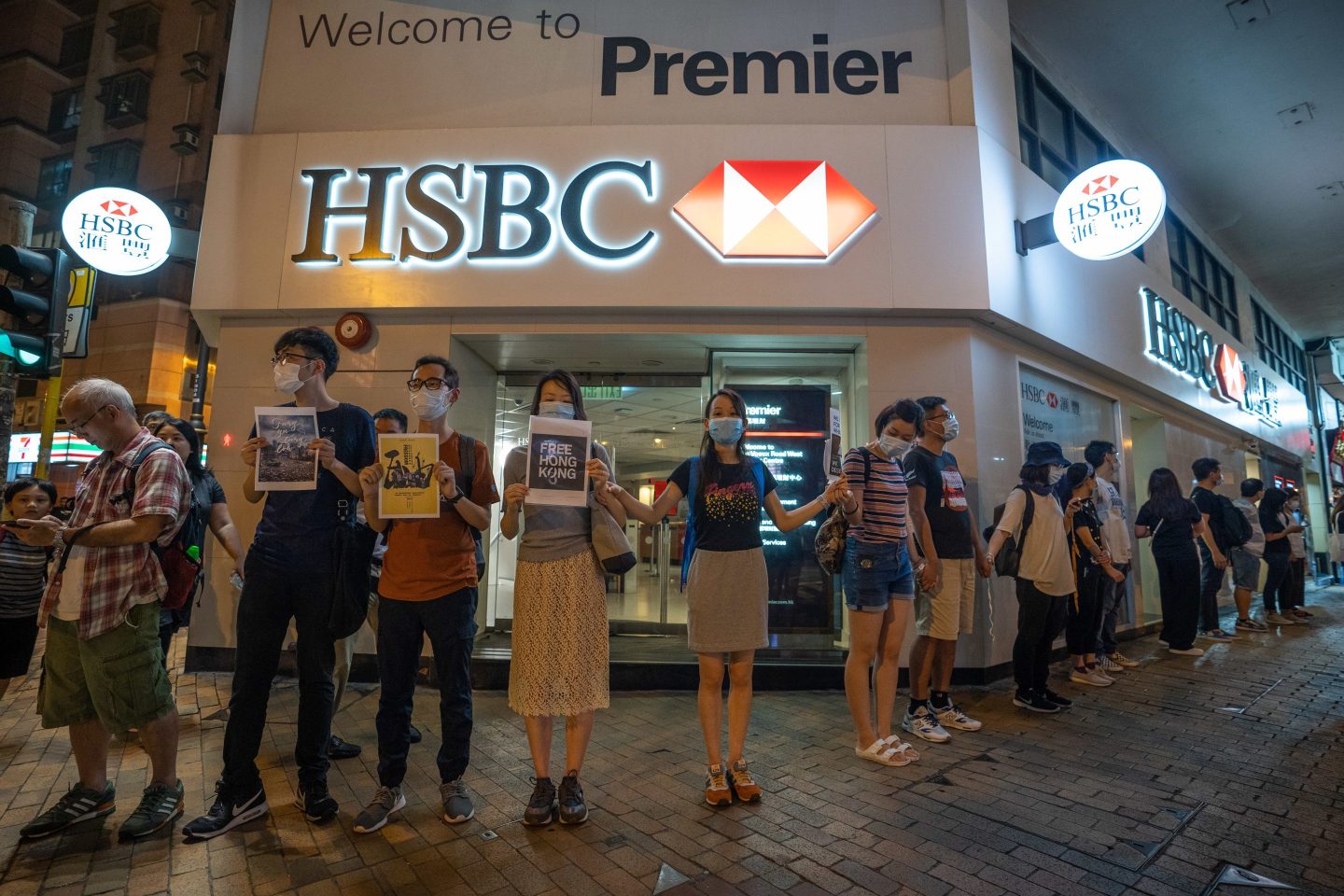
Photo of Hong Kong pro-democracy protestors forming a human chain in front of an HSBC bank branch in Hong Kong on August 23, 2019.
Pro-democracy protestors form a human chain in front of an HSBC bank branch in Hong Kong on August 23, 2019. Western countries have slammed HSBC for supporting Beijing's controversial National Security Law for Hong Kong, and accused the bank of freezing the accounts of Hong Kong activists.Geovien So—SOPA Images/LightRocket via Getty Images

One of the world’s biggest banks, and Europe’s second-largest lender, is showing that it’s playing by China’s rules. 

London-headquartered HSBC has become the first international bank to establish a Chinese Communist Party (CCP) committee, according to a new Financial Times report. China’s companies law requires firms to set up CCP committees, but this rule has been loosely enforced among global financial institutions—until now. 

HSBC’s move could pave the path for other global lenders to follow suit, and underscores the delicate line that China-based foreign banks are now toeing between Beijing and the West.

The first, but probably not the last 

HSBC’s China investment bank, known as HSBC Qianhai Securities, recently formed the CCP committee, as per the FT report that cited two people familiar with the decision. 

In China, company employees can initiate CCP committees, which are typically made up of three or more staff. The committees have two functions: to act as a workers’ union, and to facilitate installing a party representative to a company’s top ranks. 

HSBC is unlikely to offer its CCP committee any management role in the company, unlike China’s state-owned enterprises (SOEs), which are mandated to appoint a party secretary to serve as board chairman. SOEs must also establish CCP committees to facilitate party activities and advance government policies.

Following the report, HSBC released a statement noting that CCP committees are “common” in mainland China-based companies. “Management has no role in establishing such groups” and these committees exert zero influence on the direction of the business, nor hold any formal role in the business’s day-to-day operations, it added. The bank did not confirm whether its China investment bank had set up the committee. HSBC did not respond to a Fortune request for comment. 

HSBC’s actions could pave the way for other foreign lenders in China to do the same. In the last two years, global lenders have begun taking full ownership of their mainland operations, leading them to explore whether they must abide by the law to initiate a CCP committee, according to the FT. “There was an internal email that said we might need to do something, but for the time being…it’s not yet compulsory,” the Asia head of one global bank told the publication. 

In 2020, China scrapped foreign ownership limits for financial institutions. Previously, foreign financial firms were only allowed to hold a 51% stake in their Chinese joint ventures (JV). HSBC increased its stake in its China brokerage JV to 90% from 51% in April. Six other global lenders control their investment banking operations in the mainland, including U.S. banks Goldman Sachs, JPMorgan Chase, and Morgan Stanley, alongside European lenders UBS, Credit Suisse, and Deutsche Bank.

HSBC is on the “right side” in setting up the CCP committee, a person with knowledge of its decision told the FT. “You don’t second-guess the authorities in China. Any American bank who isn’t doing the same is playing a dangerous game.” 

East vs. West 

Though headquartered in London, HSBC’s focus is largely on Asia. The region, especially China and Hong Kong, accounts for the majority of the bank’s profits. 

Last year, the British lender shifted the heart of its operations to Asia, when it moved four senior executives leading its commercial banking, personal banking, and asset management divisions, from London to Hong Kong. These departments account for nearly all of the bank’s revenues. 

Asia-Pacific is “central to [our] future growth, investment, and innovation. I want more of our global executive team to be located in key growth regions,” including China, Southeast Asia, and India, HSBC CEO Noel Quinn said at the time. 

Yet as HSBC doubles down on its Asia strategy—it’s investing an additional $6 billion in the region until 2026—it has become increasingly ensnared in the geopolitical crossfire between China and the West. 

In the last couple of years, HSBC has weathered a barrage of criticism from U.S. and U.K. lawmakers over its public support for Beijing’s enactment of the national security law in Hong Kong—a response to the city’s mass pro-democracy protests that began in 2019. HSBC said at the time that it “respect[s] and support[s] laws and regulations that will enable Hong Kong to recover and rebuild the economy.” Western policymakers accuse HSBC of freezing the accounts of Hong Kong activists and have asked the bank to justify its actions—and whether it did so at the behest of Hong Kong or Beijing. 

This May, China’s largest insurer, state-run Ping An—HSBC’s biggest shareholder—called for the bank to be split into “east” and “west” units. Ping An’s suggestion highlighted HSBC’s vulnerability at being caught between Beijing and Washington. One source close to HSBC told the FTthat such a move could allow HSBC more breathing room by creating a “China-friendly bank in Asia, and a U.S.-friendly bank everywhere else.”

Sign up for the Fortune Features email list so you don’t miss our biggest features, exclusive interviews, and investigations.
About the Author
By Yvonne Lau
LinkedIn iconTwitter icon
See full bioRight Arrow Button Icon

Latest in

North Americagun violence
At least 2 killed and 8 injured hurt in shooting at Brown University with suspect still at large
By Kimberlee Kruesi, Alanna Durkin Richer, Jennifer McDermott and The Associated PressDecember 13, 2025
4 hours ago
North AmericaMexico
U.S., Mexico strike deal to settle Rio Grande water dispute
By Fabiola Zerpa and BloombergDecember 13, 2025
4 hours ago
InvestingSports
Big 12 in advanced talks for deal with RedBird-backed fund
By Giles Turner and BloombergDecember 13, 2025
4 hours ago
AIchief executive officer (CEO)
Microsoft AI boss Suleyman opens up about his peers and calls Elon Musk a ‘bulldozer’ with ‘superhuman capabilities to bend reality to his will’
By Jason MaDecember 13, 2025
5 hours ago
Danish military forces participate in an exercise with hundreds of troops from several European NATO members in the Arctic Ocean in Nuuk, Greenland, Monday, Sept. 15, 2025.
PoliticsDonald Trump
Danish intelligence report warns of U.S. economic leverage and military threat under Trump
By The Associated PressDecember 13, 2025
6 hours ago
Ukrainian President Volodymyr Zelensky gives a joint press conference in Kyiv, Ukraine in 2023 as European leaders visit the country 18 months after the start of Russia's invasion.
EuropeUkraine invasion
EU indefinitely freezes Russian assets to prevent Hungary and Slovakia from vetoing billions of euros being sent to support Ukraine
By Lorne Cook and The Associated PressDecember 13, 2025
6 hours ago

Most Popular

placeholder alt text
Success
Apple cofounder Ronald Wayne sold his 10% stake for $800 in 1976—today it’d be worth up to $400 billion
By Preston ForeDecember 12, 2025
2 days ago
placeholder alt text
Economy
Tariffs are taxes and they were used to finance the federal government until the 1913 income tax. A top economist breaks it down
By Kent JonesDecember 12, 2025
2 days ago
placeholder alt text
Success
40% of Stanford undergrads receive disability accommodations—but it’s become a college-wide phenomenon as Gen Z try to succeed in the current climate
By Preston ForeDecember 12, 2025
2 days ago
placeholder alt text
Economy
The Fed just ‘Trump-proofed’ itself with a unanimous move to preempt a potential leadership shake-up
By Jason MaDecember 12, 2025
1 day ago
placeholder alt text
Economy
For the first time since Trump’s tariff rollout, import tax revenue has fallen, threatening his lofty plans to slash the $38 trillion national debt
By Sasha RogelbergDecember 12, 2025
1 day ago
placeholder alt text
Success
Apple CEO Tim Cook out-earns the average American’s salary in just 7 hours—to put that into context, he could buy a new $439,000 home in just 2 days
By Emma BurleighDecember 12, 2025
1 day ago
Rankings
  • 100 Best Companies
  • Fortune 500
  • Global 500
  • Fortune 500 Europe
  • Most Powerful Women
  • Future 50
  • World’s Most Admired Companies
  • See All Rankings
Sections
  • Finance
  • Leadership
  • Success
  • Tech
  • Asia
  • Europe
  • Environment
  • Fortune Crypto
  • Health
  • Retail
  • Lifestyle
  • Politics
  • Newsletters
  • Magazine
  • Features
  • Commentary
  • Mpw
  • CEO Initiative
  • Conferences
  • Personal Finance
  • Education
Customer Support
  • Frequently Asked Questions
  • Customer Service Portal
  • Privacy Policy
  • Terms Of Use
  • Single Issues For Purchase
  • International Print
Commercial Services
  • Advertising
  • Fortune Brand Studio
  • Fortune Analytics
  • Fortune Conferences
  • Business Development
About Us
  • About Us
  • Editorial Calendar
  • Press Center
  • Work At Fortune
  • Diversity And Inclusion
  • Terms And Conditions
  • Site Map

© 2025 Fortune Media IP Limited. All Rights Reserved. Use of this site constitutes acceptance of our Terms of Use and Privacy Policy | CA Notice at Collection and Privacy Notice | Do Not Sell/Share My Personal Information
FORTUNE is a trademark of Fortune Media IP Limited, registered in the U.S. and other countries. FORTUNE may receive compensation for some links to products and services on this website. Offers may be subject to change without notice.