• Home
  • Latest
  • Fortune 500
  • Finance
  • Tech
  • Leadership
  • Lifestyle
  • Rankings
  • Multimedia

Trendingnow

1

Social Security unraveling: 7,100 workers sacked, performance metrics retired, disability claims falling

2

Erin Brockovich, the activist who defeated a utility giant and inspired a Julia Roberts film, is pushing data centers to be more transparent

3

'Where we are today is frightening': a Pulitzer-winning historian sees a doomsday scenario involving China and the national debt

1

Social Security unraveling: 7,100 workers sacked, performance metrics retired, disability claims falling

2

Erin Brockovich, the activist who defeated a utility giant and inspired a Julia Roberts film, is pushing data centers to be more transparent

3

'Where we are today is frightening': a Pulitzer-winning historian sees a doomsday scenario involving China and the national debt
Commentary

A list of companies supporting abortion rights after the Roe v. Wade ruling shows which firms are stepping up, and why

By
Jeffrey Sonnenfeld
Jeffrey Sonnenfeld
,
Steven Tian
Steven Tian
, and
Georgia Hirsty
Georgia Hirsty
Down Arrow Button Icon
By
Jeffrey Sonnenfeld
Jeffrey Sonnenfeld
,
Steven Tian
Steven Tian
, and
Georgia Hirsty
Georgia Hirsty
Down Arrow Button Icon
June 30, 2022, 11:30 AM ET
An abortion rights protest outside the U.S. Supreme Court building.
An abortion rights protest outside the U.S. Supreme Court after the court overturned Roe v. Wade. Firms in industries that rely heavily on younger talent have been faster to act in support of employees' reproductive rights, the authors found.Anna Moneymaker—Getty Images

It’s not “woke CEO” ideology that drives corporate civic actions. This is demonstrated by the results of our in-depth study of the scores of first-mover companies—118 so far—that have publicly responded to last week’s Supreme Court rollback of a woman’s right to reproductive choice.

Over the past 45 years, our institute’s researchers have been studying companies that have spoken out as first movers on many social issues—ranging from apartheid to abortion, from racial justice to responsible governance, from cancer control to corruption, from sustainability to gun safety, from immigration reform to investor activism, from election security to energy supply, from opposition to Chinese labor practices to  retreats from doing business in Russia. 

The stances taken by companies on most of these issues enjoyed support from more than 80% of Americans, though some others politically divided the nation. The speed of a company’s corporate engagement was rarely determined by the ideology of its leaders, but more often by its strategic positioning and considerations. Thus, where a company stood depends on where it sits in society. And current responses to the Supreme Court abortion ruling follow similar lines.

For example, it was the entire Western fashion industry, facing the prospect of consumer boycotts, that last year directly challenged China’s labor practices by opting to avoid using Xinjiang province’s fine cotton, a by-product of the oppression of China’s Uighur minority. Brands such as Nike, Levi Strauss, and H&M faced reprisals from the Chinese government this time last year, but they held their ground as demand from Chinese consumers rebounded by the fall.

Few of the first movers among the 1,300 firms we studied that exited Russia this spring have historically been early champions of social-justice campaigns. Whatever self-interest was embedded in their motives, their bold leadership was still noble and catalytic on the actions of all companies. 

Preempting critiques of oligarchical entanglements, BP, Shell, and Exxon wrote down billions of dollars immediately after the outbreak of Russia’s unprovoked bloody assault on the sovereign Ukraine nation. This was soon followed by the withdrawal of Big Tech enterprises such as Microsoft, IBM, Dell, HP, Meta, and Google, which had been deeply embedded in activities of great value to Vladimir Putin. This tech exodus, in turn, was quickly followed by professional service firms such as McKinsey, Boston Consulting Group, Bain, Deloitte, EY, PwC, KPMG, and Grant Thornton. 

Our top-read SSRN scholarly research shows that the financial markets rewarded these businesses handsomely for their ‘woke” moves in exiting Russia, because those exits were strategic reductions in business risk on many levels.

When we examined the 118 first movers on the response to the Supreme Court’s overruling of Roe v Wade’s abortion protection, the firms’ actions similarly broke down in relation to strategic positioning. Those that acted quickly to address women’s health needs, in the form of guaranteeing to pay for employee travel to states that allow abortion, don’t seem to have been driven by feminist ideology, or their leadership’s beliefs or gender identity. 

In fact, only 15% of these first mover companies are led by women CEOs. More broadly, only 8.8% of Fortune 500 companies are led by women, and so far only 5 of those 44 women-led companies have supported travel benefits for employees seeking abortions.

Logos of companies that support their employees' abortion rights.
Courtesy of the Yale Chief Executive Leadership Institute.

We also found that these first-mover companies did not have significantly more women on their boards of directors or in their ranks of senior management compared to their peers. The size of the company likewise had little bearing on first-mover status. What did matter in analyzing these first movers, however, was their strategic constituencies—their industry, their workforce, and their geographic positioning. 

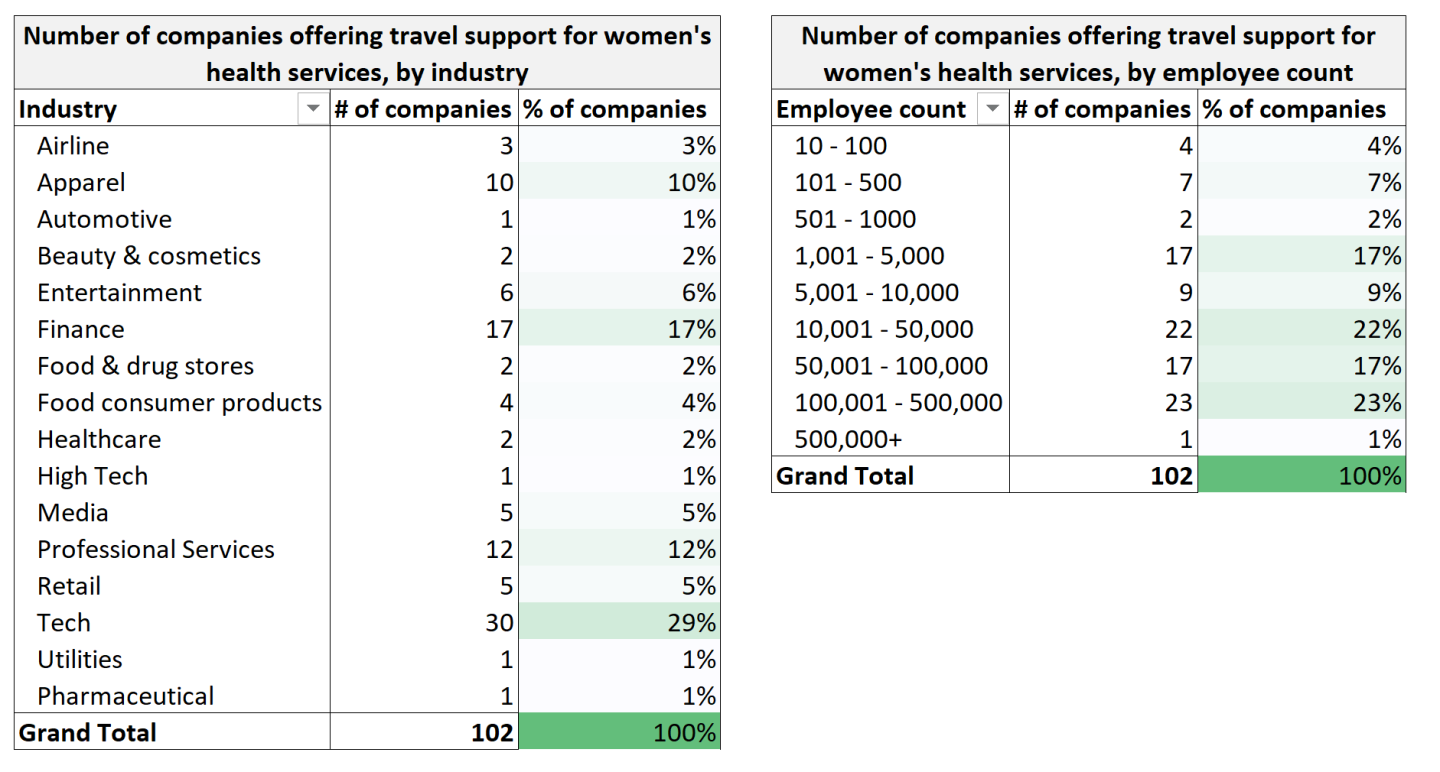
Of the 118 first-mover companies, we found that while certain industries such as heavy industry and manufacturing were sparsely represented,  nearly a third of the companies were from the tech sector, making tech by far the largest sectoral component. The average age of tech workers in the U.S. is 35, about five years younger, on average, than all other workers, and surveys consistently show strongest support for the right to choose amongst younger individuals. Indeed, a recent Morning Consult poll found that although Americans are 50-50 divided over whether companies should make their stance on abortion rights known, younger individuals are by far the most supportive of them doing so. Financial and professional service firms were the second- and third-largest cohorts; combined with tech they represent nearly two-thirds of all first movers. The image of these firms as progressive on social issues is vital to attracting the tens of thousands of socially conscious Gen Y recruits they require to feed their pyramidic staffing and business models.
Courtesy of the Yale Chief Executive Leadership Institute.

An even more powerful strategic differentiator for these first movers was physical and political geography. We found that amazingly, only 9 of the 101 first-movers were companies that are headquartered in “red states,” which we define as states where Republicans control both the legislature and the governor’s office. Indeed, many major companies from red states such as Georgia and Texas that are usually fast to move on social issues have been notably silent. 

Of course, moral outrage has led to cross-cutting business leadership engagement on popular causes—including U.S. election security, voting access, racial justice, climate change, and punishing Russia for its mass slaughter of innocent Ukrainian civilians. However, strategic considerations often push companies to be first movers in taking stands on ESG issues, which matter to their constituencies and communities; such moves aren’t motivated by some “woke” ideology or personal beliefs of executives. 

These findings may surprise the cynical cultists of Milton Friedman, but they would not surprise Friedman himself. In fact, in the 1970 article his acolytes love to cite, but have apparently never read, Friedman acknowledges, “It may well be in the long‐run interest of a corporation that is a major employer in a small community to devote resources to providing amenities to that community or to improving its government. That may make it easier toat tract desirable employees, it may reduce the wage bill or lessen losses from pilferage and sabotage or have other worthwhile effects.”

Nope: Friedman never said the only social responsibility was the bottom line, and neither do today’s smart CEOs.

Jeffrey Sonnenfeld is a senior associate dean and the Lester Crown professor of management practice at the Yale School of Management, and president of the Yale Chief Executive Leadership Institute. Follow him on Twitter.

Steven Tian is director of research at the Yale Chief Executive Leadership Institute. 

Georgia Hirsty is a research fellow in corporate social impact at the Yale Chief Executive Leadership Institute.

The opinions expressed in Fortune.com commentary pieces are solely the views of their authors and do not necessarily reflect the opinions and beliefs of Fortune.

Sign up for the Fortune Features email list so you don’t miss our biggest features, exclusive interviews, and investigations.


About the Authors
By Jeffrey Sonnenfeld

Jeffrey Sonnenfeld is the Lester Crown Professor in Management Practice and Senior Associate Dean at Yale School of Management.

See full bioRight Arrow Button Icon
By Steven Tian

Steven Tian is the director of research at the Yale Chief Executive Leadership Institute.

See full bioRight Arrow Button Icon
By Georgia Hirsty
See full bioRight Arrow Button Icon

Latest in Commentary

Finance
Lorem ipsum dolor sit amet, consectetur adipiscing elit, sed do eiusmod tempor incididunt ut labore et dolore magna aliqua. Ut enim ad minim veniam
By Fortune Editors
October 20, 2025
Finance
Lorem ipsum dolor sit amet, consectetur adipiscing elit, sed do eiusmod tempor incididunt ut labore et dolore magna aliqua. Ut enim ad minim veniam
By Fortune Editors
October 20, 2025
Finance
Lorem ipsum dolor sit amet, consectetur adipiscing elit, sed do eiusmod tempor incididunt ut labore et dolore magna aliqua. Ut enim ad minim veniam
By Fortune Editors
October 20, 2025
Finance
Lorem ipsum dolor sit amet, consectetur adipiscing elit, sed do eiusmod tempor incididunt ut labore et dolore magna aliqua. Ut enim ad minim veniam
By Fortune Editors
October 20, 2025
Finance
Lorem ipsum dolor sit amet, consectetur adipiscing elit, sed do eiusmod tempor incididunt ut labore et dolore magna aliqua. Ut enim ad minim veniam
By Fortune Editors
October 20, 2025
Finance
Lorem ipsum dolor sit amet, consectetur adipiscing elit, sed do eiusmod tempor incididunt ut labore et dolore magna aliqua. Ut enim ad minim veniam
By Fortune Editors
October 20, 2025

Most Popular

Finance
Lorem ipsum dolor sit amet, consectetur adipiscing elit, sed do eiusmod tempor incididunt ut labore et dolore magna aliqua. Ut enim ad minim veniam
By Fortune Editors
October 20, 2025
Finance
Lorem ipsum dolor sit amet, consectetur adipiscing elit, sed do eiusmod tempor incididunt ut labore et dolore magna aliqua. Ut enim ad minim veniam
By Fortune Editors
October 20, 2025
Finance
Lorem ipsum dolor sit amet, consectetur adipiscing elit, sed do eiusmod tempor incididunt ut labore et dolore magna aliqua. Ut enim ad minim veniam
By Fortune Editors
October 20, 2025
Finance
Lorem ipsum dolor sit amet, consectetur adipiscing elit, sed do eiusmod tempor incididunt ut labore et dolore magna aliqua. Ut enim ad minim veniam
By Fortune Editors
October 20, 2025
Finance
Lorem ipsum dolor sit amet, consectetur adipiscing elit, sed do eiusmod tempor incididunt ut labore et dolore magna aliqua. Ut enim ad minim veniam
By Fortune Editors
October 20, 2025
Finance
Lorem ipsum dolor sit amet, consectetur adipiscing elit, sed do eiusmod tempor incididunt ut labore et dolore magna aliqua. Ut enim ad minim veniam
By Fortune Editors
October 20, 2025
Fortune Secondary Logo
Rankings
  • 100 Best Companies
  • Fortune 500
  • Global 500
  • Fortune 500 Europe
  • Most Powerful Women
  • World's Most Admired Companies
  • See All Rankings
  • Lists Calendar
Sections
  • Finance
  • Fortune Crypto
  • Features
  • Leadership
  • Health
  • Commentary
  • Success
  • Retail
  • Mpw
  • Tech
  • Lifestyle
  • CEO Initiative
  • Asia
  • Politics
  • Conferences
  • Europe
  • Newsletters
  • Personal Finance
  • Environment
  • Magazine
  • Education
Customer Support
  • Frequently Asked Questions
  • Customer Service Portal
  • Privacy Policy
  • Terms Of Use
  • Single Issues For Purchase
  • International Print
Commercial Services
  • Advertising
  • Fortune Brand Studio
  • Fortune Analytics
  • Fortune Conferences
  • Business Development
  • Group Subscriptions
About Us
  • About Us
  • Press Center
  • Work At Fortune
  • Terms And Conditions
  • Site Map
  • About Us
  • Press Center
  • Work At Fortune
  • Terms And Conditions
  • Site Map
  • Facebook icon
  • Twitter icon
  • LinkedIn icon
  • Instagram icon
  • Pinterest icon

Latest in Commentary

as
CommentaryVenture Capital
The most contrarian and durable bet in AI is 85 million moms
By Allison SternJune 3, 2026
3 hours ago
adc
CommentaryLeadership
AI is turning workers into superhumans. Their leadership teams haven’t kept up
By Adrienne Down CoulsonJune 2, 2026
1 day ago
liaquat
CommentaryBubbles
I won a Pulitzer for explaining the Great Depression. The AI spending boom terrifies me
By Liaquat AhamedJune 2, 2026
1 day ago
Allison Danielsen is CEO, Tallo.
CommentaryCareers
My wrist injury derailed my college plans. It’s why I’m a CEO today
By Allison DanielsenMay 31, 2026
3 days ago
treble
CommentaryElections
I built a startup from scratch and still nearly died because of a broken healthcare system. That’s why I’m running for Congress
By Jonathan TrebleMay 31, 2026
3 days ago
bn
CommentaryEducation
Bill Nye: Companies say there’s a skills gap. They’re wrong — and students can prove it
By Bill NyeMay 31, 2026
3 days ago

Most Popular

Social Security unraveling: 7,100 workers sacked, performance metrics retired, disability claims falling
North America
Social Security unraveling: 7,100 workers sacked, performance metrics retired, disability claims falling
By Katie Savin, Callie Freitag, Matthew Borus and The ConversationJune 2, 2026
1 day ago
Erin Brockovich, the activist who defeated a utility giant and inspired a Julia Roberts film, is pushing data centers to be more transparent
Environment
Erin Brockovich, the activist who defeated a utility giant and inspired a Julia Roberts film, is pushing data centers to be more transparent
By Marco Quiroz-GutierrezJune 1, 2026
2 days ago
'Where we are today is frightening': a Pulitzer-winning historian sees a doomsday scenario involving China and the national debt
Banking
'Where we are today is frightening': a Pulitzer-winning historian sees a doomsday scenario involving China and the national debt
By Nick LichtenbergJune 2, 2026
1 day ago
Cognizant CEO says AI is remaking middle managers into player-coaches who can 'both  execute and develop others'
Newsletters
Cognizant CEO says AI is remaking middle managers into player-coaches who can 'both execute and develop others'
By Diane BradyJune 2, 2026
1 day ago
Current price of oil as of June 2, 2026
Personal Finance
Current price of oil as of June 2, 2026
By Joseph HostetlerJune 2, 2026
1 day ago
The Iran conflict has disrupted oil supply. Gulf states are now looking to multi-billion-dollar investments in renewables 
Energy
The Iran conflict has disrupted oil supply. Gulf states are now looking to multi-billion-dollar investments in renewables 
By Melissa HancockJune 1, 2026
2 days ago

© 2026 Fortune Media IP Limited. All Rights Reserved. Use of this site constitutes acceptance of our Terms of Use and Privacy Policy | CA Notice at Collection and Privacy Notice | Do Not Sell/Share My Personal Information
FORTUNE is a trademark of Fortune Media IP Limited, registered in the U.S. and other countries. FORTUNE may receive compensation for some links to products and services on this website. Offers may be subject to change without notice.