Text messages. Mailers. Cold calls. Over the past two years, homeowners have been bombarded with inquiries from investors who want to know one thing: Are they open to selling their property?
Since the onset of the Pandemic Housing Boom, investors have flooded the U.S. housing market. There are small players like mom-and-pop landlords and Airbnb hosts who are adding to their property portfolios. Home flippers returned with vengeance. There’s also the Wall Street types like Blackstone and iBuyer players like Opendoor Technologies that are gobbling up homes. The combination of low mortgage rates, easy access to capital, and record home appreciation was all too enticing for investors to pass up on.
However, even as investors piled into the housing market, many real estate insiders over the past two years hesitated to attribute much, if any, of the boom to investors. In their view, numerous factors drove the housing frenzy. Historically low mortgage rates, spurred by the Federal Reserve’s response to the COVID-19 recession, attracted all types of buyers. That included white-collar professionals who saw their jobs transition to remote during the pandemic and were eager to ditch apartments in places like San Francisco and Boston for homes in markets like Boise and Tampa. The pandemic also coincided with the five-year window (between 2019 and 2023) when millennials born during the generation’s five largest birth years (between 1989 and 1993) would hit the peak first-time homebuying age of 30. That elevated demand simply overwhelmed the supply side: Housing inventory, which was already trending downward before the pandemic struck, fell to a 40-year low during the boom.
But that hesitation to name investors as one of the pillars of the Pandemic Housing Boom is no longer necessary. It’s now abundantly clear that investors did indeed help accelerate the housing boom and drive up U.S. home prices. At least that’s what Fortune concluded after looking over recent data published by Redfin, Freddie Mac, and the Harvard Joint Center for Housing Studies.
In the first quarter of 2022, investors made up a record 28% of single-family home sales, according to a report published last week by the Harvard Joint Center for Housing Studies. That’s up from 19% in the first quarter of 2021. It’s also far above the 16% that investors made up of single-family home sales between 2017 and 2019. (To conduct the analysis, the Harvard researchers analyzed home sale data collected by CoreLogic.)
The investor bull rush into the housing market was the most pronounced in fast-growing markets in the U.S. South and West, according to the Harvard researchers. That finding is backed up by a separate Redfin analysis, which looked at all home sales (unlike Harvard’s single-family homes analysis). In the first quarter of 2022, investors made up a staggering 33.1% of home sales in Atlanta. Not far behind was Jacksonville (32.3%), Charlotte (32.3%), Phoenix (29.0%), and Miami (28.2%). Those same markets are also among the nation’s most “overvalued” housing markets that are at risk of seeing a home price decline, according to Moody’s Analytics.
While markets in the South and West saw the most investor activity, almost every major U.S. housing market saw an uptick. Among the 31 large markets analyzed by Redfin, 29 saw an uptick in investor activity. Look no further than Ohio, which saw the share of investor homes sales jump in Cincinnati (up 2.9 percentage points), Cleveland (up 3.1 percentage points), and Columbus (up 7 percentage points). Between the first quarter of 2021 and the first quarter of 2022, only Seattle (down 0.5 percentage point) and Milwaukee (down 0.1 percentage point) saw a decline in the share of home sales attributed to investors.
Researchers at Freddie Mac, who did their own analysis of public records, found a more modest jump in investor purchases than Harvard and Redfin researchers. Between December 2019 and December 2021, Freddie Mac found investor home purchases climbed from 26.7% to 27.6%. However, Freddie Mac acknowledges its analysis isn’t fully capturing all-cash purchases by investors.
Let’s be clear: The vast majority of investor home purchases in America are still made by small or midsize investors: ranging from average Joes owning an Airbnb rental to individuals who’ve spent years amassing a hefty portfolio of rentals. According to the Harvard study, 74% of investor purchases in September were made by investors with portfolios of less than 100 properties. The remaining 26% of investor purchases were made by groups with property portfolios of at least 100 units.
That said, it’s clear that those big investors were among the biggest drivers of the uptick in investor purchases.
“Investors with large portfolios (at least 100 properties) drove much of this growth, nearly doubling their share of investor purchases from 14% in September 2020 to 26% in September 2021,” wrote the Harvard researchers. “By buying up single-family homes, investors have reduced the already limited supply available to potential owner-occupants, particularly first-time and moderate-income buyers.”
Who are these big investors? Some are massive rental companies like Invitation Homes—the nation's largest owner of single-family rental homes—which grew its portfolio during the pandemic. Blackstone, which founded Invitation Homes back in 2012, also got back into the single-family home business during the pandemic. (In 2019, Blackstone had backed away from the business after selling its remaining shares of Invitation Homes.)
The Pandemic Housing Boom also saw a surge on the iBuying side of the market. These iBuyers—including firms like Opendoor, Offerpad, RedfinNow, and Zillow Offers—went around the country making swift offers to home sellers. The companies would then quickly put the home back on the market. It's less of a traditional "home flip" and more of a volume play: On each sale, iBuyers net a "service fee" that the firm charges the buyer in exchange for the speedy transaction.
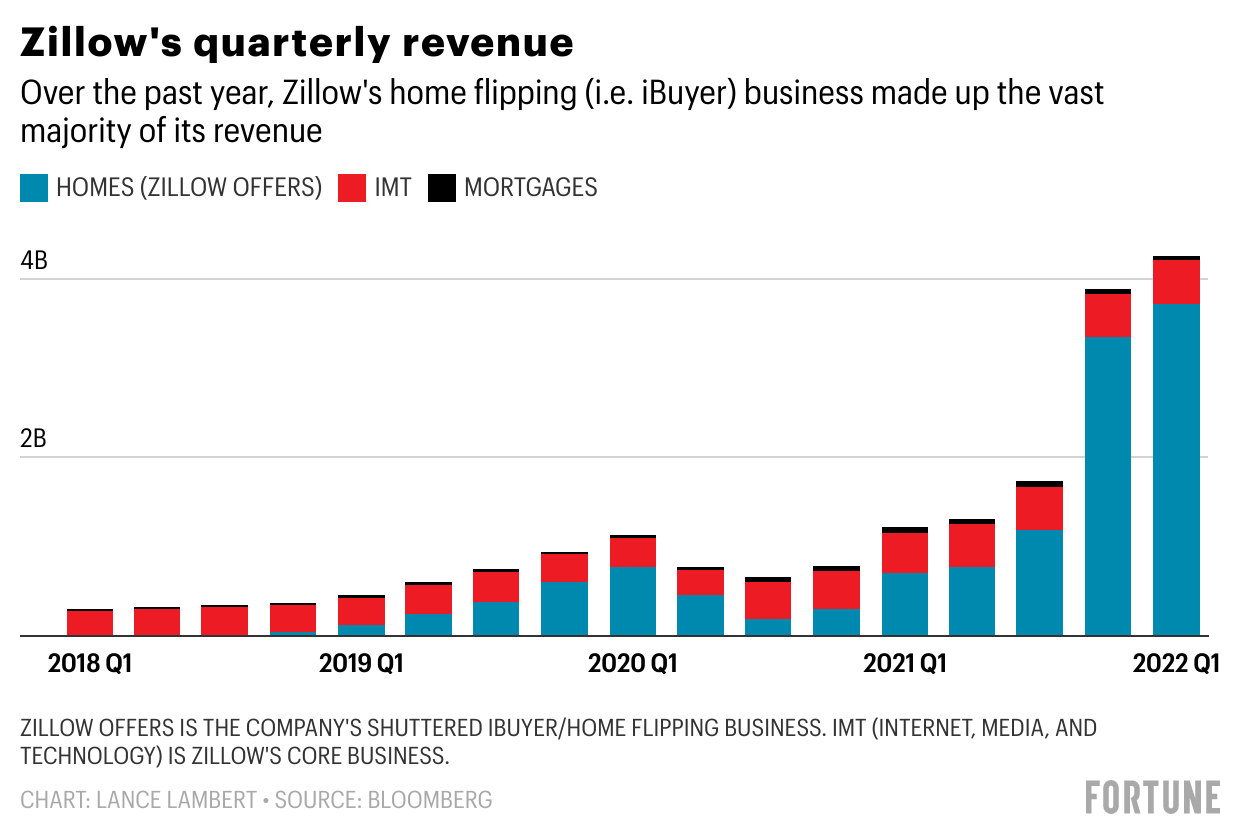
As the housing boom took hold, it saw Zillow’s earnings initially soar—with the real estate site posting a record $52 million profit in the first quarter of 2021. That fed Zillow’s iBuyer confidence as it quickly grew its home buying business to over three-fourths of its total revenues. Of course, Zillow's home flipping business would go on to implode in epic fashion last fall. But only after Zillow’s much-lauded algorithm overpaid, analysts tell Fortune, for thousands of U.S. homes.
But most housing investors are still groups you’ve likely never heard of. The Opendoor and Blackstones of the world, at least for now, are still a small piece of the investor pie.
“While large corporate investors are rapidly rising as a share of the market and are likely to expand, they remain so small that their market share only has a modest impact on the overall percentage of investors,” wrote Freddie Mac researchers earlier this month. During the pandemic, iBuyer and institutional buyers have jumped from around a 1.5% market share of purchases to around 4.5%, according to Freddie Mac.
It's intellectually dishonest to pin soaring U.S. home prices—which are up 37% over the past two years—on any one company. However, when you step back and examine the elevated demand that has come from the investor side of the market, it's clear they've attributed, at least in some degree, to soaring home prices. Investors, both big and small, gobbled up a larger market share during the pandemic. The impact of elevated investor demand also goes beyond the homes they actually bought. Even when investors are on the losing side of a bidding war, from an economic lens at least, they are still putting upward pressure on prices.
As the Pandemic Housing Boom implodes amid spiked mortgage rates, it raises the question: Is the investor rush into the housing market a temporary feature of the pandemic or the start of a lasting trend?
While spiked mortgage rates are pricing out many first-time buyers, it's also seeing investors pull back from the market. Surging mortgage rates change the math for investors: The added costs means many investors would take on mortgage payments that are greater than they can charge for rent.
“Investor home purchases are falling for the same reason overall home purchases are falling: Surging interest rates and high housing prices have made it more expensive to get a mortgage and buy a home,” wrote Sheharyar Bokhari, a senior economist at Redfin, in a report published this month. “While roughly three-quarters of investor purchases are made with cash, investors are still impacted by interest rates because they often take out loans to get that cash.”
Hungry for more housing data? Follow me on Twitter at @NewsLambert.