NASA’s Artemis program, an ambitious public/private venture that teams the space agency with research scientists from around the world and space exploration specialists at the likes of SpaceX, Lockheed Martin, and Blue Origin, has been hailed as the most significant “moonshot” program in half a century. The primary goal for Artemis is to build a long-term presence on the moon by the end of the decade, and eventually catalyze a flywheel effect in the form of pioneering new modes of transport, advancing new lunar-ready technologies, as well as triggering a raft of scientific discoveries out in space and here below on Earth. This gargantuan $35 billion mission has not yet borne fruit—but it is beginning to sprout leaves.
The latest scientific breakthrough to come out of the Artemis program was published last month in the scientific journal Communications Biology. A team of horticultural scientists from the University of Florida’s Space Plants lab made history by growing leafy green plants in a few teaspoons of lunar dust—known as regolith—on loan from NASA. In announcing the achievement, the scientists called their work “a first step toward one day growing plants for food and oxygen on the moon, or during space missions.”
In an interview with Fortune late last month, Robert Ferl and Anna-Lisa Paul, University of Florida molecular biologists whose experiments over the years have involved sending lab-grown plants onto the Space Shuttle and the International Space Station to study the effects on plant physiology, said they had long wanted to get their hands on lunar regolith for further extraterrestrial research, but were repeatedly rebuffed by the government.
The Artemis program, which was green-lighted in 2017, has changed all that.
“It took us 10 years essentially, and this [current] environment—[that] we’re going back to the moon—before it was received well,” Paul said of the successful pitch to NASA that ultimately granted them a scant 12 grams of lunar soil from the Apollo 11, 12, and 17 missions—enough, though, to grow several rows of plants.
Prior to the start of the Artemis program, she said, “nobody was thinking about greenhouses on the moon.”
‘Deep space’ farming
The scientists’ toil wouldn’t win any green-thumb awards down here on Earth. The sprouts turned out to be a bit stunted and discolored, and the species they grew—Arabidopsis—is no prized flower or any foodie’s idea of the essential summer salad. But the research does demonstrate the possibilities for growing terrestrial plants—even, one day, edible plants like spinach—on the moon or beyond. NASA administrator Bill Nelson called the achievement “critical to NASA’s long-term human exploration goals, as we’ll need to use resources found on the moon and Mars to develop food sources for future astronauts living and operating in deep space.”
There are also earthly implications.
If scientists can successfully grow terrestrial plants in lunar regolith, a soil that’s been repeatedly blasted by solar winds and is virtually devoid of basic life-sustaining nutrients, that knowledge could “unlock agricultural innovations that could help us understand how plants might overcome stressful conditions in food-scarce areas here on Earth,” Nelson added.
Ferl agrees, calling these plant-growing experiments vital to advancing our understanding of cultivating crops in some of the harshest environments on Earth, like in the vicinity of heavy-metal-rich mining sites and in areas damaged by desertification. The experiments, he says, “inform the earthly application of our understanding about the limits of what biology can adapt to,” particularly in a rapidly changing climate.
Landing on the South Pole
Under Artemis, NASA has outlined an ambitious plan to land astronauts on the moon’s south pole by the end of 2025: the first lunar landing in more than 50 years. The hope is to transport massive robotic lunar landers with the aim of building landing pads and workstations where scientists can conduct basic research and businesses can eventually mine the surface for rare metals. NASA officials have even spoken of their desire to build self-sustaining communities for researchers and other pioneers on the moon. Key to that dream is cultivating crops in specially built greenhouses.
Until now, scientists were unsure whether lunar soil was up to the task. Ferl and Paul say more experiments will be needed, but the early results are encouraging.
“Can terrestrial life sort of, writ large, live off the surface of the earth—more importantly, live on another planetary body? We got to ask that question,” Ferl says, hardly masking his excitement. The answer: It sure looks that way.
To grow the plants, Ferl, Paul and the team of researchers had to deal with a number of complications, including a big “ask” by NASA: “If they give us 900 milligrams, they want 900 milligrams back,” Paul said of NASA’s stringent conditions for using and handling the precious regolith, which involved returning 100% of it to NASA’s vaults after the experiments had concluded.
Working with such tiny quantities, the researchers grew a miniature regolith garden in their laboratory. They adapted plastic trays normally used to culture cells into tiny thimble-size pots, each of which they filled with a gram of regolith and a few seeds of Arabidopsis, a plant commonly used for research since it was the first to have its entire genome mapped by plant scientists in 2000. They added a nutrient solution to the pots and anxiously waited for something—anything—to happen. To create a control group, the researchers also planted seeds of the same species in pots filled with nonlunar soil.
It didn’t take long before their experiment sprouted to life.
“We planted them, walked away for a couple of days, and then when we first went back in to take a look, it was amazing to see that every plant group, all the seedlings germinated,” Paul told NPR last month.
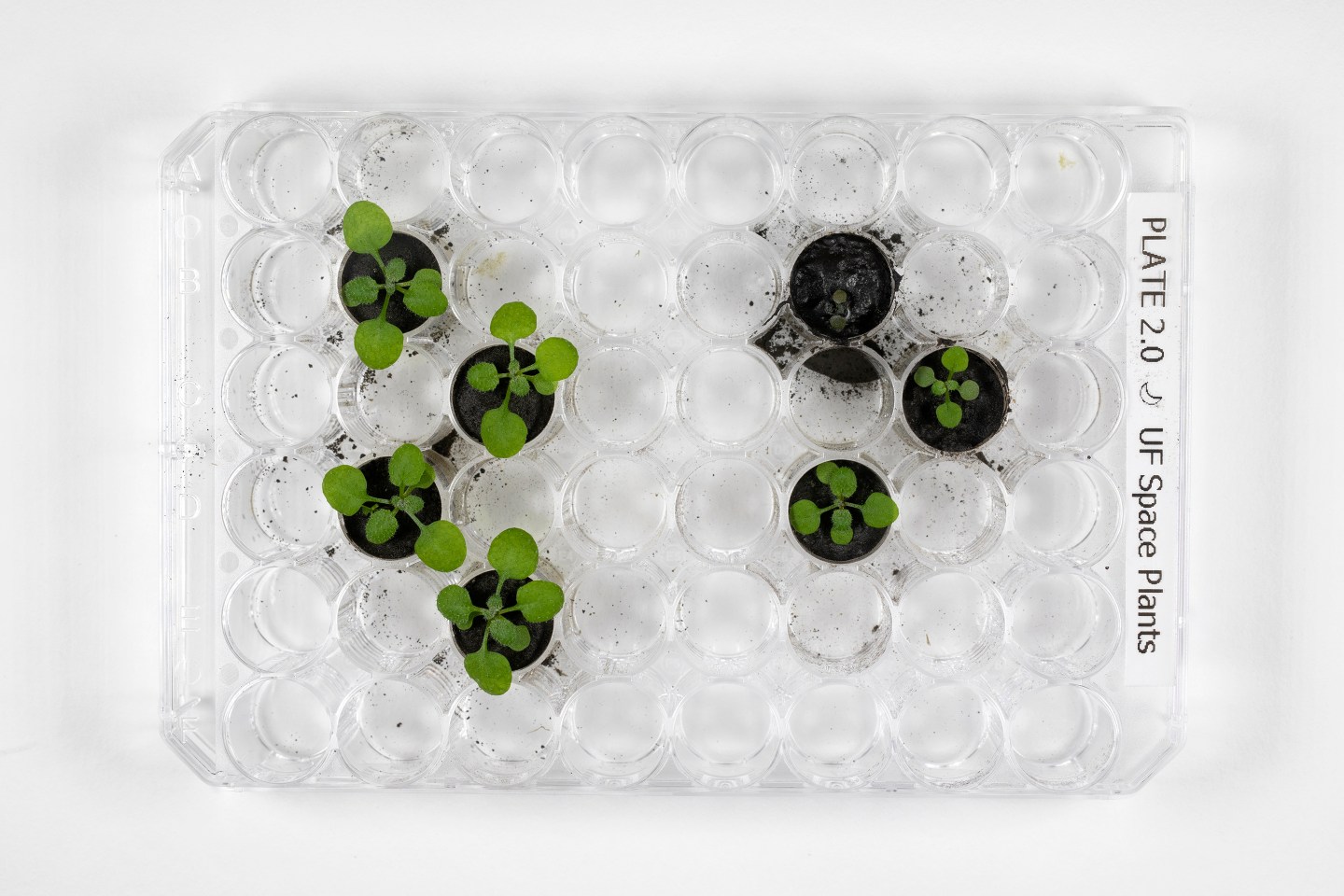
Alas, the plants that grew in the lunar soil were punier than those grown in the “control” nonlunar soil. The picture above, supplied by the UF scientists, shows the difference.
Paul said further analysis of the plants, including genetic testing, showed the chemical and physical makeup of the moon’s soil retarded the growth of the plants in later stages. But, crucially, the genetic testing revealed that the plants had in fact adapted enough to the nutrient-poor lunar regolith to grow relatively well. That was enough for the researchers to conclude this experiment could be repeated with even better results, Paul said.
They also saw that the plants grown in Apollo 12 and Apollo 17 regolith outperformed those cultivated from the Apollo 11 soil, holding out hope that there could be pockets of even more robust regolith elsewhere on the moon that would be more suitable for growing crops—the next group of astronauts would just have to know where to look for it.
There are still plenty of questions to be answered after the UF team’s experiment, but researchers now know at least which materials they’d need to bring from Earth to grow the plant life essential for a new era in lunar exploration.
Ferl already has a vision for what that might look like: “Let’s be like the first botanists on the moon,” he says, equipped with shovels, nutrients, and seeds, “and grow plants.”
Each week, Fortune covers the world of innovation in Breakthrough. You can read previous Breakthrough columns here.