• Home
  • Latest
  • Fortune 500
  • Finance
  • Tech
  • Leadership
  • Lifestyle
  • Rankings
  • Multimedia
CommentaryThe Biden administration

How the American Rescue Plan saved the public sector–and proved that investing in workers pays off

By
Lee Saunders
Lee Saunders
Down Arrow Button Icon
By
Lee Saunders
Lee Saunders
Down Arrow Button Icon
March 11, 2022, 7:55 AM ET
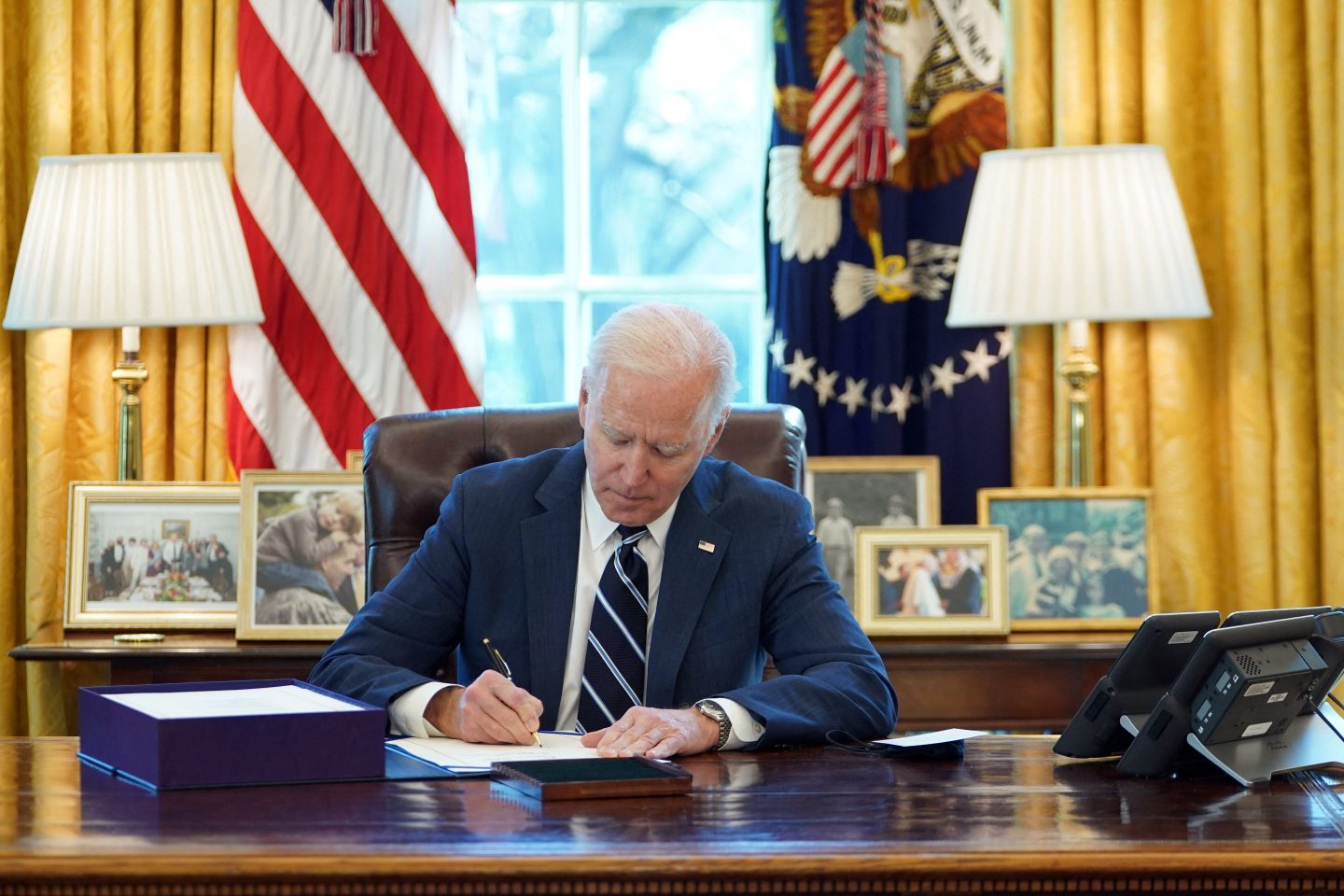
U.S. President Joe Biden signs the American Rescue Plan on March 11, 2021, in the Oval Office. The economic stimulus bill earmarked $350 billion for public services to counter the effects of the coronavirus pandemic.
U.S. President Joe Biden signs the American Rescue Plan on March 11, 2021, in the Oval Office. The economic stimulus bill earmarked $350 billion for public services to counter the effects of the coronavirus pandemic.MANDEL NGAN - AFP - Getty Images

When Shirley Thomas, a school custodian and member of the American Federation of State, County, and Municipal Employees (AFSCME)in Jacksonville, Florida, was furloughed from her job, bills piled up as she went without pay.

Then, help arrived. The American Rescue Plan (ARP) became law, and the $1,400 stimulus check that came with it meant Shirley could, in her words, put “everything back in the black.”

The ARP–the relief bill passed by Congress and signed into law by President Joe Biden one year ago today–was a lifeline for millions of public service workers like Shirley.

Throughout the pandemic, public service workers have stepped up with great courage to protect their communities. Health care workers continued to care for sick patients even when they didn’t have proper personal protective equipment. Corrections officers worked to keep inmates and staff safe even as COVID was ravaging prisons. School bus drivers and cafeteria workers continued to prepare and deliver meals to kids in need.

The rescue plan delivered $350 billion in badly needed aid to ensure that states, cities, counties, and towns were able to maintain these critical functions. Its effect was immediate: In Hawaii, for example, $2.2 billion in ARP aid enabled Gov. David Ige to call off a previous plan for thousands of furloughs and layoffs, allowing essential state services to continue uninterrupted.

Similar scenes played out across the country. Relief for childcare workers meant providers were able to keep their doors open. School funding made sure kids could get back in classrooms safely. Investments in public health have ensured a speedy rollout of the vaccine, which is helping to fast-track our nation’s economic recovery.

None of this would have happened without the steadfast work of AFSCME members, who came together to advocate for this relief package through our Fund the Front Lines campaign. From sanitation workers in Atlanta to respiratory therapists in Oregon, we spoke with one voice to demand that our elected officials invest in public services—and in the public service workers who keep our communities running.

But as important as this aid has been, we still face a growing crisis that started long before the pandemic and will only get worse if we fail to act. During the Great Recession, politicians answered the crisis with austerity. Hundreds of thousands of public sector workers lost their jobs, with many others forced to accept concessions that cut pay and benefits. This mentality continued even as the economy rebounded. The result? It took until 2019 for public sector employment to return to 2008 levels. In that time, America had grown nearly 10%–so, the same number of public service workers were tasked with serving nearly 30 million more people.

Now, more than half of public sector workers report that they’re considering leaving their jobs, and the top reasons they cite are burnout and low pay. Unsafe conditions, high stress and other pandemic-related factors have turned challenging work into a full-blown crisis, with eight in 10 public employees reporting that short staffing is making their jobs harder.

The good news is we know how to prevent this burnout and create a public sector where workers thrive while they create clean, safe, healthy communities.

The ARP provides a model. Across the country, AFSCME members are negotiating to ensure that federal aid goes toward improving the quality of public services and rebuilding our public service workforce. Ohio state employees were able to secure a nine percent raise that is helping retain corrections officers who faced some of the most dangerous COVID outbreaks in the nation. Nebraska veterans homes also faced acute staffing shortages due to low pay and an overburdened workforce; but we negotiated historic raises that promise to reduce turnover, improve working conditions, and lead to better services for our veterans.

One year after President Biden’s leadership made a historic investment in public services, we’ve averted one crisis. But if we don’t act with determination and intention, the slow-rolling crisis of public sector resignations will be devastating.

The time is now to ease the burden on the everyday heroes who pick up the trash, maintain our roads, manage our parks, strengthen our schools–and so much more. They have answered the call and then some during this pandemic. Even before it started, they had been forced to endure short-sighted funding cuts.

Let’s give them the tools and resources they need to do their essential work. When we invest in the people who provide public services, our communities thrive.

Lee Saunders is president of the American Federation of State, County and Municipal Employees, a union of 1.4 million public service workers.

Never miss a story: Follow your favorite topics and authors to get a personalized email with the journalism that matters most to you.
About the Author
By Lee Saunders
See full bioRight Arrow Button Icon

Latest in Commentary

Finance
Lorem ipsum dolor sit amet, consectetur adipiscing elit, sed do eiusmod tempor incididunt ut labore et dolore magna aliqua. Ut enim ad minim veniam
By Fortune Editors
October 20, 2025
Finance
Lorem ipsum dolor sit amet, consectetur adipiscing elit, sed do eiusmod tempor incididunt ut labore et dolore magna aliqua. Ut enim ad minim veniam
By Fortune Editors
October 20, 2025
Finance
Lorem ipsum dolor sit amet, consectetur adipiscing elit, sed do eiusmod tempor incididunt ut labore et dolore magna aliqua. Ut enim ad minim veniam
By Fortune Editors
October 20, 2025
Finance
Lorem ipsum dolor sit amet, consectetur adipiscing elit, sed do eiusmod tempor incididunt ut labore et dolore magna aliqua. Ut enim ad minim veniam
By Fortune Editors
October 20, 2025
Finance
Lorem ipsum dolor sit amet, consectetur adipiscing elit, sed do eiusmod tempor incididunt ut labore et dolore magna aliqua. Ut enim ad minim veniam
By Fortune Editors
October 20, 2025
Finance
Lorem ipsum dolor sit amet, consectetur adipiscing elit, sed do eiusmod tempor incididunt ut labore et dolore magna aliqua. Ut enim ad minim veniam
By Fortune Editors
October 20, 2025

Most Popular

Finance
Lorem ipsum dolor sit amet, consectetur adipiscing elit, sed do eiusmod tempor incididunt ut labore et dolore magna aliqua. Ut enim ad minim veniam
By Fortune Editors
October 20, 2025
Finance
Lorem ipsum dolor sit amet, consectetur adipiscing elit, sed do eiusmod tempor incididunt ut labore et dolore magna aliqua. Ut enim ad minim veniam
By Fortune Editors
October 20, 2025
Finance
Lorem ipsum dolor sit amet, consectetur adipiscing elit, sed do eiusmod tempor incididunt ut labore et dolore magna aliqua. Ut enim ad minim veniam
By Fortune Editors
October 20, 2025
Finance
Lorem ipsum dolor sit amet, consectetur adipiscing elit, sed do eiusmod tempor incididunt ut labore et dolore magna aliqua. Ut enim ad minim veniam
By Fortune Editors
October 20, 2025
Finance
Lorem ipsum dolor sit amet, consectetur adipiscing elit, sed do eiusmod tempor incididunt ut labore et dolore magna aliqua. Ut enim ad minim veniam
By Fortune Editors
October 20, 2025
Finance
Lorem ipsum dolor sit amet, consectetur adipiscing elit, sed do eiusmod tempor incididunt ut labore et dolore magna aliqua. Ut enim ad minim veniam
By Fortune Editors
October 20, 2025
Fortune Secondary Logo
Rankings
  • 100 Best Companies
  • Fortune 500
  • Global 500
  • Fortune 500 Europe
  • Most Powerful Women
  • Future 50
  • World’s Most Admired Companies
  • See All Rankings
Sections
  • Finance
  • Fortune Crypto
  • Features
  • Leadership
  • Health
  • Commentary
  • Success
  • Retail
  • Mpw
  • Tech
  • Lifestyle
  • CEO Initiative
  • Asia
  • Politics
  • Conferences
  • Europe
  • Newsletters
  • Personal Finance
  • Environment
  • Magazine
  • Education
Customer Support
  • Frequently Asked Questions
  • Customer Service Portal
  • Privacy Policy
  • Terms Of Use
  • Single Issues For Purchase
  • International Print
Commercial Services
  • Advertising
  • Fortune Brand Studio
  • Fortune Analytics
  • Fortune Conferences
  • Business Development
About Us
  • About Us
  • Editorial Calendar
  • Press Center
  • Work At Fortune
  • Diversity And Inclusion
  • Terms And Conditions
  • Site Map
Fortune Secondary Logo
  • About Us
  • Editorial Calendar
  • Press Center
  • Work At Fortune
  • Diversity And Inclusion
  • Terms And Conditions
  • Site Map
  • Facebook icon
  • Twitter icon
  • LinkedIn icon
  • Instagram icon
  • Pinterest icon

Latest in Commentary

solomon
CommentaryDEI
Goldman’s board kills DEI — and that’s not a terrible thing
By Betsy AtkinsFebruary 22, 2026
4 hours ago
jesse
CommentaryDEI
A decade ago, I had a front row seat as Jesse Jackson held big tech firms accountable for being overwhelmingly white and male
By Brennan Nevada JohnsonFebruary 22, 2026
4 hours ago
werfel
CommentaryTaxes
Former IRS Commissioner: Here’s how we used AI to create immediate value when taxpayers scrutinized every dollar
By Danny WerfelFebruary 22, 2026
5 hours ago
taylor
CommentaryMarketing
How fandom became culture’s power center — and a blueprint for Gen Z’s economic influence
By Reid LitmanFebruary 21, 2026
1 day ago
igor
CommentaryMarkets
If the recent AI and crypto shocks upset you, you’re tracking the wrong cycle
By Igor PejicFebruary 21, 2026
1 day ago
ceos
CommentaryTariffs and trade
We heard CEOs rip into Trump’s tariffs behind the scenes and the Supreme Court just vindicated them
By Jeffrey Sonnenfeld, Steven Tian and Stephen HenriquesFebruary 20, 2026
2 days ago

Most Popular

placeholder alt text
Innovation
The U.S. spent $30 billion to ditch textbooks for laptops and tablets: The result is the first generation less cognitively capable than their parents
By Sasha RogelbergFebruary 21, 2026
1 day ago
placeholder alt text
Big Tech
Peter Thiel and other tech billionaires are publicly shielding their children from the products that made them rich
By Marco Quiroz-GutierrezFebruary 21, 2026
1 day ago
placeholder alt text
Startups & Venture
'I have a chip on my shoulder.' Phoebe Gates wants her $185 million AI startup Phia to succeed with 'no ties to my privilege or my last name'
By Sydney LakeFebruary 21, 2026
1 day ago
placeholder alt text
Success
40% of Stanford undergrads receive disability accommodations—but it's become a college-wide phenomenon as Gen Z try to succeed in the current climate
By Preston ForeFebruary 21, 2026
1 day ago
placeholder alt text
Success
Mark Cuban says AI won’t take your job anytime soon because it still acts like a hungover college intern—with a $100K price tag to show for it
By Preston ForeFebruary 20, 2026
2 days ago
placeholder alt text
Politics
Trump's plan B to impose new tariffs is also illegal because a balance-of-payments deficit doesn't exist, trade experts say
By Jason MaFebruary 21, 2026
22 hours ago

© 2026 Fortune Media IP Limited. All Rights Reserved. Use of this site constitutes acceptance of our Terms of Use and Privacy Policy | CA Notice at Collection and Privacy Notice | Do Not Sell/Share My Personal Information
FORTUNE is a trademark of Fortune Media IP Limited, registered in the U.S. and other countries. FORTUNE may receive compensation for some links to products and services on this website. Offers may be subject to change without notice.