
Europe is at risk of drifting into global irrelevance unless urgent action is taken to build up its fading semiconductor industry, the region’s most valuable tech company warned.
Leading chip equipment supplier ASML called for a broad cross-sector alliance to brainstorm a “long-term semiconductor innovation road map,” before another potential chip shortage once more lays waste to its local industries.
“If no action is taken, the European semiconductor manufacturing capacity will fall below 4%, making it virtually irrelevant on a global scale,” wrote the company, based in Veldhoven, Netherlands, which counts Intel, Samsung, and TSMC among its key customers.
If the continent were to lose the race to the U.S. and Asia, it would create “a structural threat of insufficient chip supplies to European industries,“ it added.
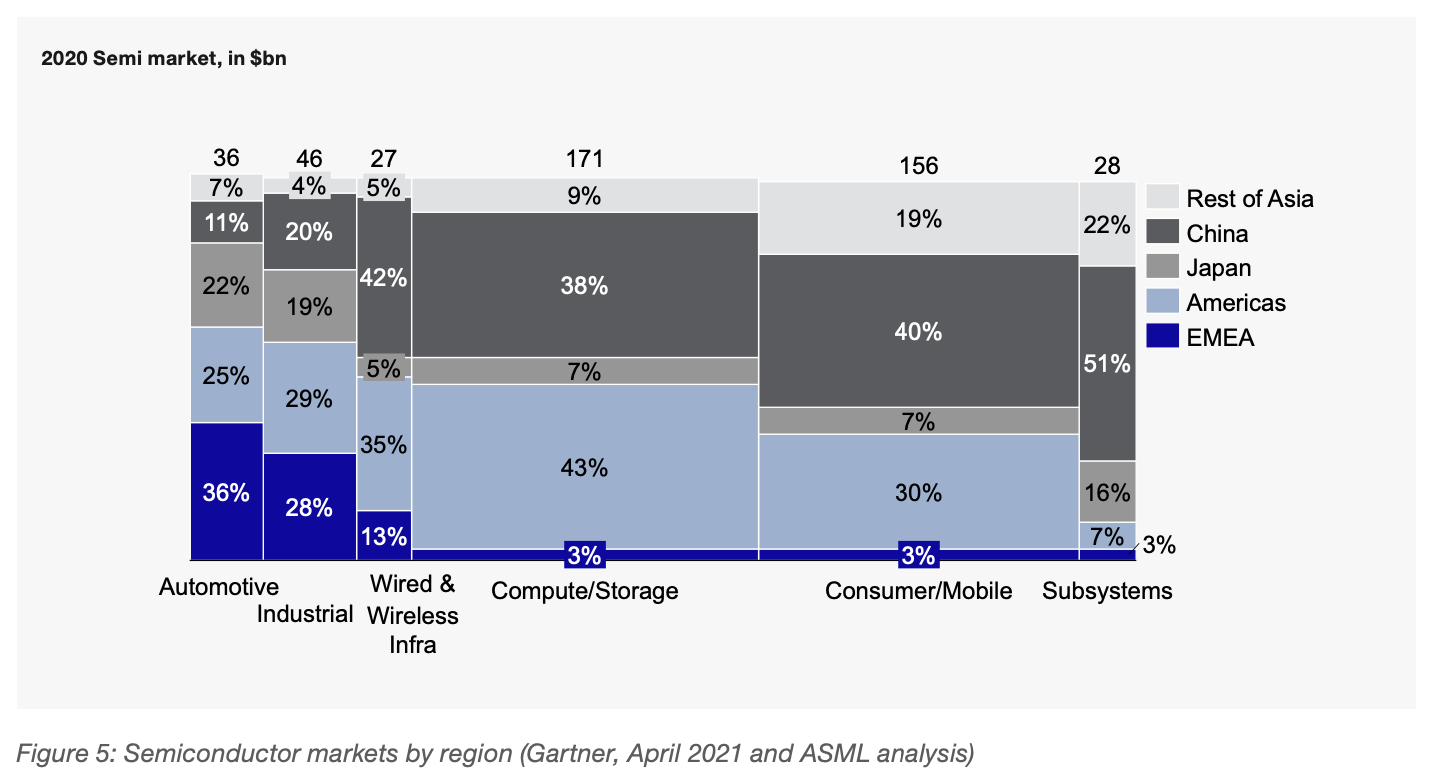
Importantly, the warning from ASML came after the European Commission presented its Chips Act on Tuesday, designed to quadruple Europe’s semiconductor production and hike its share of global output to 20% by 2030 from less than half of that currently.
The package of measures included prying open the viselike restrictions governing state subsidies in order to lure companies such as Intel to build “first of its kind” semiconductor factories. These would be so advanced, the logic goes, that they could not possibly distort competition…as there is none really to begin with.
“What’s important with the Chips Act is that we’re giving a clear signal that Europe is open for business,” a senior commission official said on Tuesday. “We’ve put forward our conditions, now [chipmakers] have a clear legal certainty on how we will handle their projects.”
Edge vs. cloud
The urgency is acute: Global demand for chips is widely expected to grow to twice its current size by 2030, which would be a whopping $1 trillion.
The surge is primarily owing to the advent of distributed computers located on the edge—an autonomous car, for example—that crunch bits and bytes themselves rather than transmit them wirelessly to central servers in the cloud.
Brussels predicts the ratio of data processed on the edge as opposed to the cloud will flip-flop by the end of the decade, from 20% today to 80%, and vice versa.
Leading that transformation will be companies like Bosch, which showcased everything from an intelligent oven to a connected thermostat at the Consumer Electronics Show in Las Vegas.
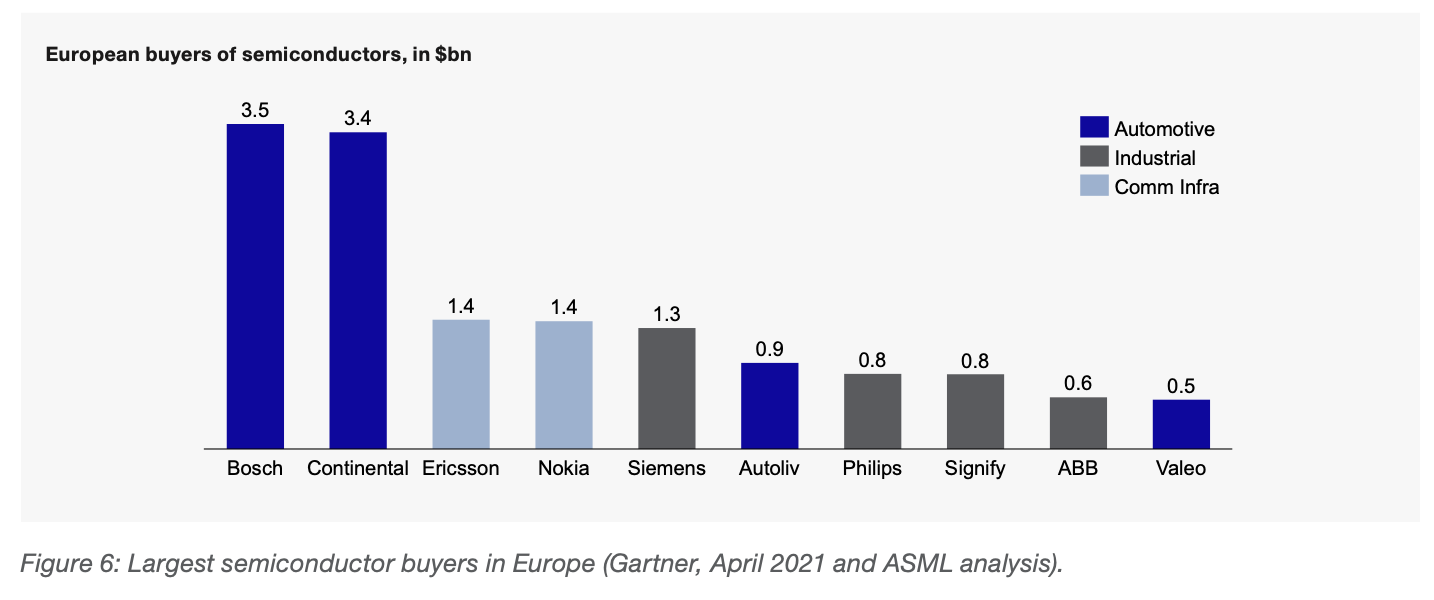
No company in Europe purchases more semiconductors, according to ASML, even though the German industrial conglomerate already assembles many of its own chips in-house. Right behind is auto parts supplier Continental, ahead of more traditional tech companies like Ericsson.
Bosch is also concerned the EU could fall further behind. “Europe must remain at eye’s level with other regions of the globe, and more than ever it needs to think and act in terms of resilient supply chains when it comes to digitalization,” Bosch said in a statement sent to Fortune, welcoming the initiative out of Brussels.
While capital spending of $66 billion would be required for the EU to maintain its 8% share, ASML estimates the bloc would logically have to invest $264 billion in total to hit its goal of quadrupling output.
Mutual dependencies
It’s not just the sheer economics that prove daunting.
The Dutch semiconductor equipment supplier said European chipmakers had all but stopped investing in advanced manufacturing capacity over the past two decades, instead outsourcing production of more state-of-the-art chip designs to independent producers called “foundries,” for example Taiwan’s TSMC.
That means there is a distinct lack of expertise in Europe, requiring a new manufacturing ecosystem to be built virtually from scratch.
“Consequently, foreign investments in advanced fabs in Europe need to be strongly incentivized [by governments] to mitigate the high risks involved,“ ASML warned. “If European policymakers do not provide sufficient incentives, these advanced fabs will be built elsewhere.“
The only way for the EU to achieve what would otherwise be unrealistic targets is for all stakeholders to jointly map out a long-term strategy. This alliance would require experts from chipmakers, their suppliers, research institutions, and the broader manufacturing industry together with senior policymakers.
Membership should be broad, it recommended—any chipmaker willing to invest in Europe and build up a presence should be allowed to join regardless of where their headquarters are. Modern semiconductor factories cannot operate without machinery from, for instance, Japan’s Tokyo Electron, nor that of ASML.
As such it would be “virtually impossible” to build a self-sufficient semiconductor supply chain for Europe, concluded the Dutch tech giant.
Never miss a story: Follow your favorite topics and authors to get a personalized email with the journalism that matters most to you.