When President Richard Nixon visited China in February 1972, the country was in the throes of the Cultural Revolution, with an economy not even a tenth as large as that of the U.S.
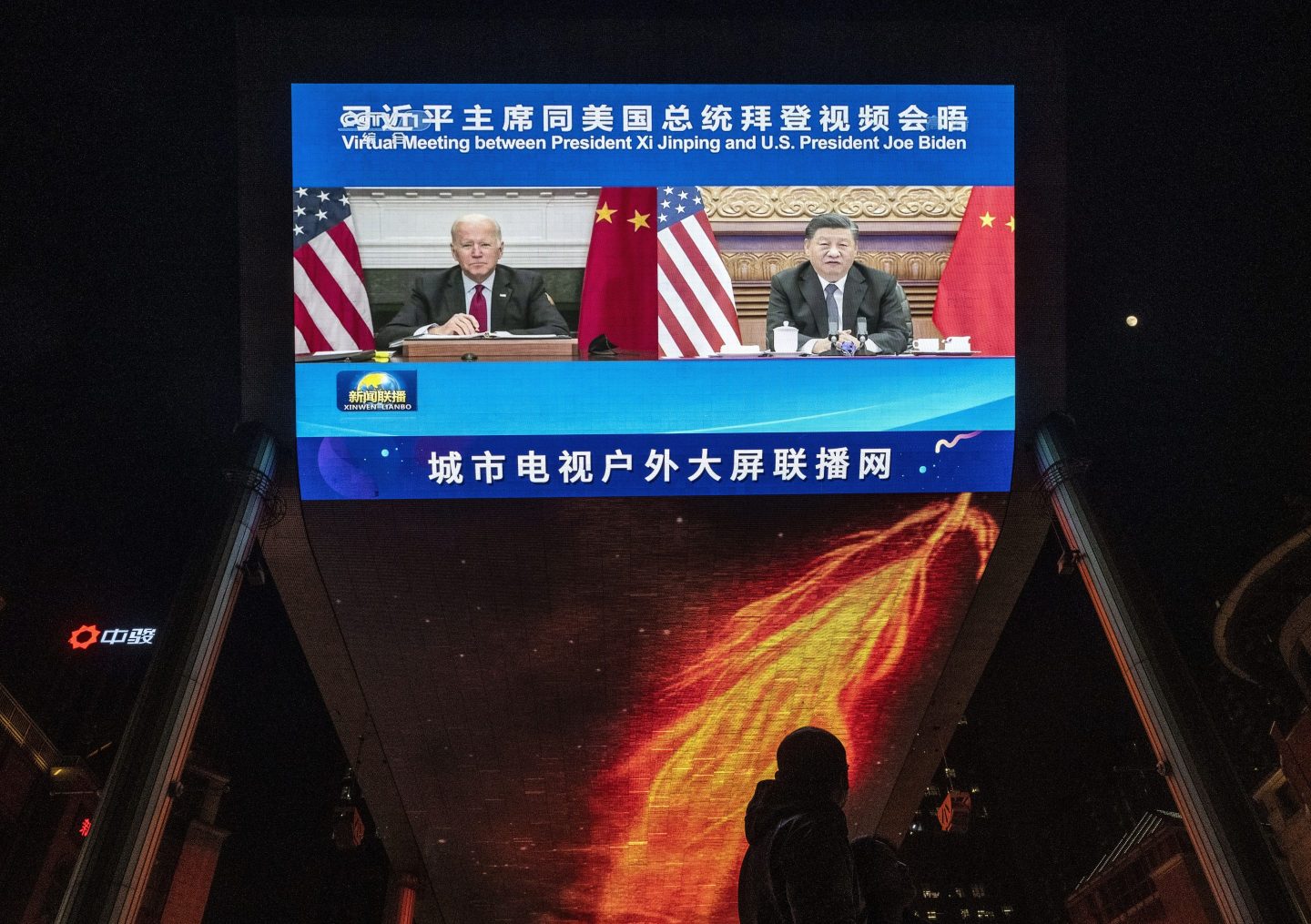
Fifty years later, China is now America’s principal challenger, presiding over the world’s second-largest economy and a rapidly modernizing military. Hopes for a “new model” of great-power relations that existed less than a decade ago—even as the two countries disagreed on what it should entail—have largely disappeared, with the U.S. and China girding themselves for a long-term, multidimensional competition and expecting that deepening distrust will steadily reduce cooperative possibilities.
Even as—or perhaps because—Washington and Beijing insist that they are not embarking on “a new Cold War,” the analogy occupies an ever-larger role in shaping discussions of their relationship.
The U.S. could not have known at the Cold War’s outset how that confrontation would conclude, or even if it would conclude. Thirty years ago, however, it did end—in dramatic fashion: the Soviet Union dissolved on December 26, 1991. Intentionally or not, then, invoking the notion of a “new Cold War” inclines policymakers and analysts to consider how the U.S might “win” over China—or how China might “lose”—rather than how the two powers can coexist.
While it is easier to conceptualize a clear outcome than an ambiguous steady state, drawing too heavily on U.S. policy towards the Soviet Union could limit Washington’s ability to formulate a sustainable approach to Beijing.
First, it is unclear what a U.S. “victory” would entail. A collapse of the Chinese Community Party (CCP), and the chaos that it would sow in the world’s most populous country, would be profoundly destabilizing to both the postwar order and the global economy. And given that both Washington and Beijing are nuclear-armed powers, the consequences of any armed confrontation between them—say, over Taiwan—could have even graver ramifications, even if the U.S. were eventually judged to have prevailed.
Second, China seems poised to be a lasting competitor, not a transient one. The CCP enjoys strong public support, and it has continued to weather major shocks such as the global financial crisis and the coronavirus pandemic—even if President Xi Jinping’s increasingly centralized, insular rule might eventually undercut the party’s capacity for prudent decision-making.
While China is projected to grow more slowly this year than in 2021—4.8% versus 8.1%, according to the International Monetary Fund—it is still on track to overtake the U.S. in aggregate economic size before mid-century, with the Japan Center for Economic Research putting the date at 2033. In addition, foreign capital flows into its equity markets reached a record high last year, and while the pandemic is compelling many companies outside of China to consider how they can reduce their dependence on mainland manufacturing, the reality of decoupling significantly lags the rhetoric.
Finally, with its growing number of globally competitive companies, China is increasingly a source of innovation in its own right. Its economic pull and technological capacity allow it to shape key international institutions, bolster its presence in developing countries, and—perhaps most importantly—promulgate a narrative that juxtaposes a resurgent Beijing against a declining Washington.
But China’s competitive liabilities could curtail its long-term trajectory. At home, it has to contend with worsening demographic trends, accumulating environmental degradation, and an increasingly inefficient growth model. Its COVID-zero strategy could exacerbate its short-term economic difficulties, and Xi’s crackdown on major technology companies including Alibaba might dissuade potential entrepreneurs.
Abroad, China faces growing resistance from advanced industrial democracies, so even if it were to articulate a coherent alternative to the postwar order, it would find it difficult to enlist those countries’ support. Deepening security ties between the members of the Quad and growing transatlantic concern over Beijing’s conduct will make it difficult for China to achieve regional dominance, let alone global hegemony.
Perhaps more important than the actual strategic balance between the U.S. and China is how each country believes it will evolve. Undue U.S. pessimism could yield miscalculation borne of defensiveness; undue Chinese triumphalism, meanwhile, could yield miscalculation borne of overreach. Beijing would be remiss to underestimate Washington’s regenerative potential or to conclude that China can immunize itself from the consequences of counterproductive diplomacy on the basis of commercial power alone. On balance, as Ryan Hass and myself argued last June, China poses an enduring challenge to the U.S., but a constrained one.
There is no self-evident playbook for forging and sustaining a competitive coexistence between the world’s two foremost powers. If, however, Washington and Beijing each acknowledge the likelihood that the other will prove resilient, they will position themselves to begin developing one. One cannot rule out the possibility that historians a generation or two hence will explain how U.S.-China competition reached a decisive conclusion. It seems safer to assume, though, that they will still be analyzing the evolution of a strained cohabitation between Washington and Beijing.
Ali Wyne is a senior analyst with Eurasia Group’s Global Macro practice. He is the author of the forthcoming book America’s Great-Power Opportunity: Revitalizing U.S. Foreign Policy to Meet the Challenges of Strategic Competition.
Never miss a story: Follow your favorite topics and authors to get a personalized email with the journalism that matters most to you.