
Every Monday night, senior leaders at RPM International gather virtually to review one of their company’s most important metrics: the global number of COVID-19 cases. An Ohio-based manufacturer of paint, specialty coatings, sealants, and building materials, RPM has spent countless man-hours tracking and tracing how COVID moves through and impacts its 16,000 employees, spread across 122 facilities in 26 countries.
On Mondays, managers harvest the fruits of that labor, spending anywhere from 45 minutes to two hours analyzing case counts and tailoring their safety strategies. It’s an operational step the Fortune 500 company implemented in 2020 and can’t afford to skip: After all, says CEO Frank Sullivan, a manufacturer doesn’t have the option to tell employees to work from home.
So when Omicron hit, RPM was ready. While it hasn’t avoided the effects of the highly infectious variant—as recently as Dec. 30, RPM had to close a plant in Colorado for 24 hours—the ripple effects in its workplaces have been manageable. Since the pandemic began, RPM has lost about 1,000 manufacturing days because of COVID-related shutdowns and closures. But it has lost only two since Omicron was first detected in the U.S. in early December. “It’s not that we don’t have problems every day, but we’ve learned how to operate,” Sullivan says.
That learning is now being tested in new and unpredictable ways. Companies across industries are grappling with the likelihood that new variants of COVID-19 will emulate Omicron, causing growing numbers of “breakthrough” infections among people who are vaccinated. Like RPM, many are relying on what they have learned in the pandemic so far to build safety protocols that emphasize flexibility and relatively low-tech mitigation efforts, while trying to avoid outright shutdowns. Their approaches could help the economy weather COVID’s next phases—though only if wider vaccination, reliable health care, and the evolution of the virus itself keep rates of severe illness relatively low.
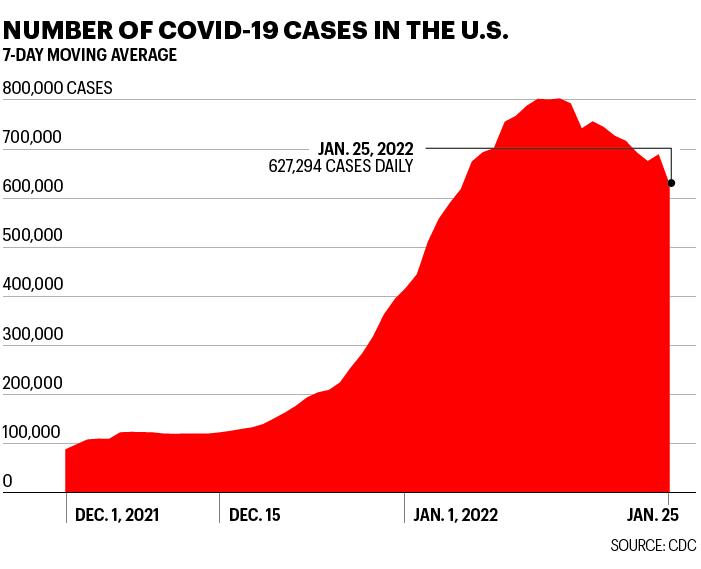
Since its surge began, Omicron has sent millions of Americans home sick—including more than 5 million, or more than 2% of the U.S. workforce, in the first week of January alone, according to Capital Economics senior U.S. economist Andrew Hunter. Absence owing to illness has disrupted countless businesses, even after the Centers for Disease Control and Prevention reduced the recommended isolation period to five days from 10 days for asymptomatic cases.
While new Omicron infections appeared to have peaked in the U.S. as of late January, the situation may well get worse before it gets better. Many experts believe it’s inevitable that what the CDC calls a “variant of high consequence” will emerge—one that’s completely resistant to current vaccines. Georgetown University immunologist Mark Dybul predicts that will happen between March and May of this year. “We are going to have continual variants that become more and more resistant,” Dybul says. “The question is, at what speed will that happen?”
Omicron has offered a preview of that future. Current vaccines offer little protection against Omicron infection, though a third dose has been shown to boost effectiveness, if only for a brief window. One takeaway from Omicron, and one immunologists hope will apply to future mutations, is that vaccines appear to lessen the severity of COVID cases. But for now, most U.S. employers are “ill prepared” to deal even with Omicron, let alone a fully resistant mutation, says Neal Mills, chief medical officer at global business consulting firm Aon.
Better preparation will mean absorbing lessons of the past two years. RPM, which had $6.1 billion in revenue in 2021, has invested about $22.5 million since the pandemic began to implement health and safety protocols. That has included providing masks and touchless thermometers to subsidiaries, implementing disinfection regimes, and moving toward flexible sick leave for workers who contract COVID. But the company has also stayed adaptable. In March 2020, for instance, RPM shut down dozens of plants as the first wave of COVID spread globally. But management learned it didn’t always need to shutter a facility because of a few cases. Instead, a plant might need to only send home workers on a certain shift, or close a specific area of a facility.
5 million
Number of Americans who missed work owing to Omicron infection in the first week of January (Source: Capital Economics)
Vaccine-resistant variants may pressure companies to be more disciplined about masking and social distancing. “The lower the effectiveness of a vaccine is, the more important masking is, the more important social distancing is,” says Rick Kennedy, co-director of the vaccine research group at the Mayo Clinic.
Implementing mask mandates at RPM went fairly smoothly, Sullivan says, because many workers have always had to wear some kind of protective gear. RPM has also required those employees attending in-person events, such as board meetings and leadership conferences, to provide proof of vaccination in order to participate. However, RPM did not implement a company-wide vaccine mandate in 2021. “What we’re doing in our offices and our work sites is effective. And if it wasn’t…we’d be taking actions at a plant level to say, ‘Hey, what the heck is going on?’” Sullivan says.
Minnesota-based 3M, a larger manufacturer, hasn’t required employees to get vaccinated but has instead relied on a “layered approach” that includes education, masking, social distancing, and maximizing ventilation in workspaces, says Oyebode Taiwo, 3M’s chief medical officer. If a fully resistant variant arrives, he adds, “I suspect that we will deal with that variant the same way we dealt with the older variants before we had vaccines.”
Global corporations generally have the resources to implement such tactics. But not all smaller employers can afford them, and even those that can may not be able to get their hands on reliable COVID tests or N95 masks. “The more companies want to suppress the transmission of any of these variants, the more it’s going to cost them,” Mills says.
42%
SHARE OF THE U.S. ADULT POPULATION WHO HAVE RECEIVED A BOOSTER DOSE OF A COVID-19 VACCINE (SOURCE: CDC—DATA AS OF Jan. 20, 2022)
At McJak Candy in Medina, Ohio, owner Larry Johns has decided that COVID mitigation policies are something he can’t afford—not when the company is facing supply challenges, rapidly rising production costs, and a tight labor market. Last year the company brought in about $7.3 million in revenues last year, down from the $8.5 million in 2019.
In the early days of the pandemic, five of McJak’s 40 employees contracted the virus, and one worker was out for a mild case of COVID right after Christmas 2021. But Johns says that implementing unpopular vaccine or mask requirements would risk driving employees away. (Previously, when Ohio temporarily required masking indoors, employees complied.)
McJak, which makes “white label” confections for fundraising campaigns and retailers, has some factors working in its favor. Employees can socially distance with relative ease in its 65,000-square-foot production facility. Should Omicron or future variants cause infections to spike among employees, Johns says, McJak can adapt by pivoting to manufacture just one product at a time—giving priority to lollipops over cotton candy, for example. “We’re so used to it now, with two years of not knowing what’s happening the next week or next month, that we’ve sort of just learned to go with the flow,” Johns says.
Employers of all sizes may get an assist against future variants from new antiviral drugs and therapeutics. Though currently in limited supply, these oral medications are expected to reduce the likelihood that infected workers need to be hospitalized and miss weeks or months at a time. It’s also possible that the Omicron surge—or the next variant—could give the U.S. a push to “reach a level of herd immunity,” says Luis Ostrosky-Zeichner, chief of infectious diseases with McGovern Medical School at Houston’s UTHealth. Still, those scenarios could leave thousands of workers facing the likelihood of COVID infections, some severe. And until the virus becomes less virulent, millions of medically high-risk American workers with other health conditions will remain unable to return to normalcy.
In the near term, companies find themselves designing safety measures for a climate in which vaccines can’t serve as a magic bullet. At RPM, Sullivan says, the best protocols come down to common sense. Recently, RPM’s legal team drafted a two-page release form for employees who contracted COVID to sign, so that their managers could tell coworkers about any possible exposure. Sullivan says he “killed it,” and now managers simply ask infected workers if it would be okay to share their status; he’s not aware of a single instance in which an employee said no.
“We communicate like mad, and we empower our local leaders to make decisions,” Sullivan says. “It’s working for us.”
A version of this article appears in the February/March issue of Fortune with the headline, “When the vaccines stop working.”
Never miss a story: Follow your favorite topics and authors to get a personalized email with the journalism that matters most to you.