Even in the high-stakes realm of Fortune Global 500 strategy, the stakes don’t get much higher than this: a new CEO fundamentally changing the strategy of a worldwide industry leader.
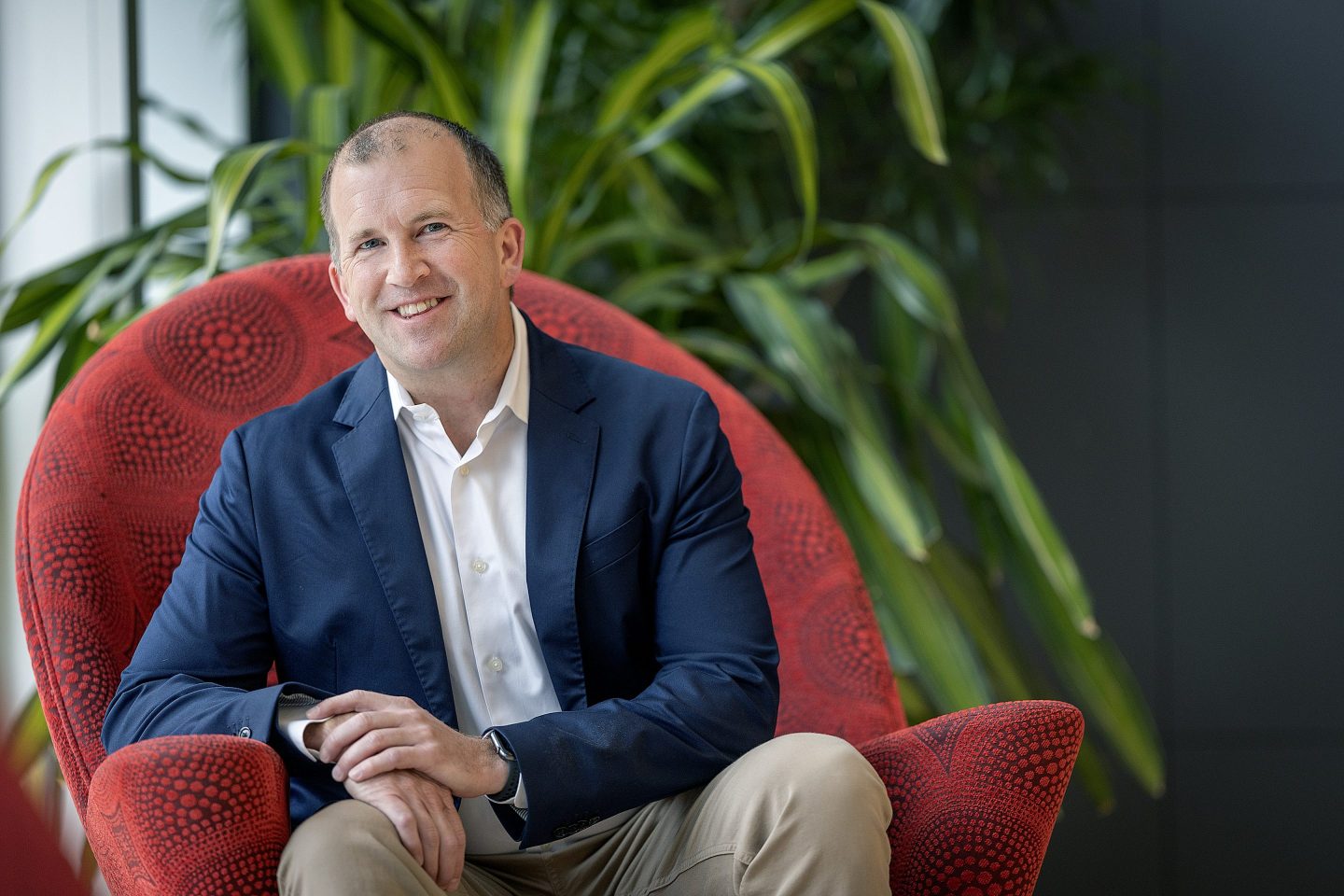
That’s what Michel Doukeris is doing, just five months after taking the helm of Anheuser-Busch InBev. The move may seem audacious. AB InBev is the planet’s beer brewing behemoth, accounting for 25% of the industry’s total revenue. It sells some 500 brands, three of which—Budweiser, Corona, and Stella Artois—are marketed globally; it also sells hard seltzers, canned wine, and other non-beers. Its closest competitor, Heineken, is only half as big.
But in truth, Doukeris has little choice, because the strategy that propelled AB InBev to global dominance no longer works. “For the last 10 or 20 years we had a strategy that was very simple and very repeatable,” he tells Fortune in an exclusive interview. That strategy was “very good cost management, very good cash generation, and excellent, excellent M&A capabilities.”
M&A is where the galloping growth came from. Brazil’s 3G Capital private equity firm bought a Brazilian brewer in 1989 and never stopped buying until, finally, it had to. In 2008 the rapidly expanding beer company bought the world’s then-largest brewer, Anheuser-Busch, and in 2016 bought the then No. 2, SAB Miller, in one of the largest acquisitions in business history, paying over $100 billion.
After that there was no place left to go. Antitrust authorities wouldn’t allow any more major acquisitions. AB InBev revenue peaked in 2017, the year after the megadeals stopped, and analysts argued that the company didn’t know how to grow the old-fashioned way, organically, through product innovation, marketing, and expansion into new sectors.
Doukeris is pronouncing the old strategy officially dead. “As we transition from this consolidation phase to what the future looks like, it’s much more about a portfolio of brands and services that deliver for consumers and customers—superior propositions, superior value,” he says.
The shift is starker than he makes it sound. The Harvard Business School’s Michael Porter, reigning master of competitive strategy, argues there are only three corporate strategies: cost leadership (operating with the lowest costs in the industry), differentiation (offering unique products and services), and focus (serving a niche market). In the past, “cost was more dominant in our strategy,” Doukeris says, and for decades it worked spectacularly well. Spartan cost cutting and increasing economies of scale enabled AB InBev to keep buying. But now, “if you give me only three options (niche, cost, or differentiation) the strategy of the future for ABI is differentiation—differentiation in high-quality products, in services that are not only physical, and not only beer products and services. It is much more than that.”
Can Doukeris change this dreadnought’s direction? Like many executives at companies 3G Capital has helped assemble—including Kraft Heinz, Restaurant Brands International (Burger King, Popeyes, Louisiana Kitchen), and others—he’s a Brazilian who rose quickly through 3G’s strict meritocracy. At age 48, he’s got plenty of time to realize his grand vision, so long as he performs well.
From an office adorned with serried ranks of Budweiser bottles, Doukeris told Fortune how digital platforms for retailers and consumers are central to AB InBev’s growth, why there aren’t nearly enough premium beers, and why anyone who thinks beer is in decline is just plain wrong.
This interview has been edited for length and clarity.
For years now customer preferences have been changing across the beverage industry and certainly in the beer industry. How is AB InBev adapting?
Our company has roots that go back more than 600 years [to the origins of the Belgian beer Leffe, an AB InBev brand], and despite all the hype today about change, change has been part of the last 600 years. Now people have this impression that everything is upside down and the world is changing, and that is just too dramatic. The truth is, beer is growing, and beer is gaining what we call share of throat—it’s growing faster than the average of the alcoholic beverage industry. That’s caused by emerging markets in the majority. In the U.S., the industry was growing in value but declining in volume for almost 10 years, but now, for three years in a row it’s been growing in volume and value.
What about all these other new products that aren’t beer?
We’re used to these three categories of beer, hard liquor, and wine. Now a phenomenon is happening in several countries, especially in the U.S. and Canada, what people call the fourth category. New beverages are popping up that are neither beer nor hard liquor nor wine. Or they are in a ready-to-drink package, solving a big problem for people, which is convenience. You’re probably very familiar with some manifestations of that, like hard seltzers in the U.S. There’s also a beverage that’s made with wine but looks like a cocktail, called BuzzBallz. Or there’s Rancho La Gloria, which people think is like a tequila but is actually a wine-based ready-to-drink beverage.
We have this brand called Cutwater, which is a ready-to-drink cocktail. People like going to a bar and drinking a mai tai or a margarita, but they never could have a margarita at the barbecue in the park, or in a stadium watching a baseball game. So we put these in a can, and we are selling today, in a very convenient pack, a very high-quality cocktail. So these beverages in the middle of the three categories are what people call the consumer changes that are happening.
You’re pushing hard on premium beers. How come?
Because when you look at consumer packaged goods and beverages in general, the percentage of the category that sits in the premium space is often one-third, sometimes 40%. Beer is very late in this process of premium-izing. Today, premium beers account for 10% to 12% of the industry globally, so there is still a lot of room for growth. Premium beers globally are growing very fast. They’re an affordable luxury. Everybody likes premium stuff, but not everybody can buy a Ferrari or a Tesla. Your Ferrari will cost you $200,000, while a premium beer costs $3, $2—if you buy in a supermarket, $1.50, maybe.
We have seven of the 10 most valuable global beer brands according to BrandZ. The premium part of our portfolio, from Corona to Budweiser to Stella Artois to some of our premium specialties, like Hoegaarden and Leffe, represent close to one-third of our global growth in revenues, and they continue to do very well.
Most giant beverage companies don’t deal directly with small retailers. Why did you create an app for them?
If you go to Latin America or Africa, our [retailer] customers are not Walmart. They are very small, and their business is very seasonal. They sell a lot on a Friday or at the beginning of the month when people have money. Because they are very small, they cannot have access to all the products they need to run their business with high quality, good service, and good credit terms. So we created an app where they can see all the products we sell and all the promotions we have. They can order any day of the week and track when the delivery is arriving.
We now offer more products on this app so they can buy milk, soft drinks, even lottery cards that they sell. They can buy credit; we enable financial institutions to offer them credit for three days, five days, or 10 days. In the 15 countries where we’ve rolled out this app, we have more than 70% of our sales going through it. The customers are growing faster, and we now have much more data that they can optimize.
You’re also using an app to sell directly to consumers, which is virtually unheard of in the industry. How come?
We have globally $1 billion in sales that we make through direct-to-consumer. Consumers order beer the same way they order from Pizza Hut; in 30 minutes we deliver them cold beer at home, the amount they ordered on the app.
Why? Each country is different, but what often happens is we produce the beer, then we sell it to a wholesaler, the wholesaler sells to a retailer, the retailer sells to a consumer. So we have four degrees of separation between the product owner and the user. This is very tough. For example, the most important day of the week for us is often Wednesday or Thursday. That’s the day we sell a lot of beer for the retailers that are stocking up for the consumers that will buy the beer on Friday or Saturday to use on Saturday or Sunday. But they are three days apart. So the important day for us is different from the important day for consumers. As we start to interact more with consumers, we start to learn more about the occasion than about the retailers. It is so much more important for us to know that consumers want to have cold beer on Saturday at 8:45 p.m. than to know that their Walmart store is located in New Jersey after the turnpike. The data of Friday, 8:45 p.m., two people, six bottles of beer, is much more relevant than the 1,000 cases that I deliver on Wednesday to Walmart.
Why are you announcing a 10-year plan for AB InBev? That seems like an awfully long time in today’s world.
I moved from Brazil to China in 2010 [to manage the company’s business there]. In China change is very fast. I thought it would be impossible to build something real on a one-year horizon or three-year horizon, so I decided to build a 10-year plan for China. The process of building that plan was incredible because it was the first time that I thought, This is a competitive advantage. While everybody is thinking short term, I was really thinking 10 years [ahead] and thinking, What are the small things that consumers want to do today that will be very big 10 years down the road?
We were speaking a lot here today about direct-to-consumer and B2B. Actually, those two things became a reality for us as a company not last year, but five years ago, based on the 10-year plan for China, which saw that consumers would move to mobile solutions and would make most of their purchases digitally. When they did, we actually didn’t sell a case of beer in e-commerce. When consumers first visited Taobao, which is the Amazon of China, it didn’t sell any beer. I was the first client to come to them to sell beer to them. And today those are large businesses for us, not because we did three-year plans, but because we did a 10-year plan.
So the idea of doing a 10-year plan is that it really sets you apart from your competition and creates the ability for you to see things that everybody can see, but at a size that nobody can see. And when you really see the potential of these small things 10 years down the road, then you can disproportionately reallocate resources, which is a strategy, right?
Subscribe to Fortune Daily to get essential business stories delivered straight to your inbox each morning.