In 2018, when the world’s largest container shipping company committed to hitting net-zero emissions by 2050, its chairman freely admitted the company’s leadership had no idea how to actually achieve that goal.
A.P. Møller–Maersk, the Danish shipping and logistics behemoth known more simply as Maersk, had already spent years trying to lower its emissions, says Jim Hagemann Snabe, who currently serves as chair. Its historical efforts—largely a matter of sailing slower, and leveraging its sheer, ginormous scale—had delivered some promising results: Emissions intensity per container, for one, had dropped by 41% since 2008.
But that wasn’t enough for many of its biggest customers, including the Swedish fashion giant H&M, which were already pushing the company for low-carbon options that could help them meet their own emissions targets.
So the decision to target net-zero “was really the trigger point for saying, ‘Well, then we have to invent a new type of vessel,’” says Snabe, who spoke to Fortune this month from the TED Countdown Summit in Edinburgh, ahead of the COP26 conference in November.
Maersk has since commissioned eight new vessels, capable of running on a no-carbon methanol the company has pioneered, at an investment of $1.4 billion. In the coming decades, it will retrofit, rather than replace, its entire fleet of roughly 750 ships to run on carbon neutral energy.
“We’re trying to break the chicken and egg problem: that nobody will build green vessels if there’s no green fuel—and nobody will build or produce green fuel if there are no vessels using them,” says Snabe. “And so we said, ‘Well, if we create the demand, we break this vicious circle.’”
Decarbonizing shipping will be critical for any company that relies on consumer goods, raw materials, or liquid energy—anything that can be put on a ship, in other words—to transition their own supply chains. But the sector is one of the hardest in the world to decarbonize. Building the ships is the easy part.
The push for carbon-neutral shipping
Why is it so hard to decarbonize shipping?
Ships are “big and heavy,” says Ami Daniel, CEO of marine consultancy Windward. “So it’s very simple—it’s physics.”
Unlike vehicles, which are quickly being electrified—spurring what the International Energy Agency says will lead to declining oil demand after 2025—bulky planes and ships have sheer size working against them. As we’ve seen from the Ever Given debacle, the trend in the industry is for larger and larger ships not greener and greener ones. Maersk’s Triple-E–class ships, for example, are more comparable to a horizontal skyscraper than a ship.
Sufficiently powerful batteries, for that reason, pose problems as they would take up huge shares of storage space on vessels. Even hydrogen would be technically complicated, Snabe points out.
While shipping makes up just 3% of global emissions, by some estimates, about 80% of the world’s goods are transported by sea. Major fashion brands and retailers are demanding that shipping decarbonize, pushed by their own customers. On Monday, Amazon, Inditex, and Ikea all said they would only use zero-emission shipping by 2040.
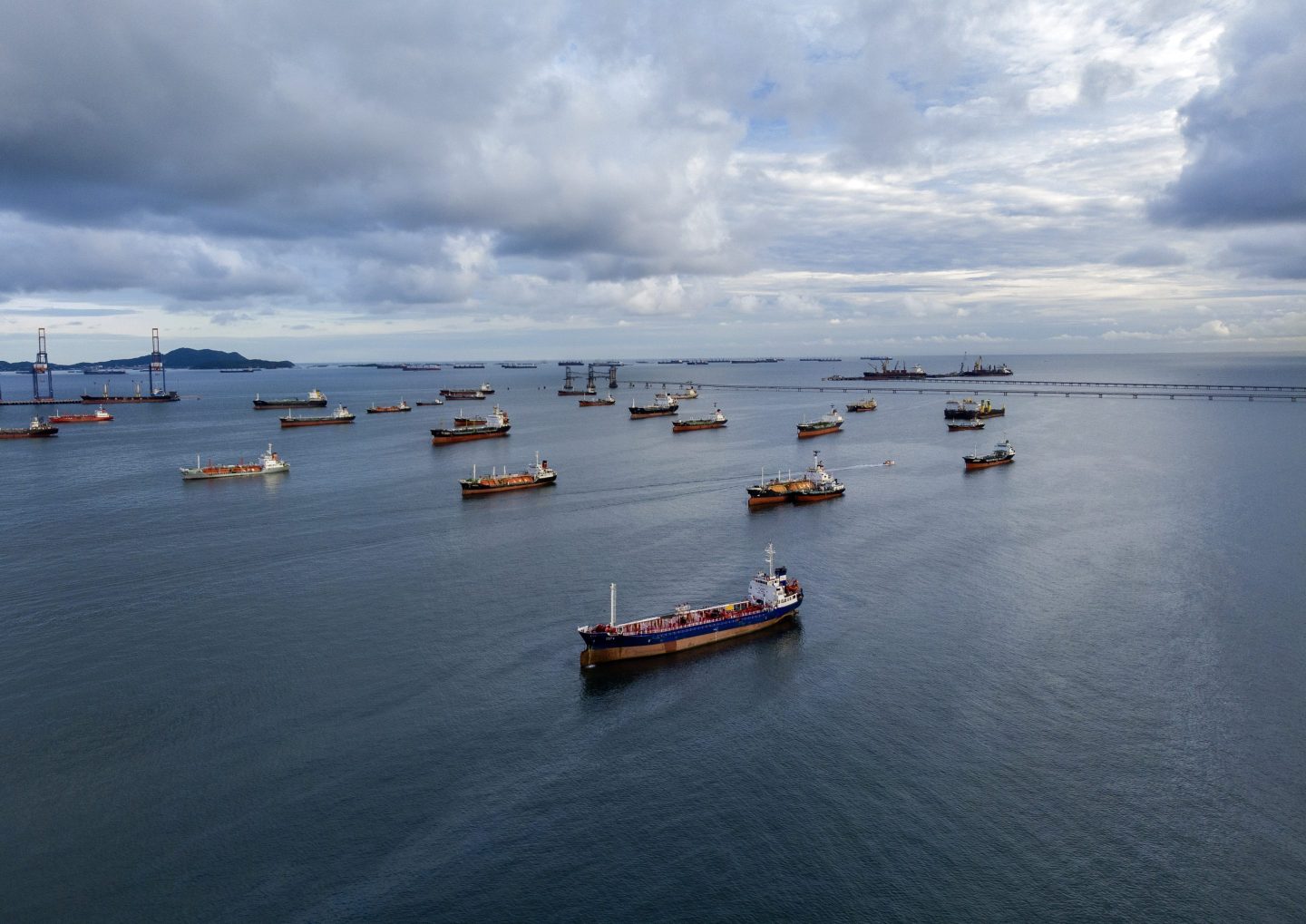
The push to decarbonize is also gaining speed at a fraught time, as the world’s supply chains are in the throes of both a wild and unpredictable demand boom, and a labor shortage. Snabe describes the situation as one of “extreme” high demand: Maersk’s ships are at 98% utilization, with about 50 to 60 ships at sea waiting just outside the Port of Los Angeles alone.
“The issue is not at sea,” says Snabe. “The issue is on the land side. We come to a port, and there’s not enough throughput at the port,” he says—not enough truck drivers, in particular. Those delays, in turn, are driving down the available capacity on ships, he adds.
It’s a situation that’s raising questions about the “single-minded” focus on just-in-time delivery, the managing director of Maersk’s China business told a Fortune conference earlier this week.
And it’s a crisis that forms a telling contrast to long-term questions posed by the decarbonization challenges Maersk now faces. The ships, made of carbon-intensive steel, last decades. But even more challenging is the creation of a whole new system of fuel production, which will by necessity need to extend across global trade routes.
Experts say the development of sufficient fuel will still take at least 10 years, likely longer, and the exact solution the industry will largely settle on is still not quite clear. Maersk’s investments to come will require a steely vision not just of whether shipping can decarbonize, but what route it will take to do so.
‘It is revolutionary’
There is precedent for Maersk’s push into green shipping.
In the 1970s, amid the rise of container shipping, the company settled on a tentative, experimental approach—running pilot efforts before deciding it could make the business work, says Henrik Sornn-Friese, a professor at Copenhagen Business School and the cofounder of CBS Maritime, the school’s center for study of the shipping industry.
“Then they went big scale,” he says—and became the largest container shipper in the world, with about 20% of the container market share alone.
The approach is characteristic of the Maersk business, which was launched in 1904, and is still controlled, in large part, by a foundation set up by the founding family.
The current investments are similarly tentative, he adds. The first, smaller “green” vessel will be delivered in 2023, in August, the company ordered another eight. Crucially, they will have dual hybrid engines—able to run off e-methanol, or conventional fossil fuels. That fuel, which the company calls “power to X,” was pioneered out of a Copenhagen research center.
It will require the creation of green hydrogen—from renewable or no-carbon energy sources—which will then be converted into liquid methanol, primarily. That fuel can then be used in much the same way as existing (liquid) fossil fuels, relying on existing infrastructure and eventually requiring—the company hopes—only a retrofit of their vessels’ engines, rather than replacing the entire fleet.
The move to order the ships has gone farther than any other major shipping company, Sornn-Friese adds. Others agree.
“I think it’s about market signaling and about leadership,” says Daniel, adding that, though the current investment is fairly small, “they are taking a risk” in betting on a route of decarbonization that hasn’t yet been proven. “In that sense, it is revolutionary.”
Daniel, for his part, says he expects other shipping giants will follow with similar green investments in the coming months, as pressure to decarbonize builds. But he cautions that the container shipping sector is moving more quickly than the shipping industry overall—in large part because of the consumer brands that rely on its services.
The Maersk investment is “a drop in the ocean, literally,” he says, in terms of scale and financial investment, given where the global shipping industry as a whole is right now.
But even if the strategy isn’t risk-free, or puts Maersk out ahead of the industry, Snabe’s argument is that’s basically the point. Its efforts “de-risk this whole investment,” he says.
“And this has been the issue. Nobody wants to invest if you don’t know if there’s a buyer for the fuel,” he says. Now, “we are the buyer.”
This article has been updated to clarify that Maersk’s ships will rely on carbon-neutral fuel rather than zero-carbon.
Subscribe to Fortune Daily to get essential business stories delivered straight to your inbox each morning.