
Hoping to enter the fledgling market for flying taxis at the ground floor, Airbus unveiled a first glimpse of a four-seat prototype that could potentially see commercial liftoff as early as 2025.
Faster than a car, more exclusive than mass transit, and quieter than a helicopter, electric vertical takeoff and landing vehicles (eVTOLs) are the latest innovation that could revolutionize urban transportation—if they ever get off the ground financially.
Their potential is compelling: Air taxis could substantially cut down the travel time in heavily congested areas, turning a 45-minute trip from downtown Manhattan to JFK International Airport into just five. Developing countries are particularly interested in the technology, given their megacities have often grown faster than the infrastructure can support, with a Chinese company ordering eVTOLs from Germany’s Volocopter on Wednesday.
“We see the need to change the way we are traveling in cities,” said Bruno Even, CEO of Airbus Helicopter, during a company event on Tuesday. “Based on all our experience, past and current, we are convinced we are well positioned to lead this future market.”
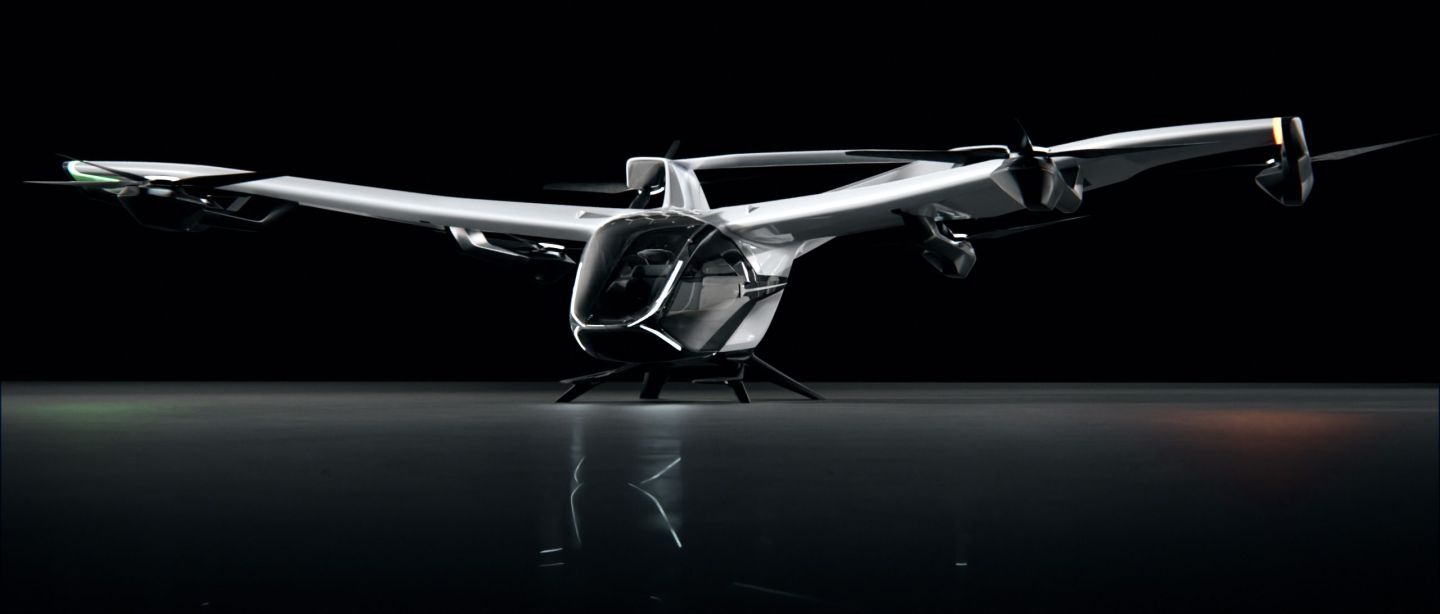
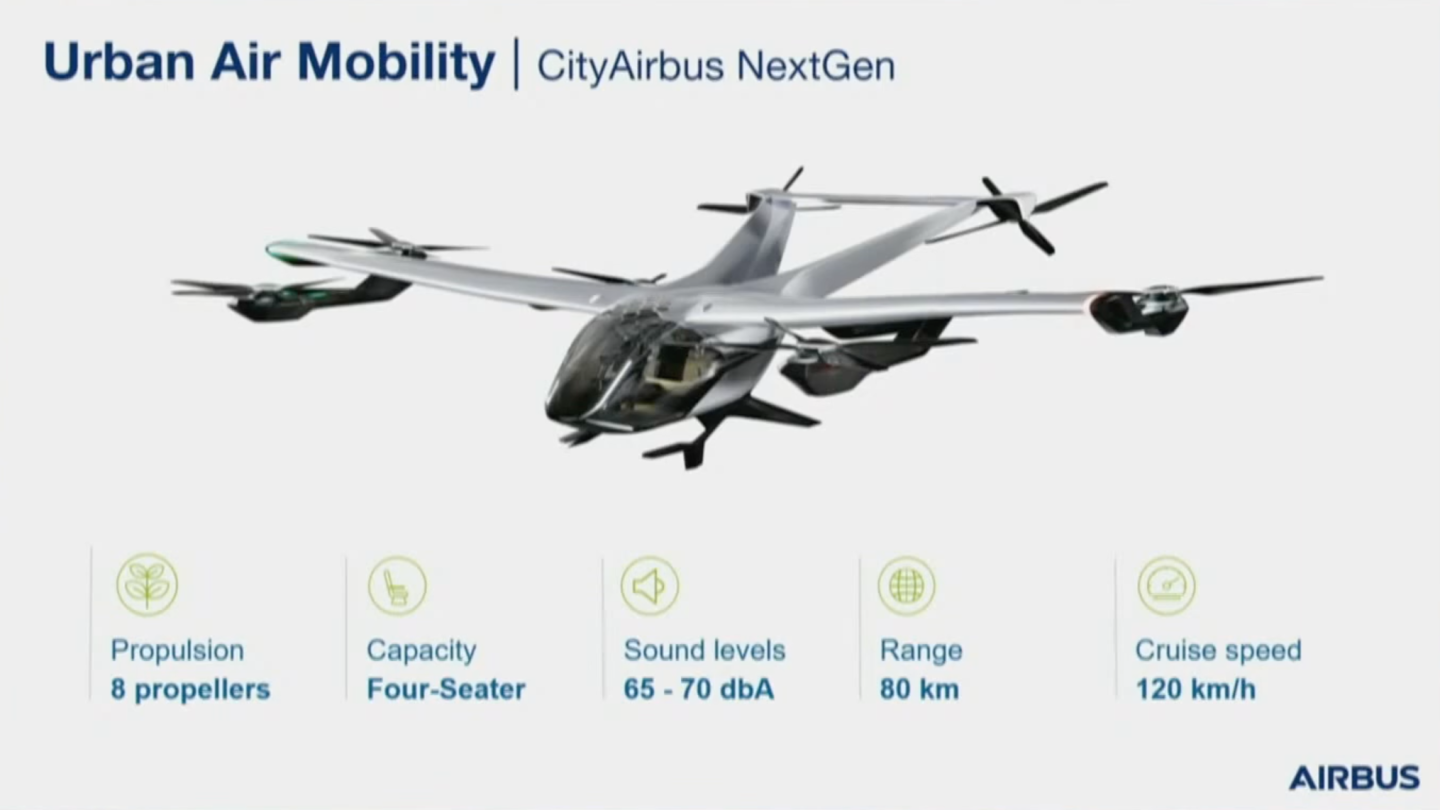
Scheduled for its first flight in 2023, the CityAirbus NextGen comes equipped with fixed wings, a split tail section, and eight electrically powered propellers and is capable of reaching a cruising speed of 120 kilometers per hour (100 mph), according to the company.
Its battery can last for 80 kilometers, and landing noise—the most audible to human ears—is expected to top out at 70 decibels, low enough to blend in with the sound of everyday traffic.
“We’ve spent hundreds of thousands of engineering hours on all aspects of eVTOL design, starting from structural mechanics to aerodynamics and electric propulsion,” said Jörg Müller, the company’s head of urban mobility, at an event on Tuesday.
Since public acceptance is as important as developing the technology, according to the company, the Airbus eVTOL should meet the highest standards for safety certification set out by European aviation regulator EASA.
Airbus Helicopter’s Even estimated annual demand could be around about 1,000 eVTOLs, with the company ruling out any plans to move beyond the sale of eVTOLs into operating fleets itself.
Much like a robotaxi, the goal is for the eVTOL in the future to maneuver itself by computer in order to make the economics more viable. Human operators take up space that could otherwise be used to transport paying customers.
“We are targeting self-piloted autonomous flight,” Müller said. “This will progressively come, and we’ll introduce it step-by-step, so that at a certain point these vehicles fly fully autonomously. Until then, we’ll fly them with a pilot, of course.”
Back in October 2019, U.S. aerospace giant Boeing agreed to pair up with luxury sports car manufacturer Porsche to build a prototype for premium urban air mobility. The Airbus rival, which does not operate its own civilian helicopter program, has since been silent about the program, however.
Perhaps Airbus’s stiffest competition, then, may come from other European firms. Munich-based Lilium counts the deep-pocketed Chinese tech company Tencent among investors and boasts former Airbus CEO Tom Enders as a board member. Last week it raised $584 million through a backdoor listing via a blank-check SPAC investment vehicle.
Fellow German startup Volocopter, which counts Daimler among its investors, said hopes to trial its two-seat VoloCity eVTOL in time for the Paris Summer Olympics in 2024. On Wednesday it announced a deal to enter the Chinese market via a joint venture with local carmaker Geely, which will purchase 150 Volocopter aircraft.
Other startups (and their backers) include Joby (Uber), Kitty Hawk (Google’s Larry Page), and Archer Aviation (United Airlines and Stellantis).
Airbus Helicopters’ head of development Tomasz Krysinski said his company had a key advantage over other rivals. “We are the only company in the world that tested such a vehicle in real size,” he said, explaining that with all rotary-wing aircrafts, the complexity of the task grows with the dimensions of the vehicle. “It’s very easy to do something with a mock-up on the small scale.”
Much like mankind’s initial attempts at flight, companies are experimenting heavily with various eVTOL concepts and have yet to agree on a single design. Some engineers are effectively shrinking airplanes, while others prefer those that function more like miniature helicopters, or concepts that employ a mix of the two.
Airbus’s new eVTOL merges the combined expertise derived from two previous demonstrators, the first generation CityAirbus and the Vahana, in order to strike a better balance between hovering and forward flight, according to the company.
In July, Porsche Consulting estimated the market for urban air taxies flying 20- to 50-kilometer trips could rise from $4 billion in 2030 to $21 billion annually five years later. Still, the economics are “challenging and fraught with high uncertainty,” the firm said in a July research paper.
“Players in this space need to show serious commitment and need to take the long view lasting at least 10 years, with no positive return on investment in sight before 2030,” it wrote.
More tech coverage from Fortune:
- OpenSea employee used insider knowledge to buy notable NFTs
- Microsoft is doing away with passwords on Outlook and other software
- Inside the race to build a supersonic airliner
- Commentary: “Fauxquisitions” are misleading the startup community
- Chipmakers to carmakers: Time to get out of the semiconductor Stone Age
Subscribe to Fortune Daily to get essential business stories straight to your inbox each morning.