
Boeing’s satellite factory sits in the sprawling industrial zone surrounding Los Angeles International Airport, long an epicenter for the American aviation and aerospace industries. The facility was built in the 1940s for the old Nash Motors, which rolled its iconic Rambler off the plant’s assembly line. In the 1950s, legendary aviation mogul Howard Hughes’s eponymous aerospace company acquired the property and soon built some of the world’s earliest commercial satellites there.
Boeing inherited the facility when it bought Hughes’s space business in 2000. Today it houses Boeing Satellite Systems—one of the largest satellite manufacturers in the world and part of a Defense, Space & Security division that generated $14 billion in sales for Boeing in the first half of this year, or more than 43% of the company’s overall revenues.
These days, Boeing faces intense competition in a rapidly growing space sector. Amid heightened demand for broadband Internet service, upstarts like Elon Musk’s SpaceX are launching lighter, leaner, and more technologically advanced satellites. Unprecedented amounts of money have poured into “space-tech,” with space-focused startups raising more than $7 billion in funding last year. Boeing, in turn, now finds itself fighting to maintain its frontrunner status in what has become a modern-day space race.
“Technology’s changing—you’re getting smaller satellites with big constellations, and how the old guard are going to compete against that is something we have to watch,” says Bank of America aerospace and defense equity analyst Ronald Epstein.
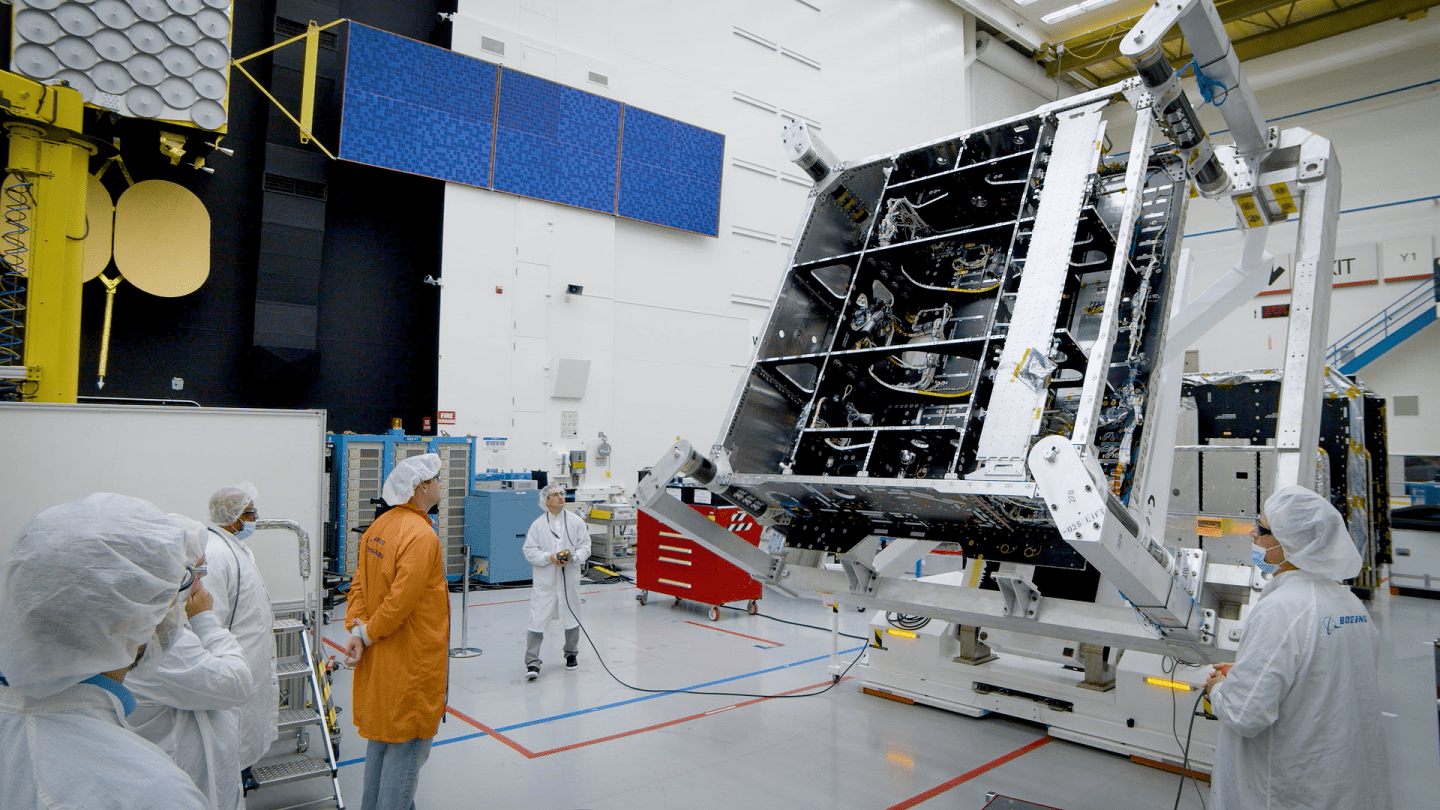
As an “old guard” company looking to keep up with the so-called new space economy, the key battleground for Boeing is its enormous, 1-million-square-foot satellite facility near LAX. The main factory floor resembles a cavernous white box, with bright fluorescent lighting beaming down from ceilings a hundred feet above. Here, Boeing’s teams are working on state-of-the-art satellites for one of the company’s largest commercial customers, Luxembourg-based satellite operator SES.
Boeing has been making satellites for SES since the early 1990s, when its satellite division was still a part of Hughes Space and Communications. Now Boeing and SES have teamed up to develop a constellation of 11 communications satellites that will operate in medium orbit, about 5,000 miles above Earth. The goal of the constellation, known as O3b mPower, is to provide broadband Internet and data connections to customers including cloud-computing providers, telecom companies, shipping lines, cruise ships, and airlines.
The satellites will update a constellation of 20 satellites operated by SES that were built by Boeing rival Thales Alenia Space and launched eight years ago. For this second generation, Boeing is helping SES expand the original network’s capabilities by designing a fleet of smaller satellites that promise to function in a faster, more flexible, and farther-reaching fashion. The new O3b mPower satellites will be nearly half the size of their predecessors but will offer more than 10 times the data capacity. The original O3b satellites came equipped with up to 10 analog “wide beams,” resembling small satellite dishes, which beamed signals down to Earth. The new versions are fully digitized and feature up to 5,000 steerable beams that can more precisely be redirected and adjusted—significantly improving their speed, reach, and accuracy for SES’s clients.
“It’s like we’re going from the iPhone to iPhone 12 in one step,” SES CEO Steve Collar says on Boeing’s factory floor—draped, like everyone in the room, in a white smock, hairnet, and clear protective goggles. Next to him stands Jim Chilton, senior vice president of Boeing’s Space and Launch division, who notes that the streamlined, digitally enabled new satellites feature only a fraction of the hardware components that their predecessors did.

With their launch into medium Earth orbit, SES’s new satellites are supposed to reduce the latency, or lag, of broadband communications by orbiting closer to Earth, while still being far enough to reach 96% of the world’s population. They will help the satellite operator meet rising demand for faster and cheaper access to broadband data, which could drive up to 70% of the global space industry’s overall growth over the next two decades, according to Morgan Stanley Research.
“Satellites have this amazing superpower, which is reach,” Collar notes. But while traditional geostationary satellites, which orbit 22,000 miles above Earth, have long enabled that reach, latency has always been an issue given their distance. “That was where this revolutionary idea of bringing the satellites closer to the Earth, and using that to deliver the Internet, came from,” he adds.
Though the first O3b mPower satellites aren’t launching until later this year, they have already attracted customers including French telecom company Orange and cruise operator Carnival. Cloud-computing companies are also a key, growing market; SES has recently lured cloud providers like Amazon’s AWS and Microsoft Azure, which have looked to the medium-orbit satellites to bolster their broadband connectivity and reduce the latency of their own cloud networks.
SES isn’t the only company marketing the potential of new satellite technologies to cloud providers. In announcing its partnership with SES last year, Microsoft also rolled out a new relationship with SpaceX that includes access to the Elon Musk-led firm’s Starlink broadband satellite network. Starlink aims to eventually deploy tens of thousands of small satellites into low Earth orbit, less than 1,000 miles above the Earth’s surface, with designs on making broadband Internet more widely accessible. (As well as being rivals in satellite development, SES and SpaceX also have a close business relationship; SES was SpaceX’s first commercial customer, and the new SES satellites will launch on SpaceX’s Falcon 9 rockets.)

While noting the prohibitive cost and technical complexity of launching satellites in low Earth orbit, Collar says SES will pursue a “multi-orbit strategy” that could eventually see it follow SpaceX’s lead with low-orbit projects of its own. He also credits SpaceX for helping drive down costs and for creating more room for new and existing players in the space sector to innovate—even as SpaceX’s emergence threatens the long-term dominance of incumbents like Boeing and SES.
Boeing has targeted a multi-orbit strategy of its own, according to Chilton—one that will see the aerospace manufacturer focus more on the “digital future” being offered by new satellite technologies like SES’s medium-orbit systems. As a manufacturer, Boeing is looking to partner with “leading edge, aggressive people who are trying to change the business,” Chilton says, while gradually moving away from the analog, geostationary technology of years past. “We have kind of bet the farm that we’re going to jump into this new world with new technology.”
The end result of that new technology, Collar adds, is a world where having Internet access anywhere you please is a choice. He notes conversations with Royal Caribbean executives several years ago in which the cruise line didn’t believe it would need more than 0.5 gigabits of data for its ships. Yet as the years went by, passengers increasingly complained about the lack of Wi-Fi during cruises. Now, according to Collar, Royal Caribbean ships each offer more than 1 gigabit of data per passenger, beamed to them from SES’s satellites.
“It’s a very exciting industry to be in right now,” says Collar. “There’s a lot of opportunity for established players who understand what space is about to go deliver a whole bunch of new services.”
Subscribe to Fortune Daily to get essential business stories straight to your inbox each morning.