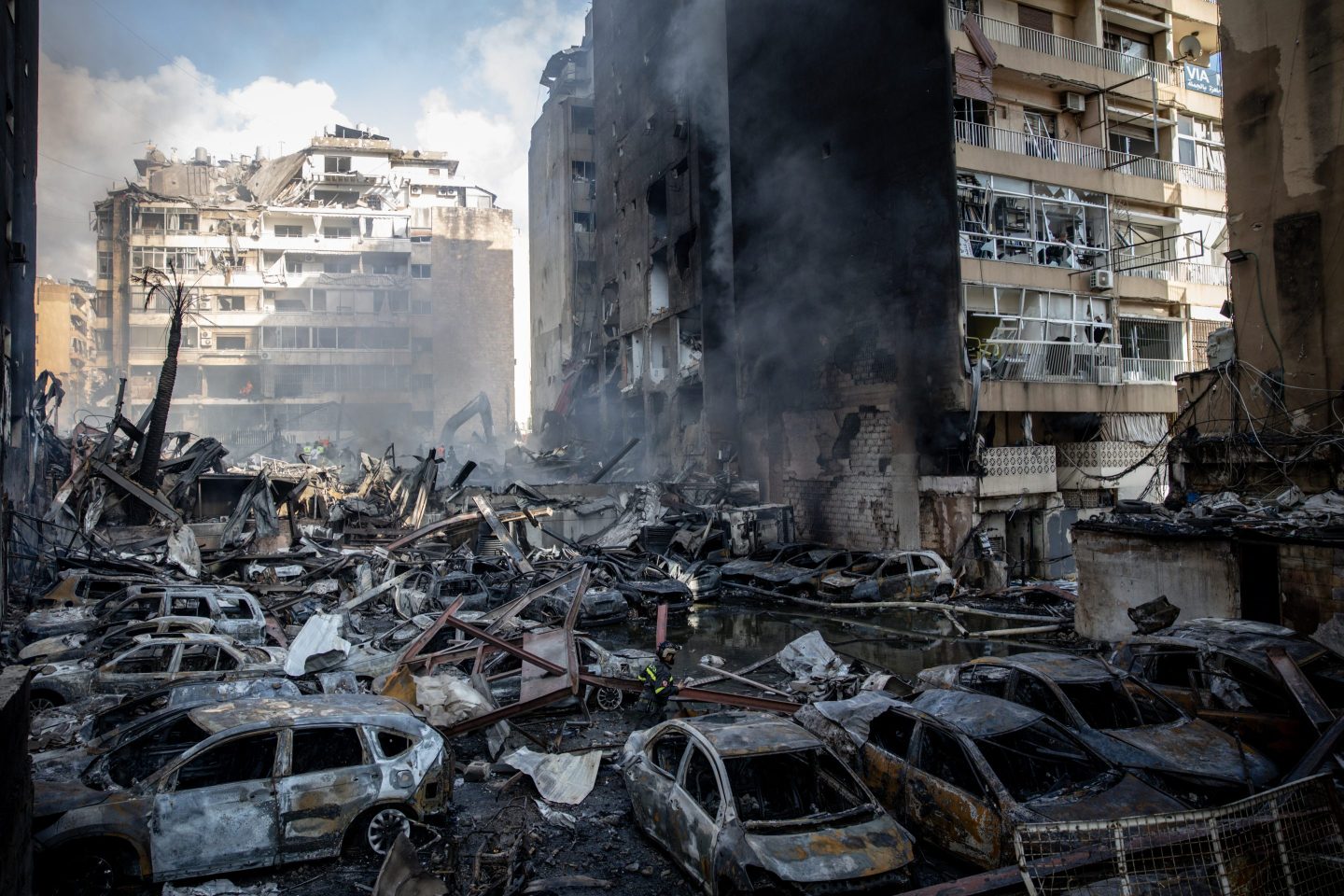
When the last U.S. military aircraft lifted off from Kabul Airport a minute before midnight in Afghanistan on Monday—7,267 days after dropping the first bombs there in October 2001—America seemingly shut the door on the 20-year war, and moved on. “We will lead with our diplomacy,” Secretary of State Antony Blinken said in a speech in Washington, to mark the moment. “The military mission is over.”
“Over,” perhaps—though not wrapped up. Left behind is the war’s mammoth expense, the bulk of it financed with borrowed money and whose financial impact could be felt for decades.
In two reports out on Wednesday, economists and social scientists unpacking the costs of the Afghanistan and Iraq wars, and far smaller engagements in Syria and Yemen, put the final tab at more than $8 trillion, well above previous estimates. About $2 trillion, they calculate, was spent on the Afghanistan war alone—double what President Joe Biden stated on Aug. 16, when he defended the tumultuous withdrawal from Afghanistan, in part by saying, “We spent over a trillion dollars.”
Biden was correct in one respect: The trillion-dollar sum comprises all military appropriations by the Pentagon for the Afghanistan war since 2001. But the figure did not include the interest payments on money the U.S. borrowed to fight the war. Nor did it include death benefits of about $704 million paid so far to the survivors of more than 7,000 U.S. soldiers killed in Afghanistan and Iraq, about 2,461 of them in Afghanistan. That figure is among several revealed in one of the new reports, The U.S. Budgetary Costs of the Post-9/11 Wars, published by the Costs of War project at Brown University’s Watson Institute and Boston University’s Frederick S. Pardee Center.
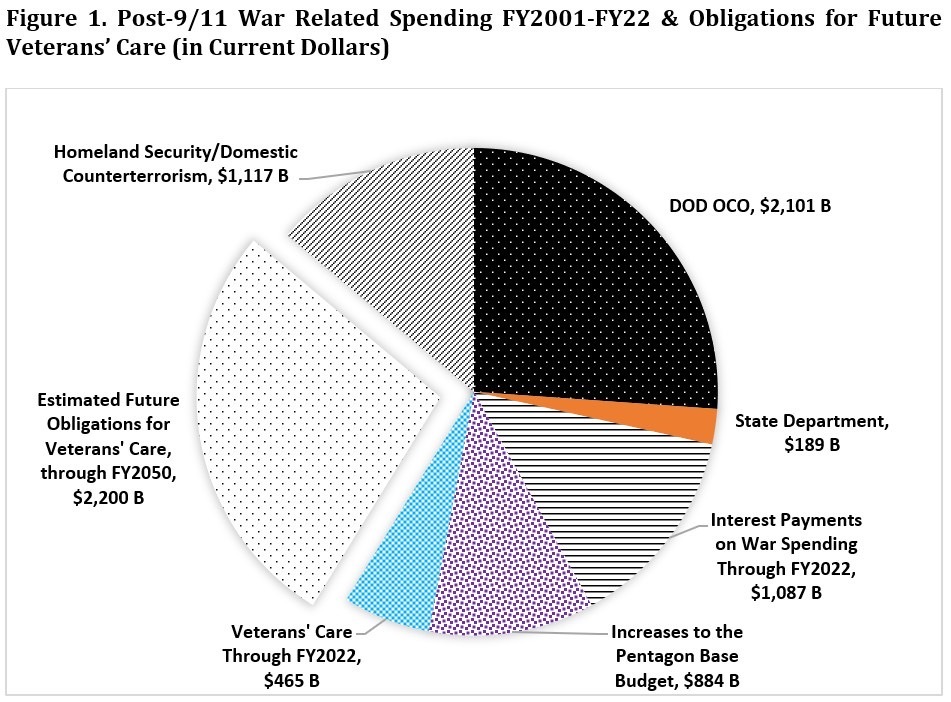
But the biggest-ticket item of all will far outlast the chaotic U.S. withdrawal: The medical benefits for wounded veterans, which the report estimates could reach about $2.3 trillion by 2050. That figure, say the researchers, is among the least-known financial burdens from the past two decades of war.
“What has consistently surprised me is how much veterans’ care has cost and will cost,” said the author of the report Neta C. Crawford, political science professor at Boston University and codirector of the Costs of War project. “These vets are sicker, and more injured, than in previous wars,” she said. The costs include long-term treatment for post-traumatic stress disorders and traumatic brain injuries—conditions that went undiagnosed among the vets who returned home from the Vietnam War in the 1970s. About 50,000 U.S. soldiers were wounded in Afghanistan and Iraq.
Despite the dizzying sums, few Americans have felt the financial burden from decades of war, especially since their federal taxes have gone down even while military costs have ballooned. Almost the entire cost of the Afghan and Iraq wars has come from borrowed money, much of which has yet to be repaid.
“It is difficult to image the scale of what we are talking about into the future,” Crawford told Fortune. “Million, billion, trillion—it all rhymes, but you’re looking at 1,000 times more with each increment,” she says. “When you look at how we’ll upgrade all the infrastructure in the U.S., it could all be done with a trillion dollars.”
Indeed, a second report, also out on Wednesday, calculates what the U.S. might have spent those trillions on, had it not launched wars in Afghanistan and Iraq. The Washington-based Institute of Policy Studies, or IPS, says the money spent on military combat could have solved multiple problems in the U.S., like erasing all student debt for $1.7 trillion, decarbonizing the entire electricity grid for $4.5 trillion, or providing COVID-19 vaccines to all low-income countries for just $25 billion—only slightly higher than the $20 billion the Pentagon budgeted in 2020 for the final year of the Afghan War.
“It really does come down to tradeoffs,” said Lindsay Koshgarian, who wrote the institute’s report, State of Insecurity: The Cost of Militarization Since 9/11. As she told Fortune, “The more we are spending on one thing, the less we are spending on other things.”
Those tradeoffs have also skewed military strategy, according to some analysts, who argue that the Pentagon’s intense focus on Afghanistan and Iraq has come at the expense of dealing with other conflicts that steadily emerged during the past 20 years.
“Beijing was busy building a military to fight and defeat a peer-level competitor,” Elliot Ackerman, a former U.S. Marine and intelligence officer who fought in Afghanistan, writes in the current issue of Foreign Affairs magazine. “Russia has expanded its territory into Crimea and backed separatists in Ukraine; Iran has backed proxies in Afghanistan, Iraq, and Syria; and North Korea has acquired nuclear weapons.”
Koshgarian, who heads the National Priorities Project at IPS, believes many Americans would support cuts in the military budget if the money was reallocated to health care and education. But last year two separate proposals for a 10% cut failed to pass in Congress. Now politicians are bitterly divided over whether to approve Biden’s request for $715 billion in military spending for the coming year or whether to cut the budget, now that the Afghan War has ended.
In the end Americans might not feel the military cost—just as they did not feel the pinch during the past 20 years. With the last U.S. soldier out of Afghanistan, the hundreds of billions could seem increasingly abstract.
Still, Koshgarian believes most would support cutting military spending in order to boost health care, education, and infrastructure. “There is a big divide between what Americans want and what our representatives in Washington are giving us,” she said. “National security and foreign policy are not top of the list when Americans go vote.”
Subscribe to Fortune Daily to get essential business stories straight to your inbox each morning.