After the U.K. stock market’s dire performance in 2020, there were hopes U.K. shares would stage a storming comeback this year, lifted by a Brexit trade deal and a strong recovery from the COVID pandemic.
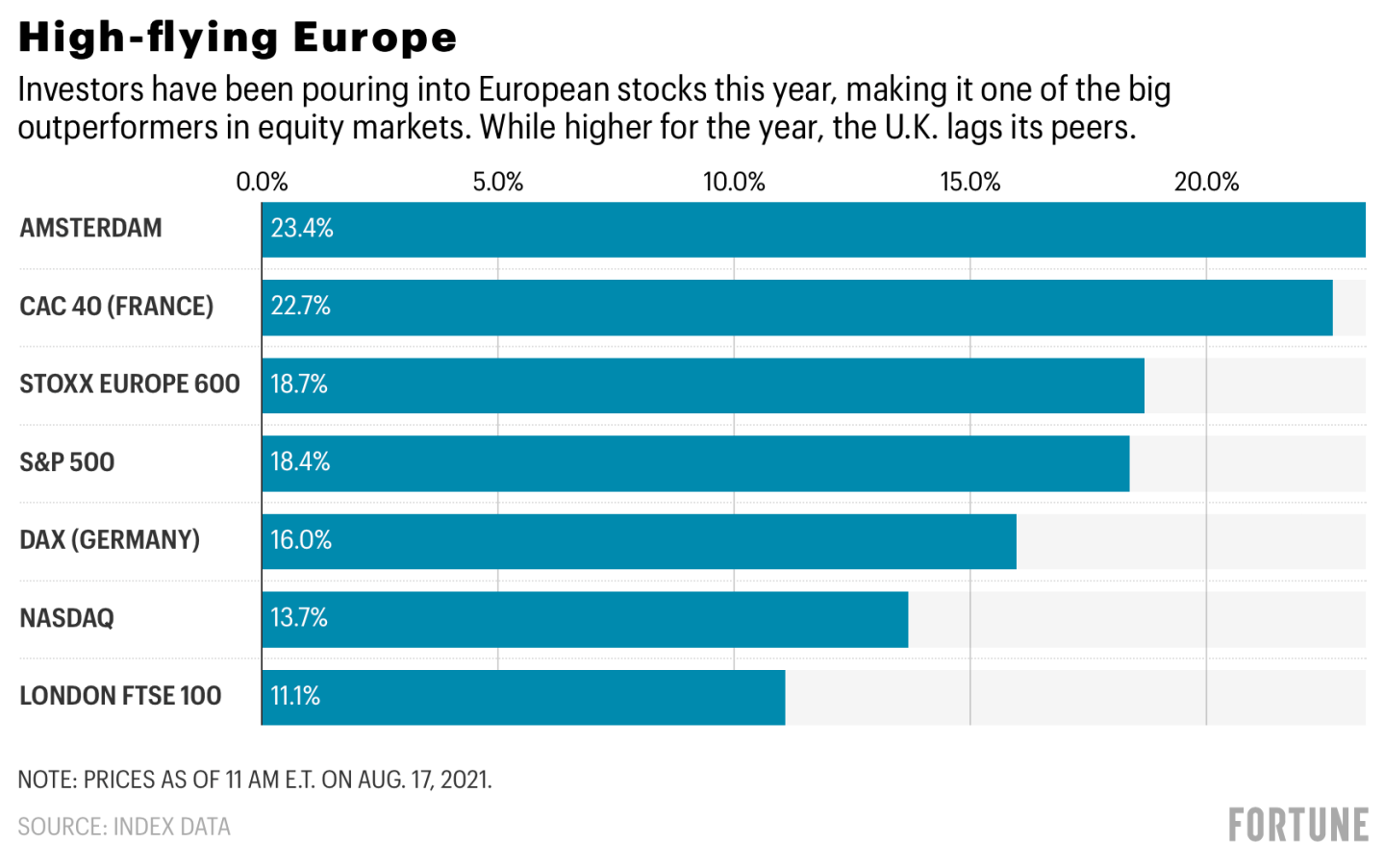
But so far the London market’s gains have been underwhelming. The flagship FTSE 100 index of the biggest U.K. companies is up 10% so far this year, but it is underperforming the S&P 500, up 19%, and the major bourses in the European Union, which Britain has just parted company with.
The Amsterdam and Paris exchanges are Europe’s star performers with gains of more than 22% so far this year, while Germany’s DAX is up 15%, including reinvested dividends.
Worse for London stocks is that this slow rise comes after the FTSE 100 slumped by 14% last year, one of the worst-performing major markets. The U.K. was hard hit by COVID last year, with 130,000 deaths to date and months of lockdown that sent the services-heavy economy into a tailspin, slashing GDP by a record 10% in 2020.
This year’s London stock recovery wasn’t supposed to be this slow. So why is the U.K. market so badly lagging its peers?
The weight of Brexit and the “old economy”
The year 2021 was meant to be when London shot ahead.
More than four years of uncertainty and wrangling following the 2016 Brexit vote to leave the EU ended with a Christmas Eve 2020 agreement that allowed tariff-free trade in goods between Britain and its biggest trading partner to continue after the U.K. left the bloc.
Britain then jumped ahead of other European countries by securing ample vaccine supplies and out-vaccinating them, allowing the government to end many restrictions and the economy to reopen. Britain’s 4.8% economic growth in the second quarter this year was the fastest in the Group of Seven major economies, according to Finance Minister Rishi Sunak.
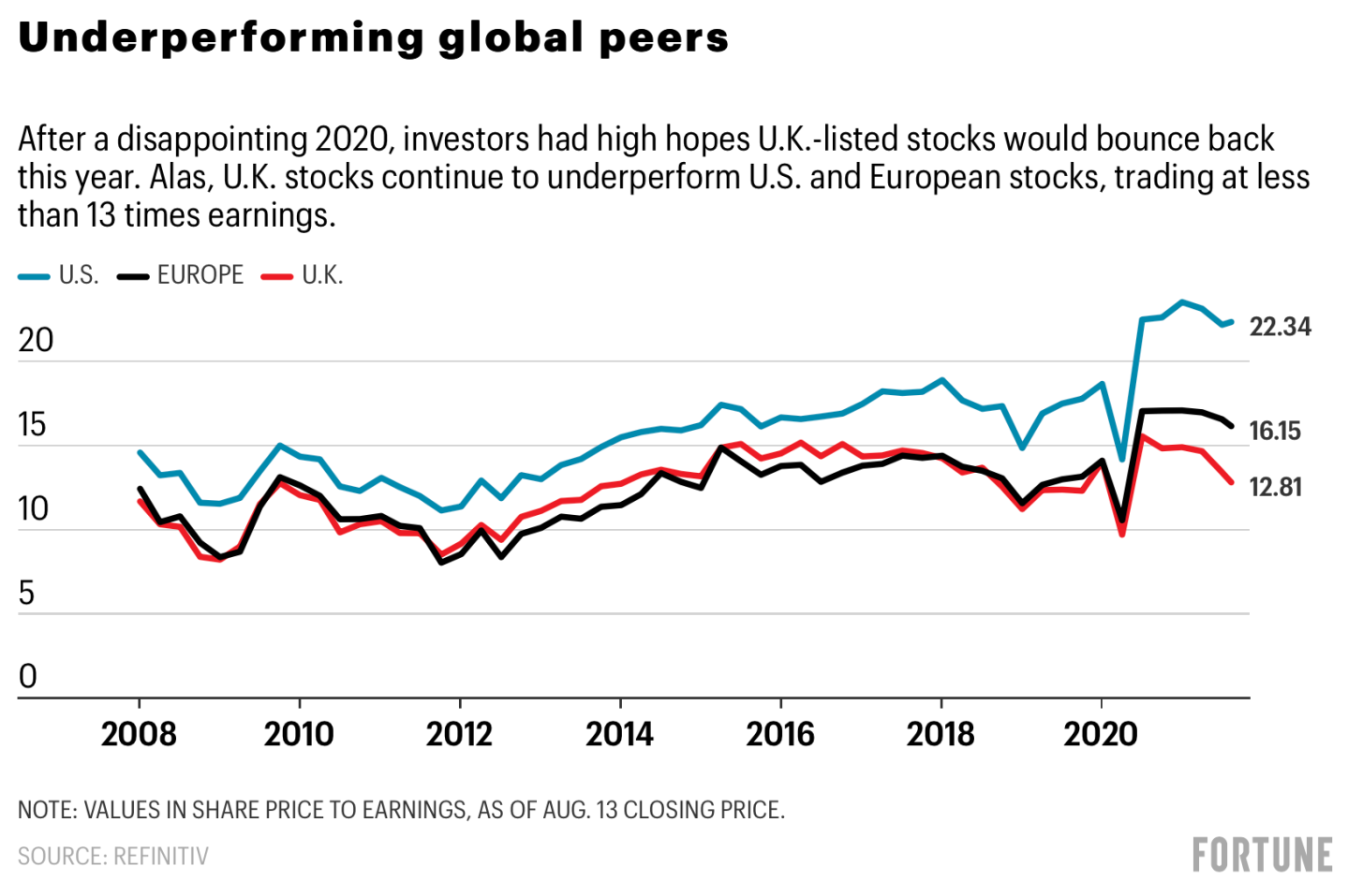
But a pall still hangs over U.K. shares, with investors awarding them a much lower valuation than international peers. U.K. shares, as of the Aug. 13 close, are trading at an average multiple of less than 13 times earnings, according to data provider Refinitiv, lagging European shares, which trade on a multiple of 16 times earnings, and far below the 22 multiple for U.S. shares.
Nick Kissack, U.K. portfolio manager at asset management firm Schroders, says a Brexit hangover in investors’ perceptions is part of the reason for the U.K. market’s underperformance.
Another factor is that the FTSE 100 is viewed as heavy on “old economy” companies—miners like Rio Tinto and BHP (which announced on Tuesday it will move to a primary listing in Australia), oil companies Shell and BP, cigarette companies British American Tobacco and Imperial Brands, and banks like Barclays and Lloyds. The U.K.’s most valuable company, worth $180 billion, is AstraZeneca, the pharma giant that partnered with Oxford University on the COVID vaccine given to most Brits.
“Unloved”
For years, however, investors’ focus has been firmly on growth stocks, especially tech stocks primed for fast future expansion. That has only increased during the pandemic as lockdowns accelerated the transition to online trade and showed how much we rely on technology. Unfortunately for the U.K., the FTSE 100 has few of the fast-growing tech companies that have driven U.S. indexes to record highs. No Apple, no Google, no Amazon.
The U.K.’s moment in the sun appeared to have arrived in the first few months of this year when rising inflation and interest rate expectations prompted a rotation to value stocks, shares that may be undervalued based on their earnings and dividends and which the U.K. is well supplied with. High inflation and rising interest rates are noxious for growth stocks as they reduce the current value of expected future earnings.
But the change turned out to be short-lived—growth stocks once again took the lead in midyear after central banks persuaded investors that a surge in inflation was only temporary and 10-year U.S. Treasury bond yields fell back.
To that end, Nick Hyett, equity analyst at investment firm Hargreaves Lansdown, says much of the London stock market’s underperformance can be chalked up to the fact that “the types of stocks that are listed in the U.K. are unloved.”
A U.K. discount?
What is making investment professionals scratch their heads is that some companies appear to trade at a discount simply because they are based in the U.K.—regardless of their performance and prospects.
Recent research by Schroders comparing U.K. businesses with equivalent companies in continental Europe, the U.S., and globally showed “a fairly pervasive and broad discount across a number of quality names,” Kissack told Fortune.
Several U.K. stocks that are among Schroders’ top 10 holdings—such as analytics firm RELX (formerly Reed Elsevier), insurer Prudential, and medical device specialist Smith & Nephew—trade at hefty discounts to global peers for no obvious reason, he said.
Hyett of Hargreaves Lansdown notes that many of the companies being hit with a kind of U.K. discount are not even closely tied to the U.K. economy.
Companies like consumer goods groups Unilever and Reckitt Benckiser and drinks giant Diageo are “businesses that are in the U.K. almost in name only,” Hyett said. “They have subsidiaries all over the world; they trade all over the world. The success or failure of the U.K. economy is a blip in the context of overall results in many cases.”
Furthering the confusion, the FTSE 250 index of midcap companies that are generally more domestically focused than the FTSE 100 members has grown more quickly than the large-cap FTSE 100—up 16% so far this year.
Some investors have started to spot opportunities in these low U.K. valuations. Takeovers of U.K. companies have risen by 277% so far this year to $232 billion, according to Refinitiv. Cybersecurity company NortonLifeLock is paying more than $8 billion for Czech Republic–based Avast, one of the few big tech firms in the FTSE 100. U.S. engineering firm Parker-Hannifin has offered a 70% premium for U.K. aerospace firm Meggitt, sparking a possible takeover battle, and two U.S. private equity firms are vying to buy U.K. supermarket chain Morrisons.
Kissack said that U.K. equities remained cheap compared to global markets, and he expected them to bounce back.
“As the market gets comfortable in a post-Brexit world, the valuation discount that’s being applied to the U.K. versus continental European peers or global peers such as the U.S. should gradually narrow,” he said. “If it isn’t done by global asset allocators, it will be done via M&A.”
The sterling effect
Other market experts say the U.K. stock market’s underperformance compared with European competitors is less pronounced if one takes account of the strengthening of the British pound as the Brexit fog cleared and the pace of vaccinations stepped up.
Sterling has gained 11% in value against the euro and 19% against the U.S. dollar since the depths of the pandemic in March 2020, so measured in dollars or euros, U.K. stock market gains would be much greater.
But the stronger pound has also hit the big multinational companies in the FTSE 100, which book revenues globally in a variety of currencies and then translate the profits back into pounds, taking the shine off their results. That has been a particular issue for mining and energy companies whose products are priced in dollars.
Joachim Klement, head of investment strategy at investment bank Liberum Capital, said stronger sterling accounted for 90% of the U.K. stock market’s underperformance compared with continental European markets.
He is bullish on the prospects for both U.K. and European stocks. The U.K. and Europe were “pretty much on track” to average a 20% return this year, “and I think we will get another 15% to 20% next year,” he told Fortune.
Klement said he expected the U.K. economy to grow more strongly than the rest of Europe and possibly also the U.S. in the second half of 2021 and 2022 as hotels and restaurants reopen and the economy bounces back, an advantage that would translate into marginally better performance by U.K. equities compared to their European peers.
But while he expects pent-up demand to lead to higher investment in the U.K. this year and next, Klement believes the U.K. economy’s medium- to long-term prospects “have definitely been damaged by Brexit, especially given that we now have a relatively hard Brexit.”
More finance coverage from Fortune:
- What are stablecoins? Your guide to the fast-rising alternative to Bitcoin and Ethereum
- Adidas gives Reebok the boot. Will this go down as one of the worst sportswear acquisitions ever?
- As climate worries spike, green bonds are having a moment. Should you invest?
- The daunting challenge ahead for Disney CEO Bob Chapek
- Crypto platform offers $500,000 “bug bounty” to hacker for returning stolen assets
Subscribe to Fortune Daily to get essential business stories straight to your inbox each morning.