This is the web version of Business By Design, a weekly newsletter exploring design’s transformative influence on industry and enterprise. Sign up to get it delivered free to your inbox.
Hi! Nicole Gull McElroy here taking over for Business by Design. A little about me: I began my career covering breaking news at regional newspapers throughout the Midwest, followed by time on staff at national magazines Inc. and Men’s Journal, writing and editing stories on startups and outdoor adventure. While at Fortune, I’ve been covering a mix of women in business, consumer packaged goods brands, growth strategy, and finance.
When Bracken Darrell started his CEO job at Logitech in 2013, he had set a quiet intention. In his years working for companies steeped in industrial design (Procter & Gamble, GE, Braun, Whirlpool) he became convinced that design can transform an organization, not only via product innovation, but through relationships, customer experience, culture, and so much more.
“I wanted to create a design company,” he says. “And I was looking for a place to do it.” Logitech, a Swiss software company that designs products and services that connect users to experiences across gaming, video, music, and computing, had a stock price per share of $6 at the start of 2013 and was worth $1 billion. The company’s GAAP net income was a loss of $250 million by the end of FY2013. The business was in trouble, and Darrell knew that if he entered a room full of engineers and told them to solve their problems, they’d need to reinvent themselves as designers, that it may not go so well.
Designers have long been framed as the creatives in the corner who swoop in at the last moment to make everything look pretty. Darrell’s vision was instead about problem solving, innovation, and using design as a way of thinking and relating. A lot of companies, he says, start with a product and build out to the user. His definition of design? “Putting the user in a chair and building the experience around them.” Darrell believed that focus could truly change Logitech’s trajectory, but he first needed to learn all he could about the company’s product design and process. “I didn’t hire a designer and I didn’t look for one,” he says. “I wanted to be involved in every product myself.” One year in, Darrell was ready.
Around the same time, Alastair Curtis had just left his post as chief designer at Nokia to set up his own design consultancy. “I was asked to fly to meet with some Logitech senior leadership and share my ideas on design and the company’s challenges,” Curtis recalls. “I had done some analysis and was pretty brutal on where they were. They had no creative compass and the brand wasn’t in a great place as far as reaching a younger audience.” Curtis returned a few weeks later to meet with Darrell and later bumped into him at the Geneva airport. The two shared a beer and joked that maybe a test drive was in order. Over the following nine months, Curtis worked alongside Darrell as an external partner, getting to know Logitech’s culture, meeting with teams across the globe, and gathering information to fuel a working list of design principles on which to recast the business.
Now Curtis sits on the company’s executive team as chief design officer. Curtis’s role, says Darrell, is an integral part of the leadership team and has helped develop and inform a new kind of collaboration and thinking at Logitech. The business is worth 20 times more than when Darrell started, and the executive team has leveraged a design mindset to make all sorts of changes: from cutting two weeks off the time spent on closing quarterly financials, to reinventing the company’s tollgate process on how new products are developed, and incorporating things like sustainability and inclusion into the fiber of the design process. With this approach, Darrell and Curtis believe the company has the potential to keep moving, growing, and changing for years to come.
A 2020 McKinsey study revealed a distinct shift toward investing in design in the top 100 companies. Forty of those surveyed had, like Logitech, hired a chief design officer. The problem, the study showed, was that in those 100 companies there was a gap in understanding in 90% of cases between the CEOs and CDOs on both the ambition and clarity of the role. “It was only back in the 1980s that design leadership was defined around color, material, and finish,” says Benedict Sheppard, partner and global leader of design research at McKinsey. “Then it was seen in middle management as an art, rather than a science. It’s not surprising that there is a lack of clarity. We are in a moment where design leadership is really coming to fruition as an executive role. CEOs are seeing the value and putting people in that role, but it’s taking a little bit of time.”
Sheppard speaks quarterly with more than 30 chief design officers at a roundtable he holds, collectively representing $2 trillion in revenue and 3 billion users. He is optimistic, noting two themes that emerged in his 2020 research. The first, he says, is ambition. Sheppard says one in 10 of the CEOs he talked to say they include both the chief design officer and the head of strategy in any long-term planning or talks on growth trajectory. That, of course, calls for the second theme: clarity. Ambition works only if the players are accountable, says Sheppard. This can be tricky in terms of design, though. “If you’re the head of sales, and you miss your numbers, you don’t get paid,” he says. “Only one in three CEOs we spoke to could say with real precision what their design head was accountable for.”
That gap is where both frustration and potential live. The dynamic among C-suite executives is changing, and as more companies leverage design to grow, managing ambition and clarity is critical. “In a simple way, [design] is the rigorous practice of analysis, strategy, and innovation that often reframes problems to create new solutions,” says Rosanne Somerson, president at the Rhode Island School of Design. “Think about something that works well, and then think about something that doesn’t work well, and you’re beginning to think about a design process.” Sheppard uses the production of a refrigerator as a concrete example: “An old-fashioned way is to make the product and packaging and that’s it,” he says. “But what if you produce a fridge and ask questions like, ‘What impact can I have on food choice? Food waste? How can I help people live healthier lives?’ If you’re asking those questions then you’re going to end up in an extraordinary place.” That, he says, is where design comes in and ambition and clarity meet to address the customer experience in a deeper, more nuanced way.
From a broader perspective, as Logitech grows, Darrell says he believes the company has managed through the first two tiers of design thinking. The first, aesthetic. The second, building around the user—helping to answer questions like the ones Sheppard suggests with the fridge. The third, he says, is the most complex tier and one he is sure no company has yet reached: using design to reimagine every aspect of the business, from the user experience, to the employee experience, to even how the building meets the needs of the business it houses. “I have this view that the world moves on marginal gains and a few bold moves,” he says. “That’s the way a company has to work. CEOs and leadership teams have to be unafraid to change.”
It’s the initial impetus to change, though, that can be the most difficult step. Justin Maguire has been leading design at cloud-based software company Salesforce since 2015, and assumed the role of chief design officer there in 2019. “I didn’t go to school and learn design with a focus on ethics and equality,” says Maguire, who is based in San Francisco. “Yet, now we are being called upon to embody our company values, shareholder values, and stakeholder values, and to carry that mindset into what we are designing.” For Maguire, his role at Salesforce is entirely about fostering collaboration and bringing humanity to technology. The approach has led Salesforce to launch a designer role and certification in the company’s ecosystem this June, allowing users on the platform to employ the practice of relationship design to create and ship apps that shareholders and stakeholders love. “Fundamentally, we need to think about the relationship between people, product, and planet,” says Maguire. “What it means to practice design today is different than 10 or 20 years ago.”
Carrying that notion into the C-suite and helping it permeate all levels of an organization isn’t easy, says Maguire, and lands squarely on trust. “The way my role has transformed here is simply by earning trust,” he says. “If I was hired tomorrow by another company in this role, that might be my title, but it would take me time to earn it. The biggest gift at Salesforce was a culture that understood that. They gave me the time to learn the business, our customers, employees, and grow from there.”
Curtis agrees. Communication and idea exchange, he says, need to be at the root of that trust. While he and Darrell don’t necessarily speak daily, Curtis knows that Darrell and his C-suite counterparts have his back and that together as a leadership team they’re working toward the same goals, solving not just design problems but all challenges the business faces. “It allows you to challenge each other in a healthy way,” he says. “When you have that, the chief design officer can succeed and sit at the table with an equal chair.”
Nicole Gull McElroy
P.S.: We’re looking for nominations for Fortune’s annual 40 Under 40 list, in which we spotlight the best and brightest in business, government, tech, and culture all under the age of 40. If you’d like to submit a nomination, please do so by the July 19 deadline.
NEWS IN DESIGN
General Motors re-opened on July 5 its newly expanded Advanced Design Center in Shanghai with more than 53,000 square feet of space meant to live on the forefront of cutting-edge automotive innovation. In September 2019, the company appointed Harry Sze as director of design there, and now will be bolstering a focus on electric vehicles and smart cars. The move comes with the intention of entirely dropping petrol and diesel vehicles from its fleet by 2035 and was marked with an opening ceremony to reveal a multimedia sculpture from artist Liu Jaiyu, representing what’s possible in the future of transportation.
Work began July 3 on the first 3d printed home in Virginia. Less expensive, faster and more sustainable, the technology layers concrete to build a home that just may have the possibility of solving a housing crisis and making homeownership approachable for a broader population. The Richmond project is funded by a $500,000 Virginia Housing grant awarded to the Virginia Center of Housing Research at Virginia Tech. The roughly 1,550 square foot 3D home is estimated to cost about $180,000 to $190,000 to build and could sell in the range of $210,000 to $220,000. The technology has emerged globally in other housing markets this year, too, from Texas, California and New York to Germany and the Netherlands.
Hyundai Motor Group and Rhode Island School of Design have teamed up to research the future of cities. The new project explores how artists and designers can leverage technology to fuel innovation in biomimicry and community design, cellular life and biosensing, and natural resource systems and infrastructures. The idea is to apply the outcomes of the research partnership to innovative vehicle design and smart city development.
THE MUSE
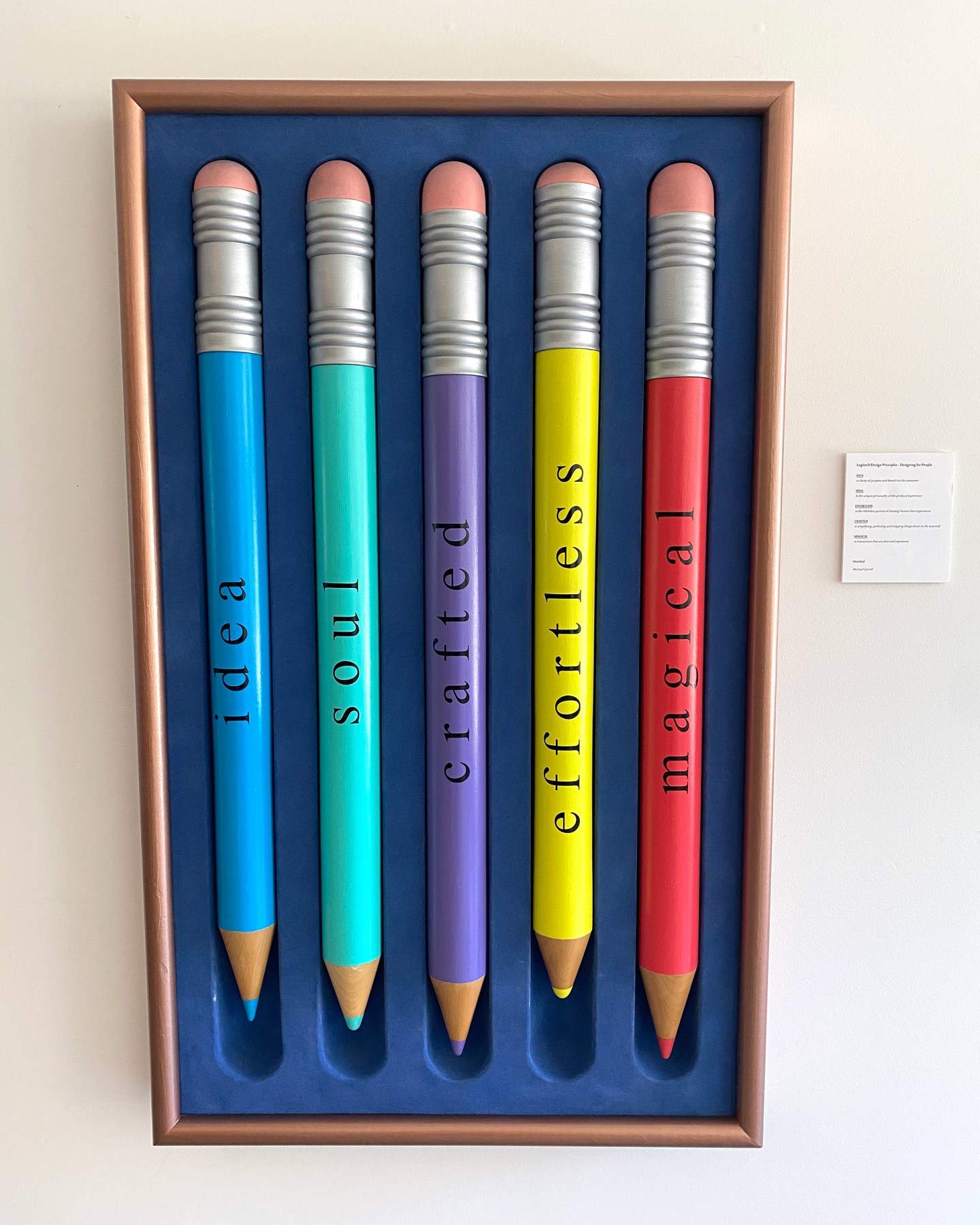
In order of appearance:
- One Powerful Idea: clarity of purpose and the benefit to the consumer
- Soul: unique personality of the product/experience
- Crafted: simplifying, perfecting, and stripping down to the essential
- Effortless: relentless pursuit of creating friction-free experiences
- Magical: interactions that are alive and expressive
Subscribe to Fortune Daily to get essential business stories straight to your inbox each morning.