This story is part of The Path to Zero, a series of special reports on how business can lead the fight against climate change. This quarter’s stories go in-depth on sustainability in supply chains.
Step inside a Starbucks café anywhere in the world, and the scene is instantly familiar: upbeat background music, the barista placing a drink down on the pickup counter, and the customer’s name written in marker on one of the 6 billion disposable cups Starbucks serves every year—nearly one for every human on planet Earth.
But that ritual could soon change, at least in some countries. After years of ballooning waste, the world’s biggest coffee company announced in early June that it plans to introduce reusable cups in all 3,480 of its outlets in Europe, the Middle East, and Africa by 2025.
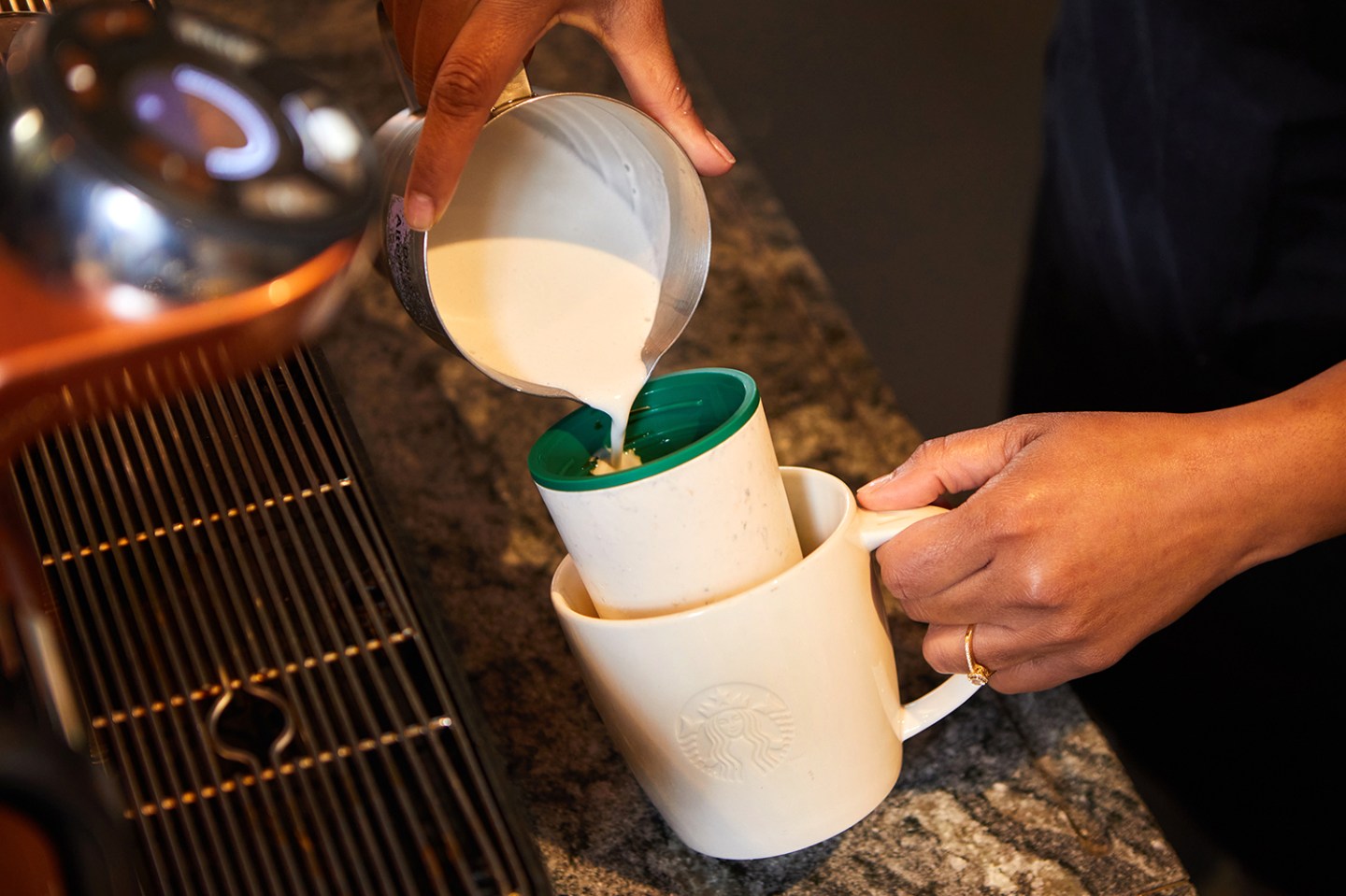
The rollout will begin during the next few months in France, Germany, and the U.K.—all countries weighing bans on single-use packaging—with customers paying a deposit on each reusable cup, refundable when they return it. The company says it plans to reuse the cups 30 times before discarding them.
In the United States, Starbucks began a similar two-month trial in five Seattle cafés in April and May, offering reusable cups for $1 deposits, which it returns along with 10 Starbucks Rewards points. That came after an entire year in which the company eliminated reusable mugs, citing COVID-19 safety.
To some environmentalists, Starbucks’ rollout of reusable cups seems far too tentative given the global plastics crisis; the company’s paper cups are plastic-lined, making most of them nonrecyclable. The company says it will also try to phase out the billion or so plastic straws it uses every year, after the pandemic scuttled its plans to do so by 2020.
To analysts who have monitored Starbucks’ carbon footprint for years, the reusable cup plan seems far too cautious.
“The timeline is not aggressive enough, and it needs to be across their global business. But it is in the right direction,” says Graham Forbes, who heads the global plastics campaign for Greenpeace USA.
Starbucks says the cup plan is one part of a far bigger commitment to halve its worldwide carbon emissions by 2030.
That is a huge challenge—one that will require far more than offering reusable cups.
Starbucks uses vast amounts of water and land at the beginning stages of its global supply chain, in the production of coffee beans and milk; it sources its beans from about 400,000 farmers in about 50 countries. It is from those early stages of production that its greatest carbon emissions derive.
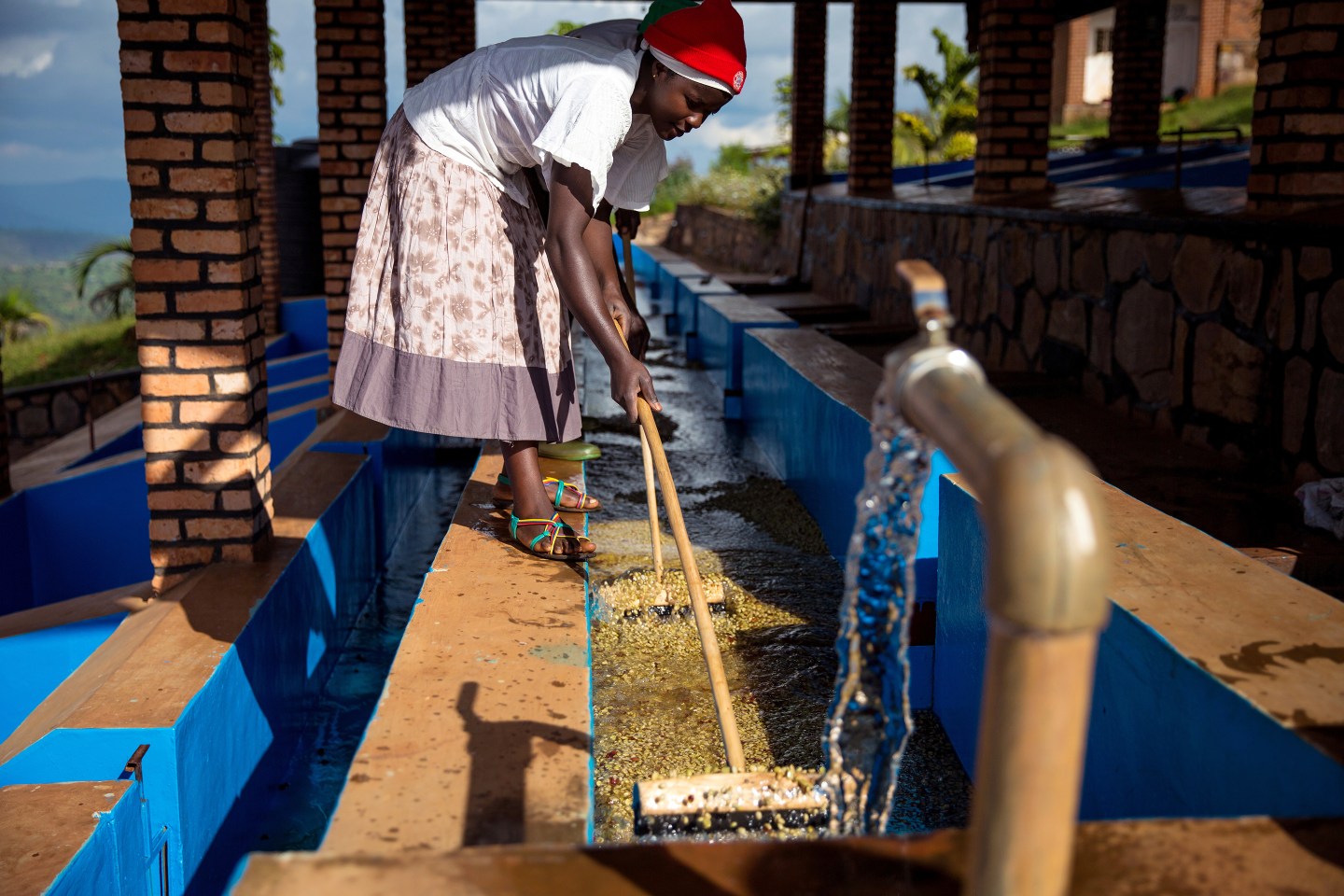
In March, it laid out a plan to overhaul farming methods, with the goal of creating “carbon-neutral coffee” by the end of this decade, by planting climate-resistant coffee trees and investing in 600 high-tech coffee mills that consume 80% less water, then distributing them to producers in Guatemala, Rwanda, Peru, Mexico, and Kenya.
In another effort to conserve natural resources, the company began promoting alternatives to cow’s milk—a move that CEO Kevin Johnson says has already paid off big financially. He told investors in April that customers had been “overwhelmingly positive” about oat-milk drinks, helping to drive a 53% increase in Starbucks’ milk-drink sales during the previous quarter, “a clear testament to the relevance of our sustainability agenda,” Johnson said.
Even so, the end stage of Starbucks’ supply chain—the baristas placing cups on the counter—is a highly visible problem.
“We must make reusability the only option, long term,” Duncan Moir, Starbucks’ EMEA president, proclaimed, without specifying what “long term” means. While the company had made “great strides” in decreasing single-use cups, he said, “there is more to be done.”
That is a serious understatement.
The $128 billion giant generated about 868,000 tons of waste in 2018 alone, according to an audit by consultancy Quantis and the World Wildlife Fund, which Starbucks commissioned. The trash added about 1.3 million tons of greenhouse gases to the atmosphere, out of Starbucks’ total that year of 16 million tons.
Countless Instagram sites with names like #starbucksgarbage feature Frappuccino and plastic-lined paper coffee cups discarded across the world, items that contribute to the 8.8 million tons of plastics dumped in the world’s oceans each year.
Most ironic, perhaps, is the logo printed on each one: a mythical sea siren that Starbucks says honors its port-city home of Seattle, where the company was founded 50 years ago, and that its website explains is “staring into your soul as you drink your latte.”
That stare might just be one of strong disapproval.
Back in 2008, Starbucks promised that by 2015 it would serve one-quarter of its drinks in the U.S. in reusable cups. But by 2018, just 1.3% of Starbucks cups were reusable.
“They failed that miserably,” says Conrad MacKerron, senior vice president of As You Sow, an environmental shareholder activist group in Berkeley. In 2019, its shareholder resolution demanding Starbucks stick to its plastic-use commitments won an impressive 44.5% of votes, about a 50% jump on a similar resolution the previous year, signaling rising concern among investors.
“Even after that, the company did not exactly jump up and talk to us,” MacKerron notes. He says he finally flew to Seattle to meet with Starbucks execs. The company crafted a plan for reusable cups, says As You Sow, after “months of constructive dialogue” with the group. “We had to go back to them and say, ‘This is huge, you have to step it up,’” MacKerron recalls.
Then came the pandemic. With billions stuck at home, Starbucks’ annual revenue plummeted about 11.3% last year. Starbucks would not tell Fortune how much it spends on sustainability, saying only in an email that its “sustainability journey is a comprehensive approach, woven into every aspect of our company.”
CEO Kevin Johnson told investors on an earnings call in April that management had used the lockdown period to work on its environmental strategies. Just as millions began returning to offices, grabbing coffees on the way, he told them he thought a Starbucks outlet should be “a place that inspires and nurtures the human spirit,” reflecting a company with “a purpose that goes beyond the pursuit of profit.”
All that sounds good, but environmentalists say that in the U.S., Americans’ increasing grab-and-go culture has helped drive the company’s growth.
“Five or 10 years ago, it was easy to go into a Starbucks and get a reusable cup,” says Forbes of Greenpeace USA. “They wouldn’t look at you weird if you asked for a mug.” Forbes recently tried that at a Starbucks café near his home in Monterey, Calif. He says it turned into an awkward exchange with the barista. “They looked around, confused,” he says.
Changing consumers’ wasteful habits will not be easy, as other businesses’ experience has shown. Boston Tea Party, a British coffee company, suffered a 25% drop in coffee sales after it abandoned single-use coffee cups in 2018. The company’s CEO, Sam Roberts, said in 2019 that he had tried to offer reusable cups with a deposit—as Starbucks plans to do—and found that only 5% of customers wanted them.
In the end, true change might come with laws. In 2019, the European Commission directed the bloc’s 27 member countries to implement bans on some single-use plastics by July 3 of this year, including disposable cups made of certain nonrecyclable plastics. And similar laws are already in force in South Korea, the only place where Starbucks has a plan to eliminate disposable cups entirely.
In parts of Europe, many customers are already accustomed to deposits for cups. They are increasingly common at mass events like the French Open tennis tournament, where for years only hard-plastic reusable cups have been on offer, for a one-euro deposit.
Contrast that with the U.S., where several proposals to ban single-use packaging have failed to pass in Congress, in large part because of heavy lobbying from the plastics industry. And in China, where Starbucks expects to have 6,000 outlets by the end of next year, the company has no plans to phase out single-use cups, because there is little legal requirement to do so. More likely is the plan for a global plastics treaty; the U.S. has not publicly backed the plan, but environmental groups believe it will eventually do so.
If Starbucks finally moves toward reusable cups, as Moir, its EMEA president, says is necessary, the company might one day need to redesign its logo, with a smile on its sea siren—though not before it tackles its biggest market, the U.S.
Subscribe to Fortune Daily to get essential business stories straight to your inbox each morning.