Subscribe to Data Sheet, a daily brief on the business of tech, delivered free to your inbox.
Since many offices shut down last year and meetings went online via videoconferencing, a growing body of research has found the trend damaging to workers’ mental health.
The “Zoom gloom” phenomenon reflects the added stress and lack of human contact inherent in virtual meetings, whether on the Zoom app or one of its many rivals. But new neurological research from Microsoft released on Tuesday offers advice for reducing the negative effects of virtual meetings.
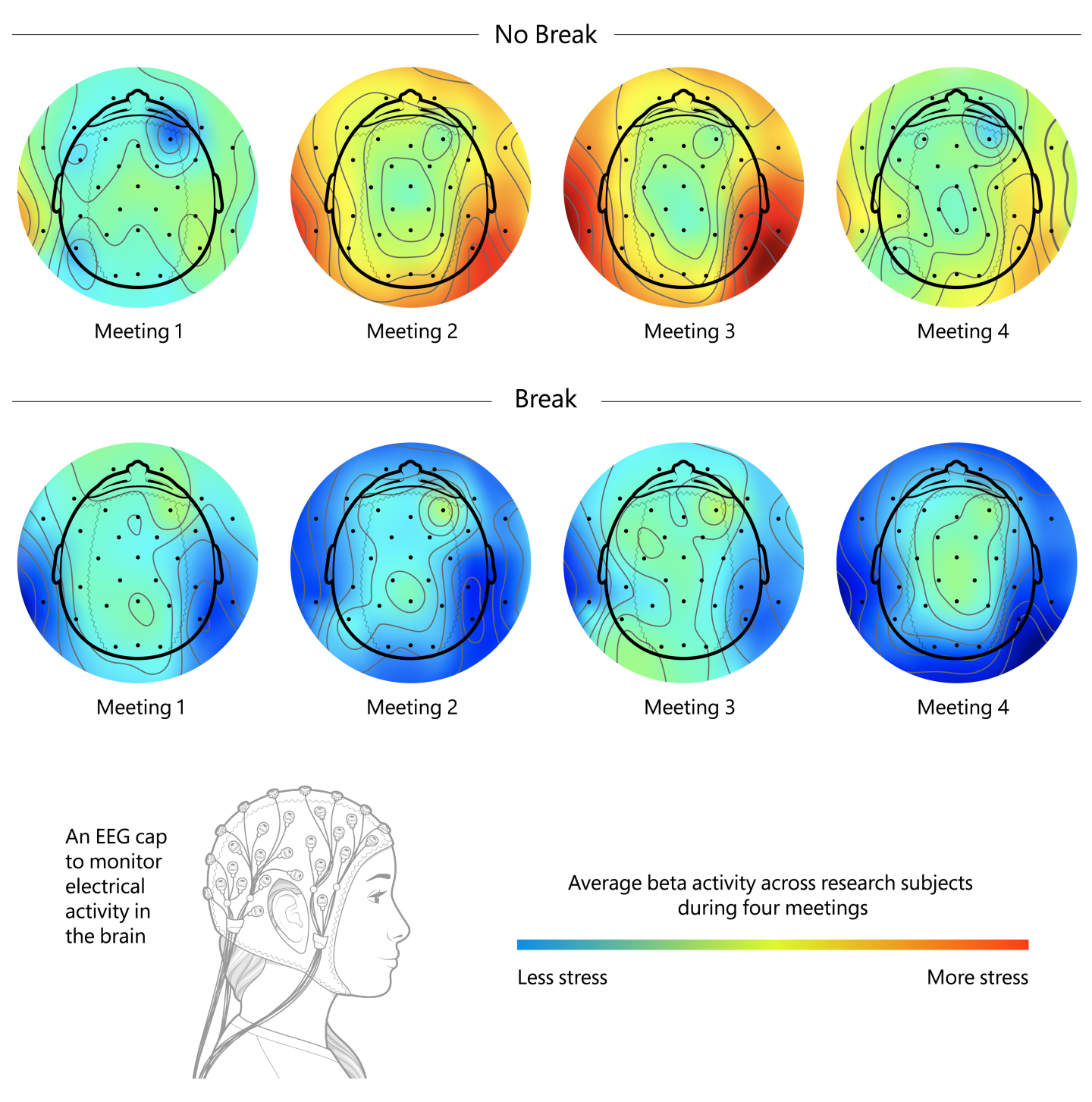
A team of researchers at Microsoft’s “human factors lab” hooked 14 people up to electroencephalogram (EEG) equipment, devices that record electrical activity in the brain. The team then put the people through two days of videoconferenced meetings.
On one day, participants attended four half-hour meetings, on four different subjects, back-to-back over two hours. On a second day, participants got 10-minute breaks between the meetings. During the breaks, participants were assigned short meditation activities.
The study found that stress, as measured by so-called beta wave activity in the brain, rose during each of the back-to-back meetings, and that it rose almost consistently, accumulating during the two hours. Beta wave activity is associated with typical work tasks, but also “with stress and anxiety, when it’s at high levels for extended periods of time,” says Michael Bohan, senior director of the lab, who worked on the study.
When participants got a break and meditated between meetings, stress levels were lower and did not build up over time. Instead, they “reset” back to a low level after each break, the researchers found.
“Breaks do, in fact, give your brain a chance to reset,” Bohan says. “And it’s not just that you’re not as fatigued, you’re actually bringing more of your ‘A game’ to each of these meetings. You’re able to be more engaged and more focused.”
The software giant is planning to assist in a small way. Its Outlook calendar app will now allow companies to set as a default that all meetings start a few minutes after the hour or end a few minutes before. Individual users can still adjust the meeting start and end times as they see fit.
“There are ways that technology can help,” says Jared Spataro, corporate vice president on the company’s Microsoft 365 office software team. If companies set the defaults to suggest between-meeting breaks, “this is a signal that they want to send about how they’re thinking about employees’ well-being.”
Microsoft’s findings are consistent with other research of workplace stress. Stanford’s “virtual human interaction lab” studied the psychological effects of virtual meetings, and it found several hidden causes of stress, including excessive close-up eye contact, sitting in one place for too long, and lack of nonverbal body clues. Jena Lee, a professor at the University of California, Los Angeles, last year identified several factors contributing to Zoom gloom, including audio delays that make people feel distrusting and increased cognitive effort due to lack of nonverbal communications cues.
Microsoft has been expanding its role in studying the workplace and changing its apps, particularly as COVID-19 shutdowns prompted the massive shift to remote work. The company’s MyAnalytics feature in its Office apps reports how much time users spend on email and chat outside of regular working hours every week, and it indicates that the extra activity may be a source of stress. The feature also suggests setting aside time on one’s calendar for uninterrupted work that requires deeper concentration.
Zoom itself has offered some advice about reducing the stress from too many virtual meetings. In a blog post, the company suggested hiding self-view or turning off the user’s own camera, based on research that seeing oneself during meetings heightened stress levels.
More must-read tech coverage from Fortune:
- Google Earth’s new tool shows the Antarctica-melting ruins of climate change
- The idea of COVID-19 vaccine passports raises privacy concerns
- Mercedes-Benz unveils the new EQS sedan, its flagship electric car
- Jim Cramer sold Bitcoin to pay his mortgage
- One year into the pandemic, video game sales aren’t slowing down