• Home
  • Latest
  • Fortune 500
  • Finance
  • Tech
  • Leadership
  • Lifestyle
  • Rankings
  • Multimedia
Finance

The price of lumber is up over 200%—and pre-COVID levels might never return

By
Lance Lambert
Lance Lambert
Former Real Estate Editor
Down Arrow Button Icon
By
Lance Lambert
Lance Lambert
Former Real Estate Editor
Down Arrow Button Icon
April 20, 2021, 10:51 AM ET

Our mission to make business better is fueled by readers like you. To enjoy unlimited access to our journalism, subscribe today.

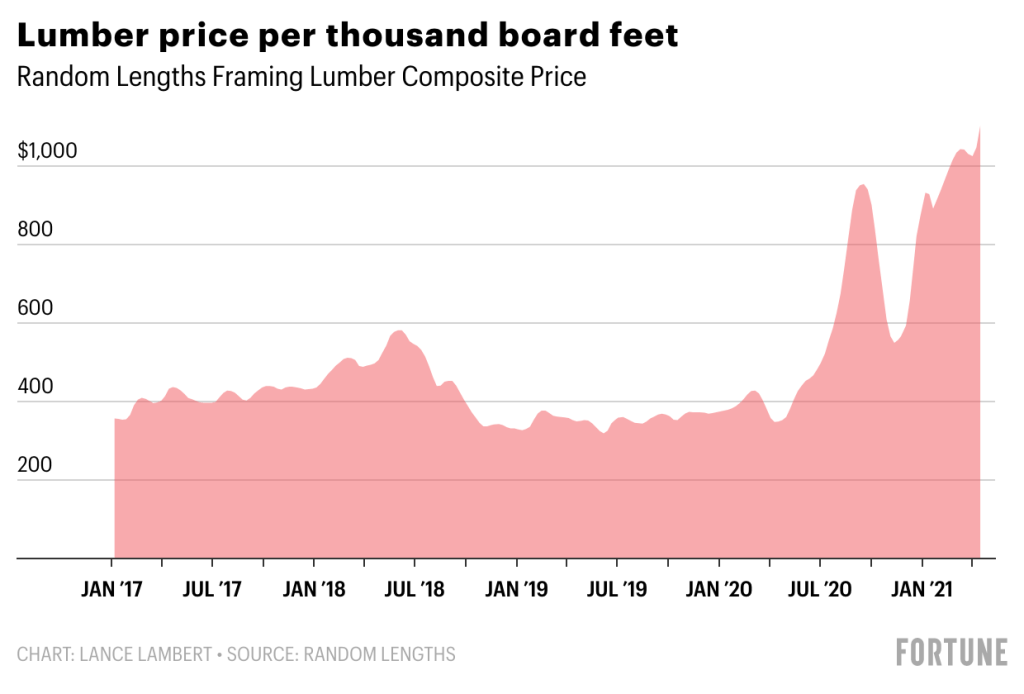
Homebuilders and do-it-yourselfers just can’t catch a break: On Friday, the price per thousand board feet of lumber jumped to an all-time high of $1,104, according to Random Lengths. That’s up a staggering 208% from a year ago.

For months, lumberyards and homebuilders held off on buying lumber in hopes that prices would correct before spring and summer building kicked off. Price relief hasn’t materialized, so now they’re rushing to buy. That frenzy is sending prices further north: On Monday, the May futures contract price per thousand board feet of two-by-fours jumped $32 to $1,326. That uptick once again triggered the circuit breakers and caused lumber trading to halt for the day.

Why haven’t prices corrected back to pre-COVID levels? Simply, backlogged supply can’t catch up to robust demand. But the full story is a perfect economic storm worthy of its own business school case study.

When the pandemic struck last year, shutdowns caused sawmills to halt production at the same time quarantining Americans rushed to Home Depot and Lowe’s to buy up materials for do-it-yourself projects. That supply-and-demand mismatch caused lumber inventory to plummet. It only got worse from there. Aided by recession-induced record low interest rates, the housing market boomed in the summer of 2020. As that market got hotter and existing home inventory fell, buyers turned to new construction. Of course, new homes require a lot of lumber, thus exacerbating the shortage.

On the supply side, production is finally rebounding: Wood production hit a 13-year high in February. But because of limited mill capacity and labor shortages, that alone can’t solve the scarcity. Classic economic theory suggests surging prices should help to dampen demand. That hasn’t happened yet. In fact, the demand for lumber has only gone higher. In March, new housing starts hit its highest levels since 2006.
Tight-budgeted DIYers don’t want to hear this, but pre-pandemic lumber prices might never return.

“I don’t think we ever go back to levels we had prior to this boom,” Michael Goodman, director of specialty products at Sherwood Lumber, told Fortune.

Why? Demographically speaking, we’re going to need a lot more lumber in the years ahead. The five largest years for millennial births occurred between 1989 to 1993. And we’re currently in the five-year window when this seismic group of younger millennials will hit the age of 30—an all-important age for first-time homebuying. A Fortune-Researchscape International poll conducted in April found 54% of these young millennials plan to buy a home in the next five years. But as the result of years of under-building following the 2008 housing bust, the country doesn’t have enough homes to accommodate that level of buying. That’s why we’re already seeing these millennial buyers cause housing inventory to dry up: The total number of homes for sale in the U.S. has dropped over 50% in the past 12 months. That means builders—and lumberyards—should remain plenty busy.

That is, if supply can keep up. Currently, sawmill capacity is too low. And even if capacity grows, it doesn’t fix the limited supply of Canadian softwood lumber, which—unlike abundant Southern yellow pine—is the go-to for framing homes.

“If the production factors remain that are limiting log supply, I find it hard to believe we return to historical price ranges,” Stinson Dean, CEO of Deacon Lumber, told Fortune.

Returning to the April 2020 price of $358 per thousand board feet is a pipe dream. But don’t scratch off the possibility of a mild pullback. If sky-high prices finally cause demand to slow a bit, Goodman says later this year we could get back to around $800.


About the Author
By Lance LambertFormer Real Estate Editor
Twitter icon

Lance Lambert is a former Fortune editor who contributes to the Fortune Analytics newsletter.

See full bioRight Arrow Button Icon

Latest in Finance

InvestingSports
Big 12 in advanced talks for deal with RedBird-backed fund
By Giles Turner and BloombergDecember 13, 2025
9 hours ago
Spanish Prime Minister Pedro Sánchez often praises the financial and social benefits that immigrants bring to the country.
EuropeSpain
In a continent cracking down on immigration and berated by Trump’s warnings of ‘civilizational erasure,’ Spain embraces migrants
By Suman Naishadham and The Associated PressDecember 13, 2025
11 hours ago
EconomyAgriculture
More financially distressed farmers are expected to lose their property soon as loan repayments and incomes continue to falter
By Jason MaDecember 13, 2025
12 hours ago
InvestingStock
There have been head fakes before, but this time may be different as the latest stock rotation out of AI is just getting started, analysts say
By Jason MaDecember 13, 2025
15 hours ago
Politicsdavid sacks
Can there be competency without conflict in Washington?
By Alyson ShontellDecember 13, 2025
15 hours ago
Investingspace
SpaceX sets $800 billion valuation, confirms 2026 IPO plans
By Loren Grush, Edward Ludlow and BloombergDecember 13, 2025
16 hours ago

Most Popular

placeholder alt text
Success
Apple cofounder Ronald Wayne sold his 10% stake for $800 in 1976—today it’d be worth up to $400 billion
By Preston ForeDecember 12, 2025
2 days ago
placeholder alt text
Economy
Tariffs are taxes and they were used to finance the federal government until the 1913 income tax. A top economist breaks it down
By Kent JonesDecember 12, 2025
2 days ago
placeholder alt text
Success
40% of Stanford undergrads receive disability accommodations—but it’s become a college-wide phenomenon as Gen Z try to succeed in the current climate
By Preston ForeDecember 12, 2025
2 days ago
placeholder alt text
Economy
The Fed just ‘Trump-proofed’ itself with a unanimous move to preempt a potential leadership shake-up
By Jason MaDecember 12, 2025
1 day ago
placeholder alt text
Success
Apple CEO Tim Cook out-earns the average American’s salary in just 7 hours—to put that into context, he could buy a new $439,000 home in just 2 days
By Emma BurleighDecember 12, 2025
2 days ago
placeholder alt text
Economy
For the first time since Trump’s tariff rollout, import tax revenue has fallen, threatening his lofty plans to slash the $38 trillion national debt
By Sasha RogelbergDecember 12, 2025
2 days ago
Rankings
  • 100 Best Companies
  • Fortune 500
  • Global 500
  • Fortune 500 Europe
  • Most Powerful Women
  • Future 50
  • World’s Most Admired Companies
  • See All Rankings
Sections
  • Finance
  • Leadership
  • Success
  • Tech
  • Asia
  • Europe
  • Environment
  • Fortune Crypto
  • Health
  • Retail
  • Lifestyle
  • Politics
  • Newsletters
  • Magazine
  • Features
  • Commentary
  • Mpw
  • CEO Initiative
  • Conferences
  • Personal Finance
  • Education
Customer Support
  • Frequently Asked Questions
  • Customer Service Portal
  • Privacy Policy
  • Terms Of Use
  • Single Issues For Purchase
  • International Print
Commercial Services
  • Advertising
  • Fortune Brand Studio
  • Fortune Analytics
  • Fortune Conferences
  • Business Development
About Us
  • About Us
  • Editorial Calendar
  • Press Center
  • Work At Fortune
  • Diversity And Inclusion
  • Terms And Conditions
  • Site Map

© 2025 Fortune Media IP Limited. All Rights Reserved. Use of this site constitutes acceptance of our Terms of Use and Privacy Policy | CA Notice at Collection and Privacy Notice | Do Not Sell/Share My Personal Information
FORTUNE is a trademark of Fortune Media IP Limited, registered in the U.S. and other countries. FORTUNE may receive compensation for some links to products and services on this website. Offers may be subject to change without notice.