• Home
  • News
  • Fortune 500
  • Tech
  • Finance
  • Leadership
  • Lifestyle
  • Rankings
  • Multimedia
Techclimate change

Google Earth’s new tool shows the Antarctica-melting ruins of climate change

By
Danielle Abril
Danielle Abril
Down Arrow Button Icon
By
Danielle Abril
Danielle Abril
Down Arrow Button Icon
April 15, 2021, 9:00 AM ET

Subscribe to Data Sheet, a daily brief on the business of tech, delivered free to your inbox.

Google Earth is debuting a new time-lapse tool that offers up 3D satellite images of the world spanning the past four decades.

People can use the feature to see the ravaging effects of climate change. In one instance, users can watch 12 miles of the Columbia Glacier in Alaska melt away from 1984 to 2020. Similarly, they can see the fastest-melting glacier in Antarctica, the Pine Island Glacier, disintegrate.

“We can objectively see global warming with our own eyes,” Rebecca Moore, director of Google Earth, said during a preview demonstration. “Time lapse distills [an] enormous archive of satellite data into an easily understandable picture of our changing planet. It makes the abstract concrete.”
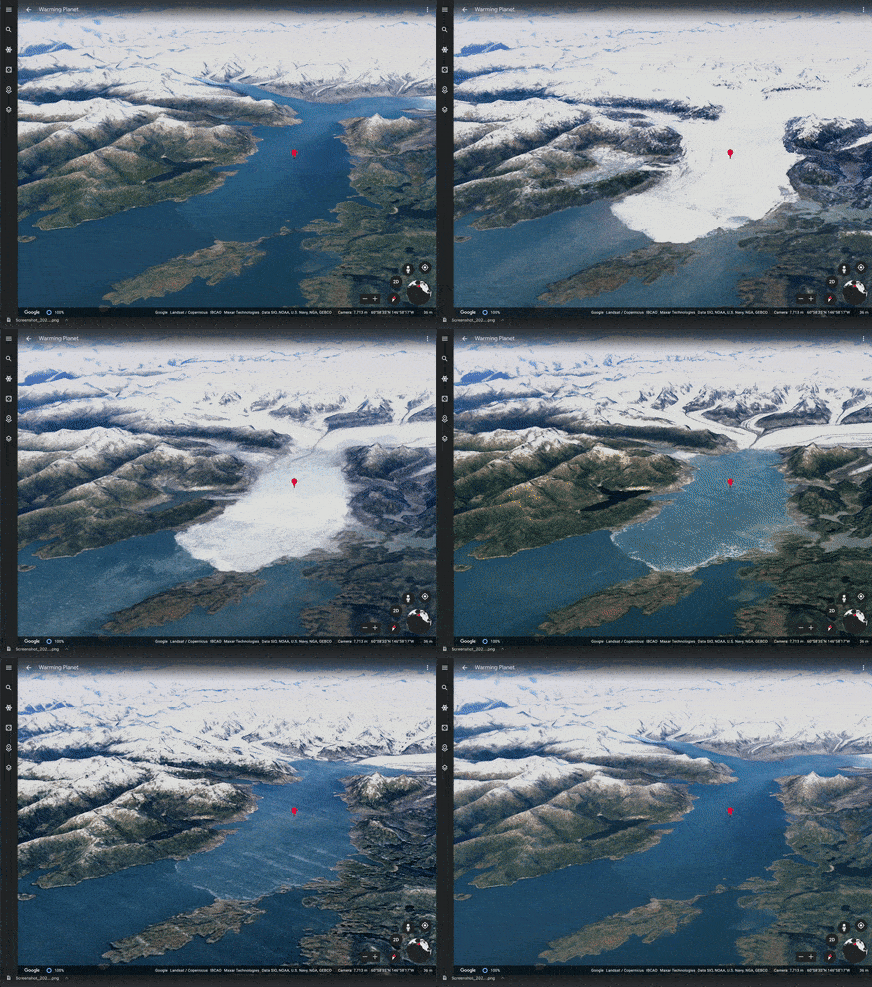
A time-lapse image from Google Earth shows the melting of the Columbia Glacier in Alaska.
Courtesy of Google Earth

Google developed the new feature with help from government partners, including NASA, the U.S. Geological Survey, the European Commission, and the European Space Agency. The collaborators provided 24 million satellite images from the past 37 years.

People can explore the interactive maps independently or by using Google Earth’s Voyager, a guided tour of five thematic stories including rising global temperatures. People can also download 800 time-lapse videos Google Earth has made available in 2D and 3D.

Google Earth’s tool comes as the ruinous effects of climate change become clearer around the world. Wildfires in California are now regular emergencies, displacing thousands of people and saturating the air with dangerous levels of smoke and debris. Meanwhile, historic winter storms in Texas recently left millions of residents without heat and water and led to hundreds of deaths.

Satellite imagery helps scientists study things like the thickness of ice glaciers to explore a polar environment in flux. These images also serve as resources for educators to teach students about climate change. The Google Earth team is hoping the new time-lapse tool will help both professionals and the public get a better understanding of what’s at stake and inspire action.

“Time lapse and Google Earth sits at the nexus of science, technology, public-private partnerships, and the next generation as we think about both climate change and climate action,” Moore said. “It’s about taking a big step back to check in on the health and well-being of our only home.”

In addition to showing the effects of climate change, Google Earth’s time-lapse tool enables people to see the effects of deforestation across the Amazon, hurricanes in places like Cape Cod, and the vanishing Aral Sea in Kazakhstan. Google Earth said it plans to update the time-lapse tool with new satellite images at least once a year. 

More must-read tech coverage from Fortune:

  • Volvo draws first blood with Nvidia’s “Orin” chip in quest for self-driving cars
  • How Google’s workers are pushing for a better Google
  • Intel CEO on Nvidia competition: “We are playing offense, not defense”
  • 1Password acquires Dutch startup SecretHub to hone secret-keeping
  • New players are piling into the world’s largest electric vehicle market—no auto experience required

About the Author
By Danielle Abril
See full bioRight Arrow Button Icon

Latest in Tech

personalized
AIGoogle
Google VP says the AI revolution is just a matter of time: ‘The younger generation is really feeling like it’s a native part of how they work’
By Nick LichtenbergDecember 4, 2025
50 minutes ago
ServiceNow president Amit Zavery
AIServiceNow
ServiceNow’s president says acquiring identity and access management platform Veza will help customers track the whereabouts of AI agents
By Jeremy KahnDecember 4, 2025
1 hour ago
NewslettersTerm Sheet
How Anthropic grew—and what the $183 billion giant faces next
By Allie GarfinkleDecember 4, 2025
2 hours ago
Andrew Ross Sorkin and Alex Karp speak onstage during The New York Times DealBook Summit 2025 at Jazz at Lincoln Center on December 03, 2025 in New York City.
C-Suitepalantir
Palantir CEO Alex Karp defends being an ‘arrogant prick’—and says more CEOs should be, too
By Eva RoytburgDecember 4, 2025
3 hours ago
Apple head of user interface design Alan Dye speaking in a video for the company's 2025 WWDC event. (Courtesy Apple)
NewslettersFortune Tech
Meta poaches Apple interface design chief Alan Dye
By Andrew NuscaDecember 4, 2025
3 hours ago
InnovationBrainstorm Design
Should form always follow function? Architect Ole Scheeren isn’t sure: ‘We think of buildings as living organisms’
By Christina PantinDecember 4, 2025
7 hours ago

Most Popular

placeholder alt text
North America
Jeff Bezos and Lauren Sánchez Bezos commit $102.5 million to organizations combating homelessness across the U.S.: ‘This is just the beginning’
By Sydney LakeDecember 2, 2025
2 days ago
placeholder alt text
Economy
Ford workers told their CEO 'none of the young people want to work here.' So Jim Farley took a page out of the founder's playbook
By Sasha RogelbergNovember 28, 2025
6 days ago
placeholder alt text
North America
Anonymous $50 million donation helps cover the next 50 years of tuition for medical lab science students at University of Washington
By The Associated PressDecember 2, 2025
2 days ago
placeholder alt text
C-Suite
MacKenzie Scott's $19 billion donations have turned philanthropy on its head—why her style of giving actually works
By Sydney LakeDecember 2, 2025
2 days ago
placeholder alt text
Innovation
Google CEO Sundar Pichai says we’re just a decade away from a new normal of extraterrestrial data centers
By Sasha RogelbergDecember 1, 2025
3 days ago
placeholder alt text
Economy
Scott Bessent calls the Giving Pledge well-intentioned but ‘very amorphous,’ growing from ‘a panic among the billionaire class’
By Nick LichtenbergDecember 3, 2025
20 hours ago
Rankings
  • 100 Best Companies
  • Fortune 500
  • Global 500
  • Fortune 500 Europe
  • Most Powerful Women
  • Future 50
  • World’s Most Admired Companies
  • See All Rankings
Sections
  • Finance
  • Leadership
  • Success
  • Tech
  • Asia
  • Europe
  • Environment
  • Fortune Crypto
  • Health
  • Retail
  • Lifestyle
  • Politics
  • Newsletters
  • Magazine
  • Features
  • Commentary
  • Mpw
  • CEO Initiative
  • Conferences
  • Personal Finance
  • Education
Customer Support
  • Frequently Asked Questions
  • Customer Service Portal
  • Privacy Policy
  • Terms Of Use
  • Single Issues For Purchase
  • International Print
Commercial Services
  • Advertising
  • Fortune Brand Studio
  • Fortune Analytics
  • Fortune Conferences
  • Business Development
About Us
  • About Us
  • Editorial Calendar
  • Press Center
  • Work At Fortune
  • Diversity And Inclusion
  • Terms And Conditions
  • Site Map

© 2025 Fortune Media IP Limited. All Rights Reserved. Use of this site constitutes acceptance of our Terms of Use and Privacy Policy | CA Notice at Collection and Privacy Notice | Do Not Sell/Share My Personal Information
FORTUNE is a trademark of Fortune Media IP Limited, registered in the U.S. and other countries. FORTUNE may receive compensation for some links to products and services on this website. Offers may be subject to change without notice.