• Home
  • Latest
  • Fortune 500
  • Finance
  • Tech
  • Leadership
  • Lifestyle
  • Rankings
  • Multimedia
Environmentclimate change

From concrete to steel, how construction makes up the ‘last mile’ of decarbonization

By
Katherine Dunn
Katherine Dunn
Down Arrow Button Icon
By
Katherine Dunn
Katherine Dunn
Down Arrow Button Icon
February 16, 2021, 5:18 AM ET

This article is part of Fortune‘s Blueprint for a climate breakthrough package, guest edited by Bill Gates.

It’s been called the “last mile” of decarbonization.

As companies and countries worldwide map out how they will hit net-zero emissions by 2050, some elements of the vast shift are relatively straightforward: Cars will go electric; power grids will adopt clean energy.
Fortune worked with Bill Gates and his colleagues at Breakthrough Energy and Gates Ventures to put together this extensive package of stories on the signal crisis of our age. That crisis is not the COVID-19 pandemic—it’s climate change. Click the image above to read the rest of the stories.

But when it comes to buildings, engineers and policymakers alike hit a hurdle: Even a house covered with solar panels is likely to contain concrete and steel—some of the most intractable sectors when it comes to emissions. To make truly low-carbon buildings, researchers say we must embrace breakthrough technology, from hydrogen to carbon capture, and explore new ways of designing concrete, industrial products, and even houses themselves.

The stakes are high. Between the energy they consume and their construction, buildings are responsible for nearly 40% of the world’s emissions, according to the International Energy Agency. To truly produce a zero carbon house, office, or shop, every industry involved in its construction and maintenance must be decarbonized first, says Dabo Guan, a professor of climate change economics at University College London’s Bartlett School of Construction and Project Management.

When buildings are constructed, “they trigger the whole economic supply chain,” says Guan. “And the emissions of the supply chain are very big.”

“Like making a cake”

When it comes to concrete, “the only thing we use more as humans is water,” says Jeremy Gregory, executive director of MIT’s Concrete Sustainability Hub.

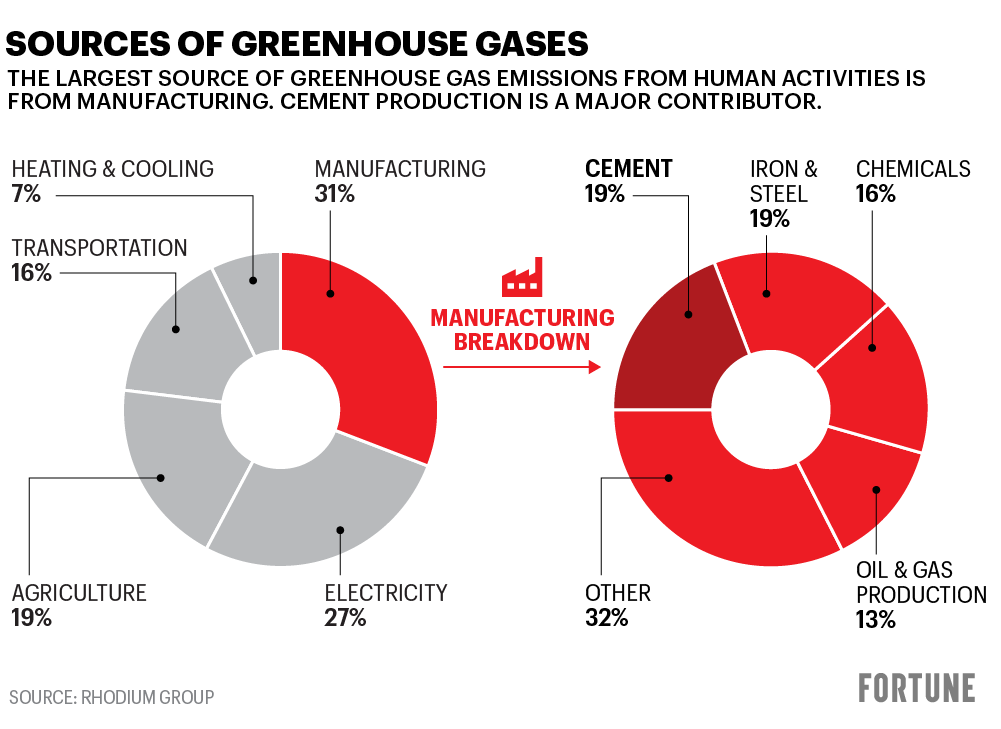
At the heart of concrete is cement: the key binding agent that turns sand and water into one of the world’s most ubiquitous materials. In 2019, the world produced roughly 4.1 billion tons of cement, according to the IEA. It’s also extremely hard to decarbonize. Cement itself must be formed at extremely high temperatures and is the product of a chemical process that naturally produces carbon dioxide. Collectively, it is responsible for up to 8% of global emissions, says Gregory.

Because it’s extremely difficult to use renewable energy to produce the energy intensity needed for ultrahigh temperatures, truly low-carbon cement will likely rely on carbon capture, storage, and utilization, which prevents CO2 from being released into the atmosphere, either by injecting it into the ground or—potentially—into the concrete itself.

There is also another approach that could help, says Gregory: diluting, or even replacing, the cement in concrete. These options already exist: The ancient Romans used volcanic ash as a binding agent to make concrete. But it’s possible to use a large number of waste products, including fly ash—a by-product from coal plants. Some blends can reduce the carbon intensity by as much as 70% compared to conventional cement and will produce a product that’s just as good.

It’s “sort of like making a cake,” says Gregory. “You can use whole wheat flour. It’ll still look like a cake. It’ll just taste a little bit different.”
Reduce, reuse, recycle

Steel struggles with some of the same problems as concrete. Mainly, it must be produced at high temperatures, and, to a lesser degree, some CO2 also results from the process. Steel has one advantage—it can more easily be recycled—but that, too, has challenges. There is not enough to meet demand, and reprocessing requires energy, says Richard Curry, a program manager at Sustain, the Future Steel Manufacturing Research Hub based at the University of Swansea in Wales.

Logistically, recycling can be challenging and degrade the quality of the metal. As with concrete, the most feasible solutions are carbon capture, utilization, and storage—even if those are not yet commercially mainstream.

Embracing better design—from buildings to infrastructure to, yes, electric cars—to make them easier to disassemble so that their parts can be accessed and recycled could help, says Cameron Pleydell-Pearce, Sustain’s deputy director.

Another option, he says, is reusing.

“One of the things that we’re looking at in a very great level of detail is the degree to which we can understand which product and trace which product is coming out of a steel mill at a particular point, and then what happens to it as it goes through its life cycle,” he says.

Unlike even recycling, that would offer a major advantage: It comes with almost no CO2 emissions at all.

Warm in winter, cool in summer

When it comes to design, there’s another potential solution staring us in the face: drawing inspiration from what our buildings used to look like.

A traditional house in New England, for example, would have had south-facing windows, maximizing the sunshine and minimizing the darkness in winter, says Anna Dyson, the founding director of Yale University’s Center for Ecosystems in Architecture.

Houses all over the world have traditionally been designed and built to best work with the climate, she adds, but “over the course of the 20th century, as buildings became more and more reliant on cheap fossil fuels, then it wasn’t so required to be really, really careful about orientation and working with climate.”

Also, to manage the indoor temperatures, houses were built in shapes and sizes that suited their climates. In humid locations, home designs included ample ventilation and steep roofs to enhance air flow. In arid climates with hot days and cold nights, houses were roomy and light-colored to reflect heat. Those principles, along with making use of biodegradable materials, from timber to straw to coconut husks and bamboo, are ideas that some architects like Dyson are now looking back to.

Of course there are no silver bullets. Houses still need energy for lights and heating, preferably clean energy, Dyson points out. And now we face the prospect of not just making houses that are suited to the next 100 years, but also finding ways to retrofit the ones that have already lasted a century.

“We’ve got a long way to go,” says Dyson. “But we’ve got a lot that we can do with design.”

Explore Fortune’s Blueprint for a climate breakthrough package:

  • Why it matters that the U.S. rejoined the Paris climate agreement
  • Bill Gates on why the ‘miracles’ of solar and wind energy won’t save us from climate change—and the breakthroughs that just might
  • This ancient Roman material could unlock the secret to building greener and longer-lasting buildings
  • What the future of clean energy may depend on
  • Bill Gates: How ‘Green Premiums’ can help us solve climate change
  • These are the biggest trends in clean tech in 2021, investors say
  • Dartmouth’s engineering dean on why buildings are the frontier for tackling climate change
  • The electrification of the auto industry is speeding up—and shaking up the energy economy
  • 8 photos show the ‘human footprint on the land’
  • From concrete to steel, how construction makes up the ‘last mile’ of decarbonization
  • Inside the ambitious venture Bill Gates built to beat climate change
  • Business leaders hope they can satisfy Biden’s big climate goals with their own promises—not regulation
  • Meet the next generation of global climate activists
  • Review: In an important new book, Bill Gates offers a real-world plan for avoiding a ‘climate disaster’
  • Why we asked Bill Gates to be Fortune’s guest editor today

Our mission to make business better is fueled by readers like you. To enjoy unlimited access to our journalism, subscribe today.
About the Author
By Katherine Dunn
LinkedIn iconTwitter icon
See full bioRight Arrow Button Icon

Latest in Environment

Finance
Lorem ipsum dolor sit amet, consectetur adipiscing elit, sed do eiusmod tempor incididunt ut labore et dolore magna aliqua. Ut enim ad minim veniam
By Fortune Editors
October 20, 2025
Finance
Lorem ipsum dolor sit amet, consectetur adipiscing elit, sed do eiusmod tempor incididunt ut labore et dolore magna aliqua. Ut enim ad minim veniam
By Fortune Editors
October 20, 2025
Finance
Lorem ipsum dolor sit amet, consectetur adipiscing elit, sed do eiusmod tempor incididunt ut labore et dolore magna aliqua. Ut enim ad minim veniam
By Fortune Editors
October 20, 2025
Finance
Lorem ipsum dolor sit amet, consectetur adipiscing elit, sed do eiusmod tempor incididunt ut labore et dolore magna aliqua. Ut enim ad minim veniam
By Fortune Editors
October 20, 2025
Finance
Lorem ipsum dolor sit amet, consectetur adipiscing elit, sed do eiusmod tempor incididunt ut labore et dolore magna aliqua. Ut enim ad minim veniam
By Fortune Editors
October 20, 2025
Finance
Lorem ipsum dolor sit amet, consectetur adipiscing elit, sed do eiusmod tempor incididunt ut labore et dolore magna aliqua. Ut enim ad minim veniam
By Fortune Editors
October 20, 2025

Most Popular

Finance
Lorem ipsum dolor sit amet, consectetur adipiscing elit, sed do eiusmod tempor incididunt ut labore et dolore magna aliqua. Ut enim ad minim veniam
By Fortune Editors
October 20, 2025
Finance
Lorem ipsum dolor sit amet, consectetur adipiscing elit, sed do eiusmod tempor incididunt ut labore et dolore magna aliqua. Ut enim ad minim veniam
By Fortune Editors
October 20, 2025
Finance
Lorem ipsum dolor sit amet, consectetur adipiscing elit, sed do eiusmod tempor incididunt ut labore et dolore magna aliqua. Ut enim ad minim veniam
By Fortune Editors
October 20, 2025
Finance
Lorem ipsum dolor sit amet, consectetur adipiscing elit, sed do eiusmod tempor incididunt ut labore et dolore magna aliqua. Ut enim ad minim veniam
By Fortune Editors
October 20, 2025
Finance
Lorem ipsum dolor sit amet, consectetur adipiscing elit, sed do eiusmod tempor incididunt ut labore et dolore magna aliqua. Ut enim ad minim veniam
By Fortune Editors
October 20, 2025
Finance
Lorem ipsum dolor sit amet, consectetur adipiscing elit, sed do eiusmod tempor incididunt ut labore et dolore magna aliqua. Ut enim ad minim veniam
By Fortune Editors
October 20, 2025
Rankings
  • 100 Best Companies
  • Fortune 500
  • Global 500
  • Fortune 500 Europe
  • Most Powerful Women
  • Future 50
  • World’s Most Admired Companies
  • See All Rankings
Sections
  • Finance
  • Leadership
  • Success
  • Tech
  • Asia
  • Europe
  • Environment
  • Fortune Crypto
  • Health
  • Retail
  • Lifestyle
  • Politics
  • Newsletters
  • Magazine
  • Features
  • Commentary
  • Mpw
  • CEO Initiative
  • Conferences
  • Personal Finance
  • Education
Customer Support
  • Frequently Asked Questions
  • Customer Service Portal
  • Privacy Policy
  • Terms Of Use
  • Single Issues For Purchase
  • International Print
Commercial Services
  • Advertising
  • Fortune Brand Studio
  • Fortune Analytics
  • Fortune Conferences
  • Business Development
About Us
  • About Us
  • Editorial Calendar
  • Press Center
  • Work At Fortune
  • Diversity And Inclusion
  • Terms And Conditions
  • Site Map
  • Facebook icon
  • Twitter icon
  • LinkedIn icon
  • Instagram icon
  • Pinterest icon

Latest in Environment

EnvironmentWeather and forecasting
Winter Storm Fern is about to slam 230 million Americans. Here’s what stores and restaurants typically stay open during severe weather
By Sydney LakeJanuary 23, 2026
6 hours ago
trump
EnergyPuerto Rico
Trump cancels Puerto Rico solar project designed to help 30,000 low-income families in rural areas
By Danica Coto and The Associated PressJanuary 23, 2026
6 hours ago
ice storm
North AmericaWeather and forecasting
The winter storm is so big that over 170 million Americans are under an ice and snow advisory
By Jeff Martin and The Associated PressJanuary 23, 2026
7 hours ago
North AmericaMedia
As Winter Storm Fern barrels in, all eyes are on the Weather Channel. Its CEO is charting the company’s next big forecast: growth
By Phil WahbaJanuary 23, 2026
7 hours ago
snow
EnvironmentWeather and forecasting
‘I’ve been here a while and my brain stopped working’: Americans struggle with sub-freezing wind chill as storm closes in
By Emilie Hawtin, Jeff Amy, Jamie Stengle and The Associated PressJanuary 23, 2026
7 hours ago
U.S. President Donald Trump speaks to the press aboard Air Force One on January 11, 2026. Trump said Sunday his administration was working well with Venezuela's interim leader Delcy Rodriguez and that he would be open to meeting with her.
EnergyVenezuela
American oil company CEOs feel increasingly ‘slighted’ by Trump’s focus on Venezuela: ‘That’s bad for U.S. producers’
By Jordan BlumJanuary 23, 2026
19 hours ago

Most Popular

placeholder alt text
Economy
'Some form of crisis is almost inevitable': The $38 trillion national debt will soon be growing faster than the U.S. economy itself, watchdog warns
By Nick LichtenbergJanuary 22, 2026
1 day ago
placeholder alt text
Europe
Denmark offered to trade Greenland to the U.S. in 1910—and America thought it was crazy
By Steven Lamy and The ConversationJanuary 22, 2026
1 day ago
placeholder alt text
Success
McDonald’s CEO shares tough love career advice he’d give Gen Z and young millennial workers: ‘No one cares about your career’
By Orianna Rosa RoyleJanuary 22, 2026
1 day ago
placeholder alt text
Energy
Elon Musk warns the U.S. could soon be producing more chips than we can turn on. And China doesn’t have the same issue
By Sasha RogelbergJanuary 22, 2026
1 day ago
placeholder alt text
Success
Nvidia CEO Jensen Huang says ‘a lot’ of six-figure jobs in plumbing and construction are about to be unlocked because someone needs to build all these new AI centers
By Preston ForeJanuary 21, 2026
2 days ago
placeholder alt text
Politics
Jamie Dimon tells Davos: ‘You didn’t do a particularly good job making the world a better place’
By Eleanor PringleJanuary 21, 2026
2 days ago

© 2026 Fortune Media IP Limited. All Rights Reserved. Use of this site constitutes acceptance of our Terms of Use and Privacy Policy | CA Notice at Collection and Privacy Notice | Do Not Sell/Share My Personal Information
FORTUNE is a trademark of Fortune Media IP Limited, registered in the U.S. and other countries. FORTUNE may receive compensation for some links to products and services on this website. Offers may be subject to change without notice.