• Home
  • News
  • Fortune 500
  • Tech
  • Finance
  • Leadership
  • Lifestyle
  • Rankings
  • Multimedia
Politicsstimulus

These three big numbers explain the stimulus debate

Geoff Colvin
By
Geoff Colvin
Geoff Colvin
Senior Editor-at-Large
Down Arrow Button Icon
Geoff Colvin
By
Geoff Colvin
Geoff Colvin
Senior Editor-at-Large
Down Arrow Button Icon
February 10, 2021, 10:00 AM ET

“Targeted” has become the key word in the debate over the next mammoth economic stimulus.

As President Biden tries to negotiate a bipartisan compromise on his promised stimulus bill—which he wants Congress to deliver by mid-March—the main battlefield will be how narrowly to target the payments. 

A consensus is coalescing around the notion that his original proposal was too broad, sending at least partial payments to married couples earning over $300,000 a year. Now Biden has stepped back from that position, saying at a press conference on Feb. 5 that the stimulus should be structured so “folks making $300,000 don’t get any windfall.”

It isn’t just that millions of taxpayers would be furious over the Treasury’s sending checks to households that earned more than 96% of the country. The larger problem is that such broadly distributed checks would do almost nothing to stimulate the economy. 

To see why, look at this snapshot of the U.S. economy today, after some $3 trillion of stimulus.
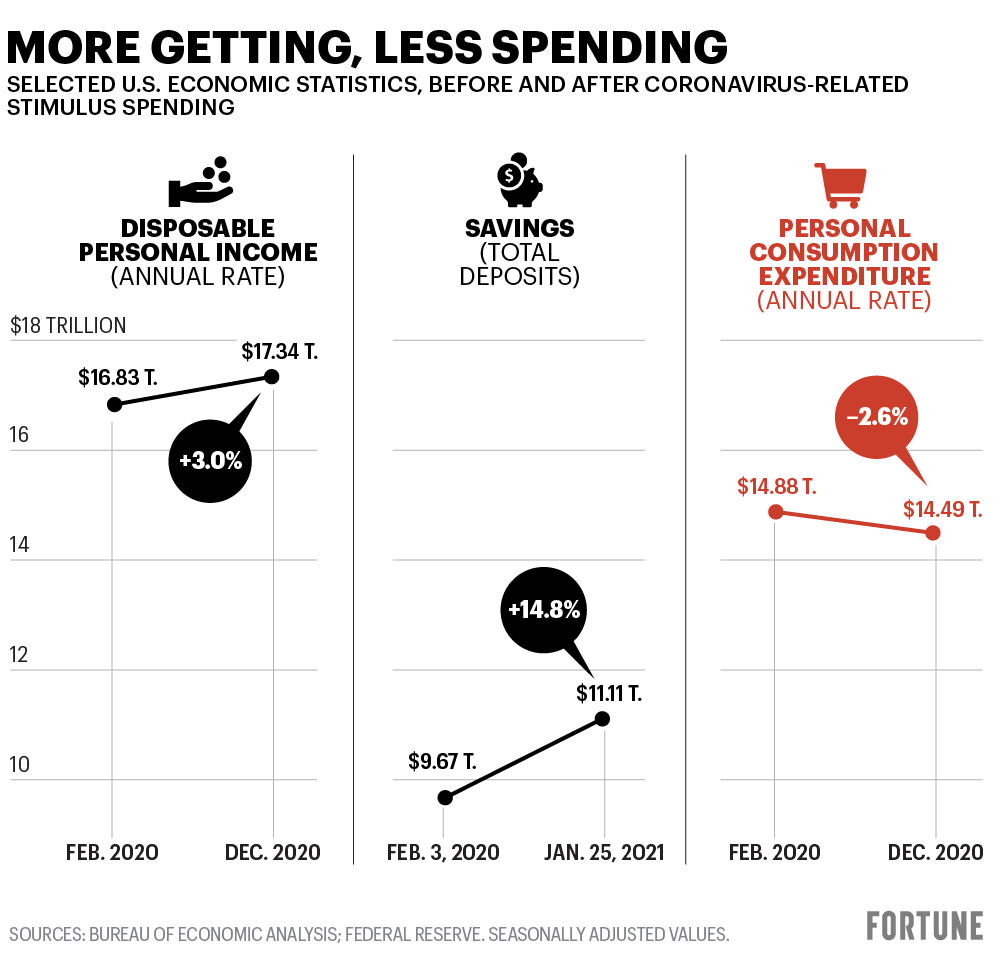
Pre-pandemic, the U.S. economy had been growing steadily for over a decade, and consumers’ disposable personal income was the highest it had ever been. The first stimulus checks and enhanced unemployment benefits then sent that income rocketing. The monthly totals have since subsided from their peak, but consumers’ disposable personal income in December—when few of the recent $600 stimulus checks had reached recipients—was still a half-trillion dollars greater than it was last February, as the column on the left in the graphic above shows.

Consumers’ savings deposits were also at an all-time high before the pandemic, and they also roared upward after the first stimulus checks went out. Consumers’ savings today are $1.4 trillion greater than they were pre-pandemic (see the graphic’s center column).

Think of those two columns together as a picture of consumer spending power; never in U.S. history has it been anywhere near this great. Now look at the third column: consumer spending.

Spending was at an all-time high just before the pandemic. It plunged in March and April, and by December it still hadn’t recovered. It was almost $400 billion less than it was last February.

Direct government payments to individuals serve two purposes: a humanitarian purpose of supporting people who’ve lost their incomes through no fault of their own, and a more general purpose of stimulating consumer spending—two-thirds of the U.S. economy—to keep businesses running and workers employed. As the charts show, the second purpose is pretty well maxed out. Flooding the economy with unprecedented spending power doesn’t necessarily make consumers spend if they’re afraid to leave home. 

Much of the money disbursed in the previous payments was saved rather than spent, and new research from Wharton estimates that 73% of Biden’s original proposal for $1,400 checks would be saved; high-income households are least likely to need the money and most likely to save it. The researchers’ conclusion: “The broad distribution of relief payments in the Biden administration’s proposed plan will flow largely into household savings and will produce only small stimulative effects.”

That’s why attention is shifting toward the first purpose of direct payments, the humanitarian purpose. “If the next round of stimulus checks goes out, they should be targeted to those who need it,” Joe Manchin of West Virginia, the most conservative Democratic U.S. senator, said recently. Biden is committed to $1,400 checks, but congressional Democrats are reportedly studying sharp reductions of the income thresholds for recipients, perhaps $100,000 for full payments to married couples. That’s not much more than what some Republican senators have proposed.

Beyond that, the unemployed are the most obvious candidates for help; the final bill will likely include enhanced benefits for them. Children could also be a focus. Congressional Democrats and Republican Sen. Mitt Romney of Utah favor sending some households thousands of dollars a year, indefinitely, for each child under 18. 

Both parties now seem to accept the reality that mere dollars from the Treasury can’t juice the economy much; only taming COVID-19 can do that. The next stimulus bill will be more narrowly targeted than previous ones, and the next few weeks will see an intense negotiation over exactly who gets exactly how much.


About the Author
Geoff Colvin
By Geoff ColvinSenior Editor-at-Large
LinkedIn iconTwitter icon

Geoff Colvin is a senior editor-at-large at Fortune, covering leadership, globalization, wealth creation, the infotech revolution, and related issues.

See full bioRight Arrow Button Icon

Latest in Politics

EconomyTariffs and trade
Macron warns EU may hit China with tariffs over trade surplus
By James Regan and BloombergDecember 7, 2025
7 hours ago
EconomyTariffs and trade
U.S. trade chief says China has complied with terms of trade deals
By Hadriana Lowenkron and BloombergDecember 7, 2025
7 hours ago
PoliticsCongress
Leaders in Congress outperform rank-and-file lawmakers on stock trades by up to 47% a year, researchers say
By Jason MaDecember 7, 2025
8 hours ago
PoliticsDonald Trump
Trump slams Democratic congressman as disloyal for not switching parties after pardon and vows ‘no more Mr. Nice guy’ next time
By Bill Barrow and The Associated PressDecember 7, 2025
10 hours ago
PoliticsRepublican Party
Republican lawmakers in Indiana face ‘a very dangerous and intimidating process’ as threats pile up while Trump pushes redistricting
By Thomas Beaumont, Isabella Volmert and The Associated PressDecember 7, 2025
14 hours ago
PoliticsSupreme Court
Supreme Court to reconsider a 90-year-old unanimous ruling that limits presidential power on removing heads of independent agencies
By Mark Sherman and The Associated PressDecember 7, 2025
15 hours ago

Most Popular

placeholder alt text
Real Estate
The 'Great Housing Reset' is coming: Income growth will outpace home-price growth in 2026, Redfin forecasts
By Nino PaoliDecember 6, 2025
2 days ago
placeholder alt text
AI
Nvidia CEO says data centers take about 3 years to construct in the U.S., while in China 'they can build a hospital in a weekend'
By Nino PaoliDecember 6, 2025
2 days ago
placeholder alt text
Economy
The most likely solution to the U.S. debt crisis is severe austerity triggered by a fiscal calamity, former White House economic adviser says
By Jason MaDecember 6, 2025
1 day ago
placeholder alt text
Economy
JPMorgan CEO Jamie Dimon says Europe has a 'real problem’
By Katherine Chiglinsky and BloombergDecember 6, 2025
1 day ago
placeholder alt text
Big Tech
Mark Zuckerberg rebranded Facebook for the metaverse. Four years and $70 billion in losses later, he’s moving on
By Eva RoytburgDecember 5, 2025
3 days ago
placeholder alt text
Politics
Supreme Court to reconsider a 90-year-old unanimous ruling that limits presidential power on removing heads of independent agencies
By Mark Sherman and The Associated PressDecember 7, 2025
15 hours ago
Rankings
  • 100 Best Companies
  • Fortune 500
  • Global 500
  • Fortune 500 Europe
  • Most Powerful Women
  • Future 50
  • World’s Most Admired Companies
  • See All Rankings
Sections
  • Finance
  • Leadership
  • Success
  • Tech
  • Asia
  • Europe
  • Environment
  • Fortune Crypto
  • Health
  • Retail
  • Lifestyle
  • Politics
  • Newsletters
  • Magazine
  • Features
  • Commentary
  • Mpw
  • CEO Initiative
  • Conferences
  • Personal Finance
  • Education
Customer Support
  • Frequently Asked Questions
  • Customer Service Portal
  • Privacy Policy
  • Terms Of Use
  • Single Issues For Purchase
  • International Print
Commercial Services
  • Advertising
  • Fortune Brand Studio
  • Fortune Analytics
  • Fortune Conferences
  • Business Development
About Us
  • About Us
  • Editorial Calendar
  • Press Center
  • Work At Fortune
  • Diversity And Inclusion
  • Terms And Conditions
  • Site Map

© 2025 Fortune Media IP Limited. All Rights Reserved. Use of this site constitutes acceptance of our Terms of Use and Privacy Policy | CA Notice at Collection and Privacy Notice | Do Not Sell/Share My Personal Information
FORTUNE is a trademark of Fortune Media IP Limited, registered in the U.S. and other countries. FORTUNE may receive compensation for some links to products and services on this website. Offers may be subject to change without notice.