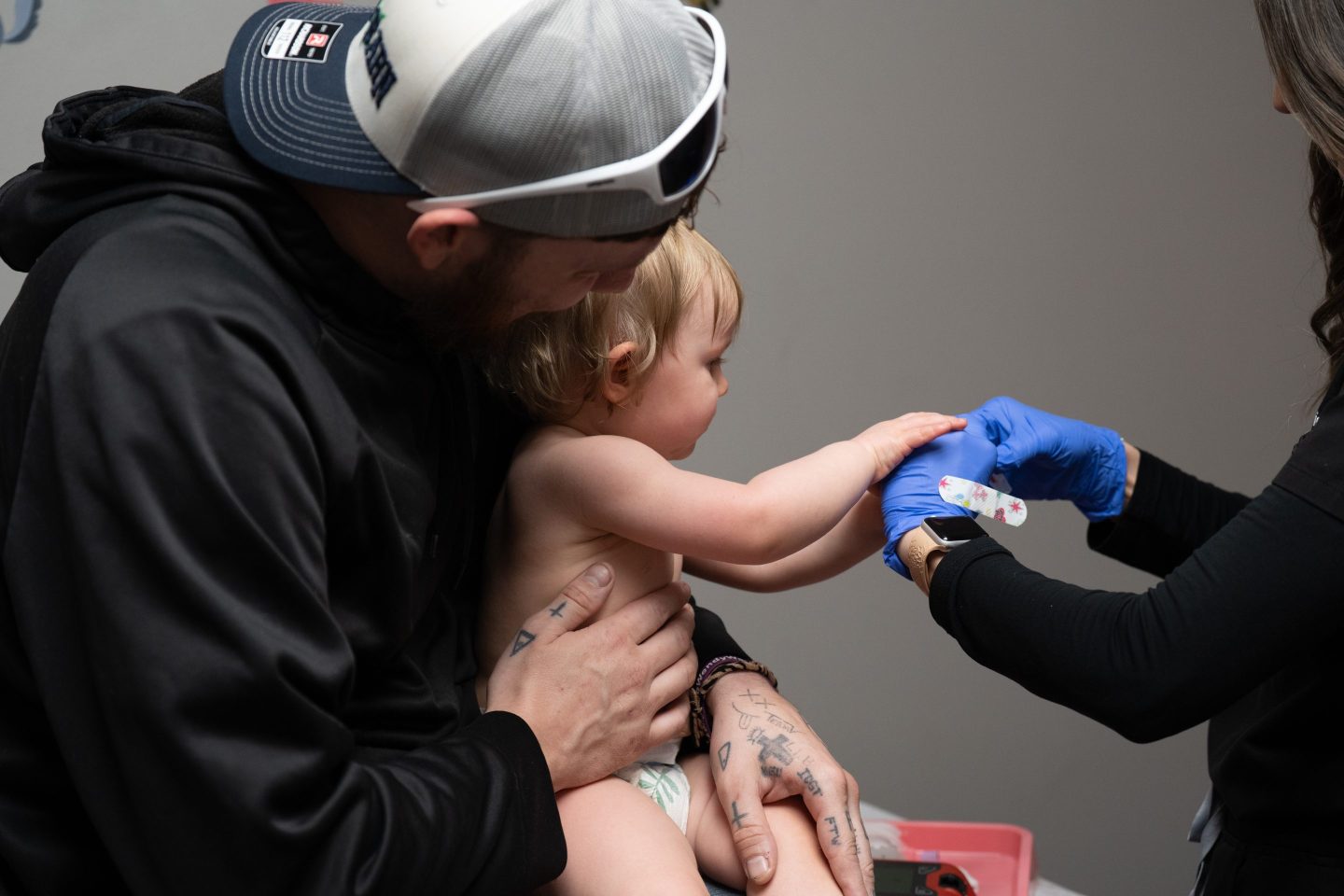
Like tens of millions of other parents nationwide, Jonathan and Sara Sadowski struggle to assist their four children, ages 5 to 11, with their online schooling at home. In addition, their eldest child, who has cerebral palsy and is in a wheelchair, needs special care.
So to help the kids and keep them safe—especially their oldest child—Jonathan opted to take 12 weeks of paid leave from his teaching job under a program authorized by an emergency federal law enacted in March.
“Qualifying for paid leave was a huge relief and has worked out really well,” said Jonathan, who lives in Concord, N.H.
But the family has learned about a new wrinkle: The 11-year-old needs surgery in January. The operation is expected to require a month or two of recovery. Unfortunately, Jonathan’s leave will be used up by then; what’s more, the emergency federal paid leave program it is based on lapses Dec. 31.
Unions and workers’ rights and consumer advocacy groups are this week waging a last-ditch effort to get Congress to extend the program into 2021. They argue that the program is a critical component helping to prevent the spread of the virus and providing financial assistance to struggling families.
They also assert that a number of unwise exemptions—plus a lack of enforcement and public awareness—have limited the program’s effectiveness.
“The emergency paid-leave provisions have been one important step in helping American families deal with this crisis,” said Sen. Kirsten Gillibrand (D-N.Y.). “Congress must extend the provision until this crisis is over. Paid leave is critical as the economy recovers.”
The program is among two dozen pandemic-related relief measures set to expire at the end of the year. Those include unemployment benefits, protections against evictions, student loan relief and payments for COVID testing.
The Democratic-controlled House twice approved bills extending most of those, including paid leave. But Republican leaders in the Senate have until this month refused to consider new relief and stimulus legislation. This week, negotiations have intensified on a compromise bill that extends some of the expiring measures. But an extension of paid sick days and paid leave is not included in that bill.
Capitol Hill staffers and workers’ rights advocates say a paid-leave extension could still be added to the relief bill or a government spending bill Congress must pass this month.
“It’s outrageous that paid leave is not in this legislation,” said Vicki Shabo, a senior fellow for paid-leave policy and strategy at New America, a Washington think tank. “The evidence is very clear paid sick days and leave help prevent spread of the virus, and it’s a benefit families overwhelmingly want and need.”
Neither the Trump administration nor President-elect Joe Biden responded to requests for comment, and neither has announced a position on the issue.
Paid sick leave “is in the public interest“
The current law requires businesses with fewer than 500 workers to allow their employees to take up to 10 days of sick leave at full pay and up to 50 more at two-thirds pay to care for a child when schools or day care centers are closed because of COVID-19.
The federal government covers the cost via tax credits to employers. The benefit covers mandatory 14-day quarantine periods for those exposed to the virus, whether they get sick or not.
Larger firms were exempted on the theory that most already provide paid sick days and some forms of extended paid leave—and don’t need federal subsidies.
But an analysis after the law was enacted found that the exemption leaves about 70 million workers in large businesses—roughly half the nation’s workforce—without the full protections offered under the COVID law.
The law and subsequent Department of Labor rules also permit firms with 50 or fewer employees to opt out of providing paid sick days or leave if they think their business will be adversely affected.
About 34 million people work for those small businesses—and the majority offer fewer than 10 paid sick days, if any. Few have extended paid leave.
In addition, the law has no guarantee of paid sick days or leave for the nation’s 13 million health care and emergency response workers.
The justification for that when the measure was enacted: Hospitals, clinics, nursing homes and emergency response companies needed to ensure that these essential workers would show up in a time of crisis.
“This was extremely shortsighted and bad policy,” said Pronita Gupta, director of job quality at the Center for Law and Social Policy in Washington, D.C. “We have seen the harmful outcome—the high number of coronavirus cases in health care facilities, especially among low-wage nursing home workers.”
Nor does the law offer extended paid leave for people who have COVID-19 or need to care for a family member with the disease beyond 10 days. Republicans opposed a broad-based benefit beyond at-home child care, advocates for the benefit noted.
“The problem is we now know that thousands of people who have COVID are sick for more than two weeks, some for months,” said Shabo. “These people need to be able to stay home and recover; that’s in the public interest as well.”
In a letter this month, a coalition of nine national public health groups urged Congress to extend the paid-leave benefits. “Paid sick leave can reduce the spread of COVID-19 in workplaces and communities by removing the barrier to employees staying home if they might have the virus,” the groups wrote. “Even one infection can set off an outbreak.”
Business groups are sympathetic, but some still oppose extending paid leave. Chief among them is the National Federation of Independent Business, a lobbying powerhouse that represents small businesses. Beth Milito, the group’s senior executive counsel, said that while small-business owners have been “highly sensitive” to their workers’ needs during the pandemic, mandating paid sick days and extended leave puts an undue burden on them.
“Figuring out who qualifies, monitoring who takes leave and then applying for the tax credit is all too much red tape,” Milito said. “It’s the hassle factor at a time when many businesses are barely making ends meet.”
Estimates of the program’s costs vary widely
Surveys show a majority of the estimated 70 million private- and public-sector workers covered under the law—after all the exemptions and carve-outs—don’t know about their right to paid sick days or leave.
“The lack of awareness has limited the potential of this benefit,” said Dawn Huckelbridge, director of the Paid Leave for All campaign, which is supported by a coalition of unions and employees and other groups. The Department of Labor, which administers the benefit, “simply fell down on the job,” she said.
Estimates last spring of the use and cost of the benefit varied widely—from around $20 billion to $105 billion.
But more recent estimates suggest it may be less. According to a Government Accountability Office report citing IRS data, as of the end of October about 150,000 employers had filed for paid family and sick leave tax credits, totaling $1.3 billion. The report noted, however, that many employers will likely wait until filing their taxes in the spring to claim the credit and recoup their costs.
The congressional Joint Committee on Taxation last month released fresh projections on the cost of an extension of paid leave—$1.4 billion if extended for two months and $1.8 billion for three months.
Although it’s too early for any full assessment of the paid-leave program’s impact, advocates point to a key study, published online in October in the journal Health Affairs. Researchers at Cornell University and the KOF Swiss Economic Institute found that in states where workers gained the right to paid sick leave under the emergency law, 400 fewer confirmed COVID cases were reported per day.
The researchers conclude: “Our findings suggest that the U.S. emergency sick leave provision was a highly effective policy tool to flatten the curve in the short run.”
KHN (Kaiser Health News) is a nonprofit news service covering health issues. It is an editorially independent program of KFF (Kaiser Family Foundation) that is not affiliated with Kaiser Permanente.