Our mission to make business better is fueled by readers like you. To enjoy unlimited access to our journalism, subscribe today.
Brian Brooks, America’s top banking regulator, has an idea to help close the wealth gap between the developing and developed world. He calls the concept “country coin.”
What the generic-sounding proposal lacks in catchy branding it makes up for in substance. The crux of the plan is to promote education and economic growth worldwide, says Brooks, the U.S. Acting Comptroller of the Currency. Since higher literacy rates correlate to higher “gross domestic product,” then incentivizing people to continue their schooling could boost productivity, individual well-being, and societal prosperity, he says.
Such rags-to-riches principles are well established in the academic literature, even if their implementation lags in practice. (Just ask the World Bank’s economists.) But it’s the nature of Brooks’ particular incentive system that might strike people as zany. The ideal inducement? Cryptocurrency tokens, he says.
Under the plan, world governments would reward people with so-called country coins for continued learning. A student earns coins by completing online courses and passing tests. The coins would essentially represent claims on a “trust fund” set up by the state; they would entitle recipients to future payouts representing a share of the rising tax revenue generated by increased GDP.
Translation: As people get more education, nations, country coin–earning students, and investors get richer together. The cryptocurrency ensures everyone benefits, rather than just people who land good salaries in the job market after finishing their studies.
“This is a way of increasing equity and increasing growth without raising taxes and without pitting the rich against the poor,” Brooks says.
Nobel no-brainer?
Brooks debuted the idea at the Singapore Fintech Festival on Dec. 9. Not shy about his own high opinion of the plan, Brooks said, “I’m telling you this should be the next Nobel Prize. It’s a big idea.” He compared the proposal’s potential impact to that had by Muhammad Yunus, founder of Bangladesh’s Grameen Bank, whose pioneering work on alleviating poverty through microloan financing won him a Nobel Peace Prize in 1996.
Brooks pointed to Afghanistan, Southeast Asia, and Latin America as being among the ripest places where country coin could have the largest impact. “There’s no technological reason this couldn’t happen right away,” he said.
What’s needed is for regulators “to recognize this as a relatively lightweight, noninterventionist, non-us-against-them policy approach to letting everyone get richer together, which is what the developing world ought to want,” Brooks continued.
Bryan Hubbard, Brooks’ deputy comptroller for public affairs, shared an exclusive preview of a report his team plans to release that describes the country coin proposal in detail. Brooks coauthored the paper with two former colleagues at Coinbase, the biggest U.S. cryptocurrency exchange, where he was previously chief legal officer.
“In effect, the coins become a quasi equity stake in the country because it represents a prediction about the growth of future cash flows,” says the paper, whose cowriters include Hermine Wong, Coinbase’s chief of staff for trust and risk, and Amy M. Luo, Coinbase’s senior counsel for global business development and “stablecoins,” a type of cryptocurrency that is designed to maintain a consistent value.
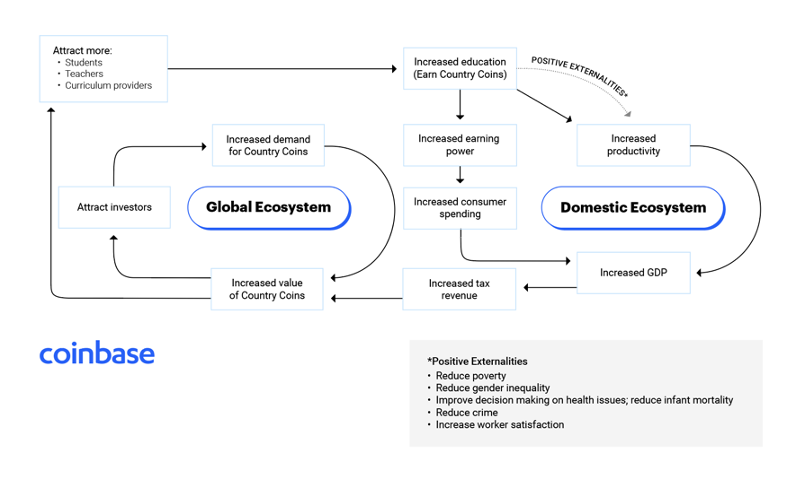
A flowchart found in the “country coin” paper describing an economic “flywheel effect” that could result from tying education to equity around the world.
In practice, this means a Colombian student could take virtual courses using a cell phone and receive, as compensation, Colombia coins from the nation’s finance ministry. If the coins are worth $10 apiece at the time of disbursement, then earning 100 coins would yield $1,000 right away. Assuming Colombia’s GDP and tax base rise over time, then the price of the coins could be expected to rise too, earning more for the recipients.
“A virtuous flywheel cycle is created in which the more students learn, the more valuable the coins become, and demand for the coins (and thus their value) increases as more students take education courses,” the paper says. The proposal addresses socioeconomic inequality “in a way traditional tax policy has not,” the abstract declares.
Universal basic instruction
The idea can be viewed as a kind of universal basic income—with a twist.
Instead of distributing a set amount of money to people simply for being taxpaying citizens, country coin would reward those people who study and learn the most. They are, after all, the very ones who are directly improving national outcomes in health, livelihood, social stability, and GDP.
The chosen discipline doesn’t matter; whether someone studies A.I. programming or postmodern literary theory makes little difference. “GDP growth is affected by the philosophy professors, no less than by the software engineers,” Brooks says. “The beauty of this approach is that the employment markets can still treat you differentially, but everybody shares in national wealth creation. We’re all in it together.”
Some countries are already experimenting with forms of universal basic income. Tests have taken place in Brazil, Kenya, Switzerland, and Finland, as well as U.S. states such as Alaska and California. In the U.S., the idea gained more traction after former Democratic presidential candidate Andrew Yang adopted it as part of his campaign platform. Cryptocurrencies have been proposed for the purpose too.
Comptroller of the (Crypto-)currency
Brooks has been shaking up the Office of the Comptroller of the Currency since he joined earlier this year. Hallmarks of his tenure include granting more banking charters to financial tech, or fintech, startups, vocally supporting cryptocurrency innovation, and pushing for a politically controversial “fair access” to banking services rule.
Some members of the progressive wing of the Democratic Party have criticized Brooks for devoting, they say, too much time and attention to the cryptocurrency industry. In contrast, he has earned plaudits from the private sector for his regulatory approach, including by clarifying that banks are permitted to hold deposits backing stablecoins.
Brooks, a former general counsel of the mortgage giant Fannie Mae, is awaiting a confirmation hearing for a possible five-year term as the country’s top bank regulator after his appointment by President Trump to the interim role in May. If Brooks gets confirmed, President-elect Joe Biden could—and, indeed, very well might—remove him from the role to install a stricter, potentially less business-friendly regulator of his own choosing.
“Finance can be a force for real change and real good in the world,” Brooks says. “Creating a permission-less country coin in countries that are on growth trajectories from developing to developed status is one of the biggest ideas in finance today.”