Public health agencies and regional governments around the U.S. and world are pushing managers of large indoor spaces to upgrade the filtration used in their heating and air-conditioning systems as a way to combat the spread of the coronavirus. But some HVAC industry leaders warn that supplies of the recommended filters, known as MERV-13, are insufficient to meet mounting demand—and will be for the foreseeable future.
“We’re 60 days out on our MERV-13 supply,” says Danny Miller, president of HVAC engineering firm Transformative Wave. “[If] this moves from a recommendation from the CDC to a regulatory requirement, frankly these guys are screwed, because the supply doesn’t exist right now. This is going to be a crisis.”
“There’s no way,” Rob Castor, vice president of sales for air filter manufacturer AAF International, says of the possibility of rapidly upgrading filters on air-handling systems nationwide. “It’s not going to happen.”
Under normal conditions, the higher-density MERV-13 filters are in demand only from industrial or medical facilities with specific air quality concerns, making up just about 5% of HVAC filter demand. Demand has increased by as much as 10 times, experts estimate. But filter supply is unlikely to keep up because of the high cost of increasing production capacity for what could be a short-term demand spike.
Terry Ritchie, national sales lead for filter manufacturer Trion, says wait times for MERV-13 filters ordered from his company have roughly doubled, from two weeks to four weeks, and he is confident the delays will get longer. Grainger, a major industrial supply wholesaler, reports that it has completely depleted its stock of MERV-13 filters on hand due to pandemic-driven demand.
Castor says some filter manufacturers have already begun “allocating” stock or only partially filling orders in order to distribute supply more evenly. He says AAF may have to begin doing the same soon.
“We’re trying to give [filters] to everyone we can,” says Castor, “But we’ve got to divvy it up.”
Others in the industry say they have not yet experienced filter shortages, including manufacturer Aprilaire and facilities management company C&W Services. According to industry leaders, organizations that had existing supplier relationships, such as building servicers or hospitals, may not bear the full brunt of shortages, which would instead fall on facilities such as malls and schools seeking the enhanced filters for the first time.
A shortage of MERV-13 HVAC filters could create a significant constraint on the ability of offices, retailers, and schools to reopen safely. That, in turn, could further constrain an already profoundly threatened U.S. economy.
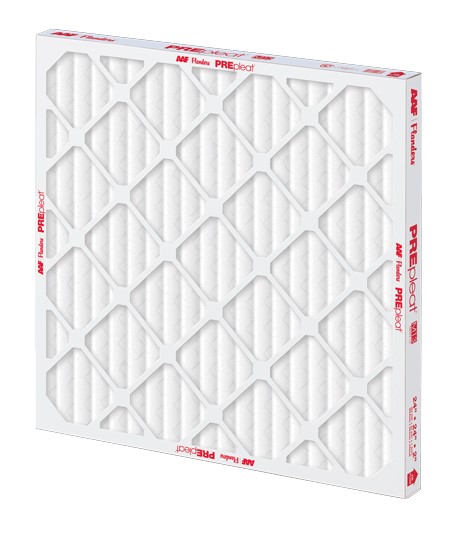
The U.S. Centers for Disease Control (CDC) has recommended since early May that office buildings and other indoor spaces upgrade their air filters to MERV-13, based on guidance from the American Society of Heating, Refrigerating and Air-Conditioning Engineers (ASHRAE). The MERV filtration rating system measures a filter’s ability to remove small particulates from the air: The higher the rating number, the smaller the particles a filter can catch. MERV-8 filters are currently in wide general use but are not considered effective in removing the coronavirus from filtered air.
Guidelines recommending MERV-13 filters have taken on new urgency in recent weeks in part thanks to the growing acknowledgment that the coronavirus may be transmitted through the air, especially indoors, and concerns that it could be spread through large indoor spaces by heating and air-conditioning systems.
Those concerns led New York Gov. Andrew Cuomo to announce on July 9 that malls in the state would be required to install MERV-13 filters in any HVAC system that can use them before reopening. A federal air quality committee also recommended upgrading systems to MERV-13 or higher earlier this month.
Filter manufacturers say they are doing everything in their power, including running double shifts at factories, to stave off shortages. But manufacturers told Fortune that the main constraint on MERV-13 supplies is a precursor material known as filter media. Machinery for creating MERV-13-class filter media is very costly, making major capacity increases financially risky for the firms that produce it, since the current demand surge may prove temporary.
Filter media producers sell their product in bulk to companies such as AAF who turn it into HVAC filters. But the media is also used for emergency respirators and for the masks that have become commonplace in the pandemic era. Some industry leaders say the increased demand for MERV-13 media for use in masks and respirators has exacerbated the shortage for HVAC filters.
Enhanced filtration is just one of a number of measures for mitigating the risk of indoor coronavirus transmission. Others include increasing fresh air flow into a building and enhanced disinfection of surfaces. Another option for increasing indoor air safety, according to C&W Services CEO Paul Bedborough, is bipolar ionization, which is a relatively simple upgrade for HVAC systems and can kill 99.9% of microbes using charged atoms.
But as with the combination of face masks and social distancing, these solutions are likely to work best in combination. A major shortage of climate-control filters capable of stopping the coronavirus would mean one less layer of protection for Americans who increasingly find themselves pressured to return to school, work, and daily life as the pandemic’s toll continues to mount.