• Home
  • Latest
  • Fortune 500
  • Finance
  • Tech
  • Leadership
  • Lifestyle
  • Rankings
  • Multimedia

Should consumers be wary of Apple’s heartbeat monitoring app?

By
John Nosta
John Nosta
Down Arrow Button Icon
By
John Nosta
John Nosta
Down Arrow Button Icon
February 26, 2020, 4:28 PM ET
Apple Watch-ECG App Heart Monitor
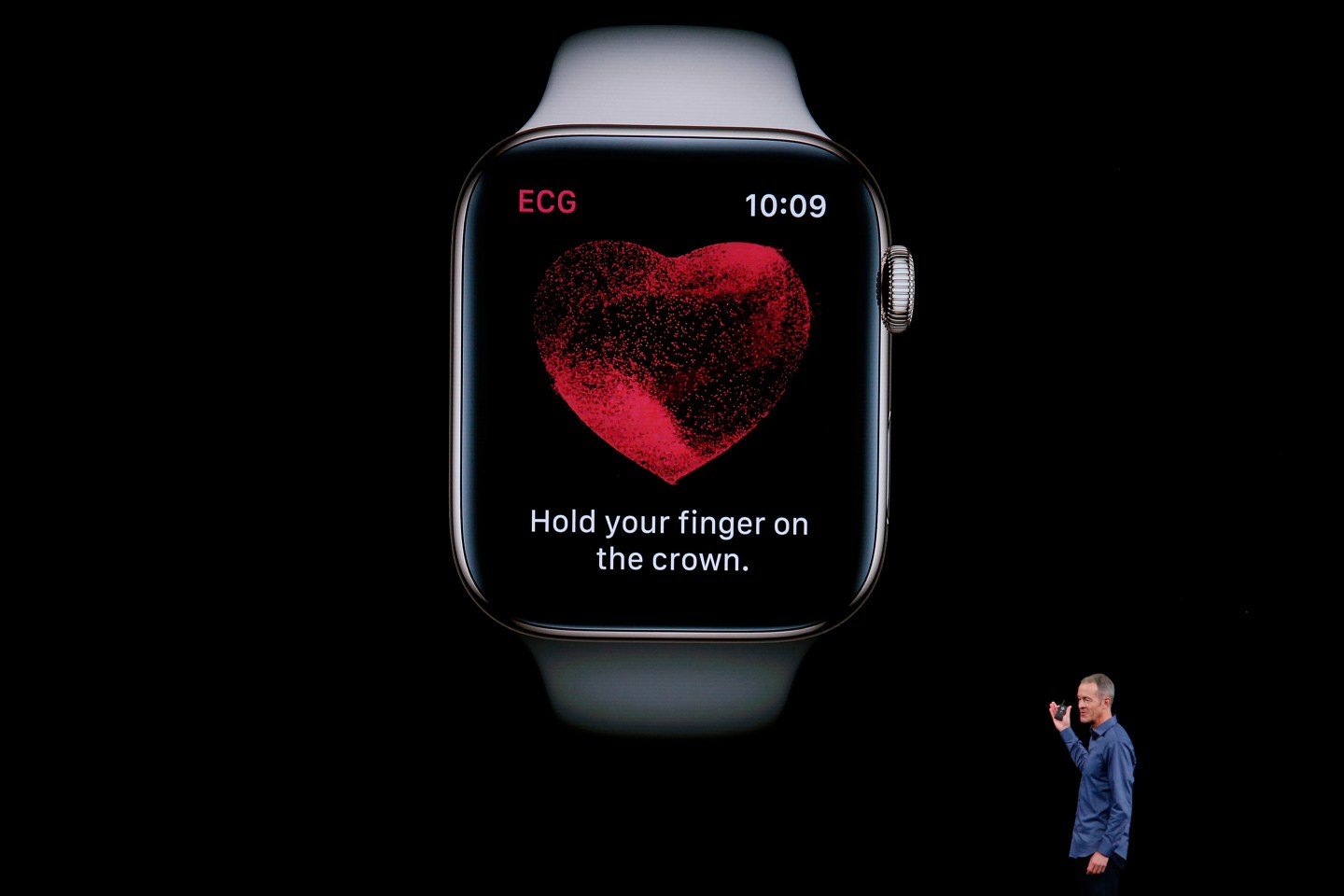
CUPERTINO, CA - SEPTEMBER 12: Jeff Williams introduces the new Apple Watch capable of taking an FDA-approved electrocardiogram at the company's annual product launch, Wednesday, Sept. 12, 2018, in Cupertino, Calif. (Karl Mondon/Digital First Media/The Mercury News via Getty Images)Karl Mondon—Digital First Media/The Mercury News/Getty Images

The success of the Apple Watch is unprecedented: In five short years, the Apple Watch has outsold the entire Swiss watch industry, with total sales exceeding 31 million units in 2019. 

Apple has also made significant strides into the health tech market in what is part of a larger shift from physician control to consumer collaboration when it comes to personal health. Apple Watch models offer a variety of health-related features, including exercise and sleep tracking, and fall detection. And beyond these conventional features, the latest Apple Watch includes an ECG App that is approved by the U.S. Food and Drug Administration (FDA) for the detection of atrial fibrillation (AFib), a beating abnormality of the heart that is associated with higher risks of stroke, including those that could lead to death. 

A 2019 study published in the New England Journal of Medicine (NEJM) examined this detection by smartwatches of “irregular pulses” in almost 420,000 people over eight months. In this study, which was funded by Apple, the authors concluded that the Apple Watch was effective in detecting AFib, stating that 84% of the smartwatch notifications were accurate in alerting for atrial fibrillation. In other words, the researchers determined that the Apple Watch was an effective consumer device in detecting an arrhythmia—an ability that was once only the domain of a doctor and ECG machine. 

But what the study didn’t find—or perhaps more accurately, didn’t even examine—is that the Apple Watch will largely not detect or categorize AFib at a heart rate greater than 120 beats per minute, according to information supplied to the FDA by Apple for the feature’s approval. 

Apple has made it clear on their Apple Watch support page that their smartwatch doesn’t diagnose AFib. In fact, they refer to any Apple Watch notification as a general indication that requires follow up by a doctor for an accurate diagnosis. Apple also openly indicates that its smartwatch “is not constantly looking for AFib,” and that “people with AFib may not get a notification.” 

AFib typically has a heart rate of 100 to 175 beats per minute (bpm), according to the Mayo Clinic. In 2015, a study published in the Annals of Medicine found that in a cohort of 2,821 patients with new-onset AFib, the mean heart rate was 109 bpm. But, according to the study, roughly one-third of patients had a heart rate of over 120. Further, some of these patients were receiving beta-blockers, a drug therapy commonly used to control the rapid rate and symptoms of AFib. Because beta blockers cause a direct decrease in heart rate, this patient population may have a slower heart rate than would be typical for an untreated patient group, resulting in an underestimation of true AFib heart rates for a larger population. 

In another recent clinical study published in Circulation, researchers examined the ability of the Apple Watch to detect AFib in a group of patients post-cardiac surgery, a common complication after this procedure. The study found that the Apple Watch detected the abnormality in only 34 of 90 instances—an accuracy of only 41%.

But should this impact the confidence consumers have in the Apple Watch considering the company has been transparent about the smartwatch’s limitations?

“Irregular rhythm notifications,” as they’re described by Apple, are part of the Apple Watch’s alerts nonetheless, potentially creating a false sense of security for a consumer who might not have read, or might not understand, the important caveats Apple has noted.

This feature appears to be caught between the world of carefully crafted user instructions and real world use. The actual detection by the Apple Watch of irregular heart rhythms is accurate on Apple’s terms, which are scientifically and legally sound. Yet, for the users, it’s likely less about the fine print and more so around the practical application of the device. The result is a gray zone that requires a heightened level of understanding from the consumer on the finer details of how the Apple Watch monitors “heart health.”

So, where does responsibility lie? That’s a complex question that reflects the broader digital health trend where new products offer up partial insights into a clinical condition or aspect of physiology. A little bit of information can be both helpful and dangerous—but rarely definitive. What is clear is the evolving path towards consumer collaboration in care. The passive nature of the Apple Watch is really a type of check engine light that prompts further professional care. Certainly, Apple can address this issue and potentially expand the range beyond the current 120 bpm limitation, but consumers need to stay engaged and understand that such tools aren’t an end to detection, but just the beginning. And it’s this partnership—informed consumer and physician—that will drive further success for health tech.

Still, it may be prudent to suggest that the exuberant response by consumers may be well-served by a reflective pause. The innovations around heart rate, heart rate variability, arrhythmias, and the vast opportunity of analytics—all that fit around your wrist—will offer a tremendous opportunity for diagnosis and treatment. Apple has taken important steps to bringing useful and important technology to the consumer, evident with the Apple Watch and its broad success. But even small blind spots pose real risks to the advancement of health care technology, physician adoption, and to the very consumers whose lives rely on technology as an integral part of their care.

John Nosta is president of NostaLab.

More opinion in Fortune:

—What companies can do to make work better for black employees
—How Democrats’ impeachment campaign helped Trump
—Fixing the corporate approach to addressing sexual harassment
—How Warren Buffett built Berkshire Hathaway
—WATCH: The double burdens that hold women back

Listen to our audio briefing, Fortune 500 Daily

About the Author
By John Nosta
See full bioRight Arrow Button Icon

Latest in

Finance
Lorem ipsum dolor sit amet, consectetur adipiscing elit, sed do eiusmod tempor incididunt ut labore et dolore magna aliqua. Ut enim ad minim veniam
By Fortune Editors
October 20, 2025
Finance
Lorem ipsum dolor sit amet, consectetur adipiscing elit, sed do eiusmod tempor incididunt ut labore et dolore magna aliqua. Ut enim ad minim veniam
By Fortune Editors
October 20, 2025
Finance
Lorem ipsum dolor sit amet, consectetur adipiscing elit, sed do eiusmod tempor incididunt ut labore et dolore magna aliqua. Ut enim ad minim veniam
By Fortune Editors
October 20, 2025
Finance
Lorem ipsum dolor sit amet, consectetur adipiscing elit, sed do eiusmod tempor incididunt ut labore et dolore magna aliqua. Ut enim ad minim veniam
By Fortune Editors
October 20, 2025
Finance
Lorem ipsum dolor sit amet, consectetur adipiscing elit, sed do eiusmod tempor incididunt ut labore et dolore magna aliqua. Ut enim ad minim veniam
By Fortune Editors
October 20, 2025
Finance
Lorem ipsum dolor sit amet, consectetur adipiscing elit, sed do eiusmod tempor incididunt ut labore et dolore magna aliqua. Ut enim ad minim veniam
By Fortune Editors
October 20, 2025

Most Popular

Finance
Lorem ipsum dolor sit amet, consectetur adipiscing elit, sed do eiusmod tempor incididunt ut labore et dolore magna aliqua. Ut enim ad minim veniam
By Fortune Editors
October 20, 2025
Finance
Lorem ipsum dolor sit amet, consectetur adipiscing elit, sed do eiusmod tempor incididunt ut labore et dolore magna aliqua. Ut enim ad minim veniam
By Fortune Editors
October 20, 2025
Finance
Lorem ipsum dolor sit amet, consectetur adipiscing elit, sed do eiusmod tempor incididunt ut labore et dolore magna aliqua. Ut enim ad minim veniam
By Fortune Editors
October 20, 2025
Finance
Lorem ipsum dolor sit amet, consectetur adipiscing elit, sed do eiusmod tempor incididunt ut labore et dolore magna aliqua. Ut enim ad minim veniam
By Fortune Editors
October 20, 2025
Finance
Lorem ipsum dolor sit amet, consectetur adipiscing elit, sed do eiusmod tempor incididunt ut labore et dolore magna aliqua. Ut enim ad minim veniam
By Fortune Editors
October 20, 2025
Finance
Lorem ipsum dolor sit amet, consectetur adipiscing elit, sed do eiusmod tempor incididunt ut labore et dolore magna aliqua. Ut enim ad minim veniam
By Fortune Editors
October 20, 2025
Fortune Secondary Logo
Rankings
  • 100 Best Companies
  • Fortune 500
  • Global 500
  • Fortune 500 Europe
  • Most Powerful Women
  • Future 50
  • World’s Most Admired Companies
  • See All Rankings
Sections
  • Finance
  • Fortune Crypto
  • Features
  • Leadership
  • Health
  • Commentary
  • Success
  • Retail
  • Mpw
  • Tech
  • Lifestyle
  • CEO Initiative
  • Asia
  • Politics
  • Conferences
  • Europe
  • Newsletters
  • Personal Finance
  • Environment
  • Magazine
  • Education
Customer Support
  • Frequently Asked Questions
  • Customer Service Portal
  • Privacy Policy
  • Terms Of Use
  • Single Issues For Purchase
  • International Print
Commercial Services
  • Advertising
  • Fortune Brand Studio
  • Fortune Analytics
  • Fortune Conferences
  • Business Development
About Us
  • About Us
  • Editorial Calendar
  • Press Center
  • Work At Fortune
  • Diversity And Inclusion
  • Terms And Conditions
  • Site Map
Fortune Secondary Logo
  • About Us
  • Editorial Calendar
  • Press Center
  • Work At Fortune
  • Diversity And Inclusion
  • Terms And Conditions
  • Site Map
  • Facebook icon
  • Twitter icon
  • LinkedIn icon
  • Instagram icon
  • Pinterest icon

Latest in

Politicsborder control
‘Our heads are exploding:’ U.S. military’s “incompetence” led to a laser take down of a Border Protection drone
By Josh Funk, Konstantin Toropin and The Associated PressFebruary 27, 2026
14 minutes ago
NewslettersMPW Daily
These are the female exec moves you need to know this week, from Xbox to Match Group’s board shakeup
By Emma HinchliffeFebruary 27, 2026
23 minutes ago
LawTariffs
The Trump administration is looking for ways to keep revenue from tariffs that were ruled illegal, after telling courts that refunds would be easy
By Jason MaFebruary 27, 2026
56 minutes ago
Spencer Rascoff, chief executive officer of Match Group Inc
SuccessGen Z
Match Group’s CEO set up an employee hotline where staff can DM him anytime—and one Gen Zer’s feedback even changed how he runs the business
By Emma BurleighFebruary 27, 2026
2 hours ago
Anthropic CEO Dario Amodei.
AIAnthropic
The Pentagon brands Anthropic’s CEO a ‘liar’ with a ‘God-complex’ as deadline looms over AI use in weapons and surveillance
By Beatrice NolanFebruary 27, 2026
2 hours ago
IRS
LawImmigration
The IRS turned over confidential taxpayer info to ICE ‘approximately 42,695 times.’ That was illegal, judge says
By Fatima Hussein and The Associated PressFebruary 27, 2026
2 hours ago

Most Popular

placeholder alt text
Innovation
An MIT roboticist who cofounded bankrupt robot vacuum maker iRobot says Elon Musk’s vision of humanoid robot assistants is ‘pure fantasy thinking’
By Marco Quiroz-GutierrezFebruary 25, 2026
2 days ago
placeholder alt text
Success
Jeff Bezos says being lazy, not working hard, is the root of anxiety: ‘The stress goes away the second I take that first step’
By Sydney LakeFebruary 25, 2026
2 days ago
placeholder alt text
Economy
Trump claims America is ‘winning so much.’ The IMF agrees, adding that Trump’s trade policies are the only thing holding it back from even more
By Tristan BoveFebruary 26, 2026
23 hours ago
placeholder alt text
Success
Gen Z Olympic champion Eileen Gu says she rewires her brain daily to be more successful—and multimillionaire founder Arianna Huffington says it really does work
By Orianna Rosa RoyleFebruary 25, 2026
2 days ago
placeholder alt text
AI
Jamie Dimon says society should start preparing for AI job displacement: ‘Now’s the time to start thinking about’ it
By Marco Quiroz-GutierrezFebruary 25, 2026
2 days ago
placeholder alt text
Economy
It’s more than George Clooney moving to France: America is becoming the ‘uncool’ country that people want to move away from
By Nick LichtenbergFebruary 27, 2026
10 hours ago

© 2026 Fortune Media IP Limited. All Rights Reserved. Use of this site constitutes acceptance of our Terms of Use and Privacy Policy | CA Notice at Collection and Privacy Notice | Do Not Sell/Share My Personal Information
FORTUNE is a trademark of Fortune Media IP Limited, registered in the U.S. and other countries. FORTUNE may receive compensation for some links to products and services on this website. Offers may be subject to change without notice.