• Home
  • Latest
  • Fortune 500
  • Finance
  • Tech
  • Leadership
  • Lifestyle
  • Rankings
  • Multimedia

Trendingnow

1

Jeff Bezos wants the bottom half of earners to pay zero income tax—he says nurses making just $75K should save $12K a year

2

Despite a $500 million net worth, Shaq just finished his fourth degree. He warns graduates: 'Your character will take you further than your resume'

3

Bolt CEO says he let go of his entire HR team for creating problems that didn’t exist: ‘Those problems disappeared when I let them go’ 

1

Jeff Bezos wants the bottom half of earners to pay zero income tax—he says nurses making just $75K should save $12K a year

2

Despite a $500 million net worth, Shaq just finished his fourth degree. He warns graduates: 'Your character will take you further than your resume'

3

Bolt CEO says he let go of his entire HR team for creating problems that didn’t exist: ‘Those problems disappeared when I let them go’ 
FinanceYield Curve

As the yield curve slips towards inversion, the recession warning light blinks red—again

By
Erik Sherman
Erik Sherman
Down Arrow Button Icon
By
Erik Sherman
Erik Sherman
Down Arrow Button Icon
January 30, 2020, 12:30 PM ET

2019 went down as the year of the yield curve inversion.

This classic sign of pending recession—when short-term government securities offer higher yields than longer-term ones—lingered for a “solid five months” from mid-May to October, according to Luke Tilley, chief economist of Wilmington Trust. It was the first time in years the yield curve had inverted.

The recession never came, of course—no small thanks to the Federal Reserve’s decision to return to more accommodative monetary policy, effectively cutting rates three times.

But now the warning signs are back. And it may be that other corrective actions by the Fed—pumping cash into the overnight lending market by buying short-term U.S. securities from banks—are effectively keeping the yield curve from going haywire once again.

Yielding to economic pressure

The Treasury sells securities of varying duration, whether measured in months or years. Under normal economic conditions, the shorter a bond’s term, the lower its yield (the interest rate it offers). The opposite is true for bonds that mature years out; investors expect a premium to have their money tied up for longer periods. After all, a lot more can go wrong over 10 years than it can over two.

An inversion then is a measure of upside-down markets logic. When demand is higher for short-term securities, the nominal rate it carries climbs. That makes sense. But when rates for short-term securities surpass those of longer-term ones, investors are telling the markets they have more confidence that things will work out better in the near-term—ergo, they expect future economic conditions to worsen.

If enough people and businesses feel that way, it might force them to curtail purchase, investment and hiring decisions, which in turn, can be enough to bring on a recession.

Because of the variety of bond durations on the market, there isn’t a single inversion scenario. Market watchers may focus on a pairing of say, a three-month bond verses a two-year bond, or the 10-year versus 30-year. The graph below shows the movement of yields for these treasuries from the beginning of 2018 to the most recent date in January.
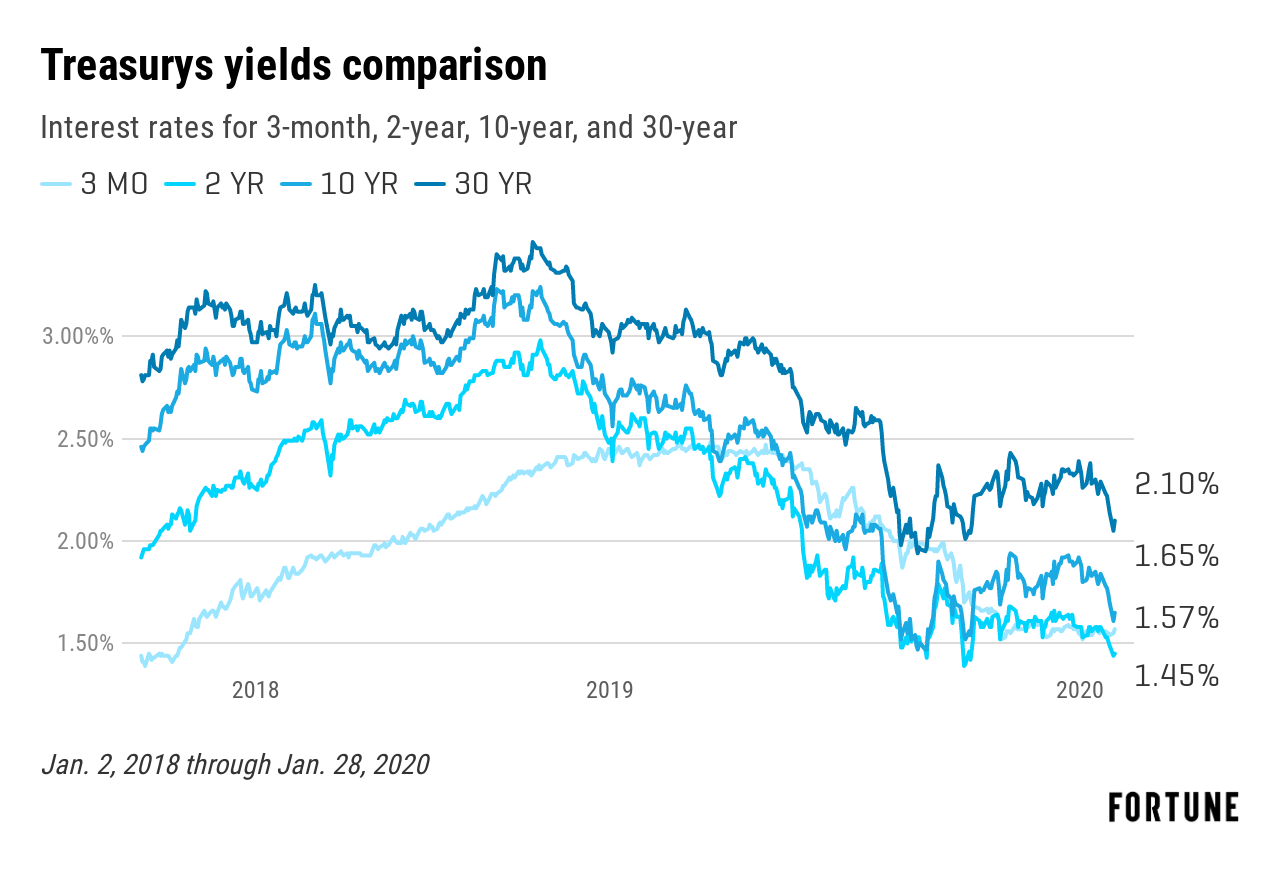
From mid- to late-2019, some curves inverted. Most recently, the three-month and 10-year curves have come closer.

Investors differ in the comparisons they find significant. “We put more importance and value on the 10-year yield versus two-year yield,” Tilley said.

“We prefer to focus on 3M-30Y inversions because they have more consistently provided investors with a lead time of about 1.5 years to recession,” wrote Allen Sukholitsky, founder and chief macro strategist Xallarap Advisory, in a note to Fortune.

A full inversion of the three-month and 10-year aren’t necessarily the biggest worries for them. And even though the two curves did invert briefly on Tuesday, there is again some distance between the two now. However, there is the question of whether an inversion would be more pronounced without the Fed’s interventions.

The agency has been buying short-term Treasurys from banks since September. The Fed has looked to control spiking interest rates on overnight lending in the so-called repo market by injecting more cash into the system, increasing liquidity.

Although the Fed has insisted that the action is not quantitative easing (QE)—the massive purchases of long-term Treasurys it undertook as part of the reaction to the great financial collapse—financial professionals don’t see much difference. Many have come to call the current round “non-QE QE.”

In addition to controlling overnight lending, the current rounds helped depress yields on short-term Treasurys and ultimately closed the inversions gaps that emerged earlier in the year. As basic economics dictate, driving up demand for a bond increases its market price, which effectively reduces the yield. The Fed bought up about $400 billion the amount of Treasurys since last September—a big jump.

Not that the action is completely unusual. “This experience of them buying short-term securities is much more in line with what they did for decades in normal circumstances,” Tilley said. And it has kept short-term rates within the Fed’s target range. At the same time, “we believe it was part of their intention” to stop yield curve inversion, he theorized.

Digging in

That may have implications for current conditions, as this next graph, focusing on the period from Dec. 2, 2019 through January 28, 2020, shows.
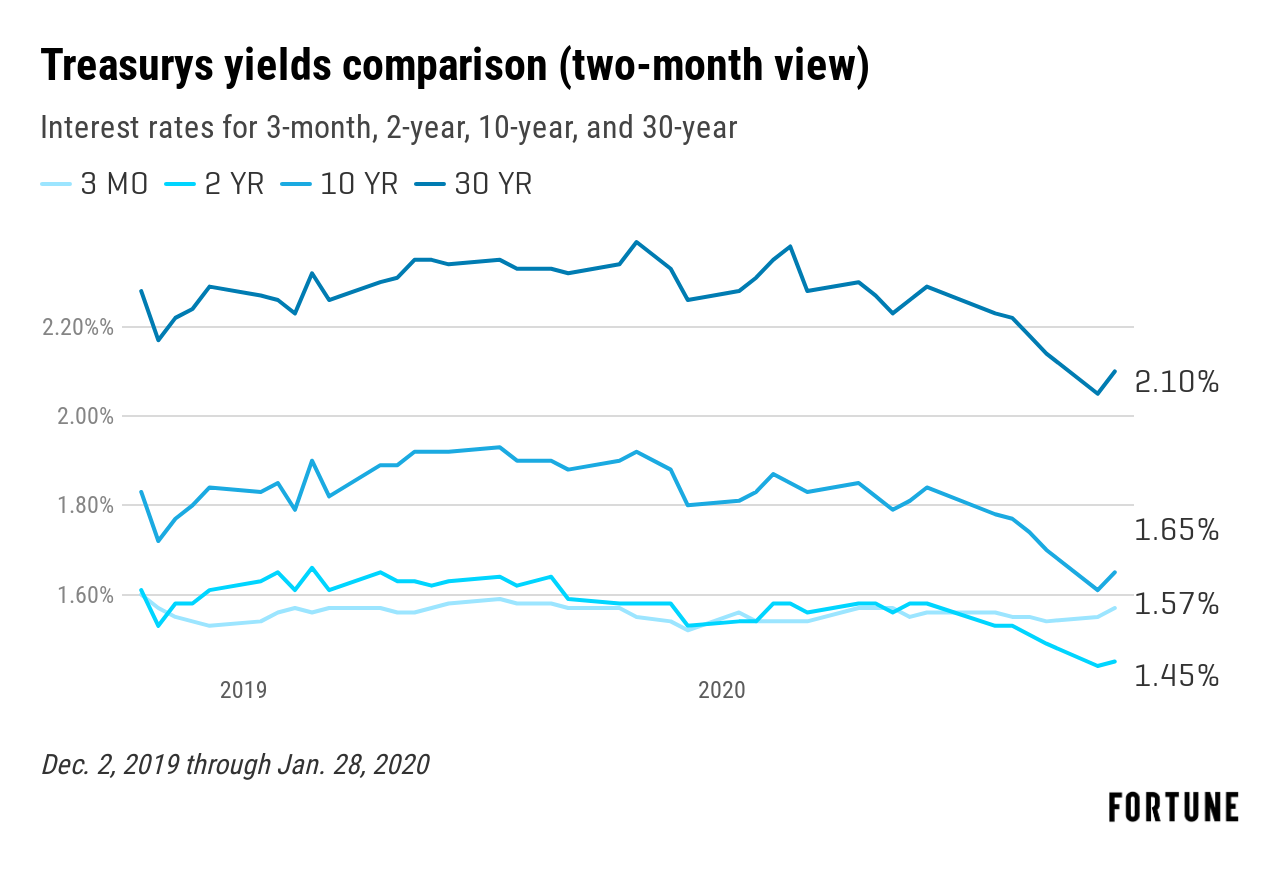
The graph shows that the three-month, ending with a 1.57% yield, was only a .08 percentage points from the 10-year on Jan. 28.

There are two trends evident here. One is that the three-month yield has stayed fairly flat, likely due in large part to the Fed’s intervention in the repo markets since last fall. Without that, the three-month might have been higher, accentuating any inversion.

The other trend is that inversion has come closer because yields on longer-range Treasurys have dropped.

“The behavior of the Treasury curve since September is a little bit disturbing in that we’ve had monetary stimulus come in,” said Ed Al-Hussainy, senior interest rate and currency analyst for Columbia Threadneedle Investments. “Despite all of this, 10-year yields basically never got above 2% since September. That to me signals monetary policy is still too tight.”

The drop in longer-rate yields suggests there has been increasing demand for the bonds. “A lot of people have thrown in the towel and said, ‘I don’t know, maybe interest rates are never going to rise that much, so maybe yields that looked disappointing maybe aren’t,” said Warren Pierson, managing director and deputy chief investment officer for Baird Advisors.

Now, the big question: Does the move towards inversion mean an increased chance of a recession? Most of the experts that spoke with Fortune didn’t think so.

“Our view is that this flight to quality [which means investment in longer-term U.S. government bonds] will be temporary, as long as we don’t see a further epidemic of what’s happening,” said Charlie Ripley, senior investment strategist for Allianz Investment Management. There is still steady growth, full employment, and plenty of consumers spending money, the last of which represents roughly 78% of GDP. “Until we see some deterioration in consumer behavior, the economy is going to chug along.”

But not everyone is so sure. “Consumer sentiment is terrific and the market is terrific, but all the surveys of CEOs say they expect a decline in the economy and I think, ‘Who’s got a better feel for that?'” said Peter Ricchiuti, a business professor at Tulane University who regularly speaks with small- to medium-cap company CEOs. “Everybody’s at least cautious. In the long run the strength of the economy is in the population of working age people.”

Birth rates are down in the U.S., as is immigration, both critical drivers of growth.

If 2019 was the “year of the inversion,” 2020 may turn out to be the year of “what does the inversion mean?”

More must-read stories from Fortune:

—All of your questions on filing taxes in 2020, answered
—The health of the economy in nine charts
—Goldman Sachs Asset Management’s Sheila Patel on her 2020 outlook
—5 pressing questions to hone your investment strategy this quarter
—10 stocks that are poised for a stellar 2020

Subscribe to Fortune’s Bull Sheet for no-nonsense finance news and analysis daily.

About the Author
By Erik Sherman
See full bioRight Arrow Button Icon

Latest in Finance

Finance
Lorem ipsum dolor sit amet, consectetur adipiscing elit, sed do eiusmod tempor incididunt ut labore et dolore magna aliqua. Ut enim ad minim veniam
By Fortune Editors
October 20, 2025
Finance
Lorem ipsum dolor sit amet, consectetur adipiscing elit, sed do eiusmod tempor incididunt ut labore et dolore magna aliqua. Ut enim ad minim veniam
By Fortune Editors
October 20, 2025
Finance
Lorem ipsum dolor sit amet, consectetur adipiscing elit, sed do eiusmod tempor incididunt ut labore et dolore magna aliqua. Ut enim ad minim veniam
By Fortune Editors
October 20, 2025
Finance
Lorem ipsum dolor sit amet, consectetur adipiscing elit, sed do eiusmod tempor incididunt ut labore et dolore magna aliqua. Ut enim ad minim veniam
By Fortune Editors
October 20, 2025
Finance
Lorem ipsum dolor sit amet, consectetur adipiscing elit, sed do eiusmod tempor incididunt ut labore et dolore magna aliqua. Ut enim ad minim veniam
By Fortune Editors
October 20, 2025
Finance
Lorem ipsum dolor sit amet, consectetur adipiscing elit, sed do eiusmod tempor incididunt ut labore et dolore magna aliqua. Ut enim ad minim veniam
By Fortune Editors
October 20, 2025

Most Popular

Finance
Lorem ipsum dolor sit amet, consectetur adipiscing elit, sed do eiusmod tempor incididunt ut labore et dolore magna aliqua. Ut enim ad minim veniam
By Fortune Editors
October 20, 2025
Finance
Lorem ipsum dolor sit amet, consectetur adipiscing elit, sed do eiusmod tempor incididunt ut labore et dolore magna aliqua. Ut enim ad minim veniam
By Fortune Editors
October 20, 2025
Finance
Lorem ipsum dolor sit amet, consectetur adipiscing elit, sed do eiusmod tempor incididunt ut labore et dolore magna aliqua. Ut enim ad minim veniam
By Fortune Editors
October 20, 2025
Finance
Lorem ipsum dolor sit amet, consectetur adipiscing elit, sed do eiusmod tempor incididunt ut labore et dolore magna aliqua. Ut enim ad minim veniam
By Fortune Editors
October 20, 2025
Finance
Lorem ipsum dolor sit amet, consectetur adipiscing elit, sed do eiusmod tempor incididunt ut labore et dolore magna aliqua. Ut enim ad minim veniam
By Fortune Editors
October 20, 2025
Finance
Lorem ipsum dolor sit amet, consectetur adipiscing elit, sed do eiusmod tempor incididunt ut labore et dolore magna aliqua. Ut enim ad minim veniam
By Fortune Editors
October 20, 2025
Fortune Secondary Logo
Rankings
  • 100 Best Companies
  • Fortune 500
  • Global 500
  • Fortune 500 Europe
  • Most Powerful Women
  • World's Most Admired Companies
  • See All Rankings
  • Lists Calendar
Sections
  • Finance
  • Fortune Crypto
  • Features
  • Leadership
  • Health
  • Commentary
  • Success
  • Retail
  • Mpw
  • Tech
  • Lifestyle
  • CEO Initiative
  • Asia
  • Politics
  • Conferences
  • Europe
  • Newsletters
  • Personal Finance
  • Environment
  • Magazine
  • Education
Customer Support
  • Frequently Asked Questions
  • Customer Service Portal
  • Privacy Policy
  • Terms Of Use
  • Single Issues For Purchase
  • International Print
Commercial Services
  • Advertising
  • Fortune Brand Studio
  • Fortune Analytics
  • Fortune Conferences
  • Business Development
  • Group Subscriptions
About Us
  • About Us
  • Press Center
  • Work At Fortune
  • Terms And Conditions
  • Site Map
  • About Us
  • Press Center
  • Work At Fortune
  • Terms And Conditions
  • Site Map
  • Facebook icon
  • Twitter icon
  • LinkedIn icon
  • Instagram icon
  • Pinterest icon

Latest in Finance

ambrose
CommentaryRobotics
Former NASA Robotics Chief: America is building the wrong kind of robots — and China knows it
By Robert AmbroseMay 23, 2026
1 hour ago
Elon Musk’s SpaceX IPO filing just told us what business he’s betting on for the future—and it’s not rockets
InvestingFinance
Elon Musk’s SpaceX IPO filing just told us what business he’s betting on for the future—and it’s not rockets
By Shawn TullyMay 23, 2026
2 hours ago
morris
CommentaryEntrepreneurship
My startup hit $200 million ARR. But first I walked away from 2.5 million YouTube subscribers and nearly went bankrupt
By Joel MorrisMay 23, 2026
3 hours ago
Beyond the diploma: Skills that actually get graduates hired
Future of WorkWorkplace Innovation Summit
Beyond the diploma: Skills that actually get graduates hired
By Ashley LutzMay 22, 2026
17 hours ago
Sam Altman standing in a lift.
AIOpenAI
The big questions looming over OpenAI’s trillion-dollar IPO
By Beatrice NolanMay 22, 2026
17 hours ago
Walmart shoppers are filling their gas tanks with less than 10 gallons for the first time since 2022, and its CFO calls it ‘an indication of stress’
EconomyRetail
Walmart shoppers are filling their gas tanks with less than 10 gallons for the first time since 2022, and its CFO calls it ‘an indication of stress’
By Marco Quiroz-GutierrezMay 22, 2026
18 hours ago

Most Popular

Jeff Bezos wants the bottom half of earners to pay zero income tax—he says nurses making just $75K should save $12K a year
Success
Jeff Bezos wants the bottom half of earners to pay zero income tax—he says nurses making just $75K should save $12K a year
By Preston ForeMay 21, 2026
2 days ago
Despite a $500 million net worth, Shaq just finished his fourth degree. He warns graduates: 'Your character will take you further than your resume'
Success
Despite a $500 million net worth, Shaq just finished his fourth degree. He warns graduates: 'Your character will take you further than your resume'
By Preston ForeMay 20, 2026
3 days ago
Bolt CEO says he let go of his entire HR team for creating problems that didn’t exist: ‘Those problems disappeared when I let them go’ 
Workplace Culture
Bolt CEO says he let go of his entire HR team for creating problems that didn’t exist: ‘Those problems disappeared when I let them go’ 
By Preston ForeMay 19, 2026
4 days ago
Indeed chief economist says we’re entering an era of ‘great mismatch’ thanks to a generational imbalance of workers
Success
Indeed chief economist says we’re entering an era of ‘great mismatch’ thanks to a generational imbalance of workers
By Emma BurleighMay 22, 2026
18 hours ago
Microsoft reports are exposing AI's real cost problem: Using the tech is more expensive than paying human employees
AI
Microsoft reports are exposing AI's real cost problem: Using the tech is more expensive than paying human employees
By Jake AngeloMay 22, 2026
17 hours ago
Pay transparency is exposing a bigger problem: Most companies can't explain why they pay what they pay
Workplace Culture
Pay transparency is exposing a bigger problem: Most companies can't explain why they pay what they pay
By Sydney LakeMay 20, 2026
3 days ago

© 2026 Fortune Media IP Limited. All Rights Reserved. Use of this site constitutes acceptance of our Terms of Use and Privacy Policy | CA Notice at Collection and Privacy Notice | Do Not Sell/Share My Personal Information
FORTUNE is a trademark of Fortune Media IP Limited, registered in the U.S. and other countries. FORTUNE may receive compensation for some links to products and services on this website. Offers may be subject to change without notice.