In a year of bad news—followed by yet more bad news—Tuesday was an extraordinary day for Boeing and its battered shareholders. Consider this rundown of headlines:
First, news broke that rival Airbus overtook Boeing in 2019, delivering more than twice as many airplanes—863 to 380—to customers last year. Dig deeper into the numbers and some real red flags appear for Boeing. The struggling aviation and defense giant reported that in 2019, for the first time in decades, it had a negative net number of commercial airplane orders. In other words, cancellations outpaced deliveries by 87 as airline customers continued to move on from the grounded Boeing 737 MAX.
Also on Tuesday, American Airlines announced it would keep the 737 MAX out of commission for a further two months, until June. And, to put a further exclamation point on the day, evidence surfaced that Boeing talked Lion Air out of more 737 MAX training for its pilots, generating further questions about whether Boeing did everything it could to keep pilots safe in the run-up to the two fatal MAX crashes that killed 346.
All in all, it was one heck of a second day on the job for new CEO David Calhoun.
And yet, with all that bad new, shares closed up 0.65%, outpacing the Dow Jones Industrial Average and S&P 500.
Through all the turmoil of firing its CEO, congressional testimony, and its finances going south, the trading dynamics for Boeing’s stock have remained remarkably steady over the past 10 months.
Yes, there’s been a 25% drop in the Boeing share price since its record high of $440.62 on March 1, 2019. But zoom out, and you see the share price is holding up fine. It’s trading 10% above where it was in December, 2018, when the markets swooned, and it’s more than twice as high as it was just three years ago. If you bought Boeing shares on January, 2, 2017, you’d be pretty happy right now with the return.
A couple of factors have put a floor on the shares, at least for now. And, market watchers believe, the company is at a crossroads. It’s primed either to take off, or to drop further. Fortune looks closely at what would trigger both scenarios.
The bearish case
Equity investing is not supposed to work this way. Bad news drives down share prices, particularly when sales are spiraling down and no one is sure what the future will bring.
In Boeing’s case, the tragedies of the 737 MAX crashes in 2018 and 2019 were the start of an historically bad stretch for the company. Business impacts began to quickly show as one national air safety regulator after another grounded the plane, and airlines began having second thoughts about the aircraft.
The graph below shows both net orders (new orders minus cancelled and rescheduled ones) and plane deliveries for both Boeing and the other half of the world’s major commercial aircraft duopoly—Airbus.
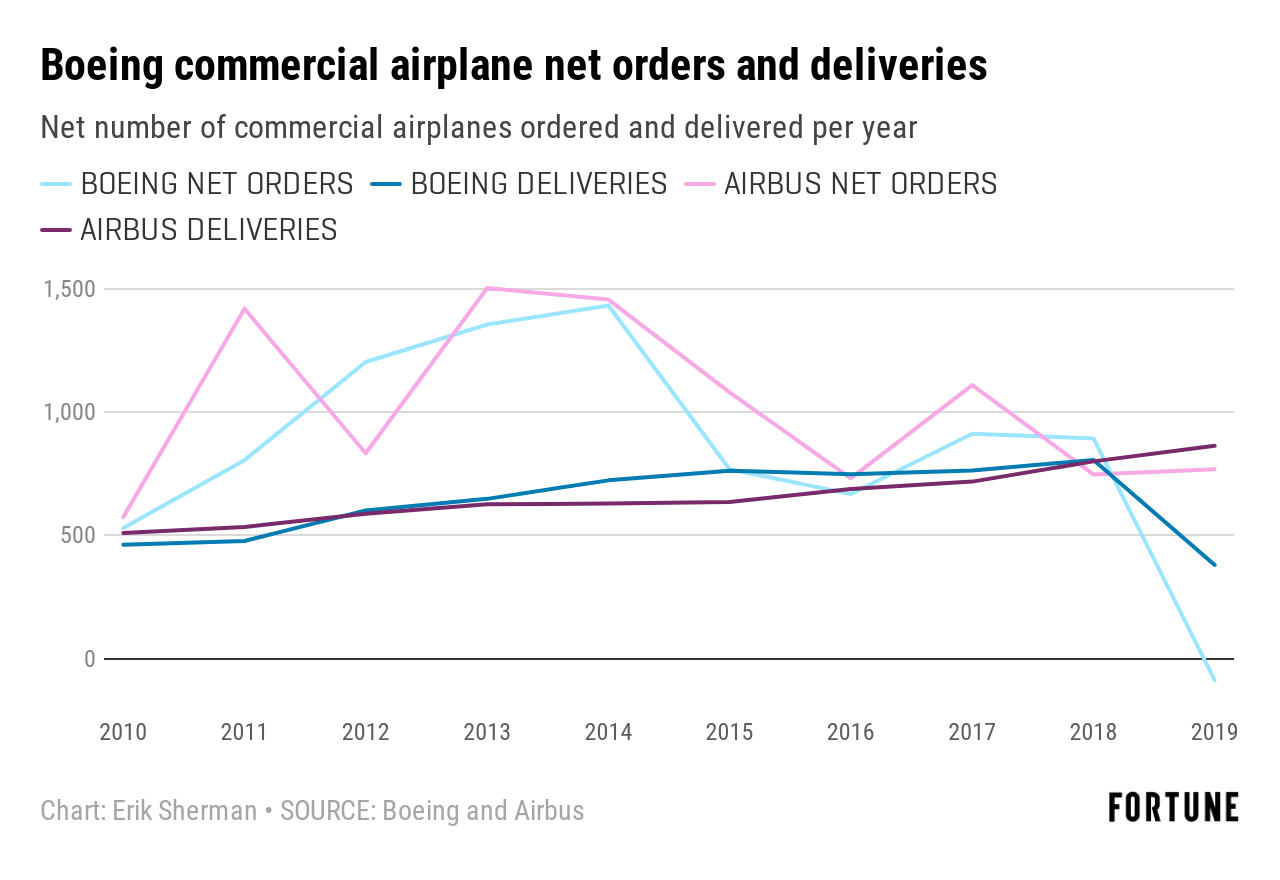
Boeing’s sales performance dropped off a cliff between 2018 and 2019. And, because of the fractured relationship between the company and regulators, particularly the Federal Air Administration, no one knows for certain when the MAX might fly again—in the U.S. or overseas.
Airliners aren’t the entirety of Boeing’s business, but they do represent an enormous piece. Commercial airplanes are only one of four major business divisions. The others include defense, space, and security; global services; and Boeing capital. But commercial airplanes have represented about 60% of total revenue. If the MAX doesn’t get off the ground, neither does Boeing’s business.
Total revenues were down 19.4% from $72.8 billion in the first nine months of 2018 to $58.6 billion in the same period of 2019. During that period, earnings per share sunk from about $12 to $0.66.
For investors, an important attraction is its commitment to share buybacks and dividend payments. But the investment community is right to feel antsy. Moody’s issued a credit downgrade review warning (S&P Global Ratings had already cut the credit rating the company in December) and now there’s fresh scrutiny on ex-CEO Dennis Muilenburg’s $80.7 million payout. Finally, there has been a series of equity analyst downgrades over the last few months, with Cowen and Berenberg announcing theirs days and weeks before yesterday’s bad news.
Still, the stock price more or less hangs on for a few reasons.
“Under normal circumstances, you say the market responds quickly to information, except for something like manufacturing,” said Giacomo Santangelo, a senior lecturer in economics at Fordham University. Even with the slide in new sales, existing contracts can’t be so easily put to the side. “All of the negative news on Boeing over the last year was not expected to affect the business now because they’re still producing. It’s the new contracts and future business” that will determine the true extent of the trouble the company faces.
The bullish case
It helps that Boeing operates in a duopolistic market. Airline customers have limited alternatives at the moment. They can’t write off fleet additions because many of their planes are aging. Newer craft have greater fuel efficiency to cut costs and boost margins at a time when air travel is booming. The only other supplier of this sort of commercial aircraft, Airbus, has its own problems with capacity. As an industry analyst at Citi told Fortune, if Boeing hadn’t had such a bad year in 2019, the big story in the sector would be the problems Airbus had meeting delivery targets.
It all points to the fact that there’s captured demand that can’t walk away or find another source.
As the Boeing share price demonstrates, investors are staying calm amid the firehose of bad news. One big reason: they believe the situation has hit bottom and can only go up from here.
“Boeing’s share price would have been hit a lot harder if people thought there was a reasonable probability that the 737 MAX would not fly again,” said Jerry Braakman, chief investment officer for First American Trust.
The larger issues of addressing the toxic workplace culture and repairing relationships with suppliers and regulators “will cost money,” said Braakman, who personally owns some Boeing shares. “And, for investors, that’s always a drag.”
The recent change at the top was also greeted with relief; investors poured back into the stock once Muilenburg was relieved of his duties.
“Bringing David Calhoun in is what gives us confidence to keep owning the stock,” said Kevin Simpson, chief investment officer at Capital Wealth Planning, which held a position in shares until they hit around $440, at which point it sold and then bought back at $375. “He’s the polar opposite of David Muilenberg. He’s not hiding things under the rug.”
However, no one is complacent about Boeing’s future. “It has resources to continue, but it needs to resolve this in a reasonable amount of time,” Braakman said.
What’s a reasonable timeline for Boeing to get back on track? Various analysts told Fortune that the company needs to be on its way to normalcy by late spring, early summer, or even the end of 2020 (although the longer the delay, the more impact share prices will feel) to fully regain the trust of the markets.
“If it happens later this year, Boeing can still do okay,” said Capital Wealth Planning lead portfolio manager Josh Smith. “If it stretches into 2021, then things get a little dicey.”
For now, all eyes and ears will be on the Boeing earnings report at the end of January. And nobody is discounting yet more bad news.
More must-read stories from Fortune:
—Forget policymakers. Greta Thunberg and her allies are targeting CEOs
—Investors see a 2020 recession coming—but think they’ll make money
—The Carlos Ghosn affair: A look inside the motivations of a fugitive CEO
—What $1,000 in 10 top stocks a decade ago would be worth today
—Laws meant to close down tax havens and shut loopholes could have opposite effect
Subscribe to Fortune’s forthcoming Bull Sheet for no-nonsense finance news and analysis daily.