New highs in the stock markets are great for those who already own stocks. But there is a downside when stocks seemingly do nothing but rise. Any investor who’s been holding cash, waiting for lower prices and a better entry point, has had to keep waiting. And those deploying new savings into the markets have had to do so at higher and higher prices.
Those rising prices are also a catch-22 for long-term investors, because pricey markets today make impressive future gains less likely. The S&P 500 currently trades at about 30 times its average inflation-adjusted earnings over the past 10 years (the so-called CAPE ratio). Historically, levels anywhere near that high have almost always preceded periods of disappointing returns.
That’s why many investors are more comfortable buying shares when there’s blood in the streets. And the good news for those investors is that there will always be a bear market somewhere, even when the broad market is killing it. Three asset classes that have been left behind during this bull run stand out in particular right now in the eyes of bargain hunters:

Energy stocks
Oil prices topped $150 a barrel in June 2008. Since then, new production unleashed by the fracking revolution, combined with low inflation, has helped drive oil prices down by two-thirds—while hammering energy-company profits. Energy has been by far the worst-performing sector of the S&P 500 since mid-2008, and it’s not even close: The Energy Select Sector SPDR ETF (XLE) has fallen more than 13%, versus a gain of more than 200% for the S&P 500. One consolation prize is high dividends: XLE, for example, currently yields 3.8%, more than twice what the broader market yields.
Precious metals and mining stocks
These commodity-producer stocks often exhibit wild volatility because they’re unusually sensitive to economic growth and fluctuating supply and demand for the commodities themselves. Vanguard Global Capital Cycles (VGPMX), a mutual fund that’s a good proxy for the metals markets and related commodities, has done worse than just trail the market during this cycle: Over the past 10 years, the fund is down nearly 50%. (Again, relatively modest global growth is a culprit.) Investors often seek metals and mining stocks because they have a low correlation to the broader market, offering the benefits of a diversified portfolio. But sometimes owning uncorrelated assets means eating big losses while the rest of the market screams higher.
Value stocks
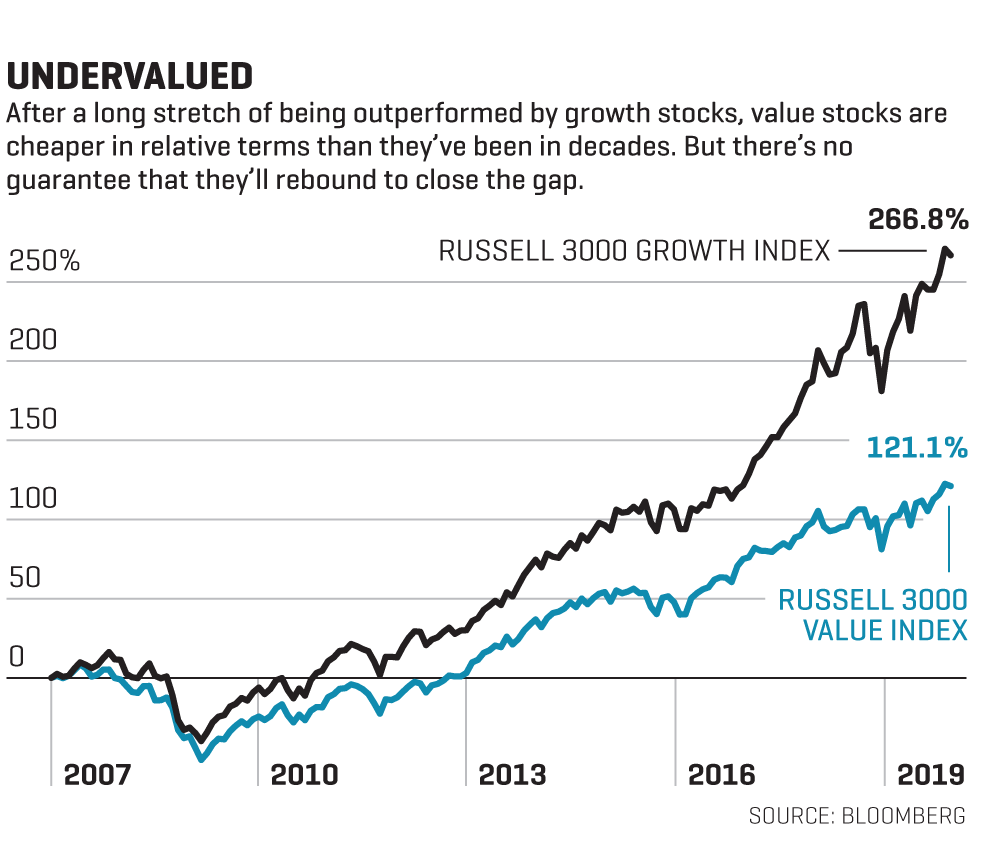
After the dotcom bubble deflated, value stocks—stocks that are cheap relative to the value of their underlying businesses—went on a run of huge outperformance over growth stocks. But growth has beaten the pants off value since the financial crisis (see graphic), led by high-growth companies such as Amazon, Netflix, Google, and Facebook that have monopolized investor mindshare. The growing economic impact of tech innovation, particularly in software; the rising value of intangible assets like patents, copyrights, and trademarks; and the willingness of investors to pay extra for growth in a world awash in capital have all contributed to growth’s edge.
Still, investors think a turning point could be near. Using a number of metrics, Cliff Asness, head of investment giant AQR Capital Management, showed in a recent piece that growth stocks are more expensive now than at any time other than the dotcom bubble. In contrast, Asness writes, “Excluding the tech bubble, the value of value is the cheapest it’s ever been.”

Of course, just because something is cheap doesn’t mean it can’t get cheaper. As our examples show, each of these categories has a black eye for a reason. That’s what makes the current situation for investors so confusing: It can seem like your only choices are to invest in assets with good fundamentals but high prices or to invest in assets with deteriorating fundamentals but low prices. Yes, history tells us that economic cycles will eventually boost energy and metals stocks and value stocks again, but it won’t tell us when.
The best move may be to worry less about “when.” Many investors (including my firm) favor a long-term strategy that involves broad diversification. In practice, that often means investing some capital in the areas of the market that have been hit the hardest, to take advantage of the cheap entry point. When deciding whether to wade into beaten-down asset classes, here are some lessons to keep in mind:
Nothing works all the time
Value investing has been repeatedly vetted by academics, professional investors, and the iconic Warren Buffett as an approach that works over the long term. But even sound investment strategies are bound to go through painful periods of underperformance. After all, the only reason any assets earn a premium over the rate of inflation is because owning them involves risks—and “sound” doesn’t mean “risk-free.”
Diversification means always having to say you’re sorry
The main reason to diversify is to avoid concentrating your money in a terrible-performing asset for an extended period. But spreading your bets also means that at least part of your portfolio will be sucking wind while the rest of it sprints ahead. You’re accepting the occasional strikeout to increase your odds of winning the game.
Don’t forget to rebalance
Diversification works only if you periodically rebalance your asset allocations. In essence, this means selling a little bit of what has done well to buy a little bit of what hasn’t. All of the asset classes above experienced strong returns before their fall from grace. Did you sell off a bit during the good times to bring them back to their target weights? If not, their losses have been even more painful for you—which could make it even harder to buy now, when strategy might dictate that you should.
Ben Carlson is director of institutional asset management at Ritholtz Wealth Management. His firm has positions in value stock funds, but not in any specific fund mentioned here.
A version of this article appears in the January 2020 issue of Fortune with the headline “Buying ‘Bears’ in a Bull Market.”
More must-read stories from Fortune:
—2020 Crystal Ball: Predictions for the economy, politics, technology, etc.
—In scooter startups, landlords see a competitive edge and the city of the future
—Big tech companies avoided over $100 billion in taxes. What that means
—How blockchain will shake up the financial world
—What went wrong at Chime? How rapid growth became its own challenge
—Don’t miss the daily Term Sheet, Fortune’s newsletter on deals and dealmakers.