This is the web version of Business x Design. Sign up here to get it in your inbox.
Welcome to Business x Design, a new newsletter on the power of design. In this email, Clay Chandler considers the fashion industry’s efforts to push a sustainable agenda. What else would you like to see from us? This newsletter is a work in progress supported by you, our readers. Reply to this email with your suggestions and feedback.
I am not a “fashionista,” as friends and colleagues readily will attest. But I confess experiencing a guilty pleasure in perusing swank luxury magazines and websites, including Fashionista.com, where a recent headline caught my eye: “2019 Was the Year Sustainability Finally Burst into the Fashion Mainstream.”
The accompanying post cites myriad examples of how this year the “sustainability conversation” in the fashion industry moved “from the margins to the mainline.” Among them: Gucci declared it would go go carbon-neutral; Kanye West launched a sustainability drive at Yeezy; LVMH and Kering are duking it out to prove which house is more environmentally responsible.
Fashionista.com’s Whitney Bauk says the newfound passion for eco-fashion burst into view during the Spring 2020 show season (which, for the uninitiated, took place in the fall of 2019). She observes that “more designers than ever” seem keen to be green—or at least keen to be seen as green.
I take this shift with a shade of jade. Haute couture is notoriously wasteful. Its lavish sets and pricey costumes tend to wind up on rubbish tips. And then there’s its customers’ carbon contrails.
In an earlier post, Bauk notes the surreal fact that this year’s fashion week coincided with climate strikes in Paris, a United Nations climate summit in New York, and raging fires in the Amazon rainforest. She highlights a photoshopped collage by French writer and artist Thomas Lelu superimposing the viral image of Jennifer Lopez’s closing moment in the plunging “jungle green” dress she wore at the Versace show Milan in front of a phalanx of French climate strikers protesting deforestation.
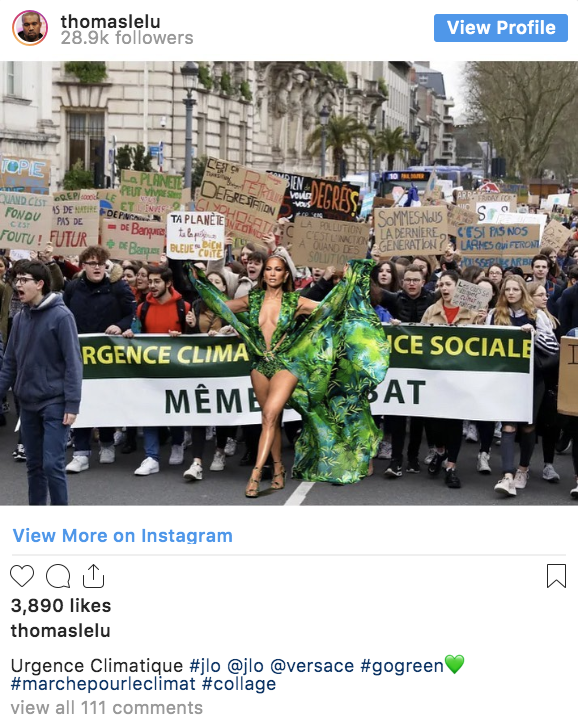
Just Jenny from the block—in a $9,325 frock!
It’s easy to poke fun at the luxury fashion industry. For years a host of smaller designers—among them Stella McCartney, Eileen Fisher, and Spencer Phipps—have shown it’s possible to make beautiful clothes without making the planet an uglier place.
In Hong Kong, where I’m based, textile giant Esquel has worked to make the apparel supply chain more environmentally friendly. The group recently unveiled a state-of-the-art production facility in the southern city of Guilin which uses natural dyes and organic cotton production.
Designers from other sectors, too, are tackling sustainability challenges. Star designers including Tony Fadell, Daan Roosegaarde, and Bill McDonough were among the most compelling speakers at the Fortune Global Sustainability Forum in Yunnan, China. As I noted last week, architects like Japan’s Kengo Kuma have explicitly rejected the “arrogance” of modernism in favor of more modest, environmentally friendly design strategies. Foster + Partners this month announced a sustainability manifesto pledging to go beyond environmental certification schemes required by the Paris climate accord.
The key to all these efforts is that designers must move beyond “greenwashing” to methods that not only “maintain” and “sustain” the planet, but also make it a better place. As McDonough puts it, it’s time for designers to put down their mops and pick up a paint brush.
Clay Chandler
@ClayChandler
Clay.Chandler@Fortune.com
VISION, EMPATHY, SCALE
This edition of Business x Design was curated by Margaret Rhodes.
PDA. Big tech companies have peddled many antidotes to phone addiction. These efforts add up to more features, both software (settings and apps that remind you to stop looking at Instagram) and hardware (experimental dumb phones). But a better experience may lie in fewer features, not more, as evidenced by the Palm Pilot. Former Palm executives and designers describe a focused design mission for the early-aughts personal-assistant device. Your Palm Pilot didn’t have to launch a business for you; it was enough that it intuitively made lists and fit in your pocket. Those were simpler times, for sure, but they also sound like healthier times: “Thanks to its ultra-simple interface and relative lack of features compared with smartphones,” journalist Erin Schulte writes, “Palm fans seemed to view their devices as tools rather than extensions of themselves.” [Fast Company]

Like a fish in water. Nike has followed up on its groundbreaking performance hijab with a new design for modest swimwear (better known as a burkini). After 18 months and 55 iterations, the sportswear company landed on a $600 high-performance swimsuit that works as an alternative to a wetsuit. Nike’s designers invented a swim cap-like pouch for the hijab, but the real innovation can be seen in how the fabric drains water: The sides of the garment are tricked out with mesh modeled after fish gills, allowing water to flow in and out, and the athlete to move unencumbered. [Wired]
Side effects. A new report on the effects of artificial intelligence looks grim: According to the AI Now Institute at New York University, AI-powered programs poses both a societal threat and an environmental one. In terms of the former, government agencies and businesses that make decisions based on facial-recognition technology may not realize the inherent racial profiling and cultural bias that’s baked into that exercise. The report also points out that training A.I. programs requires ample amounts of energy—600,000 pounds of carbon dioxide emissions per one A.I. model, by one count. These consequences are largely invisible to those who benefit from the convenience of A.I. models, which makes them all the more troubling. [OneZero]
IN CASE YOU MISSED IT
Parsing the WeWork Debacle by Alan Murray and David Meyer
Here are 2 Ways Companies Can Reduce Their Environmental Impact by Danielle Abril
In Scooter Startups, Landlords See a Competitive Edge—and a Path to the City of the Future by Rey Mashayekhi
Apple’s Busy Week: a $52,000 Mac Pro and an Acquisition of Better Camera Technology by Don Reisinger
Can Technology Save the Air Travel Industry From Its Delay Problem? by Tracey Lindeman
DISCUSSION
Free shipping sure makes for an intoxicating user experience, but there’s really no such thing. No one wants to hear this in the midst of a holiday-induced frenzied shopping week, but the idea that packaged goods can ship and get delivered for free is a mirage—one that’s hurting small businesses. Etsy, for instance, prioritizes sellers who offer free shipping, even though those artists and makers typically eat the cost. E-sellers can do this because shoppers enable it by choosing products that offer a frictionless check out. Economic (and, even more so, psychological) principle called the “pain of paying” explains why free shipping is so powerful. From The Atlantic:
“Printer ink and hotel Wi-Fi torment because they’re a means to an end that consumers feel they’ve already paid to reach. You bought the printer—of course you need to print things. You booked the hotel—of course you need to check your email during your stay. Paying for shipping is a two-for-one pain deal: Not only are you confronted with the actual cost of your convenience, but you’re being asked to pay “extra” for a store to fork over items you’re already laying out for.”
Like Etsy, Amazon offers incentives to sellers who play by its rules of convenience. An October feature in The New Yorker outlined the ways that companies who pay for the company’s Fulfillment by Amazon shipping service get preferential treatment and a “Buy Box” button on their product page. Like providing free shipping on Etsy, earning a spot in the “Buy Box” costs vendors money; one company mentioned paying Amazon as much as two dollars per item.
These measures appear to consumers as a series of buttons, boxes, and links on a website. It’s a potent mixture of consumer-experience insights and user-experience design that makes it harder and harder for buyers to accept even a fairly reasonable $3.99 shipping charge. But it’s worth a closer look: That small fee could make it possible for a small business owner to do their work, free from the vise of a corporation’s mandates.