• Home
  • Latest
  • Fortune 500
  • Finance
  • Tech
  • Leadership
  • Lifestyle
  • Rankings
  • Multimedia

Once Seen as a Novelty, Ranked-Choice Voting Gains Ground Nationally

By
Mike Hofman
Mike Hofman
Down Arrow Button Icon
By
Mike Hofman
Mike Hofman
Down Arrow Button Icon
November 6, 2019, 2:41 PM ET
New York Voting Station
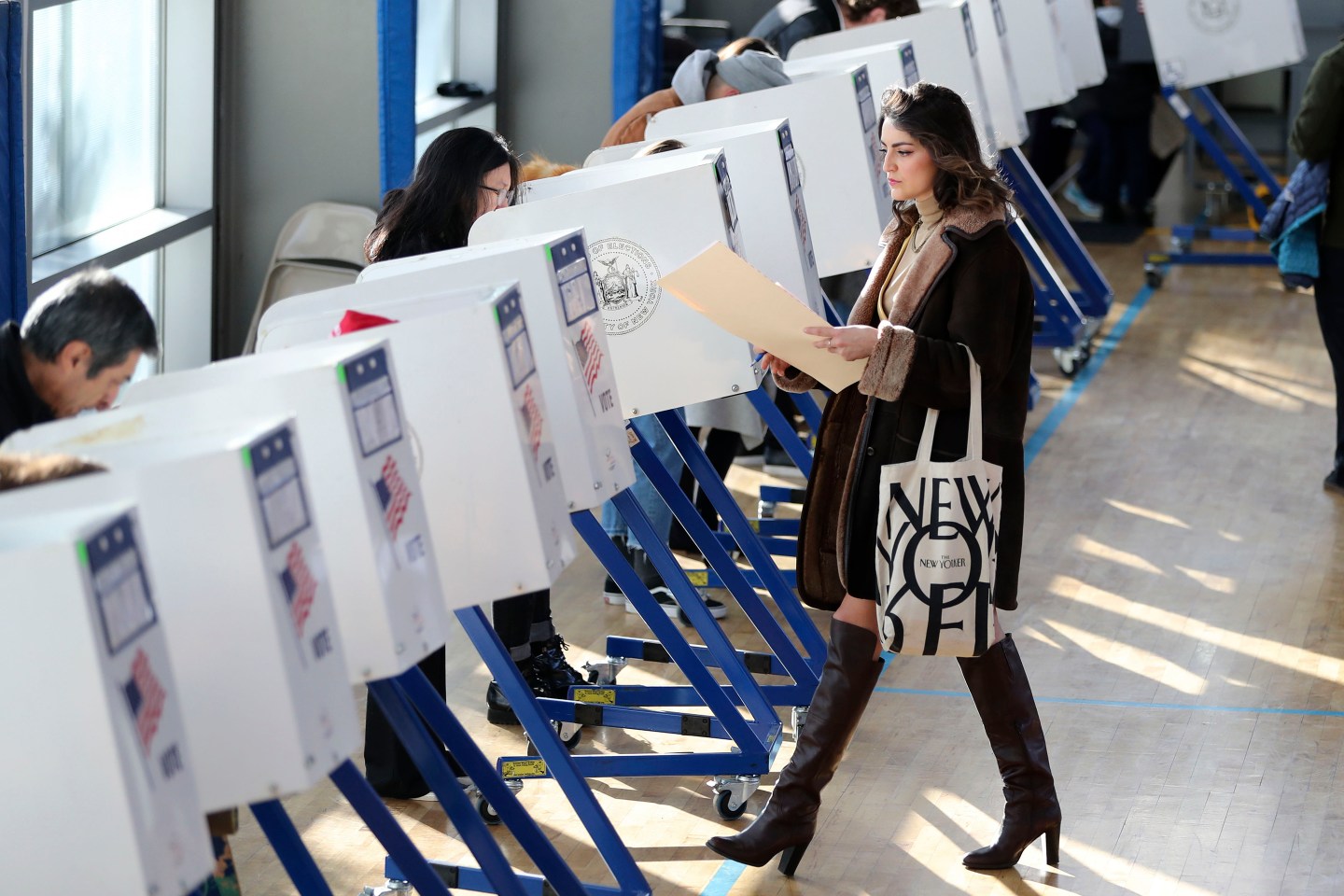
NEW YORK, Nov. 8, 2016 -- A voter walks to a booth to fill in her ballot at a polling station in Brooklyn, New York, the United States, on Nov. 8, 2016. American voters are going to the polls for the U.S. presidential election Tuesday. (Xinhua/Wang Ying via Getty Images)Xinhua/Wang Ying via Getty Images

Voters in New York City have revised the city charter to adopt ranked-choice voting, a new way of deciding who has won an election that is steadily gaining in popularity across the country. Supporters of ranked-choice voting include Democratic presidential candidate Andrew Yang and Rep. Alexandria Ocasio-Cortez (D.-N.Y.)

Under current election rules in most places in the U.S., the winner is determined by what is described as a “first across the post” system, meaning that the person with the most total votes wins. In a two-party slash two-candidate race, a person with 1,000 votes beats a person with 999 votes, for example. 

Of course, many races feature more than two candidates, and that’s where ranked-choice voting promises to offer voters a better way to navigate their choices.

Ranked-choice voting allows voters to select a favorite candidate, and then a second-favorite candidate, and so on. In New York City, the plan calls for allowing residents to rank their top five choices. 

If no candidate achieves a majority of the vote after the first round of counting, first-place votes for candidates at the bottom of the heap are set aside and those voters’ second-place votes are distributed among the top candidates, and so on, until a candidate achieves a majority.

It’s important to note that each voter still only has one vote—but under ranked-choice voting, the voter also has a new mechanism for maximizing the impact of that vote.

Critics argue that ranked-choice voting creates a muddle for voters, upending centuries of tradition that have, for the most part, worked pretty well. They also raise the concern that tabulation errors will be more likely in the future, given the sorting of ballots between those for the candidate who ultimately wins the election, and the so-called “exhausted ballots” of candidates with low vote totals, which are by design counted differently. All of this, they argue, will reduce confidence in the democratic process at a time when our institutions are already under pressure, thanks to allegations of foreign interference in the 2016 election and the mind-boggling, hanging-chad theatrics of the 2000 Bush v. Gore Florida recount.

But proponents counter that the system reduces the need for arduous runoff elections, and that it is particularly well-suited for municipal elections in which a diverse, multi-candidate field—often from within a single political party—results in a narrow win for a candidate with a strong base of support in, say, a particular neighborhood, but sometimes little appeal beyond that base. 

In this scenario, ranked-choice supporters assert, there’s a warp on both sides of the election: voters are often encouraged to abandon longer-shot candidates who they think will get too few votes in a split field. Meanwhile, candidates are thought to have greater incentives to go negative to depress a rival’s vote total, rather than running a positive campaign in an effort to be that rival’s voters’ second pick. 

“First across the post” races also create weird, specific tensions with third-party options. On the one hand, a third-party candidate who has a passionate following nevertheless has a hard time breaking through because some group of voters will opt for a less dynamic but more “electable” candidate—the lesser-of-two-evils approach to democracy that can feel so demoralizing. On the other hand, a third-party campaign can be used as a spoiler in a tight race, taking just enough votes away from a candidate whose views are broadly preferred by a slim majority of the electorate. 

In the close Kentucky governor’s race, for example, a third-party Libertarian Party candidate won 28,000 votes, about 23,000 votes more than the apparent, 5,000-vote margin of victory of Democrat Andy Beshear over Republican Matt Bevin. It’s impossible to know which alternative those Libertarian voters would have picked as a second choice, but it is well within the realm of possibility that they would have given Bevin the slim margin he needed to win a second term. (For its part, the Kentucky Libertarian Party issued a nihilistic statement that said, “We are always happy to split the vote in a way that causes delicious tears.”)

New York City joins 20 other cities nationwide in adopting ranked-choice voting—many of them liberal bastions such as San Francisco, Berkley, and Oakland, Calif.; Santa Fe, N.M.; Minneapolis and St. Paul, Minn.; and Cambridge, Mass. 

Maine is also a laboratory for ranked-choice voting, having implemented it by voter initiative in 2016 for federal elections. Last year, the state’s hotly-contested second congressional district provided a test case in ranked-choice voting outcomes. The incumbent Republican congressman, Bruce Poliquin, faced a Democratic challenger, Jared Golden, plus two additional candidates. On election night, Poliquin had the most first-place votes by a margin of 2,000. However, he did not win a majority of the total vote. When the second- and third-place votes were counted, it was actually Golden who earned a majority, and the Democrat was declared the winner. 

Following his election loss, Poliquin filed a lawsuit to challenge the constitutionality of ranked-choice voting, calling the system “exotic,” “costly,” and “confusing”—and asking the courts to order a do-over race. A federal judge who had been appointed to the bench by President Trump flatly rejected Poliquin’s argument and call for a new election.

“[T]here is no dispute that the RCV Act (ranked-choice voting act)—itself the product of a citizens’ initiative involving a great deal of First Amendment expression—was motivated by a desire to enable third-party and non-party candidates to participate in the political process, and to enable their supporters to express support, without producing the spoiler effect,” the judge wrote. “In this way, the RCV Act actually encourages First Amendment expression, without discriminating against any voter based on viewpoint, faction or other invalid criteria.”

Golden is now midway through his first term in office. On some level, it is difficult (and amusing) to imagine an aspiring politician in the Bronx or Queens studying the electoral success of a young congressman from Bangor, Maine. And yet after last night’s victory for ranked-choice voting in New York City, the race he ran might well become something of a case study for other candidates in New York, and around the country.

More must-read stories from Fortune:

—Paul Ryan’s new foundation makes poverty experts and Medicare advocates nervous
—Wall Street’s scorn for Elizabeth Warren boils over
—Trump’s national parks changes could, ironically, help Jeff Bezos
—Sherrod Brown has some advice for 2020 candidates hoping to win in Ohio
—Prisoners are fighting wildfires on the front lines, but getting little in return
Get up to speed on your morning commute with Fortune’s CEO Daily newsletter.



About the Author
By Mike Hofman
See full bioRight Arrow Button Icon

Latest in

Finance
Lorem ipsum dolor sit amet, consectetur adipiscing elit, sed do eiusmod tempor incididunt ut labore et dolore magna aliqua. Ut enim ad minim veniam
By Fortune Editors
October 20, 2025
Finance
Lorem ipsum dolor sit amet, consectetur adipiscing elit, sed do eiusmod tempor incididunt ut labore et dolore magna aliqua. Ut enim ad minim veniam
By Fortune Editors
October 20, 2025
Finance
Lorem ipsum dolor sit amet, consectetur adipiscing elit, sed do eiusmod tempor incididunt ut labore et dolore magna aliqua. Ut enim ad minim veniam
By Fortune Editors
October 20, 2025
Finance
Lorem ipsum dolor sit amet, consectetur adipiscing elit, sed do eiusmod tempor incididunt ut labore et dolore magna aliqua. Ut enim ad minim veniam
By Fortune Editors
October 20, 2025
Finance
Lorem ipsum dolor sit amet, consectetur adipiscing elit, sed do eiusmod tempor incididunt ut labore et dolore magna aliqua. Ut enim ad minim veniam
By Fortune Editors
October 20, 2025
Finance
Lorem ipsum dolor sit amet, consectetur adipiscing elit, sed do eiusmod tempor incididunt ut labore et dolore magna aliqua. Ut enim ad minim veniam
By Fortune Editors
October 20, 2025

Most Popular

Finance
Lorem ipsum dolor sit amet, consectetur adipiscing elit, sed do eiusmod tempor incididunt ut labore et dolore magna aliqua. Ut enim ad minim veniam
By Fortune Editors
October 20, 2025
Finance
Lorem ipsum dolor sit amet, consectetur adipiscing elit, sed do eiusmod tempor incididunt ut labore et dolore magna aliqua. Ut enim ad minim veniam
By Fortune Editors
October 20, 2025
Finance
Lorem ipsum dolor sit amet, consectetur adipiscing elit, sed do eiusmod tempor incididunt ut labore et dolore magna aliqua. Ut enim ad minim veniam
By Fortune Editors
October 20, 2025
Finance
Lorem ipsum dolor sit amet, consectetur adipiscing elit, sed do eiusmod tempor incididunt ut labore et dolore magna aliqua. Ut enim ad minim veniam
By Fortune Editors
October 20, 2025
Finance
Lorem ipsum dolor sit amet, consectetur adipiscing elit, sed do eiusmod tempor incididunt ut labore et dolore magna aliqua. Ut enim ad minim veniam
By Fortune Editors
October 20, 2025
Finance
Lorem ipsum dolor sit amet, consectetur adipiscing elit, sed do eiusmod tempor incididunt ut labore et dolore magna aliqua. Ut enim ad minim veniam
By Fortune Editors
October 20, 2025
Fortune Secondary Logo
Rankings
  • 100 Best Companies
  • Fortune 500
  • Global 500
  • Fortune 500 Europe
  • Most Powerful Women
  • Future 50
  • World’s Most Admired Companies
  • See All Rankings
Sections
  • Finance
  • Fortune Crypto
  • Features
  • Leadership
  • Health
  • Commentary
  • Success
  • Retail
  • Mpw
  • Tech
  • Lifestyle
  • CEO Initiative
  • Asia
  • Politics
  • Conferences
  • Europe
  • Newsletters
  • Personal Finance
  • Environment
  • Magazine
  • Education
Customer Support
  • Frequently Asked Questions
  • Customer Service Portal
  • Privacy Policy
  • Terms Of Use
  • Single Issues For Purchase
  • International Print
Commercial Services
  • Advertising
  • Fortune Brand Studio
  • Fortune Analytics
  • Fortune Conferences
  • Business Development
  • Group Subscriptions
About Us
  • About Us
  • Editorial Calendar
  • Press Center
  • Work At Fortune
  • Diversity And Inclusion
  • Terms And Conditions
  • Site Map
  • About Us
  • Editorial Calendar
  • Press Center
  • Work At Fortune
  • Diversity And Inclusion
  • Terms And Conditions
  • Site Map
  • Facebook icon
  • Twitter icon
  • LinkedIn icon
  • Instagram icon
  • Pinterest icon

Latest in

stressed worker
EconomyJobs
The job market is so bad, workers now think they have worse odds of finding a role than during the pandemic
By Jake AngeloApril 10, 2026
10 minutes ago
Fortune Brainstorm Tech 2019 in Aspen, Colo. (Photo: Fortune)
NewslettersFortune Tech
Who’s speaking at Fortune Brainstorm Tech 2026
By Andrew NuscaApril 10, 2026
18 minutes ago
Schools across America are quietly admitting that screens in classrooms made students worse off and are reversing years of tech-first policies
InnovationEducation
Schools across America are quietly admitting that screens in classrooms made students worse off and are reversing years of tech-first policies
By Marco Quiroz-GutierrezApril 10, 2026
49 minutes ago
Dario Amodei
NewslettersTerm Sheet
What Anthropic’s too-dangerous-to-release AI model means for its upcoming IPO
By Beatrice NolanApril 10, 2026
55 minutes ago
Eva Longoria says she refused to be a ‘struggling actor’—so she worked part time as a headhunter, closing deals from her soap opera dressing room
SuccessThe Promotion Playbook
Eva Longoria says she refused to be a ‘struggling actor’—so she worked part time as a headhunter, closing deals from her soap opera dressing room
By Orianna Rosa RoyleApril 10, 2026
2 hours ago
A view of a bus shelter at Pennsylvania Avenue and 22nd Street NW where an electronic billboard and a poster display the current U.S. National debt per person and as a nation at 38 Trillion dollars on October 28, 2025 in Washington, DC.
Economynational debt
‘We owe it to the next generation’ to get national debt under control, says think-tank boss, as U.S. borrowing hits $1.2 trillion in just six months
By Eleanor PringleApril 10, 2026
2 hours ago

Most Popular

The U.S. government is spending $88 billion a month in interest on national debt—equal to spending on defense and education combined
Economy
The U.S. government is spending $88 billion a month in interest on national debt—equal to spending on defense and education combined
By Fortune EditorsApril 9, 2026
21 hours ago
A Meta employee created a dashboard so coworkers can compete to be the company's No. 1 AI token user—and Zuckerberg doesn't even rank in the top 250
AI
A Meta employee created a dashboard so coworkers can compete to be the company's No. 1 AI token user—and Zuckerberg doesn't even rank in the top 250
By Fortune EditorsApril 9, 2026
1 day ago
Gen Z doesn't want your full-time job. They want several part-time roles, and it's reshaping the entire workforce
Success
Gen Z doesn't want your full-time job. They want several part-time roles, and it's reshaping the entire workforce
By Fortune EditorsApril 9, 2026
1 day ago
White-collar workers are quietly rebelling against AI as 80% outright refuse adoption mandates
AI
White-collar workers are quietly rebelling against AI as 80% outright refuse adoption mandates
By Fortune EditorsApril 9, 2026
23 hours ago
Gen Z workers are so fearful AI will take their job they’re intentionally sabotaging their company’s AI rollout
AI
Gen Z workers are so fearful AI will take their job they’re intentionally sabotaging their company’s AI rollout
By Fortune EditorsApril 8, 2026
2 days ago
2 years ago, Saudi Arabia quietly canceled the ‘petrodollar’ deal with America that wired the world economy for 50 years. Then war broke out in Iran
Energy
2 years ago, Saudi Arabia quietly canceled the ‘petrodollar’ deal with America that wired the world economy for 50 years. Then war broke out in Iran
By Fortune EditorsApril 7, 2026
3 days ago

© 2026 Fortune Media IP Limited. All Rights Reserved. Use of this site constitutes acceptance of our Terms of Use and Privacy Policy | CA Notice at Collection and Privacy Notice | Do Not Sell/Share My Personal Information
FORTUNE is a trademark of Fortune Media IP Limited, registered in the U.S. and other countries. FORTUNE may receive compensation for some links to products and services on this website. Offers may be subject to change without notice.