• Home
  • Latest
  • Fortune 500
  • Finance
  • Tech
  • Leadership
  • Lifestyle
  • Rankings
  • Multimedia
FinanceRecession

These ‘Secret’ Recession Signs May Provide Clues to When the Next Downturn Is Coming

By
Erik Sherman
Erik Sherman
Down Arrow Button Icon
By
Erik Sherman
Erik Sherman
Down Arrow Button Icon
October 31, 2019, 1:57 PM ET

With stocks near all time highs, and the Fed signaling that after three rate cuts they’re ready to hit pause (indicating they don’t believe the economy is about to slide into recession) it may be tempting for investors to breathe easy, too.

But while many rely on a few obvious markers of economic health—the yield curve, job creation and GDP—it can pay to look a level deeper for signs of what’s really driving economic growth. Below, we asked market-watchers what metrics they are keeping tabs on. Some are already flashing yellow, some look healthy for now. But be it spending patterns or freight traffic, these little-watched signs could be the clues to when the next downturn hits—and how severe it will be.

Consumer confidence and spending

Consumers—which includes all of us—compose the engine that really drives the economy. While always important, the percentage that personal consumer expenditures represent of GDP has been growing over time. In 1980, it was about 61%. Now it hovers around 68%.

Retail sales had been growing in strength, according to Census Bureau data, but tripped in September, according to preliminary estimates, dropping by about 0.3% to about $525.6 billion. That’s still up 4.1% over September 2018 and a 0.3% drop seems tiny, but it’s potentially significant if the trend continues.

Another useful measure is the Conference Board’s Consumer Confidence Index (index because everything is based on a reference value of 100 for comparison). After a slight drop in August to 134.2, the index dropped another 9.2 points to 125 for September. But the number is subtler than it might seem.

“Confidence can be quite high and we can still have a recession,” says Brad McMillan, chief investment officer at Commonwealth Financial Network. “What’s a much better indicator is year-on-year change. When it drops 20 points year on year, that’s trouble. Two months ago, the year-on-year change was 7.9. [Now] it’s -10.2. It’s dropped 18 points in two months.” If the pace continues, watch out.

Jobs numbers

According to McMillan, although the jobs numbers have continued to show expansion, if that number drops to about 1.5% of the labor market—about 1.8 million jobs a year at the moment—it’s historically been a recession indicator. And we’re just about there. .

“We’re trending down to below the 1.8 million a year,” he says. “Even as the population has grown, the labor market has gotten more efficient over time. A smaller percentage will be moving in and out and labor force participation is down.” Fewer opportunities for people to work means less spending and, therefore, lower stimulus for GDP.

Or, offering a slightly different formulation, Craig Kirsner, president of Stuart Estate Planning Wealth Advisors, says that “every time the unemployment hit low numbers between 3.5% to 4.5% and stayed at that low rate for a while, as soon as that unemployment rate started increasing recession followed shortly thereafter.”

The pattern is actually a little more general than that, according to the graph below from the Federal Reserve Bank of St. Louis. The issue isn’t that 3.5% to 4.5% range, but a relative low that lasts for at least a few quarters. Whenever unemployment begins to rise steadily, it happens during a recession, represented by a gray bar in the graph.
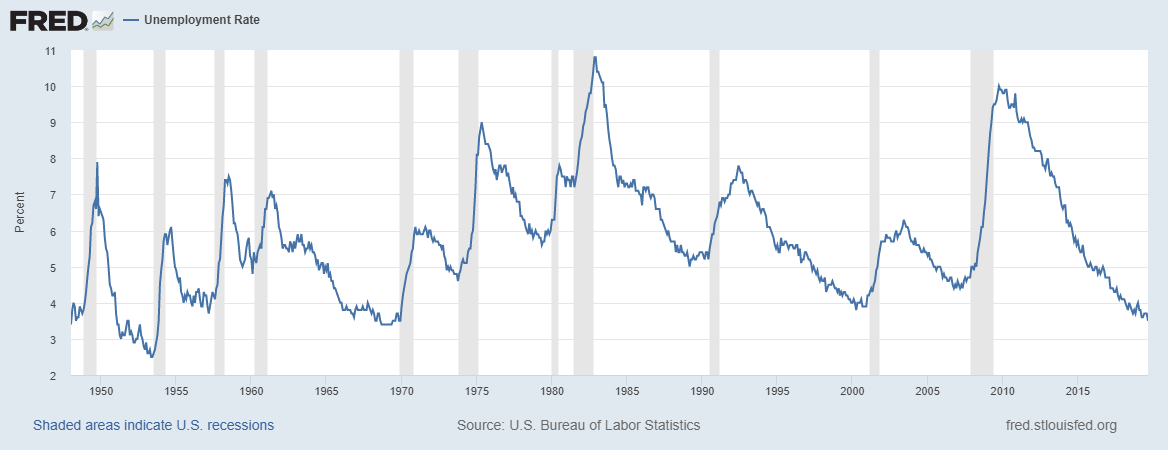
The growth of unemployment is a result of a slowing economy, as companies reduce their work forces in anticipation of and reaction to lower sales.

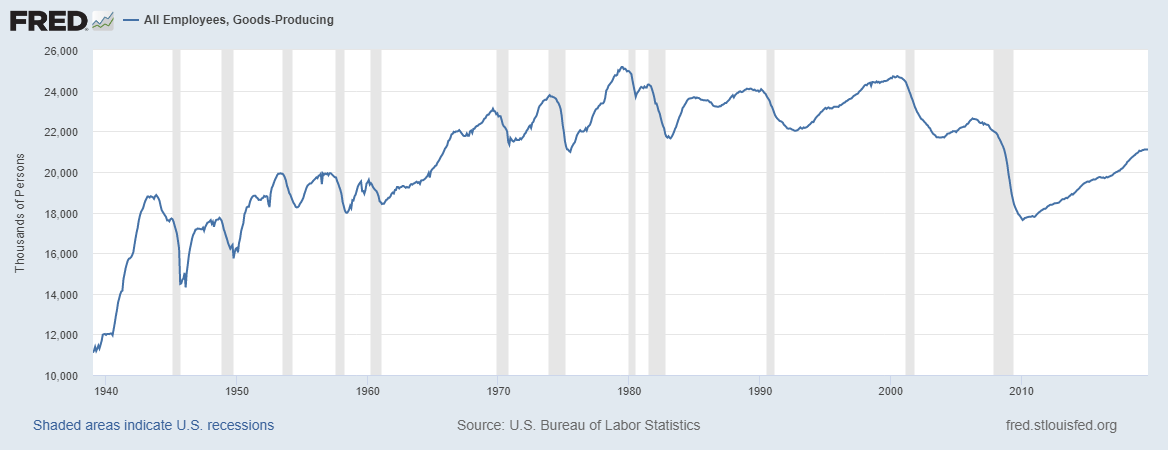
One more take on jobs comes from Adam Morehouse, a senior economist at Dun & Bradstreet, who says to look at jobs numbers in the goods-producing industries (available at the Bureau of Labor Statistics). “Since 1988, employment in the goods producing industries has typically peaked on average 16.6 months before an official recession has been called,” he says. The good news is that they haven’t yet seen that peak in goods producing employment. But the graph below, also from the St. Louis Fed, shows how the pattern works:
Work hours

While jobs are important, so are the number of hours that people work. “We believe that the total aggregate hours worked is one of the best predictors of a recession,” says Charles Self, chief investment officer at iSectors.

The observation is that the stronger the economy, the more demand there is on businesses and the more hours employees work. When the economy is cooling—a precursor to a recession—the number of hours goes down because there’s less demand and, therefore, less to do.

To be precise, Self referred to the “compounded annual rate of change of indexed aggregate weekly hours of production and nonsupervisory employees” that can be calculated at the St. Louis Fed’s site. A compounded annual growth rate would be the percentage change necessary over a year to arrive, in this case, at the number of jobs given the number 12 months before. Here’s the graph, showing the calculation done monthly:
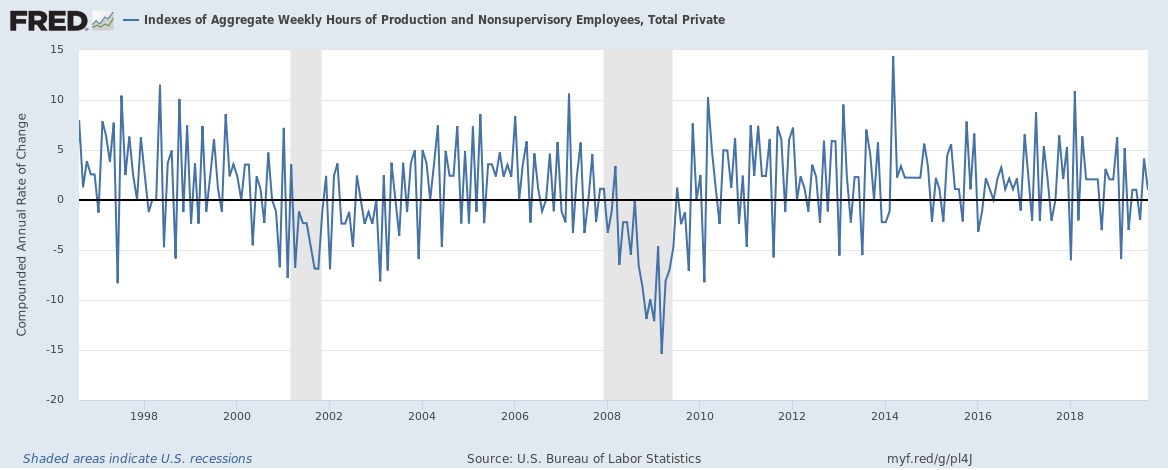
Positive change (above the horizontal black line) shows that the number of work hours is on the rise over a 12-month window. Below the black line is negative change, meaning there are fewer total hours of work. Notice that the trigger is an extended period where that compounded annual growth rate drops below zero for more than a single quarter in a row.

IPOs

The poor performances of IPOs from Lyft to Uber, and the collapse of the WeWork plan, are an ominous sign to some. When getting close to the end of a business growth cycle, companies rush in to do an IPO while they think the markets still might support them “and investors start cooling on them,” McMillan says. “When you see some high-profile deals roll over and even have to be withdrawn, that says investors are looking at things differently.” When investors get more cautious, businesses often do as well, which can generate the conditions for a recession.

Freight traffic

Even in a digital age, commerce requires the constant movement of goods from one part of the country to another, which usually means travel over land. Trains and trucks move massive amounts of products, parts, and bulk commodities, as Dejan Ilijevski, president at Sabela Capital Markets points out.

“Changes in rail [and truck] traffic data can be a leading indicator for changes in economic activity,” he says. The Association of American Railroads has some free interactive charts that show various weekly cargo data. Overall, 2019 is lagging in overall carloads compared to the previous three years.

Again, not one of these numbers is a definitive sign by itself. But taken together, if enough secret signs take a turn for the worse, you just might have the recipe for a recession.

More must-read stories from Fortune:

—Why active fund managers have ‘stopped yawning and started flexing their muscles’
—Why JPMorgan Chase wants to give more former criminals a second chance
—What handing out full size candy bars on Halloween says about you, according to behavioral economists
—Another wrinkle emerges in the WeWork saga
—As trade with China dries Up, the lobster business is caught between Trump and Canada
Don’t miss the daily Term Sheet, Fortune’s newsletter on deals and dealmakers.

About the Author
By Erik Sherman
See full bioRight Arrow Button Icon

Latest in Finance

Finance
Lorem ipsum dolor sit amet, consectetur adipiscing elit, sed do eiusmod tempor incididunt ut labore et dolore magna aliqua. Ut enim ad minim veniam
By Fortune Editors
October 20, 2025
Finance
Lorem ipsum dolor sit amet, consectetur adipiscing elit, sed do eiusmod tempor incididunt ut labore et dolore magna aliqua. Ut enim ad minim veniam
By Fortune Editors
October 20, 2025
Finance
Lorem ipsum dolor sit amet, consectetur adipiscing elit, sed do eiusmod tempor incididunt ut labore et dolore magna aliqua. Ut enim ad minim veniam
By Fortune Editors
October 20, 2025
Finance
Lorem ipsum dolor sit amet, consectetur adipiscing elit, sed do eiusmod tempor incididunt ut labore et dolore magna aliqua. Ut enim ad minim veniam
By Fortune Editors
October 20, 2025
Finance
Lorem ipsum dolor sit amet, consectetur adipiscing elit, sed do eiusmod tempor incididunt ut labore et dolore magna aliqua. Ut enim ad minim veniam
By Fortune Editors
October 20, 2025
Finance
Lorem ipsum dolor sit amet, consectetur adipiscing elit, sed do eiusmod tempor incididunt ut labore et dolore magna aliqua. Ut enim ad minim veniam
By Fortune Editors
October 20, 2025

Most Popular

Finance
Lorem ipsum dolor sit amet, consectetur adipiscing elit, sed do eiusmod tempor incididunt ut labore et dolore magna aliqua. Ut enim ad minim veniam
By Fortune Editors
October 20, 2025
Finance
Lorem ipsum dolor sit amet, consectetur adipiscing elit, sed do eiusmod tempor incididunt ut labore et dolore magna aliqua. Ut enim ad minim veniam
By Fortune Editors
October 20, 2025
Finance
Lorem ipsum dolor sit amet, consectetur adipiscing elit, sed do eiusmod tempor incididunt ut labore et dolore magna aliqua. Ut enim ad minim veniam
By Fortune Editors
October 20, 2025
Finance
Lorem ipsum dolor sit amet, consectetur adipiscing elit, sed do eiusmod tempor incididunt ut labore et dolore magna aliqua. Ut enim ad minim veniam
By Fortune Editors
October 20, 2025
Finance
Lorem ipsum dolor sit amet, consectetur adipiscing elit, sed do eiusmod tempor incididunt ut labore et dolore magna aliqua. Ut enim ad minim veniam
By Fortune Editors
October 20, 2025
Finance
Lorem ipsum dolor sit amet, consectetur adipiscing elit, sed do eiusmod tempor incididunt ut labore et dolore magna aliqua. Ut enim ad minim veniam
By Fortune Editors
October 20, 2025
Fortune Secondary Logo
Rankings
  • 100 Best Companies
  • Fortune 500
  • Global 500
  • Fortune 500 Europe
  • Most Powerful Women
  • World's Most Admired Companies
  • See All Rankings
  • Lists Calendar
Sections
  • Finance
  • Fortune Crypto
  • Features
  • Leadership
  • Health
  • Commentary
  • Success
  • Retail
  • Mpw
  • Tech
  • Lifestyle
  • CEO Initiative
  • Asia
  • Politics
  • Conferences
  • Europe
  • Newsletters
  • Personal Finance
  • Environment
  • Magazine
  • Education
Customer Support
  • Frequently Asked Questions
  • Customer Service Portal
  • Privacy Policy
  • Terms Of Use
  • Single Issues For Purchase
  • International Print
Commercial Services
  • Advertising
  • Fortune Brand Studio
  • Fortune Analytics
  • Fortune Conferences
  • Business Development
  • Group Subscriptions
About Us
  • About Us
  • Press Center
  • Work At Fortune
  • Terms And Conditions
  • Site Map
  • About Us
  • Press Center
  • Work At Fortune
  • Terms And Conditions
  • Site Map
  • Facebook icon
  • Twitter icon
  • LinkedIn icon
  • Instagram icon
  • Pinterest icon

Latest in Finance

inflation
EconomyInflation
The biggest jump in 3 years: gas’ effect on core inflation in March revealed
By Christopher Rugaber and The Associated PressApril 30, 2026
14 minutes ago
inflation
EconomyGDP
U.S. GDP rebounds from lackluster end to 2025, grows at 2% rate in first quarter
By Paul Wiseman and The Associated PressApril 30, 2026
15 minutes ago
google
InvestingMarkets
Google shares hit all-time high on blowout earnings, market cap doubles to $4.4 trillion in just a year
By Michael Liedtke and The Associated PressApril 30, 2026
24 minutes ago
AWS
Big TechMarkets
Amazon’s cloud sales are growing the most in 15 quarters. Investors sent the stock down on AI capex fears
By Anne D'Innocenzio and The Associated PressApril 30, 2026
32 minutes ago
Current price of gold as of April 30, 2026
Personal Financegold prices
Current price of gold as of April 30, 2026
By Danny BakstApril 30, 2026
2 hours ago
April 30, 2026
Personal FinanceCertificates of Deposit (CDs)
Top CD rates from major banks on April 30, 2026: Chase CDs, Bank of America CDs, Citibank CDs, and more
By Joseph HostetlerApril 30, 2026
2 hours ago

Most Popular

Apple cofounder Ronald Wayne—whose stake would be worth up to $400 billion had he not sold it in 1976—says that at 91, he has no regrets
Success
Apple cofounder Ronald Wayne—whose stake would be worth up to $400 billion had he not sold it in 1976—says that at 91, he has no regrets
By Preston ForeApril 27, 2026
3 days ago
Jamie Dimon gets candid about national debt: ‘There will be a bond crisis, and then we’ll have to deal with it’
Economy
Jamie Dimon gets candid about national debt: ‘There will be a bond crisis, and then we’ll have to deal with it’
By Eleanor PringleApril 29, 2026
1 day ago
‘They left me no choice’: Powell isn’t going anywhere—blocking Trump from another Fed appointee
Banking
‘They left me no choice’: Powell isn’t going anywhere—blocking Trump from another Fed appointee
By Eva RoytburgApril 29, 2026
20 hours ago
‘The cost of compute is far beyond the costs of the employees’: Nvidia executive says right now AI is more expensive than paying human workers
AI
‘The cost of compute is far beyond the costs of the employees’: Nvidia executive says right now AI is more expensive than paying human workers
By Sasha RogelbergApril 28, 2026
2 days ago
‘Take the money and run’: Johns Hopkins economist Steve Hanke on why the UAE quit OPEC
Energy
‘Take the money and run’: Johns Hopkins economist Steve Hanke on why the UAE quit OPEC
By Shawn TullyApril 29, 2026
1 day ago
Google Cloud revenue is now 18% of Alphabet's business. Is this the beginning of the end of Google's search identity?
Big Tech
Google Cloud revenue is now 18% of Alphabet's business. Is this the beginning of the end of Google's search identity?
By Alexei OreskovicApril 29, 2026
13 hours ago

© 2026 Fortune Media IP Limited. All Rights Reserved. Use of this site constitutes acceptance of our Terms of Use and Privacy Policy | CA Notice at Collection and Privacy Notice | Do Not Sell/Share My Personal Information
FORTUNE is a trademark of Fortune Media IP Limited, registered in the U.S. and other countries. FORTUNE may receive compensation for some links to products and services on this website. Offers may be subject to change without notice.