• Home
  • Latest
  • Fortune 500
  • Finance
  • Tech
  • Leadership
  • Lifestyle
  • Rankings
  • Multimedia
Electric vehicles

Where Are the Boring EVs?

By
Andrew Moseman
Andrew Moseman
Down Arrow Button Icon
By
Andrew Moseman
Andrew Moseman
Down Arrow Button Icon
October 17, 2019, 5:52 PM ET

The Volkswagen Group is getting charged up, and doing so in two vastly different ways. 

In September, the car conglomerate’s prized Porsche showed off the long-awaited Taycan, its entry into the luxury electric vehicle (EV) space. Taycan has a properly Porsche name (it translates from Turkish origin as “the soul of a spirited young horse”), ultra-fast charging capability, 200-plus miles of range, and a slew of fancy tech features and controls in the cabin. It also starts at a price north of $150,000. Meanwhile, at Germany’s own Frankfurt Auto Show, Volkswagen debuted the ID.3, a little hatchback promising 341 miles of range. The car, which sadly won’t be coming to America in this configuration, looks a bit like a typical Volkswagen Golf, albeit with a jazzy teal two-tone paint job to mark it as exotic and futuristic. 

The big deal about the ID.3 is its very ordinariness—and its attempt at an ordinary price tag (starting at about $33,000 USD) combined with a big enough battery to ease range anxiety. We know the luxury EV market is here to stay, as the rise of Tesla and the long line of Porsche Taycan preorders (30,000 deposits so far) have proven it. But how far are we from having a fleet of perfectly plain EVs populating our roads—our standard soccer-dad crossovers, our prized pickups, and our kids’ first car? Where are the mundane, workaday EVs?
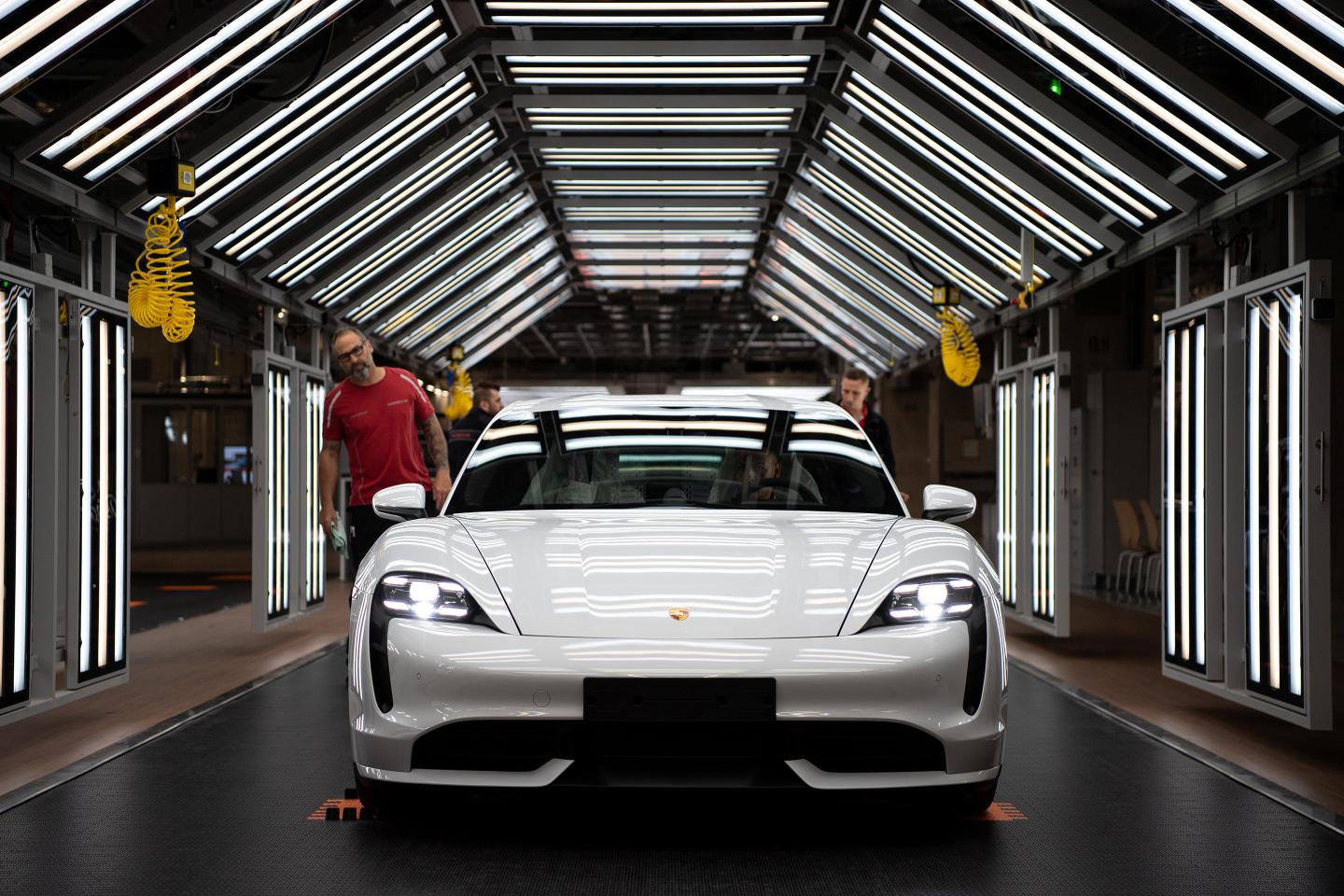
Porsche Taycan
A Taycan is in the final inspection during a show production opening the production of the Porsche Taycan, the first all-electric model of the sports car manufacturer.
Sebastian Gollnow—picture alliance via Getty Images

A Flashy Start

Rewind a decade, back to the dawn of our current electric car resurgence, and you’ll see the hasty evolution in how EVs are supposed to look and what they’re allowed to be. The first Nissan Leaf, released in 2010, resembled a bulbous rolling potato. Its signature look stemmed in part from the fact that Nissan based the car on the entry-level Versa. Part of the science-project aesthetic was clearly intentional, though, meant to appeal to the same kind of early adopters who swarmed to the pod-like Toyota Prius during the previous decade, when it was the driving darling of the green set.

That paradigm changed with Tesla. Elon Musk and company made electric driving sexy and attractive, stamping the brand’s vision of a zero-emissions luxury car onto our collective consciousness with the 2012 rollout of the Model S. Tesla pulled a double trick here. Reinventing the electric car as a premium product positioned it for success beyond just eco-focused buyers and helped to mask the steep cost of putting a big lithium-ion battery in a car.

Both of those market trends continue. Jaguar built the all-electric i-Pace, which, along with the likes of the Audi e-Tron and the Taycan, competes with the Tesla Model S in the high-end electric market. And the more affordable future-pods roll on, with the Chevy Bolt and BMW i3 finding modest sales in electric-friendly markets. 

Now, though, the U.S. auto market stands at the start of a third phase of electrified driving: EV everything. Most of the world’s major auto companies have pledged to electrify their lineups during the 2020s, selling a wide variety of hybrids and totally electric vehicles to meet increasingly stringent fuel economy targets. Electric pickup trucks are coming, not only from flashy startups like Tesla and Rivian but also from established automakers. So are big crossovers, small crossovers, vans and cars. It won’t be long before every major car model offers a hybrid or all-electric version; EV Ford Mustangs and F-150 full-size trucks are a few years away. 

So why does it feel like adoption of everyday EVs isn’t exactly imminent? Take a quick look at sales numbers. 

An Affordable EV Is Not Necessarily An Affordable Vehicle 

In California, the nation’s largest auto market and biggest EV market by far, electric vehicle sales rose by more than 63 percent to 51,750 EV sales in the first half of 2019. However, the strength of the much-anticipated Tesla Model 3 drove that rise. Tesla sold 33,000 Model 3s against just 4,482 Chevy Bolts and 2,034 for the Nissan Leaf. In other words: the less-flashy electric offerings from traditional automakers aren’t drumming up the sort of EVmania we’ve been lead to believe is inevitable.

A sleeker design, more robust charging infrastructure, and better tech features certainly aided Tesla’s strong sales. The steady drumbeat of Model 3 hype didn’t hurt, either. As usual, though, the prime culprit comes down to price. 

While Elon Musk ballyhooed the Model 3 as Tesla’s $35,000 everyman EV, it’s not exactly priced for the masses. Add on any options plus the new car fees and taxes, and the cost of even the base model can slip well over $40,000. (Meanwhile, Tesla’s federal tax credit is now down to $1,875, soon to disappear entirely.) And the competition isn’t doing much better. The Chevy Bolt starts north of $36,000. Nissan’s second-generation Leaf is a marked improvement over the original, but equipped with a 220-mile battery it also reaches the high $30,000s. The same is true of the Kia Niro and Hyundai Kona, fully electrified versions of popular small crossovers.

The Hyundai is a telling case study. The Kona EV is derived from the brand’s popular gasoline-powered car, and together the two versions won the 2019 North American Utility of the Year award. Publications like Car and Driver lauded the Kona EV as one of the best fully electric options on the market, with its 258-mile range outpacing the 240 miles of the Tesla Model 3. Upon the EV’s release, I personally heralded it as a sign of things to come, when electric powertrains finally will enter the anonymous crossovers that Americans just can’t stop buying. But Hyundai, despite some success in friendlier overseas markets, is selling the Kona EV in just a select few coastal states and had moved a paltry 1,751 units in the U.S. through July 2019. For comparison’s sake, that’s 40,000 fewer than the gasoline-powered Kona sold during the same time period.

[Note: For the sake of apples-to-apples comparison, I’m omitting EVs like the Volkswagen e-Golf and Fiat e500, whose limited range make them impractical and primary autos. For the same reason, this article doesn’t dive into plug-in hybrid vehicles—those that allow drivers to plug into a charger and travel a few dozen miles on electric power before a backup gas engine kicks on. PHEVs cratered in the first half of 2019, largely because GM discontinued the field’s standard-bearer, the Chevrolet Volt.] 

The Kona EV’s killer might just be the Kona. Hyundai’s gasoline version starts with an MSRP of $20,100, barely more than half the cost of its electric cousin. Even a buyer who can snag a fat federal tax credit plus a state or local rebate for buying electric can’t make up that kind of gap. Meanwhile, with gas prices more or less stagnant across America, drivers have one less incentive to buy a ride that doesn’t rely on the pump.

Volkswagen’s announced price for the ID.3 comes in at an estimated $33,000. That’s a step in the right direction, but VW stares down the same problem hanging over all the established car companies: Until batteries come down in price, at least enough that electric offerings become truly competitive with their internal combustion counterparts, budget-conscious Americans aren’t shifting into the EV lane.

Correction, Oct. 18, 2019: An earlier version of this story misstated the number of Hyundai Kona models sold.

About the Author
By Andrew Moseman
See full bioRight Arrow Button Icon

Latest in

Finance
Lorem ipsum dolor sit amet, consectetur adipiscing elit, sed do eiusmod tempor incididunt ut labore et dolore magna aliqua. Ut enim ad minim veniam
By Fortune Editors
October 20, 2025
Finance
Lorem ipsum dolor sit amet, consectetur adipiscing elit, sed do eiusmod tempor incididunt ut labore et dolore magna aliqua. Ut enim ad minim veniam
By Fortune Editors
October 20, 2025
Finance
Lorem ipsum dolor sit amet, consectetur adipiscing elit, sed do eiusmod tempor incididunt ut labore et dolore magna aliqua. Ut enim ad minim veniam
By Fortune Editors
October 20, 2025
Finance
Lorem ipsum dolor sit amet, consectetur adipiscing elit, sed do eiusmod tempor incididunt ut labore et dolore magna aliqua. Ut enim ad minim veniam
By Fortune Editors
October 20, 2025
Finance
Lorem ipsum dolor sit amet, consectetur adipiscing elit, sed do eiusmod tempor incididunt ut labore et dolore magna aliqua. Ut enim ad minim veniam
By Fortune Editors
October 20, 2025
Finance
Lorem ipsum dolor sit amet, consectetur adipiscing elit, sed do eiusmod tempor incididunt ut labore et dolore magna aliqua. Ut enim ad minim veniam
By Fortune Editors
October 20, 2025

Most Popular

Finance
Lorem ipsum dolor sit amet, consectetur adipiscing elit, sed do eiusmod tempor incididunt ut labore et dolore magna aliqua. Ut enim ad minim veniam
By Fortune Editors
October 20, 2025
Finance
Lorem ipsum dolor sit amet, consectetur adipiscing elit, sed do eiusmod tempor incididunt ut labore et dolore magna aliqua. Ut enim ad minim veniam
By Fortune Editors
October 20, 2025
Finance
Lorem ipsum dolor sit amet, consectetur adipiscing elit, sed do eiusmod tempor incididunt ut labore et dolore magna aliqua. Ut enim ad minim veniam
By Fortune Editors
October 20, 2025
Finance
Lorem ipsum dolor sit amet, consectetur adipiscing elit, sed do eiusmod tempor incididunt ut labore et dolore magna aliqua. Ut enim ad minim veniam
By Fortune Editors
October 20, 2025
Finance
Lorem ipsum dolor sit amet, consectetur adipiscing elit, sed do eiusmod tempor incididunt ut labore et dolore magna aliqua. Ut enim ad minim veniam
By Fortune Editors
October 20, 2025
Finance
Lorem ipsum dolor sit amet, consectetur adipiscing elit, sed do eiusmod tempor incididunt ut labore et dolore magna aliqua. Ut enim ad minim veniam
By Fortune Editors
October 20, 2025
Fortune Secondary Logo
Rankings
  • 100 Best Companies
  • Fortune 500
  • Global 500
  • Fortune 500 Europe
  • Most Powerful Women
  • World's Most Admired Companies
  • See All Rankings
  • Lists Calendar
Sections
  • Finance
  • Fortune Crypto
  • Features
  • Leadership
  • Health
  • Commentary
  • Success
  • Retail
  • Mpw
  • Tech
  • Lifestyle
  • CEO Initiative
  • Asia
  • Politics
  • Conferences
  • Europe
  • Newsletters
  • Personal Finance
  • Environment
  • Magazine
  • Education
Customer Support
  • Frequently Asked Questions
  • Customer Service Portal
  • Privacy Policy
  • Terms Of Use
  • Single Issues For Purchase
  • International Print
Commercial Services
  • Advertising
  • Fortune Brand Studio
  • Fortune Analytics
  • Fortune Conferences
  • Business Development
  • Group Subscriptions
About Us
  • About Us
  • Press Center
  • Work At Fortune
  • Terms And Conditions
  • Site Map
  • About Us
  • Press Center
  • Work At Fortune
  • Terms And Conditions
  • Site Map
  • Facebook icon
  • Twitter icon
  • LinkedIn icon
  • Instagram icon
  • Pinterest icon

Latest in

Trump says a ‘final proposal’ for a taxpayer-funded takeover of Spirit Airlines is under consideration
PoliticsAirline industry
Trump says a ‘final proposal’ for a taxpayer-funded takeover of Spirit Airlines is under consideration
By Michelle L. Price, Rio Yamat and The Associated PressMay 1, 2026
3 hours ago
U.S. to withdraw 5,000 troops from Germany as Trump feuds with Merz over the Iran war
EuropeGermany
U.S. to withdraw 5,000 troops from Germany as Trump feuds with Merz over the Iran war
By Ben Finley and The Associated PressMay 1, 2026
3 hours ago
EBay soars on report that GameStop is preparing a takeover bid
Investingecommerce
EBay soars on report that GameStop is preparing a takeover bid
By Spencer Soper, Cecilia D'Anastasio and BloombergMay 1, 2026
4 hours ago
ExxonMobil CEO Darren Woods, far right, listens as U.S. President Donald Trump,left, speaks during a meeting with oil company executives in the East Room of the White House on Jan. 9. President Trump is aiming to convince oil executives to support his plans in Venezuela, a country whose energy resources he says he expects to control for years to come. US forces seized Venezuelan president Nicolas Maduro in a sweeping military operation on January 3, with Trump making no secret that control of Venezuela's oil was at the heart of his actions.
EnergyIran
Exxon Mobil CEO sees ‘more to come’ on price spikes from Iran war as Exxon, Chevron beat on earnings despite plunging profits
By Jordan BlumMay 1, 2026
5 hours ago
trump
PoliticsIran
Trump on Iran: ‘They want to make a deal, I’m not satisfied with it, so we’ll see what happens’
By Toqa Ezzidin, Munir Ahmed, Collin Binkley and The Associated PressMay 1, 2026
7 hours ago
infantino
North AmericaWorld Cup
Fifa’s Infantino predicted sellouts and ‘1,000 years of World Cups at once,’ but fans aren’t biting
By James Robson and The Associated PressMay 1, 2026
7 hours ago

Most Popular

Scott Bessent on financial literacy: 'it drives me crazy' to see young men in blue-collar construction jobs playing the lottery
Personal Finance
Scott Bessent on financial literacy: 'it drives me crazy' to see young men in blue-collar construction jobs playing the lottery
By Fatima Hussein and The Associated PressMay 1, 2026
13 hours ago
China dominates the world's lithium supply. The U.S. just found 328 years' worth in its own backyard
North America
China dominates the world's lithium supply. The U.S. just found 328 years' worth in its own backyard
By Jake AngeloApril 30, 2026
1 day ago
The U.S. economy is booming — just not where 50 million Americans live
Commentary
The U.S. economy is booming — just not where 50 million Americans live
By Derek KilmerMay 1, 2026
17 hours ago
Accenture's Julie Sweet blew up 50 years of company history. She says the hardest part is still ahead
Conferences
Accenture's Julie Sweet blew up 50 years of company history. She says the hardest part is still ahead
By Nick LichtenbergApril 29, 2026
3 days ago
Apple cofounder Ronald Wayne—whose stake would be worth up to $400 billion had he not sold it in 1976—says that at 91, he has no regrets
Success
Apple cofounder Ronald Wayne—whose stake would be worth up to $400 billion had he not sold it in 1976—says that at 91, he has no regrets
By Preston ForeApril 27, 2026
4 days ago
Exclusive: America's largest Black-owned bank launches podcast with mission to unlock hidden shame holding back generational wealth
Banking
Exclusive: America's largest Black-owned bank launches podcast with mission to unlock hidden shame holding back generational wealth
By Nick LichtenbergApril 29, 2026
2 days ago

© 2026 Fortune Media IP Limited. All Rights Reserved. Use of this site constitutes acceptance of our Terms of Use and Privacy Policy | CA Notice at Collection and Privacy Notice | Do Not Sell/Share My Personal Information
FORTUNE is a trademark of Fortune Media IP Limited, registered in the U.S. and other countries. FORTUNE may receive compensation for some links to products and services on this website. Offers may be subject to change without notice.