• Home
  • News
  • Fortune 500
  • Tech
  • Finance
  • Leadership
  • Lifestyle
  • Rankings
  • Multimedia
MagazineInvesting

Bond market turbulence: Why it matters and what to do about it

By
Kevin Kelleher
Kevin Kelleher
Down Arrow Button Icon
By
Kevin Kelleher
Kevin Kelleher
Down Arrow Button Icon
September 20, 2019, 6:30 AM ET
BRB10.19.Jerome-Powell
Jerome Powell, the Federal Reserve chair, testifies during a House Financial Services Committee hearing on Capitol Hill in Washington, July 10, 2019.Gabriella Demczuk—The New York Times/Redux

For decades, bonds have offered a kind of fallout shelter for jittery investors in uncertain times. But in 2019, the bond market has looked more like the tip of a warhead aimed at their portfolios.

Global interest rates, already low for most of the decade since the Great Recession, are falling again, making it harder for pension funds and small investors to harvest the slow-and-steady interest income that makes bonds the foundation of many retirement funds. There are a number of factors at play: A decade-long economic expansion is starting to lose its momentum. The U.S.-China trade war threatens to weigh down global commerce. And a majority of economists expect a recession by 2021. 

Here’s why that all matters: These factors drive down rates, as investors become more willing to accept less “yield,” or interest, in return for  bonds’ perceived safety. Taken together, these forces have dragged the rate on the benchmark 10-year U.S. Treasury from 3.24% in November 2018 to as low as 1.45% this September.

Falling rates have an upside, at least on paper: The further they fall, the higher prices rise on existing bonds, whose higher rates look more attractive. The Bloomberg Barclays U.S. Aggregate Bond Index is up 8% this year through mid-September, while an index of U.S. corporate bonds is up 12.3%. Still, few bond investors relish going back to near-zero interest rates because meager yields will outweigh any price gains.

“Going forward, the returns are going to be lower than they have been in the last decade,” says Scott Mather, a managing director at bond-investing giant Pimco, which has $1.8 trillion in assets under management. “And that makes it challenging for investors.”
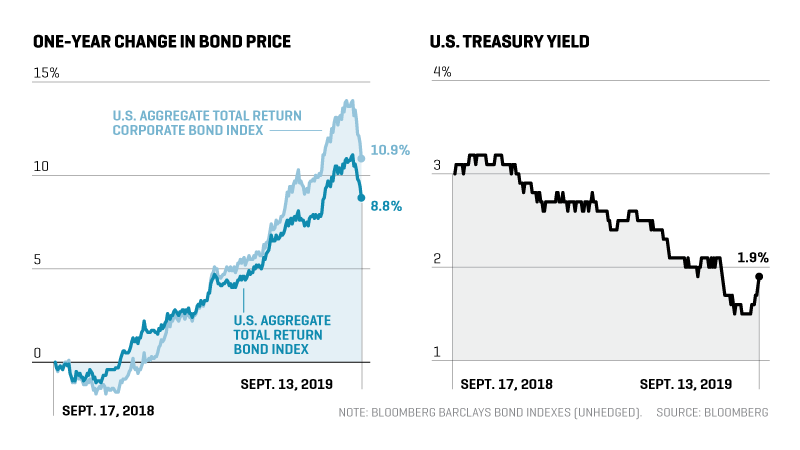
What can bond investors do in such an environment? The confluence of low yields and a weakening economy leaves few palatable options. With bond prices high, now could be an opportune time to sell off riskier securities, such as higher-yield bonds, which­—not unlike growth-oriented tech stocks—tend to be more volatile in bear markets. 

For investors near or in retirement, the safest approach may be to hunker down in U.S. Treasuries, higher-quality mortgage-backed bonds, and investment-grade corporate bonds in sectors with strong fundamentals, such as financials. Their yields may be low, sure, but other assets could end up performing far worse. Mather says the Fed could cut U.S. interest rates to near zero, even if it’s “highly unlikely” it would veer into the risky terrain of negative interest rates, which have become commonplace in Europe and Japan. That’s likely to leave cash a relatively unattractive investment for a while, just as it was during the last recession. 

Investors who still have decades to save for retirement can stomach more risk and ride out bear markets in more volatile investments. Put another way: If you’re in this category, now’s probably not the time to move a lot of money from stocks into bonds. Trying too hard to time market highs and lows, after all, is a time-proven way to under­perform a steadier buy-and-hold approach. But now’s also no time to chase higher returns by loading up on higher-risk, higher-yield junk bonds.

“The natural inclination people have when they see lower yields in their portfolio is to think, ‘Maybe I should allocate more to high yield,’ ” Mather says. “That’s the wrong decision because it can be more dangerous.”

A version of this article appears in the October 2019 issue of Fortune with the headline “Bonds Put Buyers in a Bind.”

More must-read stories from Fortune:

—Wall Street has never had a woman CEO. Why not?
—Passive investing has exploded. But here’s why fears of a bubble are overblown
—Why the next recession may feel very different than 2008
—Social Security increases in 2020 will be noticeably smaller than this year
—U.S. recession indicators haven’t made up their minds
Don’t miss the daily Term Sheet, Fortune’s newsletter on deals and dealmakers.
About the Author
By Kevin Kelleher
See full bioRight Arrow Button Icon

Latest from the Magazine

MagazineMarkets
Why an AI bubble could mean chaos for stock markets—and how smart investors are protecting their portfolios
By Alyson ShontellDecember 3, 2025
21 hours ago
MagazineMedia
CoComelon started as a YouTube show for toddlers. It’s now a $3 billion empire that even Disney can’t ignore
By Natalie JarveyDecember 3, 2025
23 hours ago
MagazineFood and drink
A Chinese ice cream chain, powered by super-cheap cones, now has more outlets than McDonald’s
By Theodora YuDecember 3, 2025
1 day ago
AITikTok
China’s ByteDance could be forced to sell TikTok U.S., but its quiet lead in AI will help it survive—and maybe even thrive
By Nicholas GordonDecember 2, 2025
2 days ago
MagazineAnthropic
Anthropic is all in on ‘AI safety’—and that’s helping the $183 billion startup win over big business
By Jeremy KahnDecember 2, 2025
2 days ago
MagazineDoorDash
How DoorDash became an $85 billion behemoth and won the delivery wars
By Jason Del ReyDecember 1, 2025
3 days ago

Most Popular

placeholder alt text
North America
Jeff Bezos and Lauren Sánchez Bezos commit $102.5 million to organizations combating homelessness across the U.S.: ‘This is just the beginning’
By Sydney LakeDecember 2, 2025
2 days ago
placeholder alt text
Economy
Ford workers told their CEO 'none of the young people want to work here.' So Jim Farley took a page out of the founder's playbook
By Sasha RogelbergNovember 28, 2025
6 days ago
placeholder alt text
North America
Anonymous $50 million donation helps cover the next 50 years of tuition for medical lab science students at University of Washington
By The Associated PressDecember 2, 2025
2 days ago
placeholder alt text
C-Suite
MacKenzie Scott's $19 billion donations have turned philanthropy on its head—why her style of giving actually works
By Sydney LakeDecember 2, 2025
2 days ago
placeholder alt text
Innovation
Google CEO Sundar Pichai says we’re just a decade away from a new normal of extraterrestrial data centers
By Sasha RogelbergDecember 1, 2025
3 days ago
placeholder alt text
Economy
Scott Bessent calls the Giving Pledge well-intentioned but ‘very amorphous,’ growing from ‘a panic among the billionaire class’
By Nick LichtenbergDecember 3, 2025
18 hours ago
Rankings
  • 100 Best Companies
  • Fortune 500
  • Global 500
  • Fortune 500 Europe
  • Most Powerful Women
  • Future 50
  • World’s Most Admired Companies
  • See All Rankings
Sections
  • Finance
  • Leadership
  • Success
  • Tech
  • Asia
  • Europe
  • Environment
  • Fortune Crypto
  • Health
  • Retail
  • Lifestyle
  • Politics
  • Newsletters
  • Magazine
  • Features
  • Commentary
  • Mpw
  • CEO Initiative
  • Conferences
  • Personal Finance
  • Education
Customer Support
  • Frequently Asked Questions
  • Customer Service Portal
  • Privacy Policy
  • Terms Of Use
  • Single Issues For Purchase
  • International Print
Commercial Services
  • Advertising
  • Fortune Brand Studio
  • Fortune Analytics
  • Fortune Conferences
  • Business Development
About Us
  • About Us
  • Editorial Calendar
  • Press Center
  • Work At Fortune
  • Diversity And Inclusion
  • Terms And Conditions
  • Site Map

© 2025 Fortune Media IP Limited. All Rights Reserved. Use of this site constitutes acceptance of our Terms of Use and Privacy Policy | CA Notice at Collection and Privacy Notice | Do Not Sell/Share My Personal Information
FORTUNE is a trademark of Fortune Media IP Limited, registered in the U.S. and other countries. FORTUNE may receive compensation for some links to products and services on this website. Offers may be subject to change without notice.