• Home
  • News
  • Fortune 500
  • Tech
  • Finance
  • Leadership
  • Lifestyle
  • Rankings
  • Multimedia
Commentary

Silicon or Soy? Targets of the U.S.-China Trade War

By
Eamon Barrett
Eamon Barrett
Down Arrow Button Icon
By
Eamon Barrett
Eamon Barrett
Down Arrow Button Icon
April 6, 2019, 4:45 AM ET
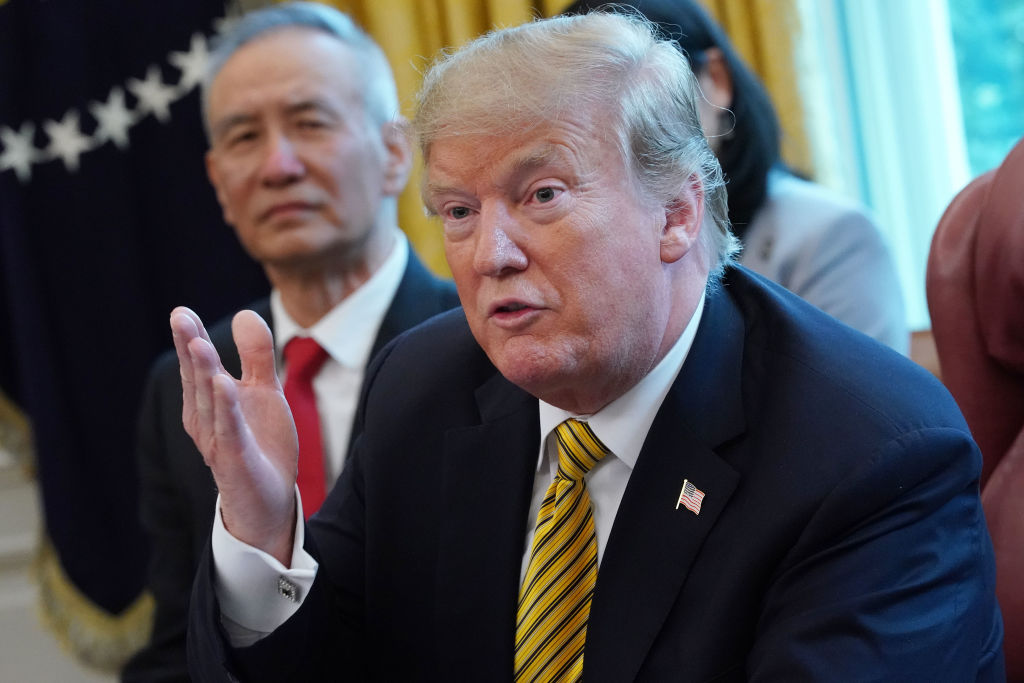
President Trump Meets With Vice Premier Of China At The White House
WASHINGTON, DC - APRIL 04: U.S. President Donald Trump (R) and Chinese Vice Premier Liu He talk to reporters in the Oval Office at the White House April 04, 2019 in Washington, DC. The New York Times reported Thursday that Trump is likely to announce plans for a future summit meeting with Chinese President Xi Jinping to resolve remaining trade issues and sign a final agreement between the U.S. and China. (Photo by Chip Somodevilla/Getty Images)Chip Somodevilla—Getty Images

On Wednesday the U.S. Semiconductor Industry Association (SIA), an industry group that includes Intel, Micron Technology and Nvidia among its members, released a report no doubt designed to capture the imagination of President Donald Trump. It came out a day before the president met with China Vice Premier Liu He to discuss trade and was called “Winning the Future”—a very Trumpian sentiment.

The report sets out the challenge of securing America’s leadership in the semiconductor space—where the U.S. has dominated ever since the industry was created.

Semiconductors are vital to all the next great tech advances, including 5G, AI, and quantum computing. However, as the report explains, Silicon Valley’s supremacy is “under threat from [foreign] government policies that seek to localize supply chains and build state-backed national champions to compete abroad.”

In case it isn’t obvious: they’re talking about China.

We’ve mentioned before how last year’s blockade on U.S. companies exporting microchips to Chinese telecom manufacturer ZTE was a wake-up call for Beijing, demonstrating how many of China’s tech champions are dangerously dependent on supplies from the U.S.

In fact, Beijing became wary of China’s crippling silicon addiction years before. The government released the National Guideline for the Development of the Semiconductor Industry in 2014 and established a $22 billion fund, nicknamed the Big Fund, to invest in domestic chip makers. The incident with ZTE only made Beijing realize it had to double-down its efforts.

China’s private tech companies have promptly answered the call. Baidu released its smart chip, Kunlun, last July; Huawei unveiled the world’s first 7nm microchip in August; Alibaba launched its semiconductor division Pingtouge last September; and this week smart phone maker Xiaomi announced it will reorganize its microprocessor subsidiary as part of a $1.5 billion AI strategy.

It’s the age of AI that might give China a chance to excel in the semiconductor business. AI chips are a different class from semiconductors of old so China is starting (relatively) fresh, rather than playing catch up. China’s huge data pools also give it an advantage when it comes to testing and improving AI chipsets.

The problem for China, and the saving grace for the U.S., is that Chinese companies are designing chips too sophisticated for domestic foundries to manufacture. For example, Huawei had to outsource the manufacturing of its groundbreaking 7nm chip to the Taiwan Semiconductor Manufacturer Company (TSMC).

But that won’t be the case forever. Chinese foundries currently meet 30% of domestic demand. Beijing wants to boost that number to 40% by next year and is flooding the sector with subsidies to do so.

To keep an American hand in the lucrative silicon trade, the SIA recommends the government does three things: first, triple federal funding for industry research to $5 billion a year; second, scrap immigration caps on qualified STEM candidates; and third, protect intellectual property.

That last point is something the U.S. has a real chance to do now, as Chinese negotiators engaged in discussions on forced tech transfers last week for the first time since the Trade war began nearly a year ago. Hopefully, negotiators will be able to keep focus on this space and away from less important objectives, such as reducing the trade deficit and increasing sales of soy.

This story originally appeared in Fortune’s CEO Daily newsletter. Subscribe here.

About the Author
By Eamon Barrett
LinkedIn iconTwitter icon
See full bioRight Arrow Button Icon

Latest in Commentary

Google.org
CommentaryTech
Nonprofits are solving 21st century problems—they need 21st century tech
By Maggie Johnson and Shannon FarleyDecember 8, 2025
6 hours ago
Will Dunham is President and Chief Executive Officer of the American Investment Council
CommentaryRetirement
Private equity is being villainized in the retirement debate — even as it provides diversification and outperforms public markets long-term
By Will DunhamDecember 8, 2025
6 hours ago
Justin Hotard, CEO of Nokia
CommentaryGen Z
Nokia CEO: The workforce is becoming AI-native. Leadership has to evolve
By Justin HotardDecember 8, 2025
10 hours ago
Alex Amouyel is the President and CEO of Newman’s Own Foundation
Commentaryphilanthropy
Following in Paul Newman and Yvon Chouinard’s footsteps: There are more ways for leaders to give it away in ‘the Great Boomer Fire Sale’ than ever
By Alex AmouyelDecember 7, 2025
1 day ago
Amit Walia
CommentaryM&A
Why the timing was right for Salesforce’s $8 billion acquisition of Informatica — and for the opportunities ahead
By Amit WaliaDecember 6, 2025
2 days ago
Steve Milton is the CEO of Chain, a culinary-led pop-culture experience company founded by B.J. Novak and backed by Studio Ramsay Global.
CommentaryFood and drink
Affordability isn’t enough. Fast-casual restaurants need a fandom-first approach
By Steve MiltonDecember 5, 2025
3 days ago

Most Popular

placeholder alt text
Real Estate
The 'Great Housing Reset' is coming: Income growth will outpace home-price growth in 2026, Redfin forecasts
By Nino PaoliDecember 6, 2025
2 days ago
placeholder alt text
Politics
Supreme Court to reconsider a 90-year-old unanimous ruling that limits presidential power on removing heads of independent agencies
By Mark Sherman and The Associated PressDecember 7, 2025
1 day ago
placeholder alt text
AI
Nvidia CEO says data centers take about 3 years to construct in the U.S., while in China 'they can build a hospital in a weekend'
By Nino PaoliDecember 6, 2025
2 days ago
placeholder alt text
Economy
The most likely solution to the U.S. debt crisis is severe austerity triggered by a fiscal calamity, former White House economic adviser says
By Jason MaDecember 6, 2025
2 days ago
placeholder alt text
Uncategorized
Transforming customer support through intelligent AI operations
By Lauren ChomiukNovember 26, 2025
12 days ago
placeholder alt text
Economy
JPMorgan CEO Jamie Dimon says Europe has a 'real problem’
By Katherine Chiglinsky and BloombergDecember 6, 2025
2 days ago
Rankings
  • 100 Best Companies
  • Fortune 500
  • Global 500
  • Fortune 500 Europe
  • Most Powerful Women
  • Future 50
  • World’s Most Admired Companies
  • See All Rankings
Sections
  • Finance
  • Leadership
  • Success
  • Tech
  • Asia
  • Europe
  • Environment
  • Fortune Crypto
  • Health
  • Retail
  • Lifestyle
  • Politics
  • Newsletters
  • Magazine
  • Features
  • Commentary
  • Mpw
  • CEO Initiative
  • Conferences
  • Personal Finance
  • Education
Customer Support
  • Frequently Asked Questions
  • Customer Service Portal
  • Privacy Policy
  • Terms Of Use
  • Single Issues For Purchase
  • International Print
Commercial Services
  • Advertising
  • Fortune Brand Studio
  • Fortune Analytics
  • Fortune Conferences
  • Business Development
About Us
  • About Us
  • Editorial Calendar
  • Press Center
  • Work At Fortune
  • Diversity And Inclusion
  • Terms And Conditions
  • Site Map

© 2025 Fortune Media IP Limited. All Rights Reserved. Use of this site constitutes acceptance of our Terms of Use and Privacy Policy | CA Notice at Collection and Privacy Notice | Do Not Sell/Share My Personal Information
FORTUNE is a trademark of Fortune Media IP Limited, registered in the U.S. and other countries. FORTUNE may receive compensation for some links to products and services on this website. Offers may be subject to change without notice.