
• Home
  • Latest
  • Fortune 500
  • Finance
  • Tech
  • Leadership
  • Lifestyle
  • Rankings
  • Multimedia
Techquantum computer

Quantum Computers Threaten the Web’s Security. We Must Take Action Now.

Robert Hackett
By
Robert Hackett
Robert Hackett
Down Arrow Button Icon
Robert Hackett
By
Robert Hackett
Robert Hackett
Down Arrow Button Icon
December 15, 2018, 10:18 PM ET
IBM Quantum Computing
IBM Quantum ComputingIBM

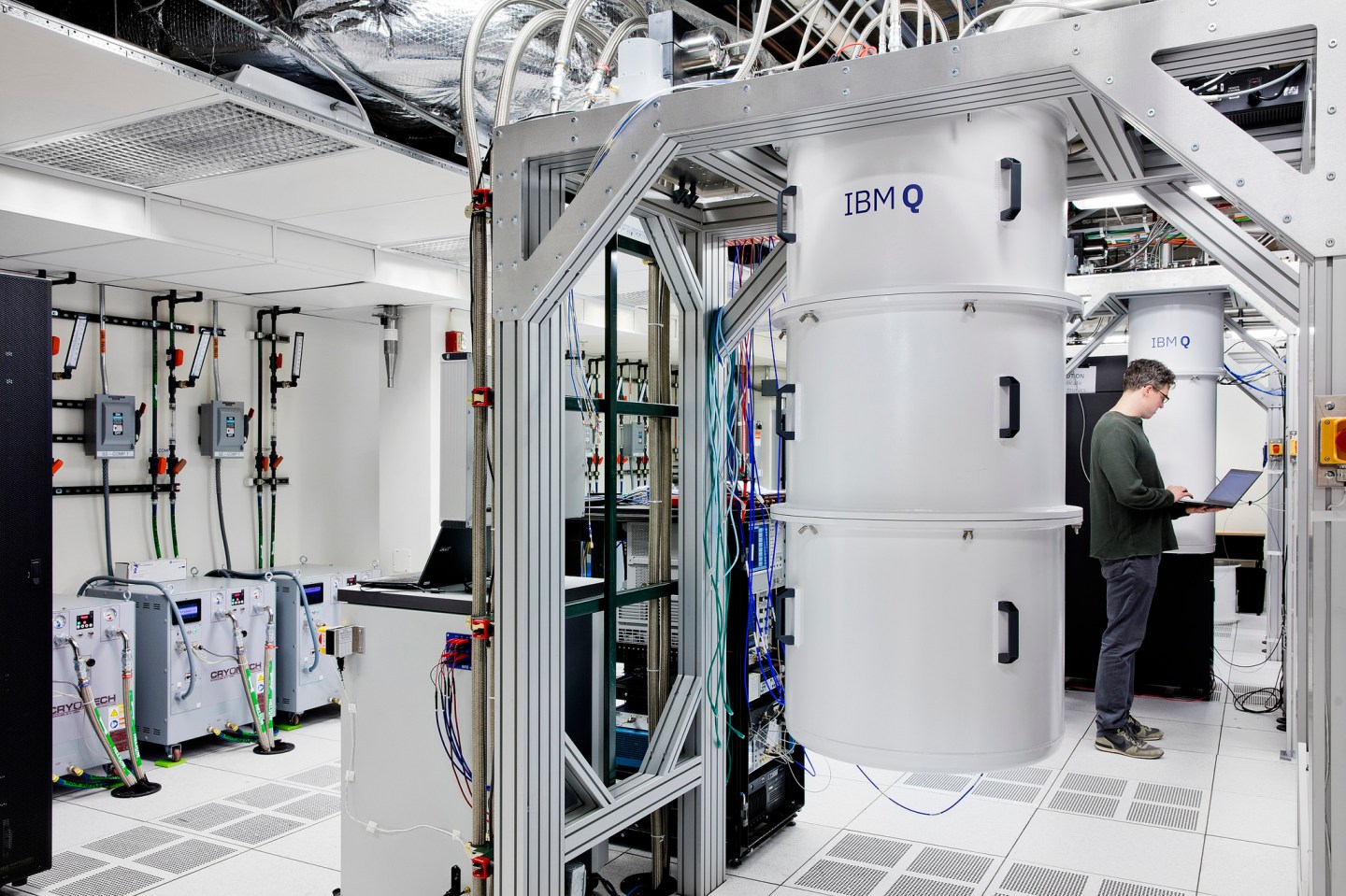
Inside the stark and sweeping Eero Saarinen-styled exterior of the Thomas J. Watson Research Center in Yorktown Heights, IBM’s blue jeans-wearing boffins are assembling a new generation of super-powered computers built on quantum mechanical principles. These otherworldly machines dangle from sturdy, metal frames, looking like golden chandeliers, or robotic beehives. The devices perform their magical-seeming operations inside vacuum-sealed, super-cooled refrigerator encasements. It’s a technology that combines both brains and beauty.

Future iterations of these quantum computers will be able to solve mathematical problems ordinary computers have no hope of computing. They will vastly speed up classical calculations, accurately model complex natural phenomena like chemical reactions, and open as yet unexplored frontiers for scientific inquiry. Despite seeming arcane, machines like these will touch every aspect of our lives—from drug discovery to digital security.

IBM scientists examine quantum computing hardware. Courtesy of [hotlink]IBM[/hotlink].
Courtesy of IBM

This latter area presents significant challenges. One advantage quantum computers have over traditional ones is a knack for factoring large numbers, an operation so difficult for present-day computers that it has become the foundation for almost all today’s encryption schemes. A sufficiently advanced quantum computer, on the other hand, can chew through these math problems with the destructive force of that metal-melting Xenomorph blood in the Alien film franchise. The prospect of quantum computing necessitates a complete rethinking of cryptography.

Today’s encryption may be rendered obsolete sooner than most people anticipate. As Adam Langley, a senior software engineer at Google, has pointed out in a recent blog post, some experts predict this latter-day Y2K could occur within the decade. Michele Mosca, cofounder of the Institute for Quantum Computing in Waterloo, Ontario, has estimated a 1-in-7 chance that quantum breakthroughs will defeat RSA-2048, a common encryption standard, by 2026. If that’s true, then the time to begin reengineering our digital defenses is now. As Langley writes, waiting around for guidance on standards “seems dangerous”; there’s no time to lose.

Buttressing Langley’s view is a recent paper out of the National Academies of Sciences, Engineering, and Medicine. The research organization determined that, while the advent of an encryption-busting quantum computer is unlikely within the decade, preparations to defend against one must be undertaken as soon as possible. Since web standards take more than a decade to implement, a press release accompanying the paper warned, developing new, attack-resistant algorithms “is critical now.”

The era of quantum computation fast approaches. Fortune 500 companies like IBM, Google, Microsoft, and Intel, are plugging away on the tech alongside smaller startups, like Calif.-based Rigetti. Nation states like China are, meanwhile, dumping billions of dollars into research and development. Whichever entity achieves so-called quantum supremacy first will find itself in possession of unprecedented power—the equivalent of X-Ray goggles for the Internet.

That is, unless we act with urgency to armor up.

A version of this article first appeared in Cyber Saturday, the weekend edition of Fortune’s tech newsletter Data Sheet. Sign up here.


About the Author
Robert Hackett
By Robert Hackett
Instagram iconLinkedIn iconTwitter icon
See full bioRight Arrow Button Icon

Latest in Tech

robots
InnovationRobots
‘The question is really just how long it will take’: Over 2,000 gather at Humanoids Summit to meet the robots who may take their jobs someday
By Matt O'Brien and The Associated PressDecember 12, 2025
8 hours ago
Man about to go into police vehicle
CryptoCryptocurrency
Judge tells notorious crypto scammer ‘you have been bitten by the crypto bug’ in handing down 15 year sentence 
By Carlos GarciaDecember 12, 2025
9 hours ago
three men in suits, one gesturing
AIBrainstorm AI
The fastest athletes in the world can botch a baton pass if trust isn’t there—and the same is true of AI, Blackbaud exec says
By Amanda GerutDecember 12, 2025
10 hours ago
Brainstorm AI panel
AIBrainstorm AI
Creative workers won’t be replaced by AI—but their roles will change to become ‘directors’ managing AI agents, executives say
By Beatrice NolanDecember 12, 2025
10 hours ago
Fei-Fei Li, the "Godmother of AI," says she values AI skills more than college degrees when hiring software engineers for her tech startup.
AITech
‘Godmother of AI’ says degrees are less important in hiring than how quickly you can ‘superpower yourself’ with new tools
By Nino PaoliDecember 12, 2025
12 hours ago
C-SuiteFortune 500 Power Moves
Fortune 500 Power Moves: Which executives gained and lost power this week
By Fortune EditorsDecember 12, 2025
13 hours ago

Most Popular

placeholder alt text
Economy
Tariffs are taxes and they were used to finance the federal government until the 1913 income tax. A top economist breaks it down
By Kent JonesDecember 12, 2025
18 hours ago
placeholder alt text
Success
At 18, doctors gave him three hours to live. He played video games from his hospital bed—and now, he’s built a $10 million-a-year video game studio
By Preston ForeDecember 10, 2025
3 days ago
placeholder alt text
Success
Apple cofounder Ronald Wayne sold his 10% stake for $800 in 1976—today it’d be worth up to $400 billion
By Preston ForeDecember 12, 2025
14 hours ago
placeholder alt text
Success
Palantir cofounder calls elite college undergrads a ‘loser generation’ as data reveals rise in students seeking support for disabilities, like ADHD
By Preston ForeDecember 11, 2025
2 days ago
placeholder alt text
Success
40% of Stanford undergrads receive disability accommodations—but it’s become a college-wide phenomenon as Gen Z try to succeed in the current climate
By Preston ForeDecember 12, 2025
13 hours ago
placeholder alt text
Arts & Entertainment
'We're not just going to want to be fed AI slop for 16 hours a day': Analyst sees Disney/OpenAI deal as a dividing line in entertainment history
By Nick LichtenbergDecember 11, 2025
1 day ago
Rankings
  • 100 Best Companies
  • Fortune 500
  • Global 500
  • Fortune 500 Europe
  • Most Powerful Women
  • Future 50
  • World’s Most Admired Companies
  • See All Rankings
Sections
  • Finance
  • Leadership
  • Success
  • Tech
  • Asia
  • Europe
  • Environment
  • Fortune Crypto
  • Health
  • Retail
  • Lifestyle
  • Politics
  • Newsletters
  • Magazine
  • Features
  • Commentary
  • Mpw
  • CEO Initiative
  • Conferences
  • Personal Finance
  • Education
Customer Support
  • Frequently Asked Questions
  • Customer Service Portal
  • Privacy Policy
  • Terms Of Use
  • Single Issues For Purchase
  • International Print
Commercial Services
  • Advertising
  • Fortune Brand Studio
  • Fortune Analytics
  • Fortune Conferences
  • Business Development
About Us
  • About Us
  • Editorial Calendar
  • Press Center
  • Work At Fortune
  • Diversity And Inclusion
  • Terms And Conditions
  • Site Map

© 2025 Fortune Media IP Limited. All Rights Reserved. Use of this site constitutes acceptance of our Terms of Use and Privacy Policy | CA Notice at Collection and Privacy Notice | Do Not Sell/Share My Personal Information
FORTUNE is a trademark of Fortune Media IP Limited, registered in the U.S. and other countries. FORTUNE may receive compensation for some links to products and services on this website. Offers may be subject to change without notice.