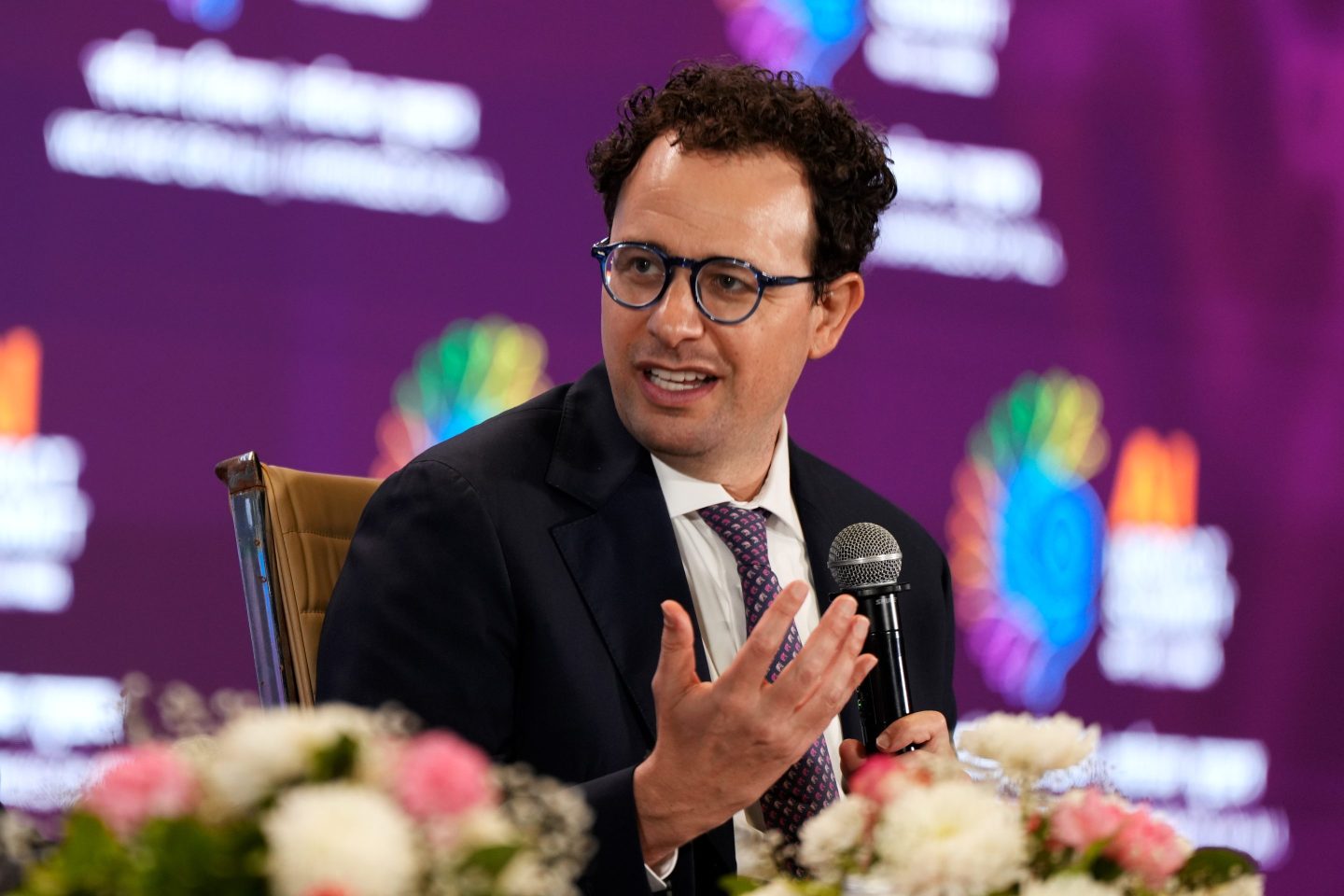
Microsoft President Brad Smith wants the government to regulate the use of facial recognition technology.
Smith said in a blog post on Friday that Microsoft believes there should be “thoughtful government regulation” of the controversial technology that can automatically recognize a person’s face. He also said that there should be standards created—via both the public and private sectors—“for the development of norms around acceptable uses.”
“In a democratic republic, there is no substitute for decision making by our elected representatives regarding the issues that require the balancing of public safety with the essence of our democratic freedoms,” Smith wrote. “Facial recognition will require the public and private sectors alike to step up—and to act.”
The Microsoft (MSFT) executive’s comments come amid a turbulent time in the technology industry during which tech giants like Facebook (FB), Google (GOOG), and Amazon (AMZN) face increased public scrutiny about their growing influence in society. Particularly concerning to researchers and activists is the rapid development of artificial intelligence technologies that tech companies could sell to government agencies, which in turn could use in ways that could compromise civil liberties.
Many employees at companies like Google, Salesforce (CRM), Microsoft, and Amazon have urged their management to abolish government contracts, either current or in the works, that they believe could hurt human rights, such as the use of AI technologies in warfare.
One of the most current cutting-edge ways deep-learning technologies are being used today is to improve how computers recognize objects in images. The technology has advanced to the point that companies like Apple and Facebook are using deep learning, a subset of AI, so that people can unlock their iPhones with their faces or help automatically recognize and “tag” a person’s face in a photo on a social network.
Smith acknowledges that the use of facial recognition technology can be “both positive and potentially even profound” and cites hypothetical scenarios in which computers could more easily find missing children or help law enforcement identify terrorists.
It’s in other more controversial uses of the technology that Smith calls “more sobering,” and he believes the government should step in with regulation. He cites scenarios like people being monitored in political rallies or shopping mall vendors scanning people’s faces and sharing that data with others without permission.
“This has long been the stuff of science fiction and popular movies – like Minority Report, Enemy of the State and even 1984—but now it’s on the verge of becoming possible,” Smith said. “Perhaps as much as any advance, facial recognition raises a critical question: what role do we want this type of technology to play in everyday society?”
He reiterated Microsoft’s previous comments that its contract with the U.S. Immigration and Customs Enforcement agency does not involve facial-recognition technology. Microsoft employees were concerned that the company’s technology was being used in some way in President Donald Trump’s controversial immigration policy that led to children being separated from their parents.
That said, Smith acknowledged that Microsoft’s contract with ICE involves “legacy email, calendar, messaging, and document management workloads “ and that “some nonetheless suggested that Microsoft cancel the contract and cease all work with ICE.”
Smith said that Congress “should create a bipartisan expert commission” to determine the “best way to regulate the use of facial recognition technology in the United States.” In May, the White House created an artificial intelligence task force that is intended to study and foster the development of cutting-edge data crunching technologies, but it did not weigh in about any of the controversial uses of AI that Smith outlined in his blog post.
Get Data Sheet, Fortune’s technology newsletter.
Some of the questions Smith wants the government to discuss are:
Should law enforcement use of facial recognition be subject to human oversight and controls, including restrictions on the use of unaided facial recognition technology as evidence of an individual’s guilt or innocence of a crime?
Similarly, should we ensure there is civilian oversight and accountability for the use of facial recognition as part of governmental national security technology practices?
What types of legal measures can prevent use of facial recognition for racial profiling and other violations of rights while still permitting the beneficial uses of the technology?
Smith conceded that despite wanting the government to be more involved with AI’s development, Microsoft and other companies face ethical issues that they must address themselves. These issues include biased facial-recognition technologies that more accurately identify white males than females with darker skin pigmentation, a problem that affects the technologies of Microsoft, IBM, and others.
“’Move fast and break things’ became something of a mantra in Silicon Valley earlier this decade,” Smith wrote. “But if we move too fast with facial recognition, we may find that people’s fundamental rights are being broken.”