• Home
  • Latest
  • Fortune 500
  • Finance
  • Tech
  • Leadership
  • Lifestyle
  • Rankings
  • Multimedia
Commentary

Why Renegotiating the Paris Agreement Would Be a Total Waste of Time

By
Nicolas Loris
Nicolas Loris
and
Bethany Cianciolo
Bethany Cianciolo
Down Arrow Button Icon
By
Nicolas Loris
Nicolas Loris
and
Bethany Cianciolo
Bethany Cianciolo
Down Arrow Button Icon
September 26, 2017, 5:17 PM ET
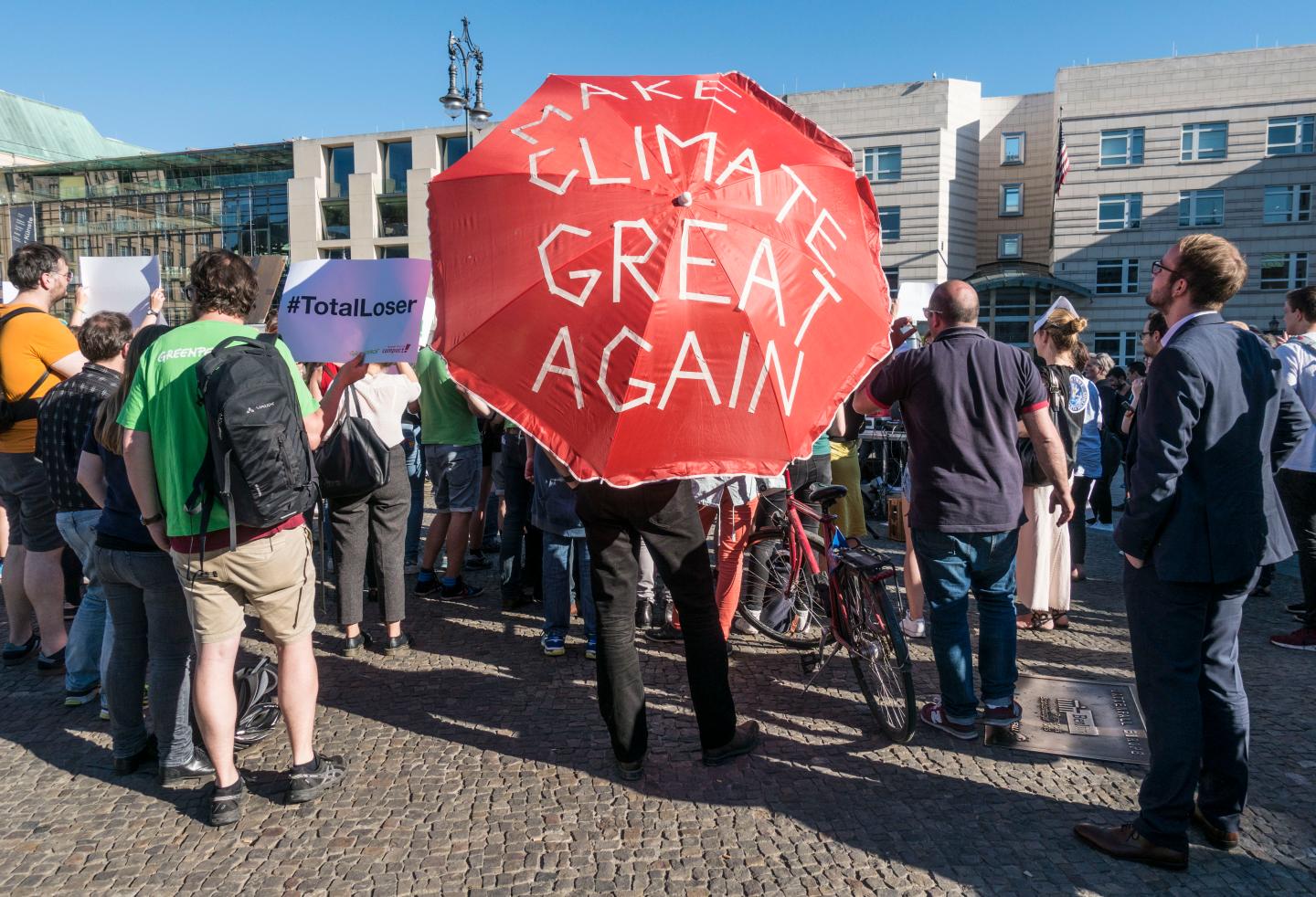
Demonstration Against U.S Retreat From The Paris Agreement
Demonstrators hold signs to protest against President Trump's decision to pull out of the Paris Agreement, on June 2, 2017, near the Brandenburg Gate, in Berlin. ***ISRAEL OUT*** (Photo by Omer Messinger/NurPhoto via Getty Images)NurPhoto NurPhoto via Getty Images

Last week, The Wall Street Journal reported that President Trump was looking for a way to avoid withdrawing from the Paris climate accord. This blockbuster story quickly fizzled when top White House advisor Gary Cohn rebuffed it. But there’s a good chance it will rise again.

In August, the administration officially notified the UN that it intends to withdraw from the accord. But under the terms of the agreement, the U.S. cannot withdraw until Nov. 4, 2019. That gives politicians and pundits more than two years to speculate about potential renegotiations of the climate agreement.

To be clear, renegotiating the pact would be a waste of time. Costly, ineffective, and unworkable, it’s beyond redemption.

Unless you work in the green-energy industry, Paris will cost you money—and lots of it. Countries that stick to their carbon-cut pledges will drive energy prices higher. This will create hardship in industrialized countries and thwart developing countries (where 1.2 billion people are without access to electricity) from attaining a better quality of life.

No amount of negotiating will change that fact.

Nevertheless, if the administration does reengage on Paris, it should insist that a new agreement:

Does no violence to the economy

Protecting our economy from costly international climate agreements was once a bipartisan idea. In 1997, months before negotiation on the Kyoto Protocol resumed, the Byrd–Hagel Resolution urged then-President Bill Clinton not to sign any agreement that “would result in serious harm to the economy of the United States.” It passed unanimously, 95–0.

Achieves meaningful results

The Paris agreement gives two of the world’s top carbon emitters, India and China, pretty much a free pass on carbon reduction. China is allowed to continuously increase its emissions until 2030. And India is committed only to improving its emissions per unit of GDP (i.e., it’s emissions can continue to increase as the economy grows)—and at a slower rate of improvement than it was already achieving. That essentially precludes any meaningful slowing of global warming. Even former secretary of state John Kerry, who led the U.S. negotiating team in Paris, admitted, “If … all the industrial nations went down to zero emissions, it wouldn’t be enough, not when more than 65% of the world’s carbon pollution comes from the developing world.”

Stops funding the Green Climate Fund (GCF)

The GCF funnels taxpayer money to support expensive “green” energy technologies and pays for climate adaptation and mitigation programs in developing nations. The result: Developing countries are pressured to shift from cheaper, more reliable conventional fuels to expensive technologies that cannot survive without public financing. This keeps them dependent on wealthy nations and extends their risk of energy poverty.

These criteria and the Paris agreement are mutually incompatible. Renegotiation should be a non-starter.

But what if Trump does try to turn the pact into something workable? He should at least handle it in a way that doesn’t flout the Constitution—something his predecessor failed to do.

Article II, Section 2, stipulates that the president must get the Senate’s advice and consent before any treaty can bind the U.S. President Obama knew the Senate would not ratify the Paris pact, so he declared it was just an “agreement,” not a treaty. Voila, problem solved!

If sometime in the future President Trump thinks he’s negotiated a carbon reduction pact that serves the interests of the U.S., he should submit it to the Senate, thereby respecting the legislative branch’s constitutional role in foreign policy.


It’s true that now the only countries not signed up for the Paris agreement are the U.S. and Syria. But the U.S. has no obligation to run lemming-like over the green-energy cliff. And the cost of doing so would be enormous.

While foreign leaders score political points at home by criticizing the U.S. for not joining in, they really have no room to talk. As the journal Nature notes: “All major industrialized countries are failing to meet the pledges they made to cut greenhouse-gas emissions.”

Indeed, the U.S. continues to reduce its carbon emissions, and can do so with or without the pact. We don’t need to renegotiate. We don’t need Paris at all.

Nicolas Loris is The Heritage Foundation’s Herbert and Joyce Morgan Research Fellow in Energy and Environmental Policy.

About the Authors
By Nicolas Loris
See full bioRight Arrow Button Icon
By Bethany Cianciolo
See full bioRight Arrow Button Icon

Latest in Commentary

Finance
Lorem ipsum dolor sit amet, consectetur adipiscing elit, sed do eiusmod tempor incididunt ut labore et dolore magna aliqua. Ut enim ad minim veniam
By Fortune Editors
October 20, 2025
Finance
Lorem ipsum dolor sit amet, consectetur adipiscing elit, sed do eiusmod tempor incididunt ut labore et dolore magna aliqua. Ut enim ad minim veniam
By Fortune Editors
October 20, 2025
Finance
Lorem ipsum dolor sit amet, consectetur adipiscing elit, sed do eiusmod tempor incididunt ut labore et dolore magna aliqua. Ut enim ad minim veniam
By Fortune Editors
October 20, 2025
Finance
Lorem ipsum dolor sit amet, consectetur adipiscing elit, sed do eiusmod tempor incididunt ut labore et dolore magna aliqua. Ut enim ad minim veniam
By Fortune Editors
October 20, 2025
Finance
Lorem ipsum dolor sit amet, consectetur adipiscing elit, sed do eiusmod tempor incididunt ut labore et dolore magna aliqua. Ut enim ad minim veniam
By Fortune Editors
October 20, 2025
Finance
Lorem ipsum dolor sit amet, consectetur adipiscing elit, sed do eiusmod tempor incididunt ut labore et dolore magna aliqua. Ut enim ad minim veniam
By Fortune Editors
October 20, 2025

Most Popular

Finance
Lorem ipsum dolor sit amet, consectetur adipiscing elit, sed do eiusmod tempor incididunt ut labore et dolore magna aliqua. Ut enim ad minim veniam
By Fortune Editors
October 20, 2025
Finance
Lorem ipsum dolor sit amet, consectetur adipiscing elit, sed do eiusmod tempor incididunt ut labore et dolore magna aliqua. Ut enim ad minim veniam
By Fortune Editors
October 20, 2025
Finance
Lorem ipsum dolor sit amet, consectetur adipiscing elit, sed do eiusmod tempor incididunt ut labore et dolore magna aliqua. Ut enim ad minim veniam
By Fortune Editors
October 20, 2025
Finance
Lorem ipsum dolor sit amet, consectetur adipiscing elit, sed do eiusmod tempor incididunt ut labore et dolore magna aliqua. Ut enim ad minim veniam
By Fortune Editors
October 20, 2025
Finance
Lorem ipsum dolor sit amet, consectetur adipiscing elit, sed do eiusmod tempor incididunt ut labore et dolore magna aliqua. Ut enim ad minim veniam
By Fortune Editors
October 20, 2025
Finance
Lorem ipsum dolor sit amet, consectetur adipiscing elit, sed do eiusmod tempor incididunt ut labore et dolore magna aliqua. Ut enim ad minim veniam
By Fortune Editors
October 20, 2025
Fortune Secondary Logo
Rankings
  • 100 Best Companies
  • Fortune 500
  • Global 500
  • Fortune 500 Europe
  • Most Powerful Women
  • World's Most Admired Companies
  • See All Rankings
  • Lists Calendar
Sections
  • Finance
  • Fortune Crypto
  • Features
  • Leadership
  • Health
  • Commentary
  • Success
  • Retail
  • Mpw
  • Tech
  • Lifestyle
  • CEO Initiative
  • Asia
  • Politics
  • Conferences
  • Europe
  • Newsletters
  • Personal Finance
  • Environment
  • Magazine
  • Education
Customer Support
  • Frequently Asked Questions
  • Customer Service Portal
  • Privacy Policy
  • Terms Of Use
  • Single Issues For Purchase
  • International Print
Commercial Services
  • Advertising
  • Fortune Brand Studio
  • Fortune Analytics
  • Fortune Conferences
  • Business Development
  • Group Subscriptions
About Us
  • About Us
  • Press Center
  • Work At Fortune
  • Terms And Conditions
  • Site Map
  • About Us
  • Press Center
  • Work At Fortune
  • Terms And Conditions
  • Site Map
  • Facebook icon
  • Twitter icon
  • LinkedIn icon
  • Instagram icon
  • Pinterest icon

Latest in Commentary

Duncan Tait, CEO of Inchcape
Europecar manufacturing
“Competition is good for the industry”. Inchcape CEO’s case for optimism in automotive’s next chapter
By Duncan TaitApril 30, 2026
48 minutes ago
agentic
CommentaryAI agents
Why your data infrastructure — not your AI model — will determine whether Agentic AI scales
By Jeffrey Sonnenfeld, Stephen Henriques, Catherine Dai and Zander JeinthanuttkanontApril 30, 2026
4 hours ago
hoskins
Commentaryoffices
Gensler Co-Chair: Hot-desking was supposed to save money. It may be costing you your culture
By Diane HoskinsApril 30, 2026
5 hours ago
tillis
CommentaryCongress
Thom Tillis: Free markets built American prosperity. Government intervention puts it at risk
By Thom Tillis and John StanfordApril 30, 2026
7 hours ago
iran
CommentaryIran
The Strait of Hormuz is a data problem, not just a military one
By Erik Bethel and Ami DanielApril 30, 2026
7 hours ago
hollywood
CommentaryMarketing
I spent 20 years learning to navigate an industry. Then I built a campaign for the man who’s dismantling it
By Matti YahavApril 29, 2026
1 day ago

Most Popular

Apple cofounder Ronald Wayne—whose stake would be worth up to $400 billion had he not sold it in 1976—says that at 91, he has no regrets
Success
Apple cofounder Ronald Wayne—whose stake would be worth up to $400 billion had he not sold it in 1976—says that at 91, he has no regrets
By Preston ForeApril 27, 2026
3 days ago
Jamie Dimon gets candid about national debt: ‘There will be a bond crisis, and then we’ll have to deal with it’
Economy
Jamie Dimon gets candid about national debt: ‘There will be a bond crisis, and then we’ll have to deal with it’
By Eleanor PringleApril 29, 2026
1 day ago
‘They left me no choice’: Powell isn’t going anywhere—blocking Trump from another Fed appointee
Banking
‘They left me no choice’: Powell isn’t going anywhere—blocking Trump from another Fed appointee
By Eva RoytburgApril 29, 2026
20 hours ago
‘The cost of compute is far beyond the costs of the employees’: Nvidia executive says right now AI is more expensive than paying human workers
AI
‘The cost of compute is far beyond the costs of the employees’: Nvidia executive says right now AI is more expensive than paying human workers
By Sasha RogelbergApril 28, 2026
2 days ago
‘Take the money and run’: Johns Hopkins economist Steve Hanke on why the UAE quit OPEC
Energy
‘Take the money and run’: Johns Hopkins economist Steve Hanke on why the UAE quit OPEC
By Shawn TullyApril 29, 2026
1 day ago
Google Cloud revenue is now 18% of Alphabet's business. Is this the beginning of the end of Google's search identity?
Big Tech
Google Cloud revenue is now 18% of Alphabet's business. Is this the beginning of the end of Google's search identity?
By Alexei OreskovicApril 29, 2026
14 hours ago

© 2026 Fortune Media IP Limited. All Rights Reserved. Use of this site constitutes acceptance of our Terms of Use and Privacy Policy | CA Notice at Collection and Privacy Notice | Do Not Sell/Share My Personal Information
FORTUNE is a trademark of Fortune Media IP Limited, registered in the U.S. and other countries. FORTUNE may receive compensation for some links to products and services on this website. Offers may be subject to change without notice.