• Home
  • News
  • Fortune 500
  • Tech
  • Finance
  • Leadership
  • Lifestyle
  • Rankings
  • Multimedia
Commentary

How Congress Can Avoid a Health Care Train Wreck

By
Thomas Huelskoetter
Thomas Huelskoetter
Down Arrow Button Icon
By
Thomas Huelskoetter
Thomas Huelskoetter
Down Arrow Button Icon
July 14, 2017, 4:55 PM ET
Drew Angerer/Getty Images

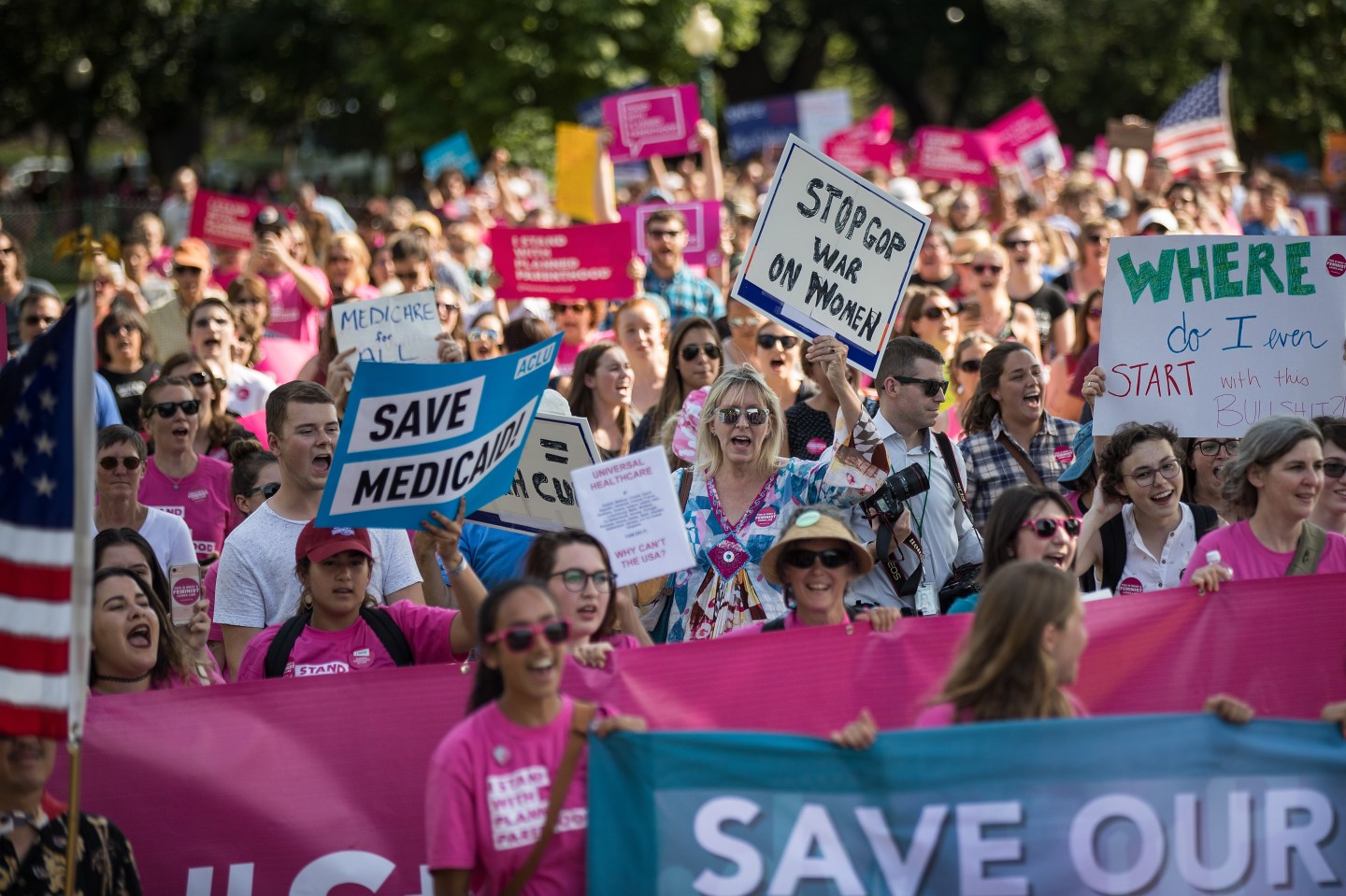
Although the Senate is perilously close to passing its Affordable Care Act (ACA) repeal bill, Senate Majority Leader Mitch McConnell continues to struggle to lock down the final votes necessary for passage. Meanwhile, senators from both sides of the aisle have voiced increasing interest in shifting to a bipartisan effort to fix the ACA, more popularly known as Obamacare.

If it wasn’t obvious enough already, it’s become crystal clear over the course of this debate that progressives and conservatives have sharply diverging goals when it comes to health policy. But a bipartisan path forward on health care reform doesn’t have to resolve those differences. It simply has to commit to one principle: Do no harm.

A “do no harm” approach would be simple—drop the draconian cuts to Medicaid and tax cuts for the wealthy, and instead just pass targeted measures to stabilize the individual insurance market. In fact, the necessary ingredients for such legislation already exist in the Senate repeal bill. The Center for American Progress has proposed pulling out four pages of the Senate bill that focus on market stabilization and passing them as a standalone bill.

First, this bill would permanently commit funding for cost-sharing reduction subsidies, which help low-income people afford their deductibles and other cost-sharing expenses. The current uncertainty over the future of these payments—fueled by the Trump administration’s threats to withhold them—has destabilized the market and directly increased premiums. Actuaries at Oliver Wyman estimate that two-thirds of next year’s proposed premium increases are due to uncertainty over whether the Trump administration will make the cost-sharing payments and enforce the individual mandate.

Second, the bill would provide funding for reinsurance programs—which distribute funds to plans that enroll higher-cost individuals—to reduce premiums. Such an approach would follow the model already pioneered in states like Alaska, which enacted a reinsurance program in 2016 that reduced proposed premium increases from 40% to 10%. Earlier this week, the Trump administration validated Alaska’s approach by approving the state’s waiver request and providing addition funding for the state’s program.

Third, we should provide additional coverage options, especially in counties that currently lack sufficient plan choices next year. Legislation recently considered in Nevada to allow people to buy in to Medicaid offers a promising public option approach that would significantly improve access to affordable coverage. Alternatively, the bill could let people in underserved counties buy in to the Federal Employees Health Benefit Program or use tax incentives to encourage insurers to enter counties that were underserved prior to the passage of the bill.

The “do no harm” approach wouldn’t give either side their long-term vision for health reform in America. But right now, with the ACA and Medicaid under attack, lawmakers must stay focused on averting the immediate threat of 22 million people losing coverage. That’s why the best step forward in the near term is a narrow, bipartisan bill to stabilize the ACA.

Luckily, there’s already a bipartisan path forward laid out—all the Senate has to do is choose to walk down it. And for Republican politicians looking for an off-ramp from a repeal bill that is catastrophically unpopular, a bill to stabilize the markets is their best chance of escape.

Thomas Huelskoetter is a health policy analyst at the Center for American Progress.

About the Author
By Thomas Huelskoetter
See full bioRight Arrow Button Icon

Latest in Commentary

Rakesh Kumar
CommentarySemiconductors
China does not need Nvidia chips in the AI war — export controls only pushed it to build its own AI machine
By Rakesh KumarDecember 3, 2025
5 hours ago
Rochelle Witharana is Chief Financial and Investment Officer for The California Wellness Foundation
Commentarydiversity and inclusion
Fund managers from diverse backgrounds are delivering standout returns and the smart money is slowly starting to pay attention
By Rochelle WitharanaDecember 3, 2025
5 hours ago
Ayesha and Stephen Curry (L) and Arndrea Waters King and Martin Luther King III (R), who are behind Eat.Play.Learn and Realize the Dream, respectively.
Commentaryphilanthropy
Why time is becoming the new currency of giving
By Arndrea Waters King and Ayesha CurryDecember 2, 2025
1 day ago
Trump
CommentaryTariffs and trade
The trade war was never going to fix our deficit
By Daniel BunnDecember 2, 2025
1 day ago
Elizabeth Kelly
CommentaryNon-Profit
At Anthropic, we believe that AI can increase nonprofit capacity. And we’ve worked with over 100 organizations so far on getting it right
By Elizabeth KellyDecember 2, 2025
1 day ago
Decapitation
CommentaryLeadership
Decapitated by activists: the collapse of CEO tenure and how to fight back
By Mark ThompsonDecember 2, 2025
1 day ago

Most Popular

placeholder alt text
North America
Jeff Bezos and Lauren Sánchez Bezos commit $102.5 million to organizations combating homelessness across the U.S.: ‘This is just the beginning’
By Sydney LakeDecember 2, 2025
1 day ago
placeholder alt text
Economy
Ford workers told their CEO 'none of the young people want to work here.' So Jim Farley took a page out of the founder's playbook
By Sasha RogelbergNovember 28, 2025
5 days ago
placeholder alt text
Economy
Elon Musk says he warned Trump against tariffs, which U.S. manufacturers blame for a turn to more offshoring and diminishing American factory jobs
By Sasha RogelbergDecember 2, 2025
1 day ago
placeholder alt text
Success
Warren Buffett used to give his family $10,000 each at Christmas—but when he saw how fast they were spending it, he started buying them shares instead
By Eleanor PringleDecember 2, 2025
1 day ago
placeholder alt text
North America
Anonymous $50 million donation helps cover the next 50 years of tuition for medical lab science students at University of Washington
By The Associated PressDecember 2, 2025
1 day ago
placeholder alt text
C-Suite
MacKenzie Scott's $19 billion donations have turned philanthropy on its head—why her style of giving actually works
By Sydney LakeDecember 2, 2025
1 day ago
Rankings
  • 100 Best Companies
  • Fortune 500
  • Global 500
  • Fortune 500 Europe
  • Most Powerful Women
  • Future 50
  • World’s Most Admired Companies
  • See All Rankings
Sections
  • Finance
  • Leadership
  • Success
  • Tech
  • Asia
  • Europe
  • Environment
  • Fortune Crypto
  • Health
  • Retail
  • Lifestyle
  • Politics
  • Newsletters
  • Magazine
  • Features
  • Commentary
  • Mpw
  • CEO Initiative
  • Conferences
  • Personal Finance
  • Education
Customer Support
  • Frequently Asked Questions
  • Customer Service Portal
  • Privacy Policy
  • Terms Of Use
  • Single Issues For Purchase
  • International Print
Commercial Services
  • Advertising
  • Fortune Brand Studio
  • Fortune Analytics
  • Fortune Conferences
  • Business Development
About Us
  • About Us
  • Editorial Calendar
  • Press Center
  • Work At Fortune
  • Diversity And Inclusion
  • Terms And Conditions
  • Site Map

© 2025 Fortune Media IP Limited. All Rights Reserved. Use of this site constitutes acceptance of our Terms of Use and Privacy Policy | CA Notice at Collection and Privacy Notice | Do Not Sell/Share My Personal Information
FORTUNE is a trademark of Fortune Media IP Limited, registered in the U.S. and other countries. FORTUNE may receive compensation for some links to products and services on this website. Offers may be subject to change without notice.