• Home
  • Latest
  • Fortune 500
  • Finance
  • Tech
  • Leadership
  • Lifestyle
  • Rankings
  • Multimedia
Retail

How Vans Skated Past a Big Retail Milestone

Phil Wahba
By
Phil Wahba
Phil Wahba
Senior Writer
Down Arrow Button Icon
Phil Wahba
By
Phil Wahba
Phil Wahba
Senior Writer
Down Arrow Button Icon
March 31, 2017, 8:00 AM ET
Inside The D23 Expo 2015
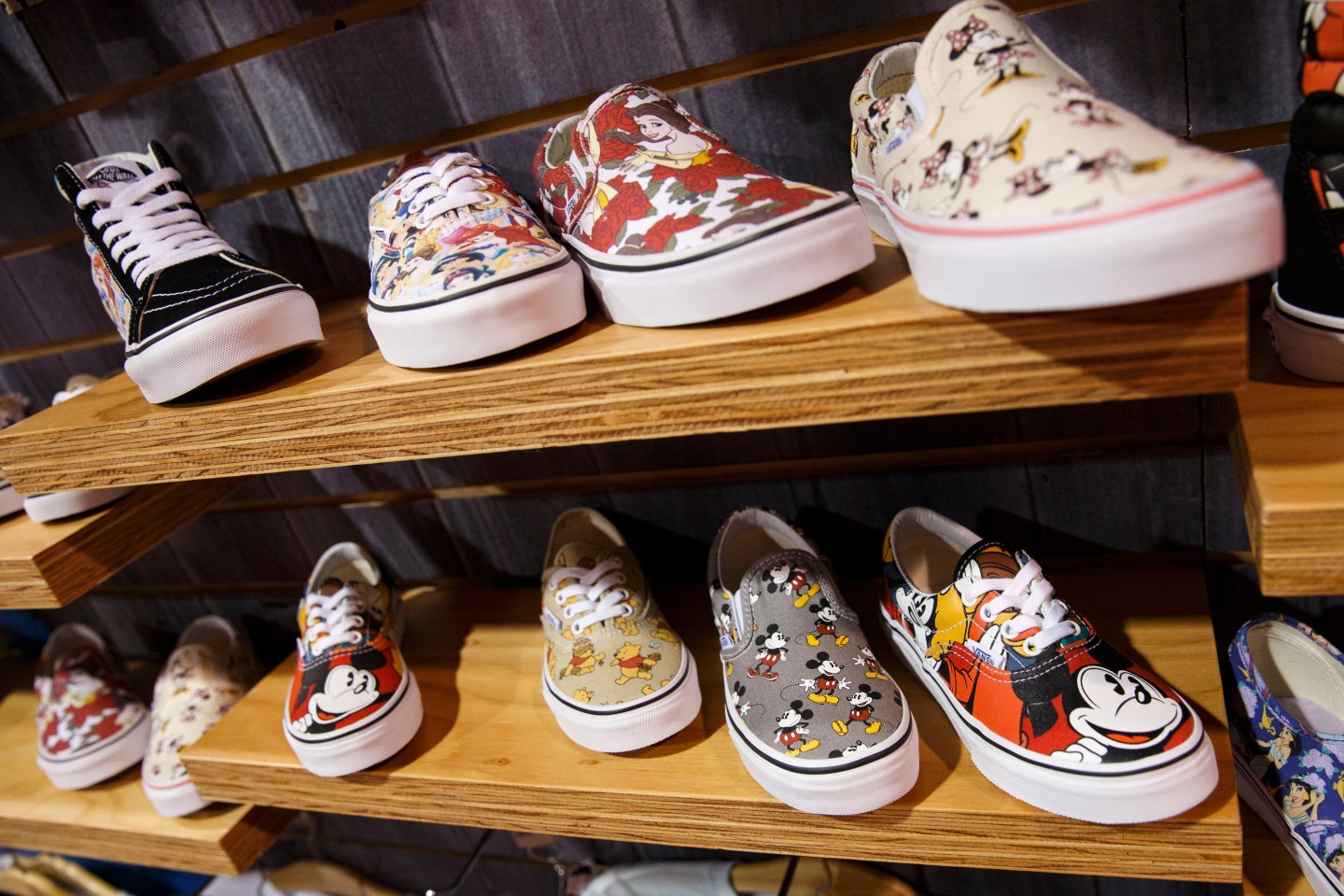
Vans Inc. shoes featuring Walt Disney Co.'s Mickey Mouse character are displayed for sale during the D23 Expo 2015 in Anaheim, California, U.S., on Friday, Aug. 14, 2015. The D23 Expo 2015, presented by the Official Disney Fan Club, includes sneak peeks of upcoming films from The Walt Disney Studios, celebrity appearances, as well as a look at what's coming from Disney Parks and Resort. Photographer: Patrick T. Fallon/Bloomberg via Getty Images Patrick T. Fallon—Bloomberg via Getty Images

Vans, the highly popular, eternally youthful skater footwear brand, hit a major milestone last year: It eclipsed The North Face juggernaut as apparel giant VF’s top-selling brand.

The 51-year-old Vans saw sales hit $2.3 billion in 2016, after years of work expanding the brand’s appeal beyond teenage skateboarders. It did that by being selective about where its products are distributed and also by leveraging one of the biggest assets VF (VFC) brings to its stable of labels: tech. And Vans has been careful to use those advances in the service of the brand rather try to change its personality.

Take Vans’ upcoming launch of a major new line, the UltraRange. The shoe, which hits stores this summer, features light cushioning and mesh to make it breathable, responding to what Vans’ athletes want. And a few years ago, Vans launched the All Weather Mountain line, with water-repelling and weatherized materials to make the shoes more resistant to snow and rain. Those were technologies that VF developed and that outdoorsy brand Timberland, another VF company, also taps into.

“This isn’t about trying to replicate Timberland,” Doug Palladini, Vans global brand president, told Fortune in a recent interview. He added: “We saw a lot of white space in becoming a four-season brand.”

One of the most crucial balancing acts for VF is to make sure brands share tech advances and efficiencies without becoming too similar to one another or cannibalizing sales. It is particularly crucial, as VF CEO Steve Rendle told Wall Street analysts on Thursday at the company’s investor day, because 45% of Vans consumers also buy The North Face. So far the balancing act seems to be working: As Palladini said at the same conference, “We’ve leveraged the research center, we’ve leveraged the supply chain.”

By the time VF bought Vans in 2004, for $396 million, it had been deemed tired by Wall Street. The brand has countless Generation X fans, thanks in part to cultural milestones like the 1982 movie Fast Times at Ridgemont High, in which Sean Penn’s slacker character Jeff Spicoli wore white checkered Vans slip-on shoes, and some analysts believed sales would sputter out as those fans aged.

But focusing on innovation has helped Vans stay relevant with ever-fickle younger consumers: It still does best with shoppers aged 16 to 34. Sales growth continued under VF, and Vans posted impressive double-digit growth for five straight years between 2010 and 2014, followed by a still-strong increase of 7% for 2015 and then 6% last year, vaulting it past The North Face. Not bad for a brand born on March 16, 1966 in Anaheim, Calif., when Paul Van Doren opened up a retail store whose wares quickly caught on with the skateboarding crowd.

Of course, any youth-oriented brand knows you can quickly slide into irrelevance if you don’t keep up. Vans’ five most popular sneaker styles—the Authentic, the Era, the Slip-on, the Old Skool and the Sk8-Hi—are constantly refreshed and updated with new materials and looks.

And last year, for its 50th birthday, Vans hosted events across several cities, including at two “House of Vans” locations in Brooklyn and London and at pop-ups in cities including Toronto, Mexico City, Hong Kong and Cape Town. The brand uses its stores for marketing opportunities, such as shoe personalization and do-it-yourself design workshops. Last year, Vans held a pro competition in four countries to create buzz around the fact that skateboarding will be an official Olympic discipline for the first time at the 2020 Tokyo Games.

For all its success, Vans still has a lot of runway. Palladini told investors the brand commands only 5% of the $39 billion U.S. footwear market and 1% of the apparel market. (The brand gets about 20% of its revenue from clothing and accessories, and the rest from footwear.) Vans, which started out as a retailer all those years ago, has been adding about 50 stores a year (600 worldwide or so now). Still, the brand will be careful about not going on an expansion binge by opening tons of stores and selling through many more outside retailers, lest it hurt its own cachet.

“Ubiquity is not Vans’ objective,” Palladini said. “We’re not for everybody.”

About the Author
Phil Wahba
By Phil WahbaSenior Writer
LinkedIn iconTwitter icon

Phil Wahba is a senior writer at Fortune primarily focused on leadership coverage, with a prior focus on retail.

See full bioRight Arrow Button Icon

Latest in Retail

millennial
CommentaryConsumer Spending
Meet the 2025 holiday white whale: the millennial dad spending $500+ per kid
By Phillip GoerickeDecember 12, 2025
1 day ago
McDonald
RetailRetail
Lululemon CEO Calvin McDonald to step down as quarterly profit dips 13%
By Anne D'Innocenzio and The Associated PressDecember 12, 2025
1 day ago
Sarandos
CommentaryAntitrust
Netflix, Warner, Paramount and antitrust: Entertainment megadeal’s outcome must follow the evidence, not politics or fear of integration
By Satya MararDecember 12, 2025
1 day ago
InvestingMarkets
Retail investors drive stocks to a pre-Christmas all-time high—and Wall Street sees a moment to sell
By Jim EdwardsDecember 12, 2025
1 day ago
Five panelists seated; two women and five men.
AIBrainstorm AI
The race to deploy an AI workforce faces one important trust gap: What happens when an agent goes rogue?
By Amanda GerutDecember 11, 2025
2 days ago
Oreo
RetailFood and drink
Zero-sugar Oreos headed to America for first time
By Dee-Ann Durbin and The Associated PressDecember 11, 2025
2 days ago

Most Popular

placeholder alt text
Economy
Tariffs are taxes and they were used to finance the federal government until the 1913 income tax. A top economist breaks it down
By Kent JonesDecember 12, 2025
1 day ago
placeholder alt text
Success
Apple cofounder Ronald Wayne sold his 10% stake for $800 in 1976—today it’d be worth up to $400 billion
By Preston ForeDecember 12, 2025
23 hours ago
placeholder alt text
Success
40% of Stanford undergrads receive disability accommodations—but it’s become a college-wide phenomenon as Gen Z try to succeed in the current climate
By Preston ForeDecember 12, 2025
22 hours ago
placeholder alt text
Economy
For the first time since Trump’s tariff rollout, import tax revenue has fallen, threatening his lofty plans to slash the $38 trillion national debt
By Sasha RogelbergDecember 12, 2025
18 hours ago
placeholder alt text
Economy
The Fed just ‘Trump-proofed’ itself with a unanimous move to preempt a potential leadership shake-up
By Jason MaDecember 12, 2025
17 hours ago
placeholder alt text
Success
At 18, doctors gave him three hours to live. He played video games from his hospital bed—and now, he’s built a $10 million-a-year video game studio
By Preston ForeDecember 10, 2025
3 days ago
Rankings
  • 100 Best Companies
  • Fortune 500
  • Global 500
  • Fortune 500 Europe
  • Most Powerful Women
  • Future 50
  • World’s Most Admired Companies
  • See All Rankings
Sections
  • Finance
  • Leadership
  • Success
  • Tech
  • Asia
  • Europe
  • Environment
  • Fortune Crypto
  • Health
  • Retail
  • Lifestyle
  • Politics
  • Newsletters
  • Magazine
  • Features
  • Commentary
  • Mpw
  • CEO Initiative
  • Conferences
  • Personal Finance
  • Education
Customer Support
  • Frequently Asked Questions
  • Customer Service Portal
  • Privacy Policy
  • Terms Of Use
  • Single Issues For Purchase
  • International Print
Commercial Services
  • Advertising
  • Fortune Brand Studio
  • Fortune Analytics
  • Fortune Conferences
  • Business Development
About Us
  • About Us
  • Editorial Calendar
  • Press Center
  • Work At Fortune
  • Diversity And Inclusion
  • Terms And Conditions
  • Site Map

© 2025 Fortune Media IP Limited. All Rights Reserved. Use of this site constitutes acceptance of our Terms of Use and Privacy Policy | CA Notice at Collection and Privacy Notice | Do Not Sell/Share My Personal Information
FORTUNE is a trademark of Fortune Media IP Limited, registered in the U.S. and other countries. FORTUNE may receive compensation for some links to products and services on this website. Offers may be subject to change without notice.