• Home
  • News
  • Fortune 500
  • Tech
  • Finance
  • Leadership
  • Lifestyle
  • Rankings
  • Multimedia
Oil Prices

Saudi Arabia Revives Price War Specter to Stop Oil Cheats

By
Geoffrey Smith
Geoffrey Smith
Down Arrow Button Icon
By
Geoffrey Smith
Geoffrey Smith
Down Arrow Button Icon
March 14, 2017, 1:33 PM ET
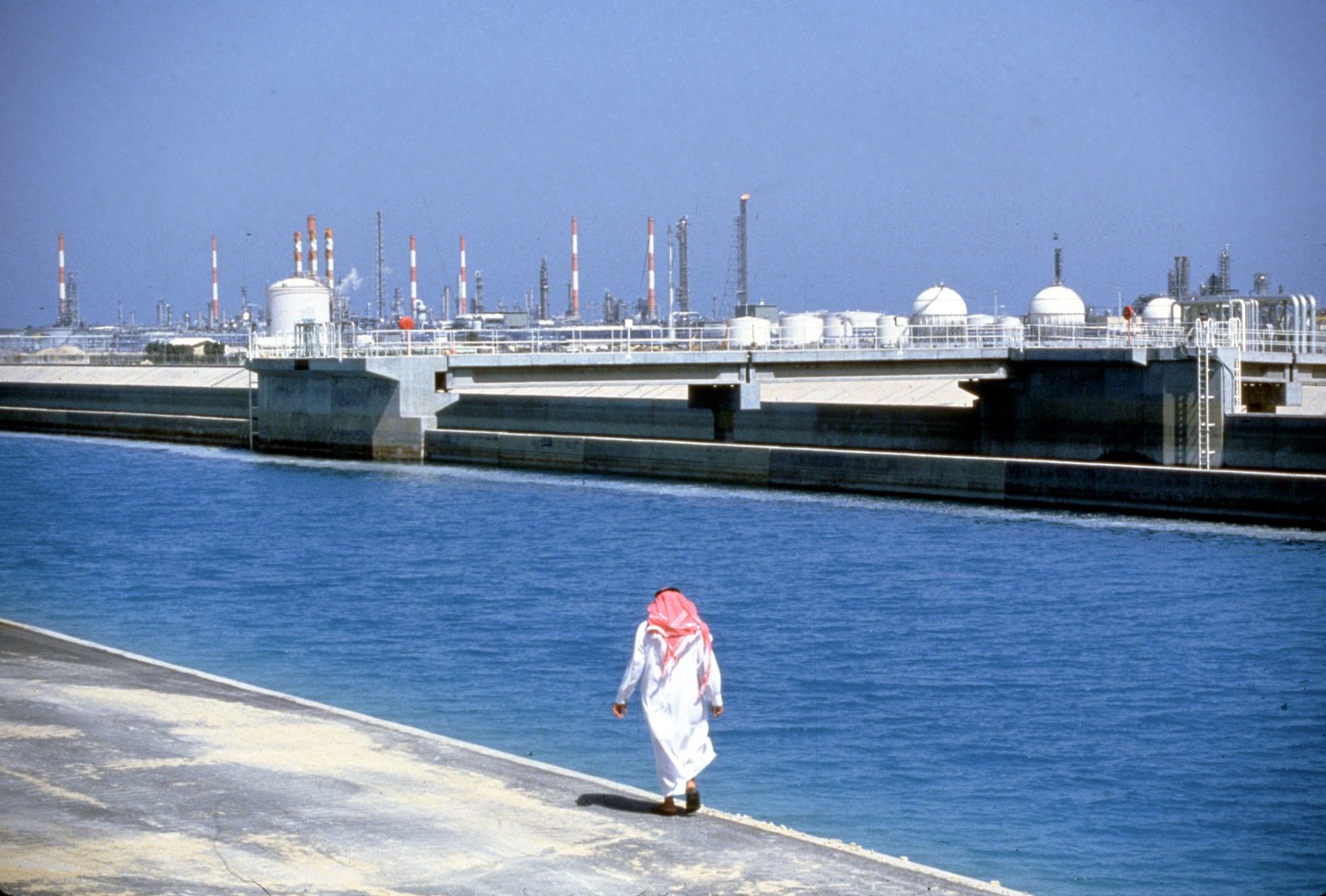
Oil refinery plant in Saudi Arabia
075847 01: A citizen walks along a waterfront oil refinery plant December 10, 1987 in Saudi Arabia. (Photo by Liaison)Cynthia Johnson Getty Images

Is the oil price war back on? Or is it just a Saudi head fake?

Saudi Arabia Tuesday fired a shot across the bows of those who think that last November’s deal on cutting crude oil output is an invitation to them to take a ‘free ride’ at others’ expense.

According to its own data, the Desert Kingdom produced an average of 10.011 million barrels a day in February, up 263,000 barrels a day from January. At first sight, that goes against the grain of the agreement that Saudi brokered with fellow OPEC members and other non-OPEC producers such as Russia and Mexico in November.

The news sent shudders through crude oil markets, pushing futures down by over 2% to their lowest since the November deal.

That accord had aimed to cut world oil supply by 1.8 million barrels a day (around 2% of world output) from January through June, to speed the rebalancing of a world market suffering from a glut. It had been hailed as the de facto end to a two-year price war that had pushed crude from over $100 a barrel to under $30 at its low point a year ago. At 1640 Eastern Time, the benchmark U.S. future was trading at $47.30, down 2.3% on the day.

It’s less than a week since Saudi Energy Minister Khalid al-Falih came to Houston to warn an industry conference that “We will not bear the burden of free riders,” a clear sign of displeasure at apparent cheating on the agreed quotas. Russia, the world’s biggest producer, had only cut its output from the agreed baseline by 100,000 barrels a day through February, in contrast to the 300,000 pledged. Matt Smith, an analyst with ClipperData in Louisville, points out that other countries both inside OPEC (Venezuela, Angola) and outside (Azerbaijan, Kazakhstan) appeared to be failing to comply recently, judging by evidence of higher export volumes.

To rub salt in Saudi wounds, U.S. companies (who aren’t bound by the accord) have responded with alarming speed to cash in on the rise in prices. The number of U.S. oil drilling rigs has risen 30% since November to 617 as of last week, according to Baker Hughes. That’s the highest since February 2015.

But Saudi’s numbers come with a caveat. They were what OPEC calls ‘primary source’ data – i.e., what OPEC members officially report to the organization.
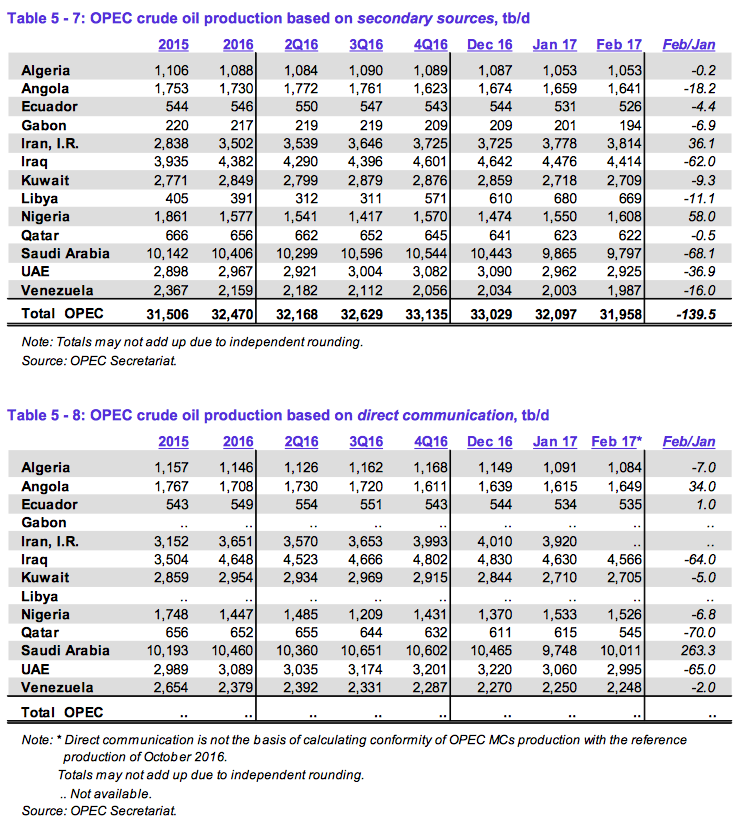
But, because some members have accused each other of lying about output levels in the past, OPEC also publishes numbers based on independent, or ‘secondary’ sources, deduced from granular tracking of cargo movements and other data. And according to the secondary sources, Saudi actually cut output further in February to 9.797 million barrels a day. Some conclude that Saudi’s official data may be just a bluff, a signal to the oil producing world not to take too much for granted.

“It’s a shot across the bow,” said Clipper’s Smith. “These hints are only going to continue as long as they see other parties to the accord not complying.”

Whatever the intent, some in Riyadh were obviously alarmed by the interpretation of their data, hurriedly putting out a statement later that Saudi had only “supplied” 9.90 million barrels a day to the world, and stressed that it had shown “responsible behaviour.” The market was unimpressed, only clawing back a small fraction of the day’s losses.

Smith said that irrespective of who is actually cheating or not on their agreed quota, the biggest problem is that the goal of ending the glut on world markets – the whole reason for the output restraint – is still far away. According to the OPEC report, inventories in developed economies actually rose in January (the last month for which data are available) after coming down slightly in previous months. At 3.006 billion barrels, they’re 10%, or 278 million barrels, above their five-year average.

“Today’s figures show them going in the wrong direction,” Smith summed up.

UPDATE: This story has been updated to include Saudi Arabia’s statement.

About the Author
By Geoffrey Smith
See full bioRight Arrow Button Icon

Latest in

Personal Financemortgages
Current mortgage rates report for Dec. 8, 2025: Rates hold steady with Fed meeting on horizon
By Glen Luke FlanaganDecember 8, 2025
6 minutes ago
Personal FinanceReal Estate
Current ARM mortgage rates report for Dec. 8, 2025
By Glen Luke FlanaganDecember 8, 2025
6 minutes ago
Personal FinanceReal Estate
Current refi mortgage rates report for Dec. 8, 2025
By Glen Luke FlanaganDecember 8, 2025
6 minutes ago
CryptoBinance
Binance has been proudly nomadic for years. A new announcement suggests it’s finally chosen a headquarters
By Ben WeissDecember 7, 2025
4 hours ago
Big TechStreaming
Trump warns Netflix-Warner deal may pose antitrust ‘problem’
By Hadriana Lowenkron, Se Young Lee and BloombergDecember 7, 2025
8 hours ago
Big TechOpenAI
OpenAI goes from stock market savior to burden as AI risks mount
By Ryan Vlastelica and BloombergDecember 7, 2025
8 hours ago

Most Popular

placeholder alt text
Real Estate
The 'Great Housing Reset' is coming: Income growth will outpace home-price growth in 2026, Redfin forecasts
By Nino PaoliDecember 6, 2025
2 days ago
placeholder alt text
AI
Nvidia CEO says data centers take about 3 years to construct in the U.S., while in China 'they can build a hospital in a weekend'
By Nino PaoliDecember 6, 2025
2 days ago
placeholder alt text
Economy
The most likely solution to the U.S. debt crisis is severe austerity triggered by a fiscal calamity, former White House economic adviser says
By Jason MaDecember 6, 2025
1 day ago
placeholder alt text
Economy
JPMorgan CEO Jamie Dimon says Europe has a 'real problem’
By Katherine Chiglinsky and BloombergDecember 6, 2025
1 day ago
placeholder alt text
Big Tech
Mark Zuckerberg rebranded Facebook for the metaverse. Four years and $70 billion in losses later, he’s moving on
By Eva RoytburgDecember 5, 2025
3 days ago
placeholder alt text
Politics
Supreme Court to reconsider a 90-year-old unanimous ruling that limits presidential power on removing heads of independent agencies
By Mark Sherman and The Associated PressDecember 7, 2025
16 hours ago
Rankings
  • 100 Best Companies
  • Fortune 500
  • Global 500
  • Fortune 500 Europe
  • Most Powerful Women
  • Future 50
  • World’s Most Admired Companies
  • See All Rankings
Sections
  • Finance
  • Leadership
  • Success
  • Tech
  • Asia
  • Europe
  • Environment
  • Fortune Crypto
  • Health
  • Retail
  • Lifestyle
  • Politics
  • Newsletters
  • Magazine
  • Features
  • Commentary
  • Mpw
  • CEO Initiative
  • Conferences
  • Personal Finance
  • Education
Customer Support
  • Frequently Asked Questions
  • Customer Service Portal
  • Privacy Policy
  • Terms Of Use
  • Single Issues For Purchase
  • International Print
Commercial Services
  • Advertising
  • Fortune Brand Studio
  • Fortune Analytics
  • Fortune Conferences
  • Business Development
About Us
  • About Us
  • Editorial Calendar
  • Press Center
  • Work At Fortune
  • Diversity And Inclusion
  • Terms And Conditions
  • Site Map

© 2025 Fortune Media IP Limited. All Rights Reserved. Use of this site constitutes acceptance of our Terms of Use and Privacy Policy | CA Notice at Collection and Privacy Notice | Do Not Sell/Share My Personal Information
FORTUNE is a trademark of Fortune Media IP Limited, registered in the U.S. and other countries. FORTUNE may receive compensation for some links to products and services on this website. Offers may be subject to change without notice.