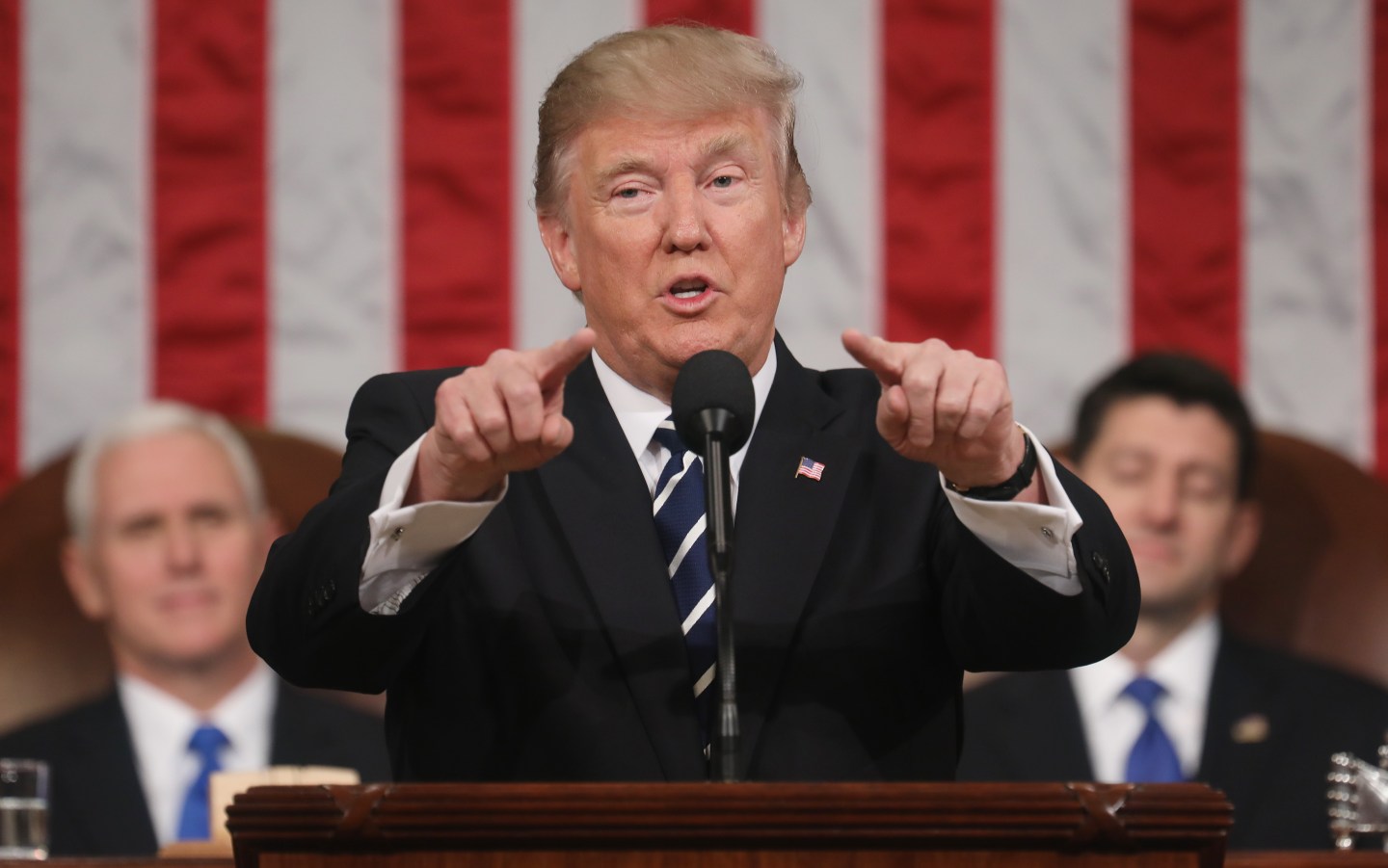
In his address to Congress on Tuesday, President Trump assailed the steep rise in federal debt under his predecessor.
“In the past eight years, the past administration has piled on more new debt than nearly all other presidents combined,” Trump said.
While it’s not clear Trump’s numbers would stand up once adjusted for inflation, it’s clear Obama did raise debt as a share of the economy far more than any post-war POTUS. Under Obama, federal borrowing as a share of the economy soared by an astounding 40 percentage points, from around 36% when he took office to the current, near-post-war high of 77%.
But while Trump has denounced the dangers of piling on mountainous debt, his own “phenomenal” plans for the US economy seem to do the same.
Trump’s platform would raise the nation’s debt-to-GDP ratio higher by double-digits. So here’s a warning to the Trump optimists: It’s far safer for America to borrow a lot more when its debt is modest, as it was eight years ago, than to keep gorging when you’re already heavily burdened, as we are today. In the past, every time America’s debt has reached lofty levels, it’s declined. Under Trump, we’re heading into unknown territory.
Let’s examine four factors that explain the looming perils of excessive debt.
The budget is in worse shape than the official numbers show.
The official ten-year budget projections from the CBO, issued in January, show the deficit rising from $586 billion in 2016 to $684 billion in 2020, and hitting $1 trillion in 2023. But the CBO bases its forecasts on existing law, even though it’s clear to everyone that the rules governing tax rules are bound to change. The non-partisan Tax Policy Institute ran an alternative scenario in January that might be called “business as usual.” It eliminated, delayed, or suspended taxes that are almost certain to disappear, notably the cadillac-tax on pricey health insurance and the levy on medical device makers.
It also assumed that discretionary outlays, most notably defense spending, would grow fast enough to maintain current services. Overall, that adds a couple of points annually to the official projections.
Under the TPC forecasts, the deficit reaches $841 billion by 2020, 23% more than the CBO’s number. That’s 3.9% of GDP versus the CBO forecast of 3.2%. The point is that rather than remaining flat as a share of the economy over the next few years, as the official figures show, the deficit is far more likely to rise sharply in the first two-and-as-half years of the Trump administration. That’s the real, and alarming, backdrop on which the Trump plan must be measured.
The tax bill threatens to dig a big hole in the tax revenues
Let’s assume for the moment that the Trump plan fails to raise growth to 3% or 4% as advertised, or perhaps doesn’t ignite the economy at all. All forecasts show that his platform for slashing both personal and corporate income taxes cause a gigantic reduction in future tax revenues on their own, absent a big boost to GDP to help offset the lower rates with higher revenue. The Trump plan substantially increases the standard deduction, as well as lowering the top tier for families to 33% from 39.6%. It also reduces rates on corporate income to 15% from 35%.
In an analysis of the Trump plan published in December, the TPC projected that if the economy chugs along as if nothing changed, the deficit would increase by $1 trillion in 2020, meaning it would total $1.9 trillion, or over 90% of GDP, which many economists agree is the severe danger zone. The Tax Foundation, which has a free-market tilt, puts the revenue loss at a maximum of around $590 billion a year over the next decade. That’s still a gigantic hole. Whether the reduction is $600 billion or a trillion, the US deficit will go far over $1 trillion by 2020 if the Trump growth explosion fails to materialize.
To make his plan work, Trump needs to get America growing really, really fast
Keep in mind that so far, we’ve talked only about the loss in revenues, both from taxes that won’t come back (the “business-as-usual” budget projections), and the potential lowering of tax collections from the reductions in rates and expansion of the standard deduction.
But just before Trump delivered his address, budget director Mick Mulvaney announced plans to increase defense spending by $54 billion a year. That represents a raise of around 10%. To pay for the well-deserved increase, Mulvaney declared that the new regime would slash non-defense discretionary spending by the same amount, from $519 billion to $465 billion.
The discretionary budget has already been squeezed for the past six years. So new, draconian cuts may be a fantasy. “The problem is that the discretionary budget includes spending on veterans’ health care, child care, and highways,” says Brian Riedl of the conservative Manhattan Institute. “Those are areas where Trump has promised big increases in spending.”
Just after Mulvaney announced the steep reductions, anonymous White House sources played down the severe austerity, stating instead that Trump sought to pay for the new defense outlays from enhanced growth.
It’s indeed possible that the tax plan could pay for itself. But it would need to be the more modest program proposed by the House Republicans, which lowers the corporate rate to 20% instead of 15%, and champions smaller reductions in personal taxes. The Tax Foundation predicts that by allowing companies and workers to keep more of the money they earn, lifting consumption and investment, the program could put the economy on a far faster track. That growth surge would generate additional tax receipt sufficient to pay for almost all of the tax reductions.
Still, the takeoff would also need to pay for the extra $60 billion or so a year in defense spending as well as new outlays on infrastructure, and other promised initiatives.
And what if the tax cuts don’t produce the growth explosion that Trump is selling? “It all assumes we don’t have a recession, or a trade war,” says Riedl. “If we get those things or slower growth than predicted from the tax reforms, deficits will go to over $1 trillion in a couple of years.”
Bottom Line: Debt and Deficits kill growth
Here’s the big problem: Even if Trump produces a growth spurt, how long will it last?
It’s impossible to lower spending nearly enough to offset the kind of revenue shortfalls now on the horizon, in the absence of severe and unpopular rollbacks to Medicare, Medicaid, and Social Security. Trump has parked such reforms strictly off limits. As deficits and debt rise, government spending absorbs bigger and bigger shares of the economy. That spending sidelines private investment, and lifts interest rates as private borrowers compete with the government for a shrinking pool of savings.
Those trends operate precisely counter to what Trump hopes to accomplish. Hence, it’s possible that his plan creates a growth spurt that’s quickly halted by a debt crisis. The Trump agenda will bang against tough constraints, as trillion dollar deficits spread fears of a fiscal crisis, a lot sooner than its champions are admitting.
The tax plan is good, the lack of spending cuts to pay for it may be the Trump plan’s undoing.